
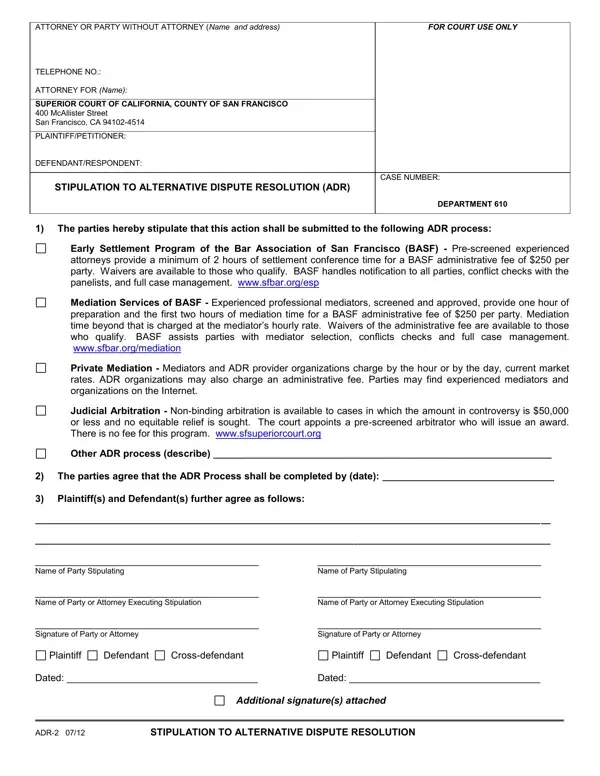
Navigating through legal disputes often involves procedures that are both complex and time-consuming. At the heart of seeking resolutions without resorting to the traditional trial process is the use of Alternative Dispute Resolution (ADR) strategies, encapsulated in specific legal documents like the ADR 2 form. This form serves as a formal agreement between disputing parties to resolve their issues outside of court, saving both time and resources. It outlines various ADR processes available, such as the Early Settlement Program, Mediation Services, Private Mediation, and Judicial Arbitration, detailed with their corresponding requirements, benefits, and fees. It is specifically used within the Superior Court of California, County of San Francisco, making it a crucial document for litigants within this jurisdiction. Moreover, the ADR 2 form highlights critical elements like the stipulated submission to an ADR process chosen by the parties, the agreed deadline for completing the ADR process, and any further agreements made by the disputing parties. By signing this form, all parties involved commit to working towards a resolution through the selected ADR method, marking a pivotal step in the dispute resolution process. The form is not just a piece of paper; it's a pathway chosen by those who seek to find common ground in a less adversarial setting than a courtroom.
| Question | Answer |
|---|---|
| Form Name | Form Adr 2 |
| Form Length | 1 pages |
| Fillable? | No |
| Fillable fields | 0 |
| Avg. time to fill out | 15 sec |
| Other names | Stipulation to ADR Form 2012 final adr 2 0712 stipulation to alternative dispute resolution form |