
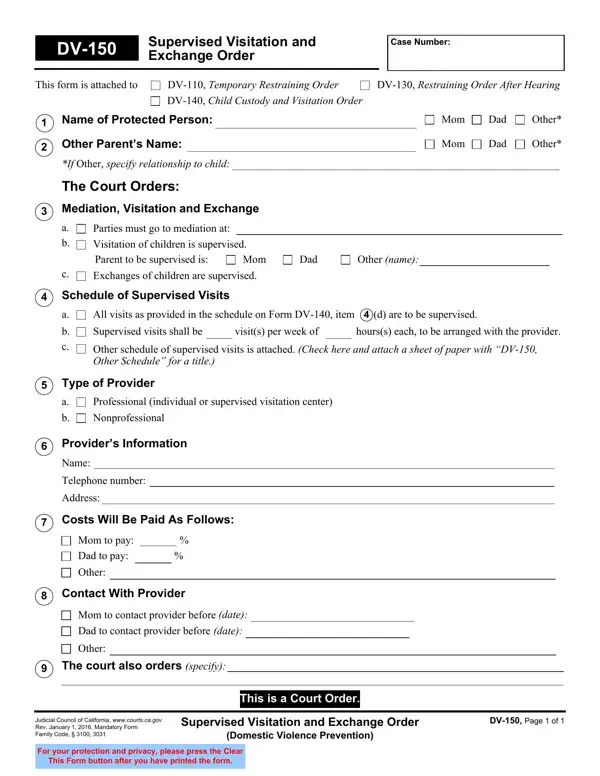

Form DV-150 at a glance
What it is: DV-150 Mandatory Findings for Child Custody and Visitation Order (Domestic Violence Prevention) is a Court Order.
Who signs: The Judge or Judicial Officer signs the Judge's Signature line.
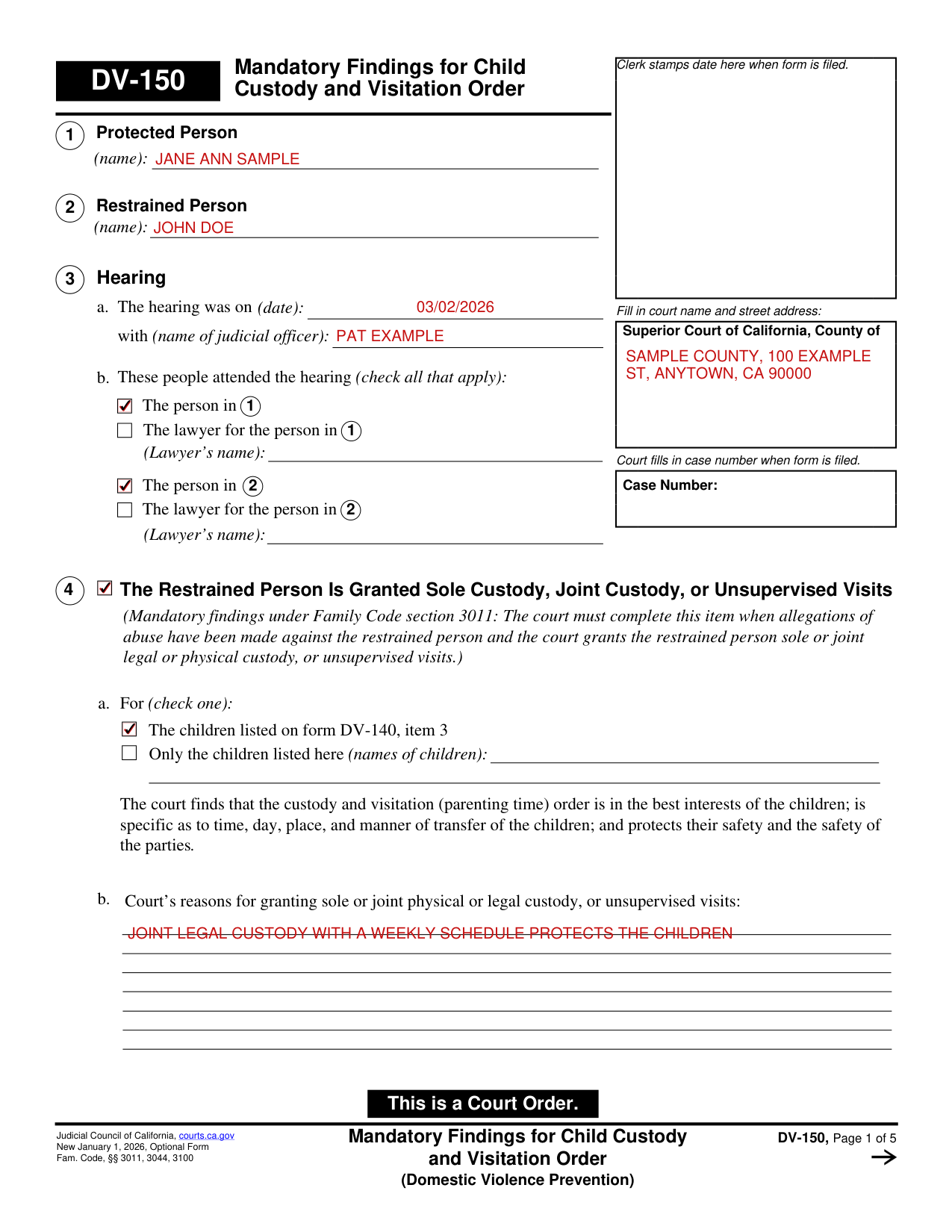
A filled-in Form DV-150 example: a judge completes the findings for joint legal custody
How to fill out Form DV-150, box by box
1 Protected Person, 2 Restrained Person and 3 Hearing
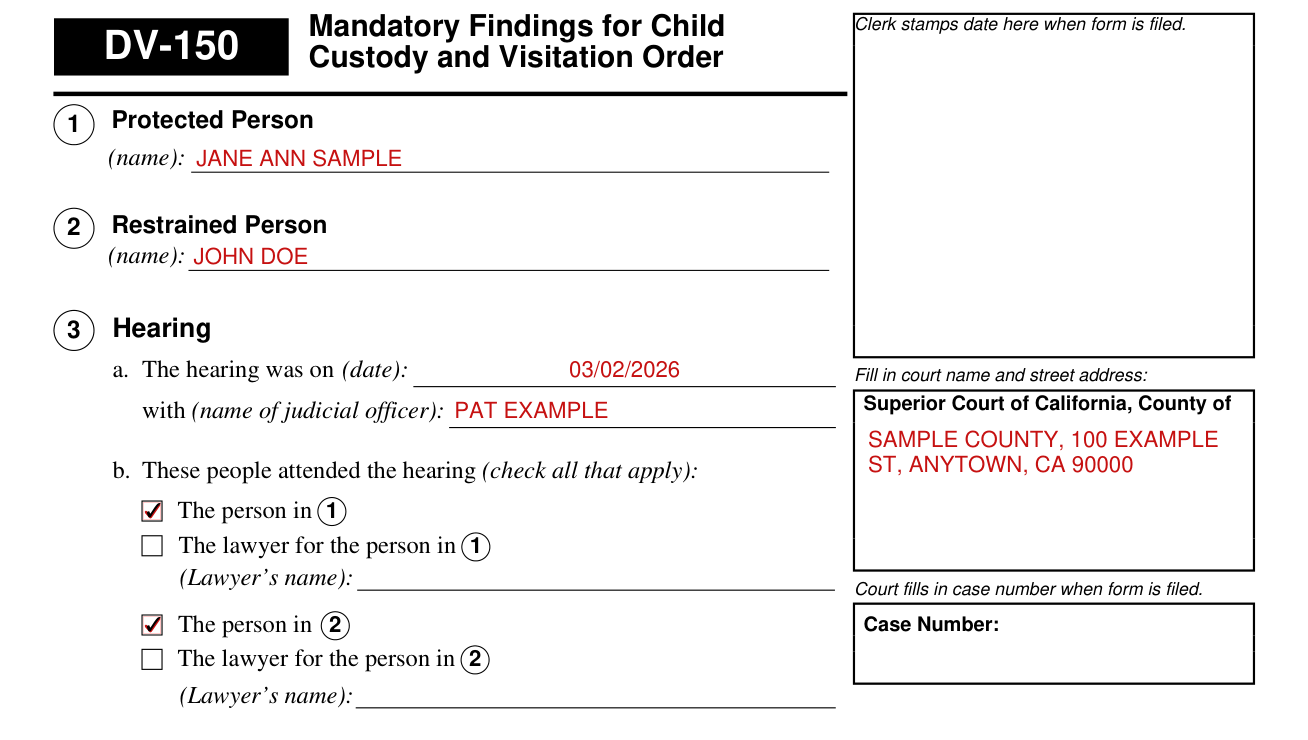
Fill in the court name and street address next to Superior Court of California, County of.
The court fills in the Case Number when the form is filed.
Under 1 Protected Person, fill in the (name).
Under 2 Restrained Person, fill in the (name).
Under 3 Hearing, fill in the date the hearing was on and the name of the judicial officer.
In 3b, check all that apply: the person in 1, the lawyer for the person in 1, the person in 2 and the lawyer for the person in 2, and fill in the Lawyer's name.
4 The Restrained Person Is Granted Sole Custody, Joint Custody, or Unsupervised Visits
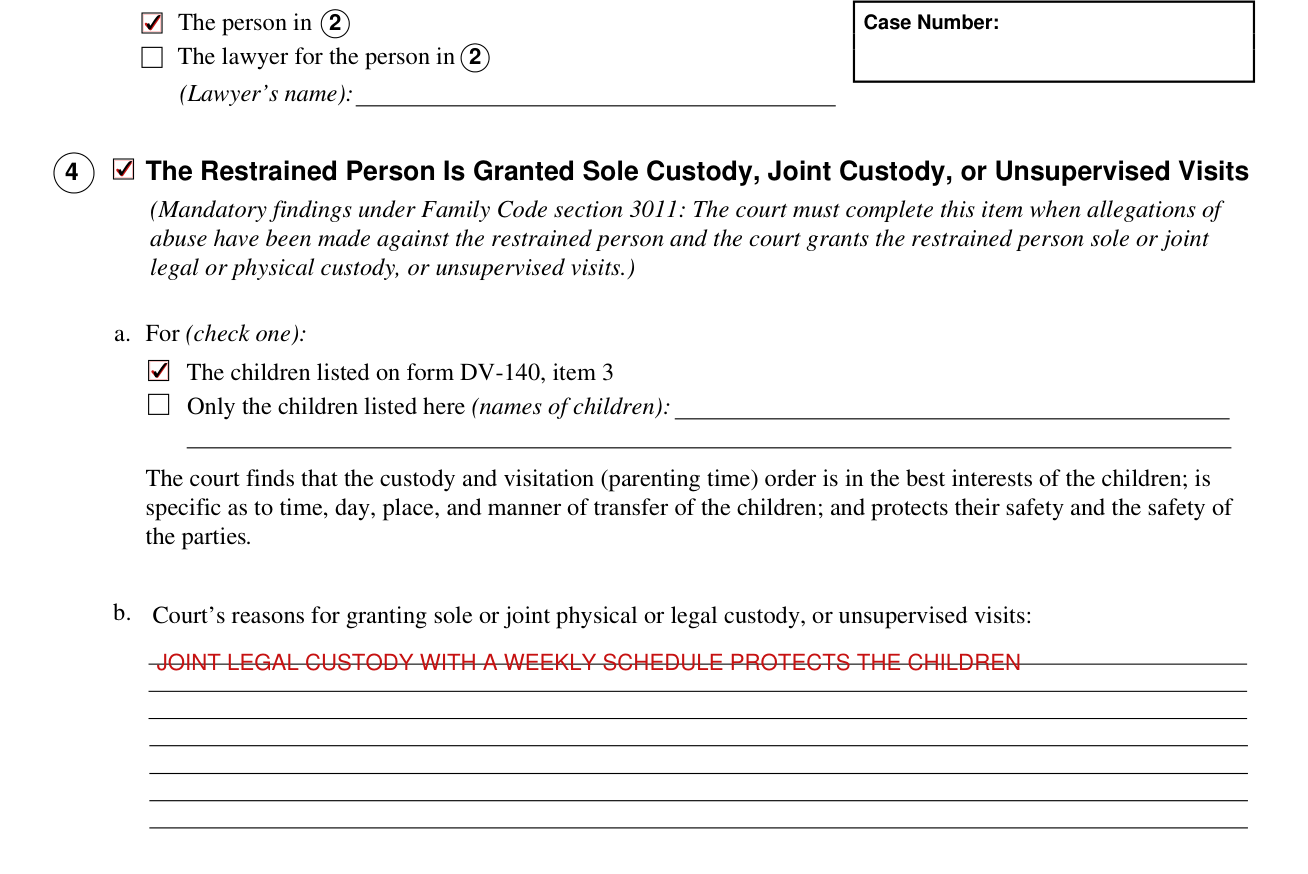
The court must complete item 4, The Restrained Person Is Granted Sole Custody, Joint Custody, or Unsupervised Visits, when allegations of abuse have been made against the restrained person and the court grants the restrained person sole or joint legal or physical custody, or unsupervised visits.
In 4a, check one: The children listed on form DV-140, item 3, or Only the children listed here, and fill in the names of children.
The court finds that the custody and visitation (parenting time) order is in the best interests of the children; is specific as to time, day, place, and manner of transfer of the children; and protects their safety and the safety of the parties.
In 4b, fill in the court's reasons for granting sole or joint physical or legal custody, or unsupervised visits.
5 The Restrained Person Is Granted Sole or Joint Custody and Has Committed Domestic Violence in the Last Five Years
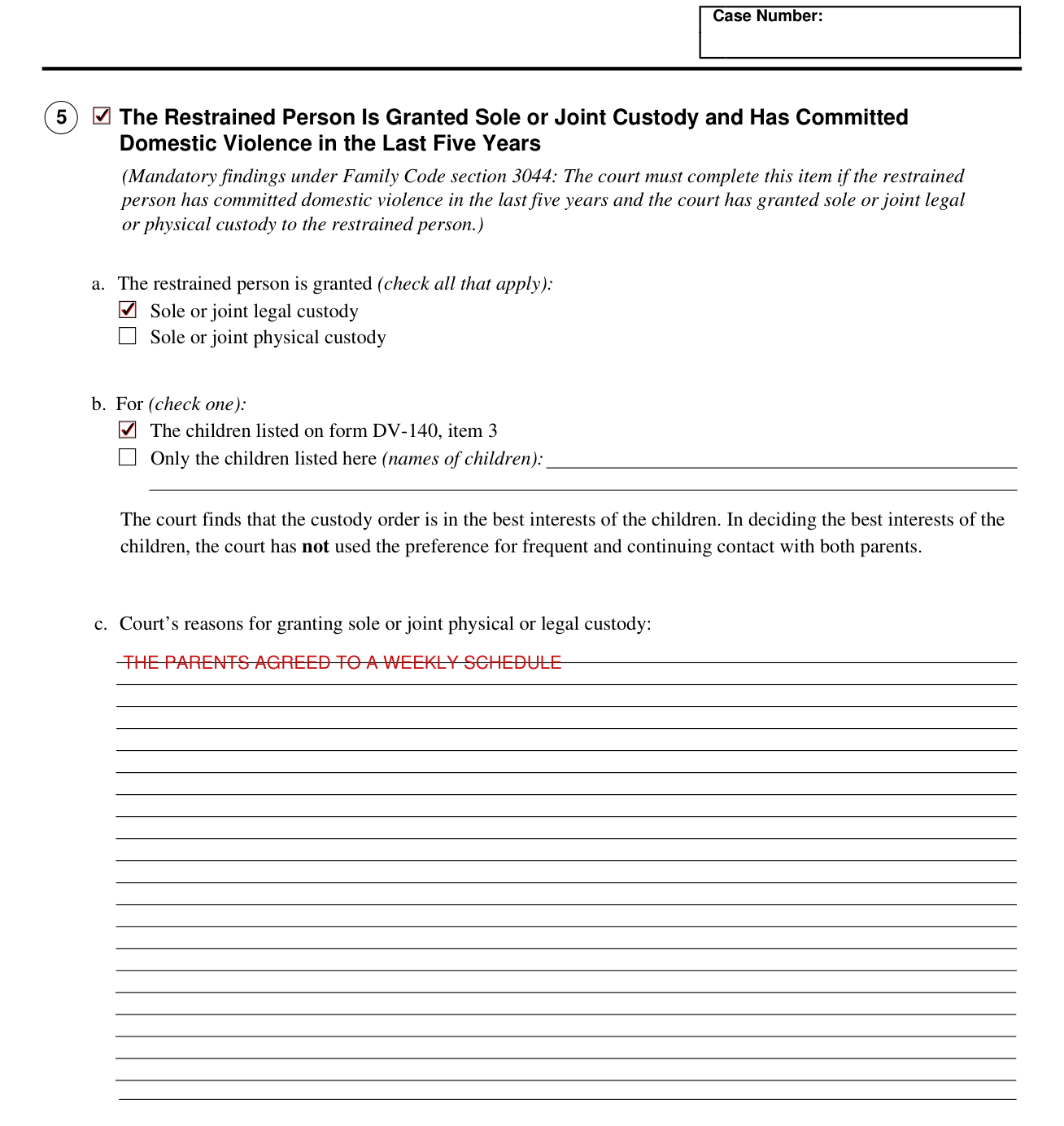
The court must complete item 5 if the restrained person has committed domestic violence in the last five years and the court has granted sole or joint legal or physical custody to the restrained person.
In 5a, check all that apply: the restrained person is granted Sole or joint legal custody, Sole or joint physical custody.
In 5b, check one: The children listed on form DV-140, item 3, or Only the children listed here, and fill in the names of children.
The court finds that the custody order is in the best interests of the children. In deciding the best interests of the children, the court has not used the preference for frequent and continuing contact with both parents.
In 5c, fill in the court's reasons for granting sole or joint physical or legal custody.
5 d. (1) to (5): The court has balanced all required factors
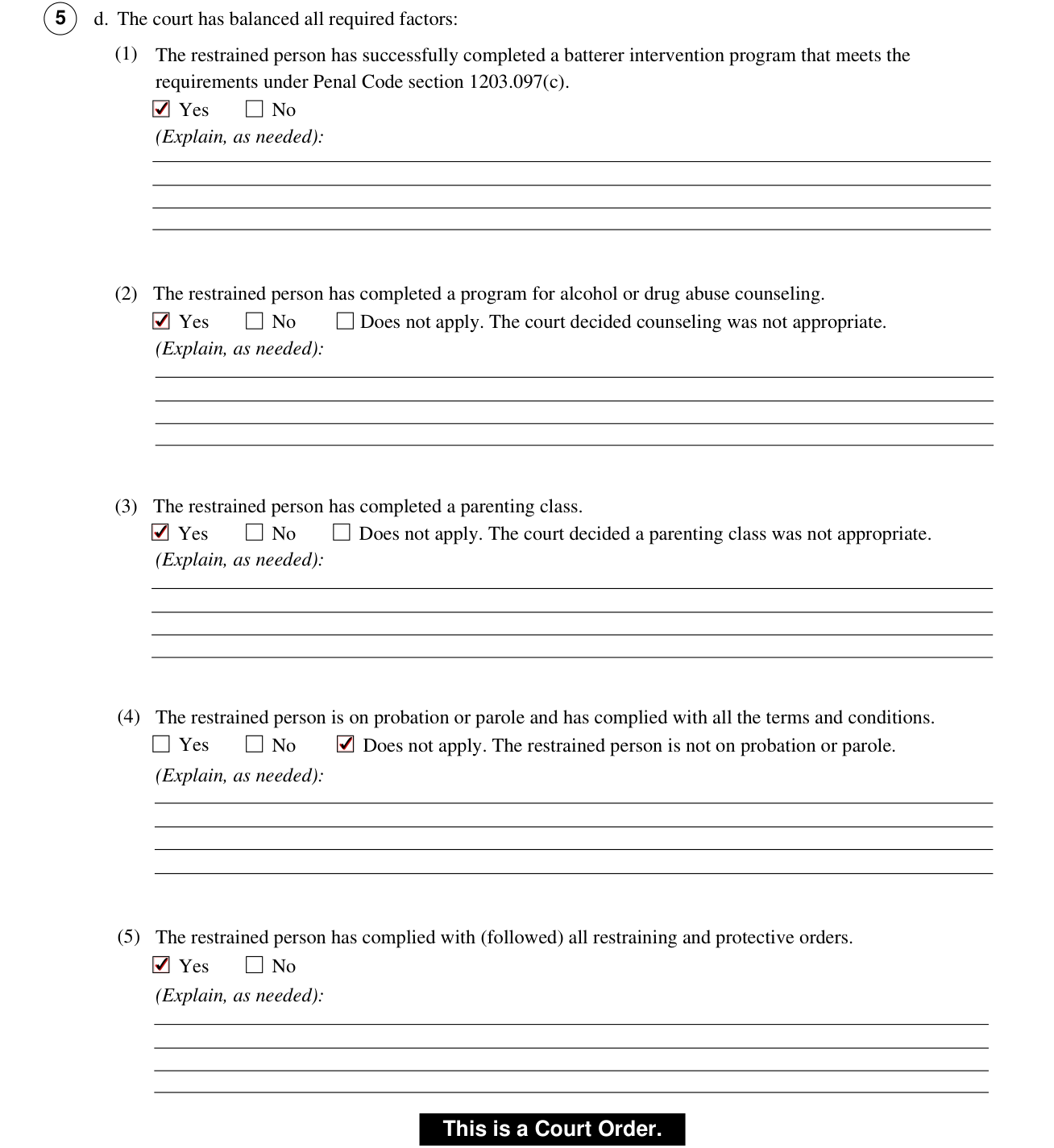
In 5d, the court has balanced all required factors.
For (1), the restrained person has successfully completed a batterer intervention program that meets the requirements under Penal Code section 1203.097(c): check Yes or No and Explain, as needed.
For (2), the restrained person has completed a program for alcohol or drug abuse counseling: check Yes, No or Does not apply (the court decided counseling was not appropriate), and Explain, as needed.
For (3), the restrained person has completed a parenting class: check Yes, No or Does not apply (the court decided a parenting class was not appropriate), and Explain, as needed.
For (4), the restrained person is on probation or parole and has complied with all the terms and conditions: check Yes, No or Does not apply (the restrained person is not on probation or parole), and Explain, as needed.
For (5), the restrained person has complied with (followed) all restraining and protective orders: check Yes or No and Explain, as needed.
5 d. (6) to (8): Additional acts of domestic violence, firearms or ammunition and additional reasons
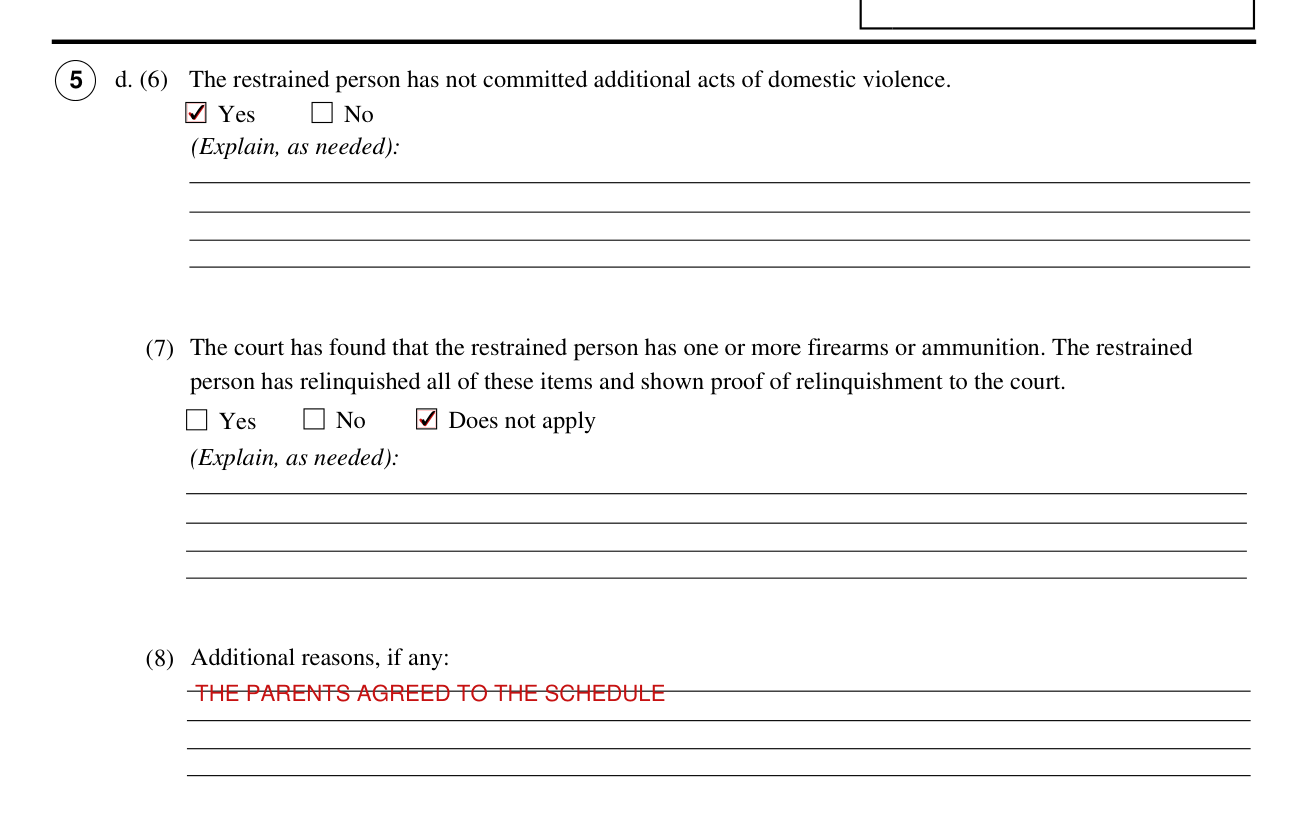
For 5 d. (6), the restrained person has not committed additional acts of domestic violence: check Yes or No and Explain, as needed.
For (7), the court has found that the restrained person has one or more firearms or ammunition. The restrained person has relinquished all of these items and shown proof of relinquishment to the court: check Yes, No or Does not apply and Explain, as needed.
For (8), fill in the additional reasons, if any.
6 Court Has Granted In-Person Visits for Restrained Person
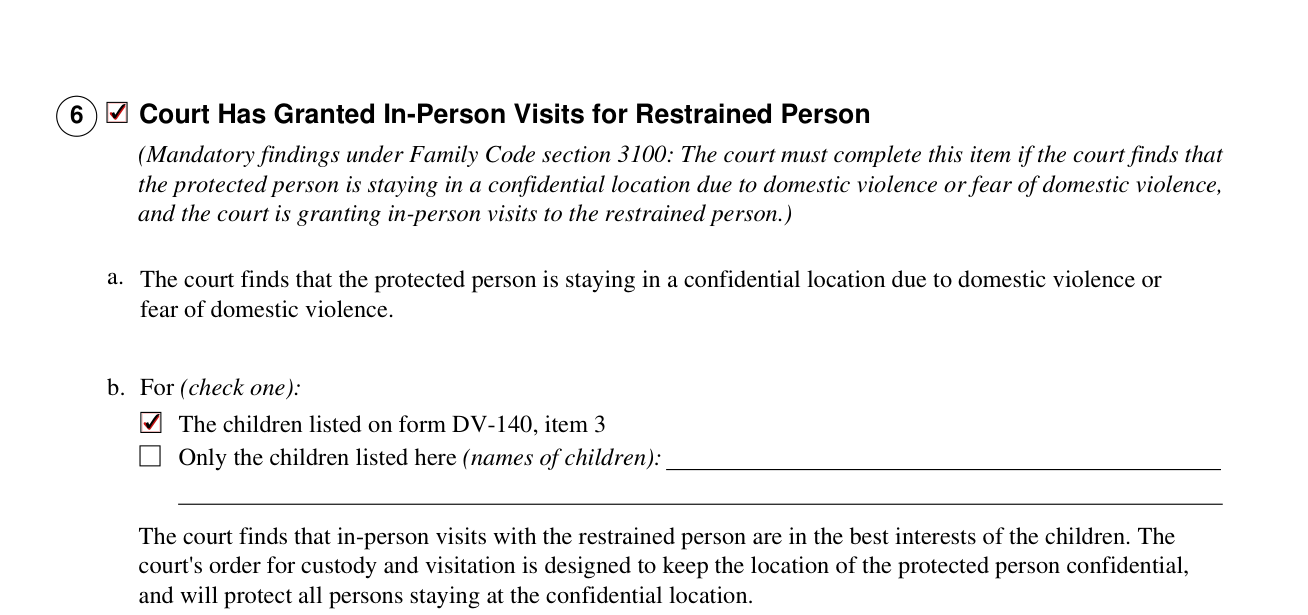
The court must complete item 6, Court Has Granted In-Person Visits for Restrained Person, if the court finds that the protected person is staying in a confidential location due to domestic violence or fear of domestic violence, and the court is granting in-person visits to the restrained person.
In 6a, the court finds that the protected person is staying in a confidential location due to domestic violence or fear of domestic violence.
In 6b, check one: The children listed on form DV-140, item 3, or Only the children listed here, and fill in the names of children.
The court finds that in-person visits with the restrained person are in the best interests of the children. The court's order for custody and visitation is designed to keep the location of the protected person confidential, and will protect all persons staying at the confidential location.
6 c. Required factors for in-person visits
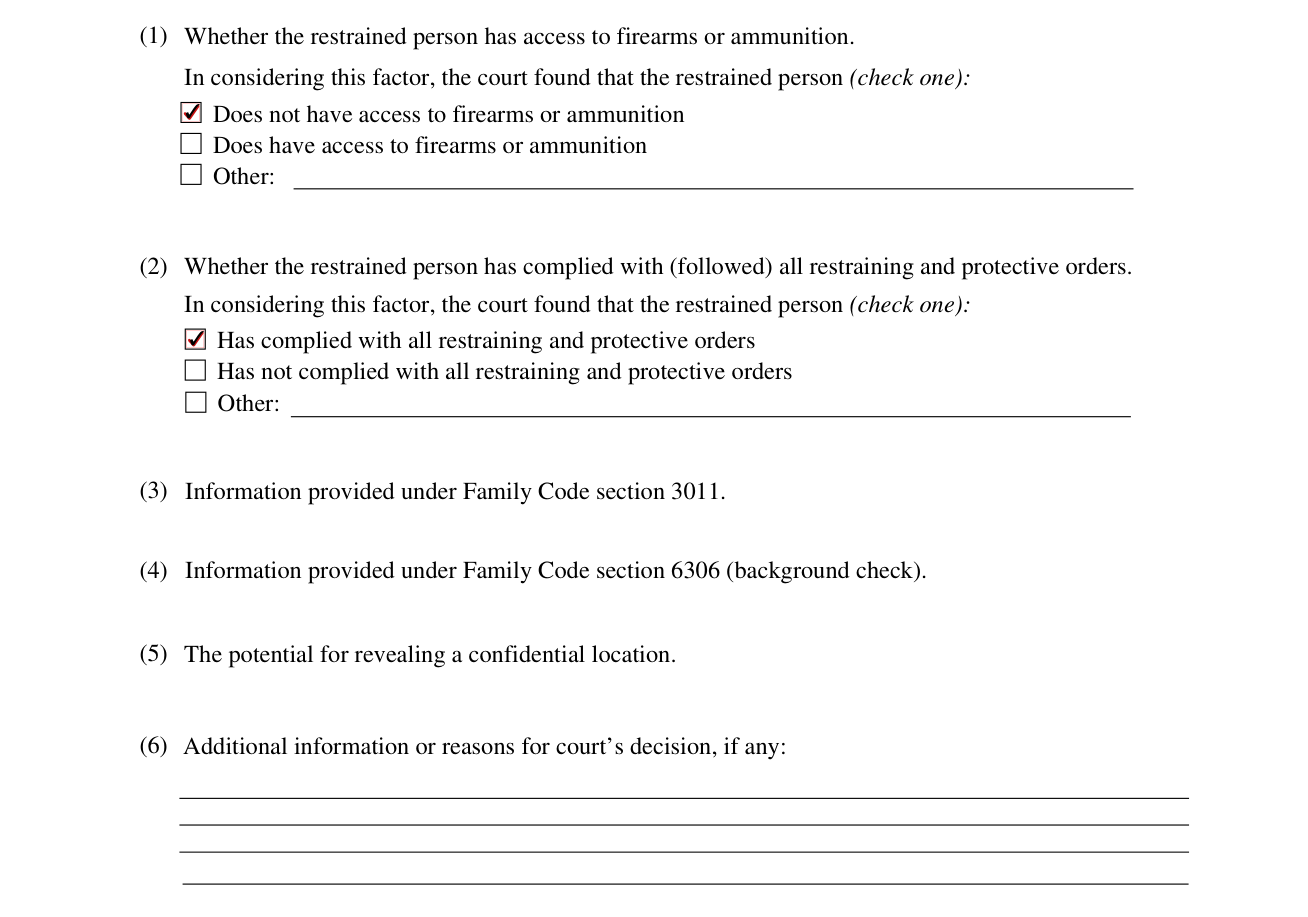
In granting in-person visits, the court has considered the following required factors in 6c.
For (1), whether the restrained person has access to firearms or ammunition: in considering this factor, check one: Does not have access to firearms or ammunition, Does have access to firearms or ammunition, or Other.
For (2), whether the restrained person has complied with (followed) all restraining and protective orders: in considering this factor, check one: Has complied with all restraining and protective orders, Has not complied with all restraining and protective orders, or Other.
(3) Information provided under Family Code section 3011.
(4) Information provided under Family Code section 6306 (background check).
(5) The potential for revealing a confidential location.
For (6), fill in the additional information or reasons for the court's decision, if any.
7 Other Findings (if any)

Under 7 Other Findings (if any), fill in the other findings.
Judge's Signature

Under Judge's Signature, fill in the Date.
Sources
[1] Form DV-150 (New January 1, 2026), Mandatory Findings for Child Custody and Visitation Order (Domestic Violence Prevention), Judicial Council of California (the Official source link on this page).