

Form TR-13A at a glance
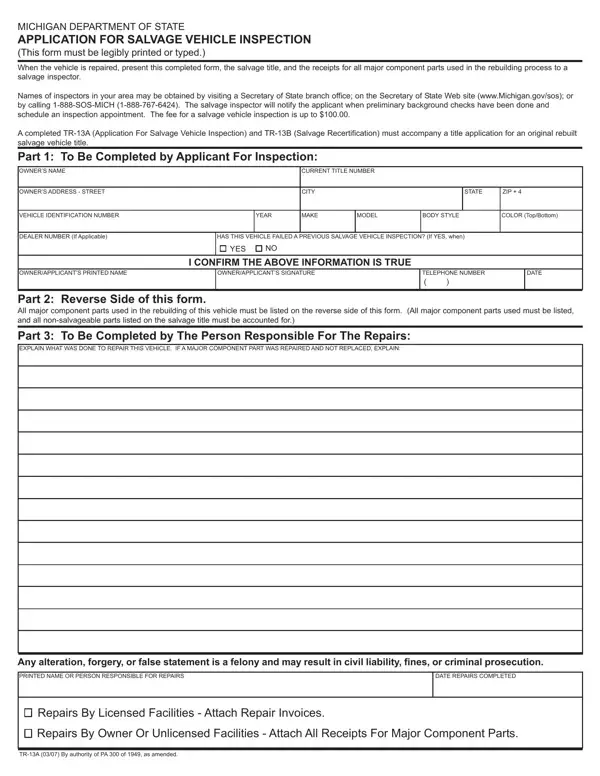
What it is: This is an Application for Salvage Vehicle Inspection from the Michigan Department of State, and this form must be legibly printed or typed.
Who signs: Sign on the Owner/Applicant's Signature line and write the Owner/Applicant's Printed Name, Telephone Number and Date.
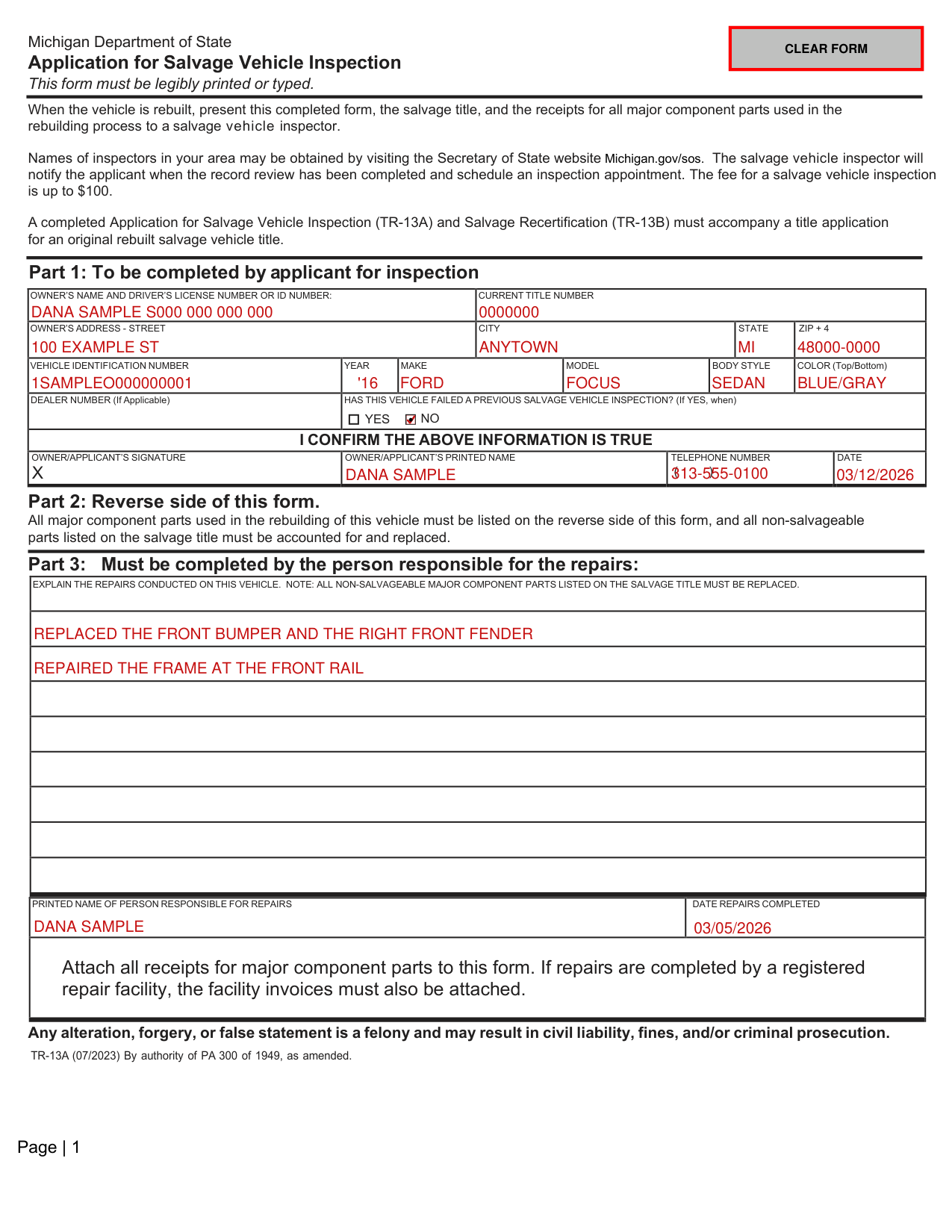
A filled-in Form TR-13A example: a rebuilt pickup goes to inspection
How to fill out Form TR-13A, box by box
Tap a group of boxes to open it, and a picture to see it full size.
Part 1: To be completed by applicant for inspection
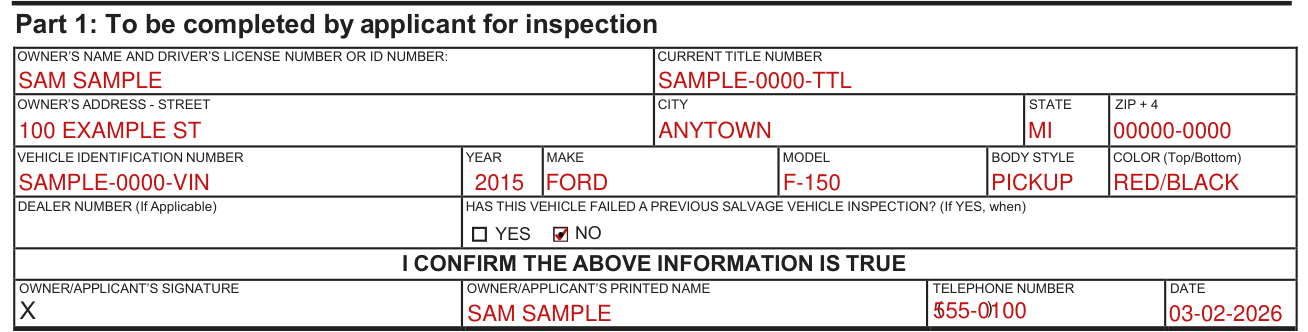
Part 1 is to be completed by applicant for inspection.
Write the Owner's Name and Driver's License Number or ID Number, and the Current Title Number.
Write the Owner's Address: Street, City, State, ZIP + 4.
Write the Vehicle Identification Number, Year, Make, Model, Body Style and Color (Top/Bottom).
Write the Dealer Number (If Applicable). Check YES or NO for HAS THIS VEHICLE FAILED A PREVIOUS SALVAGE VEHICLE INSPECTION; if YES, write when.
Check YES or NO to confirm the above information is true.
Owner applicant's signature

Sign on the Owner/Applicant's Signature line and write the Owner/Applicant's Printed Name, Telephone Number and Date.
Part 2: Reverse side of this form

Part 2 is the reverse side of this form: all major component parts used in the rebuilding of this vehicle must be listed on the reverse side of this form, and all non-salvageable parts listed on the salvage title must be accounted for and replaced.
The major component parts listed here have been used in rebuilding this vehicle; all major component parts used must be listed and all non-salvageable parts listed on the salvage title must be accounted for and replaced.
The major component parts are: Engine, Passenger vehicle body, Pickup cargo box, Frame, Truck cab, Doors, Transmission, Right or left front fender, Hood, Trunk or floor pan, Front or rear bumper, Right or left rear quarter panel, Deck lid, tailgate, or hatchback.
For each part listed, write the Major Component Part, Year, Make, VIN or I.D. Number, Part Source & Address and Date Acquired.
Part 3: Must be completed by the person responsible for the repairs
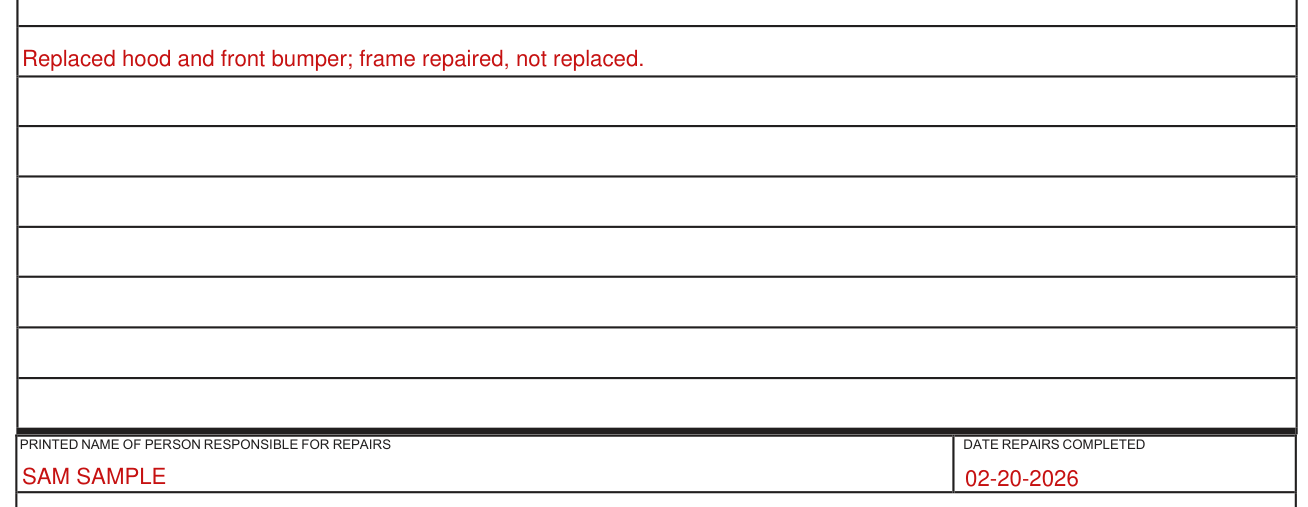
Part 3 must be completed by the person responsible for the repairs: explain the repairs conducted on this vehicle; note that all non-salvageable major component parts listed on the salvage title must be replaced.
Write the Printed Name of Person Responsible for Repairs and the Date Repairs Completed.
Attach all receipts for major component parts to this form; if repairs are completed by a registered repair facility, the facility invoices must also be attached.
Part 4: Mechanic certification of salvage vehicle repairs
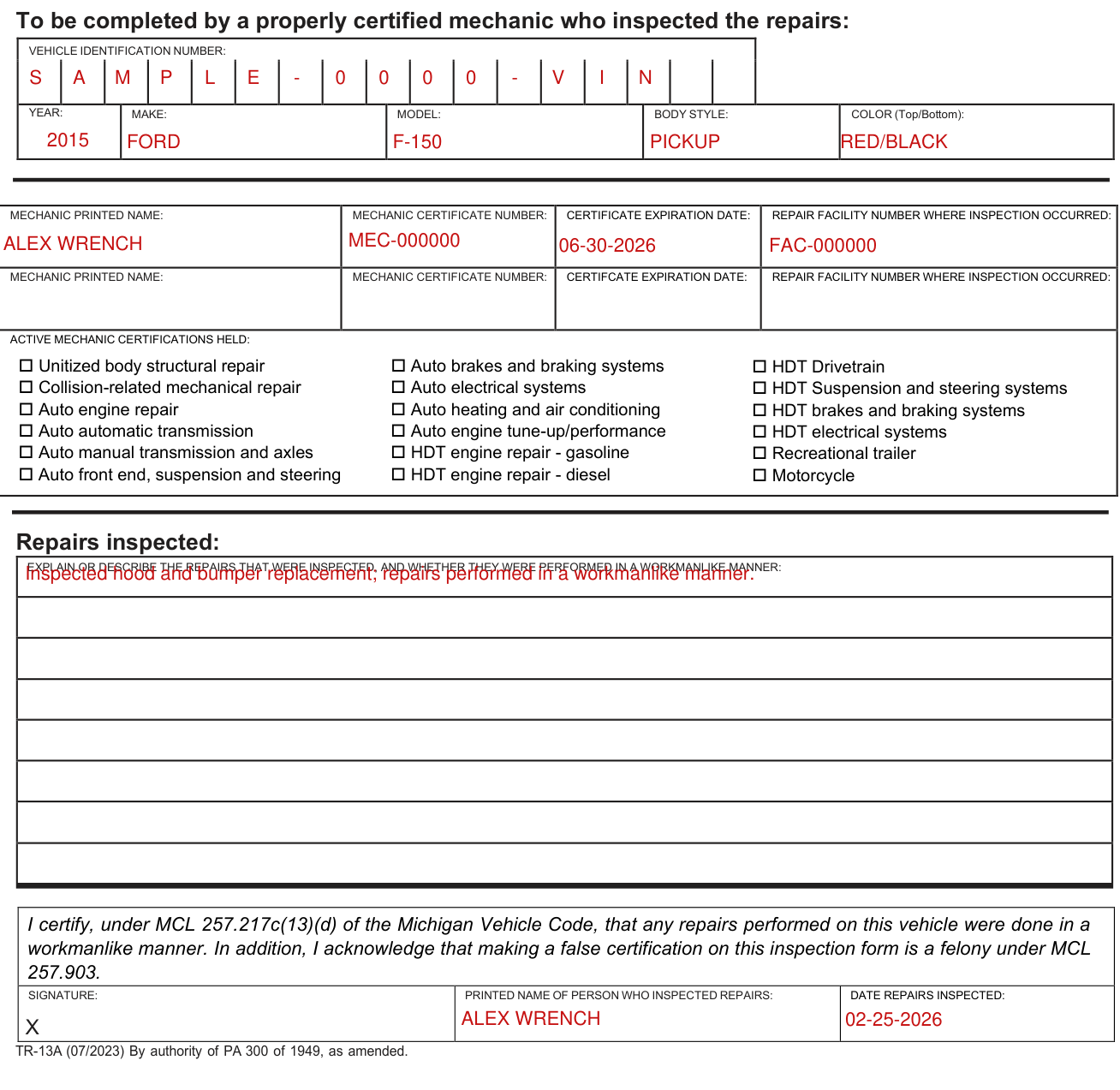
Part 4 is the Mechanic certification of salvage vehicle repairs: application for salvage recertification (rebuilt salvage title) requires that any repairs performed on the vehicle were done in a workmanlike manner, as certified on this form, by a properly licensed vehicle mechanic in the appropriate specialty.
At a minimum, any mechanic listed on the TR-13A should be a certified mechanic with both unitized body and structural repair, and collision-related mechanical repair specialty categories.
If additional certified mechanics are needed to certify other repairs conducted in an additional specialty, provide additional copies of Part 4 as necessary.
Part 4 is to be completed by a properly certified mechanic who inspected the repairs.
Write the Vehicle Identification Number, then the Year, Make, Model, Body Style and Color (Top/Bottom).
For each mechanic, write the Mechanic Printed Name, Mechanic Certificate Number, Certificate Expiration Date and Repair Facility Number Where Inspection Occurred.
Check the Active Mechanic Certifications held: Unitized body structural repair, Auto brakes and braking systems, Auto electrical systems, Auto engine repair, Auto automatic transmission, Auto engine tune-up/performance, Auto manual transmission and axles, Auto front end, suspension and steering, Auto heating and air conditioning, HDT Drivetrain, Collision-related mechanical repair, HDT Suspension and steering systems, HDT brakes and braking systems, HDT electrical systems, HDT engine repair - gasoline, HDT engine repair - diesel, Recreational trailer, Motorcycle.
Under Repairs inspected, explain or describe the repairs that were inspected, and whether they were performed in a workmanlike manner.
I certify, under MCL 257.217c(13)(d) of the Michigan Vehicle Code, that any repairs performed on this vehicle were done in a workmanlike manner, and I acknowledge that making a false certification on this inspection form is a felony under MCL 257.903.
Sign on the Signature line and write the Printed Name of Person Who Inspected Repairs and the Date Repairs Inspected.
More rules for Form TR-13A
A completed Application for Salvage Vehicle Inspection (TR-13A) and Salvage Recertification (TR-13B) must accompany a title application for an original rebuilt salvage vehicle title.
Additional Application for Salvage Vehicle Inspection forms (TR-13A) may be obtained by visiting the Secretary of State website at Michigan.gov/SOS.
Common questions about Form TR-13A
Where do I file it?
When the vehicle is rebuilt, present this completed form, the salvage title, and the receipts for all major component parts used in the rebuilding process to a salvage vehicle inspector. Names of inspectors in your area may be obtained by visiting the Secretary of State website Michigan.gov/sos. The salvage vehicle inspector will notify the applicant when the record review has been completed and schedule an inspection appointment.
Are there fees?
The fee for a salvage vehicle inspection is up to $100.
Is there a penalty?
Any alteration, forgery, or false statement is a felony and may result in civil liability, fines, and/or criminal prosecution.
Sources
[1] Form TR-13A (07/2023), Application for Salvage Vehicle Inspection, Michigan Department of State (the Official source link on this page).