

Form WD-1 at a glance
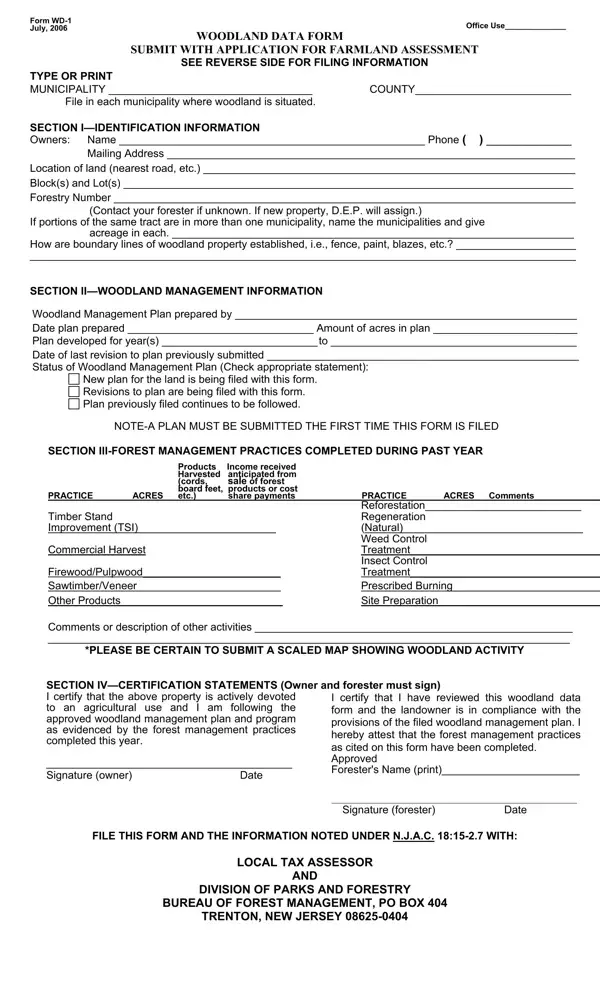
What it is: The WOODLAND DATA FORM is for use with Woodland Management and/or NJ Forest Stewardship and is submitted with the Application for Farmland Assessment.
Where and when to file: An Application for Farmland Assessment must be filed annually, on or before August 1, with the local assessor in each taxing district in which the property is located.
An owner seeking approval for woodland that can qualify as non-appurtenant woodland to be valued, for local property tax purposes, under farmland assessment must include this form with the annually-filed Application for Farmland Assessment for the property.
However, an assessor will not approve an application that requests such tax status for non-appurtenant woodland unless the owner has either a woodland management plan approved by the State Forester as satisfying the criteria at N.J.A.C. 18:15-2.10 or a NJ forest stewardship plan approved by the State Forester as satisfying the criteria at N.J.A.C. 7:3-5; and the owner has managed the woodland in compliance with an approved plan for at least the two successive years immediately preceding the tax year for which valuation, assessment, and taxation under farmland assessment is requested.
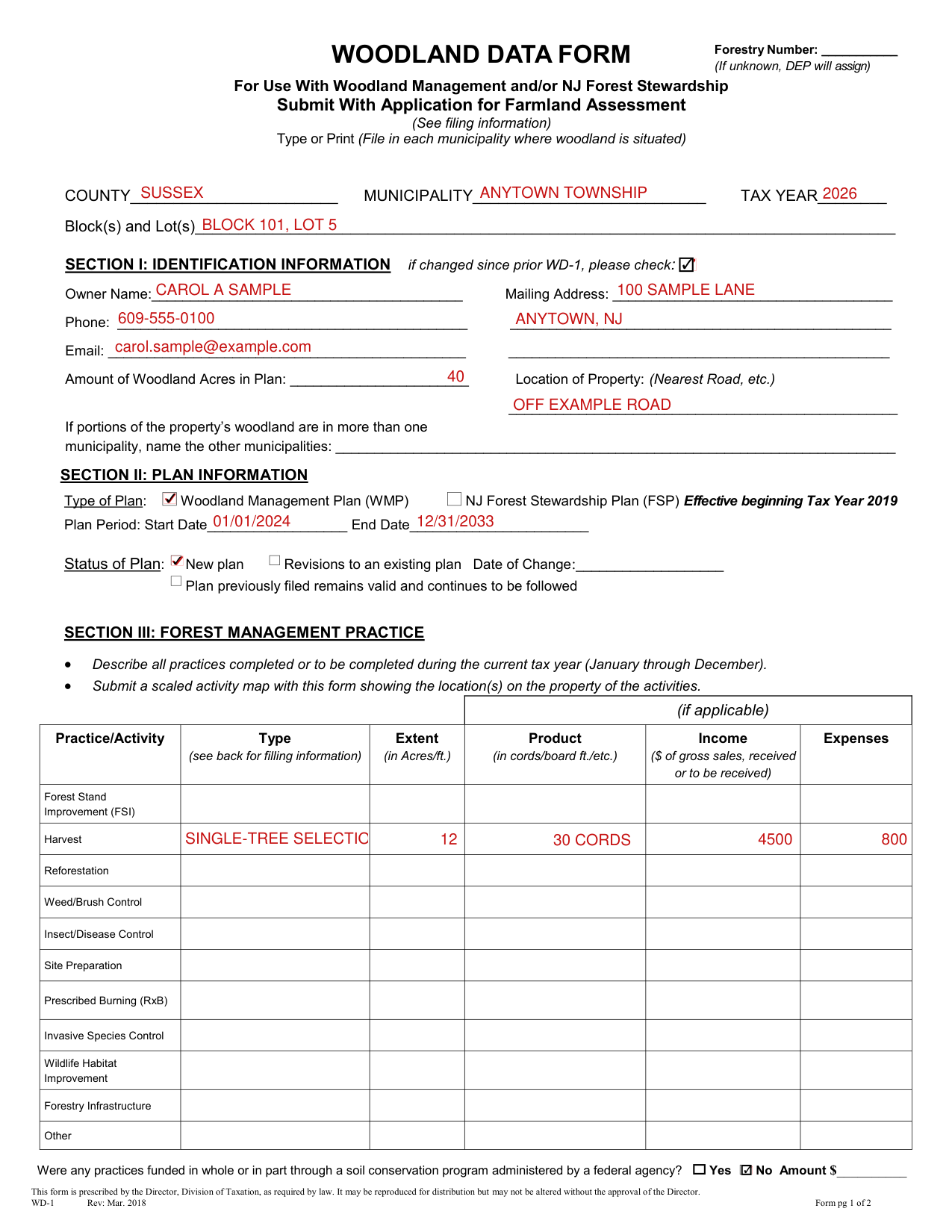
A filled-in Form WD-1 example: an owner reports a harvest
How to fill out Form WD-1, box by box
Forestry Number, COUNTY, MUNICIPALITY, TAX YEAR, Block(s) and Lot(s)
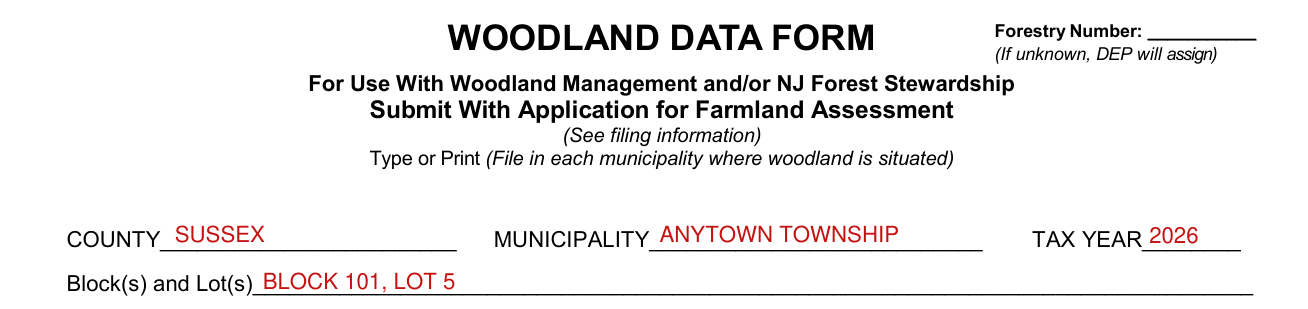
Forestry Number: If unknown, DEP will assign.
Type or Print. File in each municipality where woodland is situated. Fill in COUNTY, MUNICIPALITY, TAX YEAR and Block(s) and Lot(s).
SECTION I: IDENTIFICATION INFORMATION
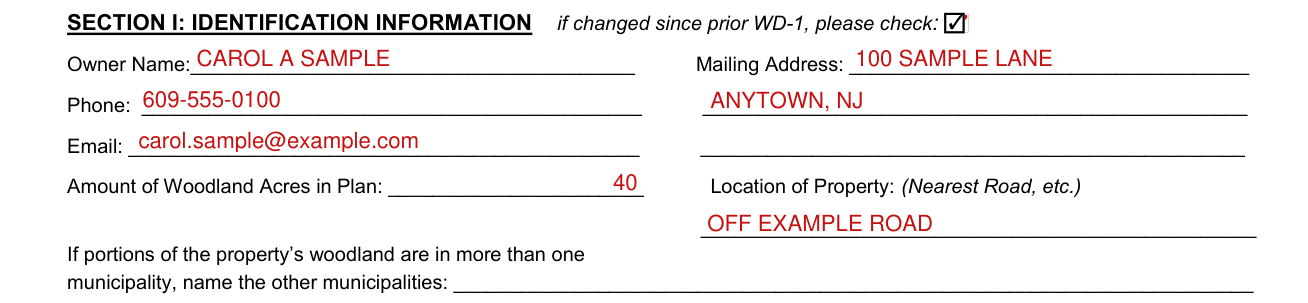
If changed since prior WD-1, please check.
Fill in Owner Name, Mailing Address, Phone and Email.
Fill in Amount of Woodland Acres in Plan and Location of Property (Nearest Road, etc.). If portions of the property's woodland are in more than one municipality, name the other municipalities.
SECTION II: PLAN INFORMATION

Type of Plan: check Woodland Management Plan (WMP) or NJ Forest Stewardship Plan (FSP). Effective beginning Tax Year 2019.
Plan Period: enter the Start Date and the End Date.
Status of Plan: check New plan, Revisions to an existing plan (enter the Date of Change), or Plan previously filed remains valid and continues to be followed.
SECTION III: FOREST MANAGEMENT PRACTICE
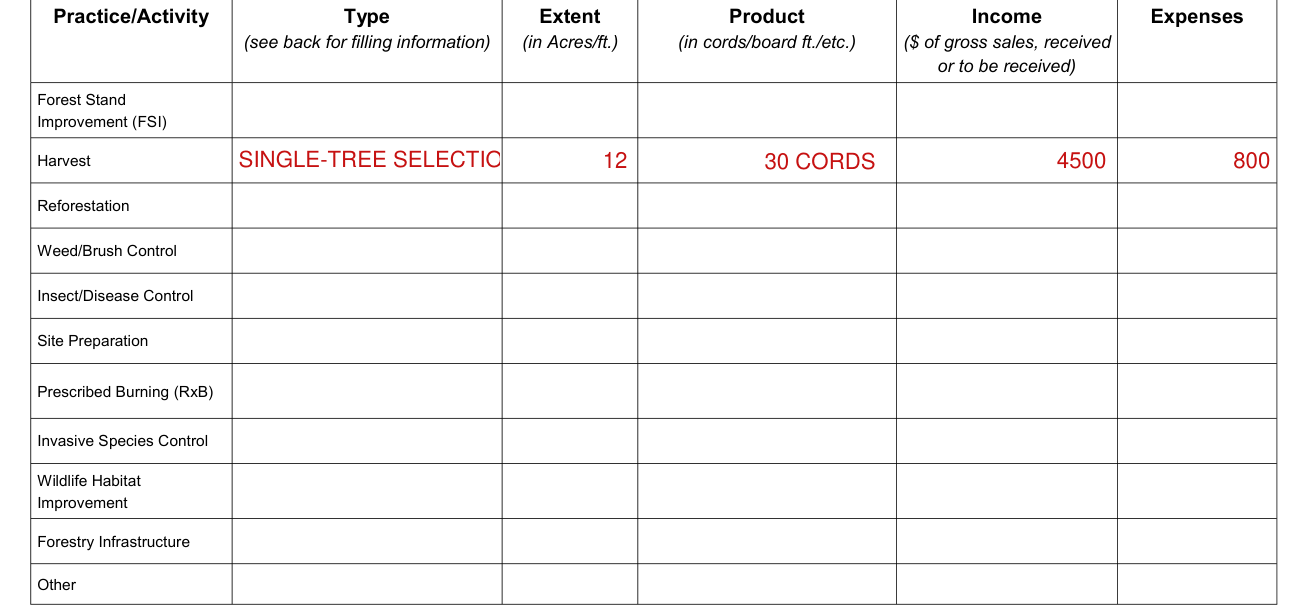
Describe all practices completed or to be completed during the current tax year (January through December). Submit a scaled activity map with this form showing the location(s) on the property of the activities.
Enter Practice/Activity Type (see back for filling information), Extent (in Acres/ft.) and Product (in cords/board ft./etc.).
Enter Income of gross sales, received or to be received (if applicable) and Expenses.
Fill the line for Forest Stand Improvement (FSI), Harvest, Reforestation, Weed/Brush Control, Insect/Disease Control, Site Preparation, Prescribed Burning (RxB), Invasive Species Control, Wildlife Habitat Improvement, Forestry Infrastructure or Other.
Practice/Activity Examples: Forest Stand Improvement (FSI) Thinning, crop tree release, pruning, weeding, sanitation; Harvest Single-tree selection, clearcut, seed tree, group selection, shelterwood; Reforestation Natural or artificial means; Weed/Brush Control Mechanical, chemical, hand, animal (e.g. goats); Insect/Disease Control Aerial, backpack, integrated pest management (IPM); Site Preparation Mowing, drum chop, scarification, chemical treatment; Invasive Species Control Hand pulling, goats, integrated pest management; Wildlife Habitat Improvement Practices to enhance or create habitat; Forestry Infrastructure Access roads, boundary marking, trail improvements, deer fencing; Other Non-traditional forest products.
Were any practices funded in whole or in part through a soil conservation program administered by a federal agency?

Were any practices funded in whole or in part through a soil conservation program administered by a federal agency? Check Yes or No and enter the Amount.
SECTION IV: CERTIFICATION STATEMENTS (Owner and Forester must sign)
The woodland is actively devoted to agricultural use, the activities and practices reported are those specified for the pre-tax year in the filed plan and are being carried out in compliance with the plan, and the information provided on this form is true and correct.
For woodland management plans, the income reported on the form as received or anticipated to be received from the sale of forest products is valid and true and, if any activities and practices reported on the form have not been completed at the time of form submission, they will be completed within the pre-tax year.
The Owner, or a Co-owner if there is one, signs the one signature line and enters the Date.
Or Corporate Officer: sign and enter the Corporate Name and Date.
The Approved Forester certifies that the woodland is actively devoted to agricultural use, that the activities and practices reported are those specified for the pre-tax year in the filed plan and are being carried out in compliance with the plan, and that the information provided on this form is true and correct. Approved Forester: enter the Approved Forester's Name (print), Signature and Date, and the Approved Foresters most recent on-site inspection date.
Both the owner and the Approved Forester must certify on the WD-1 that the forest management activities and practices are being carried out in compliance with the plan.
Furthermore, the property is subject to inspection by a forester from the New Jersey Forest Service pursuant to N.J.A.C. 18-15-2.13 to verify compliance with the plan.
If non-compliance is found, the New Jersey Forest Service will transmit a notice of non-compliance to the local assessor stating the reasons for the finding.
The Department maintains the List of Approved Foresters online at http://www.state.nj.us/dep/parksandforests/forest/ACF.pdf. Upon request, the New Jersey Forest Service will provide a print out of this list.
Regional Offices of the New Jersey Forest Service
File this form and your Farmland Assessment Application with the Local Tax Assessor.
Also file this form, Activity Map, and FA-1 Form with the New Jersey Forest Service Regional Office that serves your county.
If a WD-1 form is included with the application, a copy of the FA-1 form, the WD-1 form, and activity map must be submitted to the Regional Office of the New Jersey Forest Service that serves the county in which the property is situated.
Regional Offices of the New Jersey Forest Service: Northern Region 240 Main Street Andover, NJ 07821, Counties served: Bergen, Essex, Hudson, Hunterdon, Morris, Passaic, Sussex, Warren. Central Region PO Box 239 New Lisbon, NJ 08064, Counties served: Burlington, Mercer, Middlesex, Monmouth, Ocean, Somerset, Union. Southern Region 5555 Atlantic Avenue Mays Landing, NJ 08330, Counties served: Atlantic, Camden, Cape May, Cumberland, Gloucester, Salem.
More rules for Form WD-1
Pre-tax year means the calendar year immediately preceding the tax year. Tax year means the calendar year in which the local property tax is due and payable. Non-appurtenant woodland means woodland that qualifies for farmland assessment by being in compliance with a WMP or FSP.
Before you go
When a WD-1 form is submitted, a property map that shows the location(s) of forest management activity in the pre-tax year must also be filed. This map must be prepared in accordance with the applicable mapping standards set forth at N.J.A.C. 18:15-2.10 or N.J.A.C. 7:3-5.8.
Also with a WD-1 form, a copy of the approved plan must be submitted, unless that assessor already has the plan on file. However, if any revisions have been made to the plan on file, the revisions must be submitted to the assessor. (Please check appropriate box under Status of Plan in Section II of this form.)
Sources
[1] Form WD-1 (Rev. Mar. 2018), Woodland Data Form, New Jersey Division of Taxation (the Official source link on this page).