
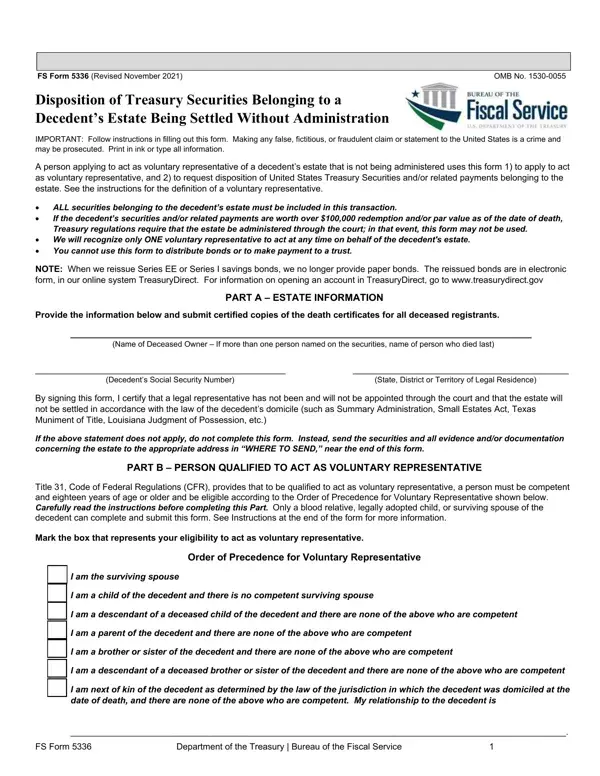

FS Form 5336 at a glance
What it is: FS Form 5336 is the Disposition of Treasury Securities Belonging to a Decedent's Estate Being Settled Without Administration.
Who signs: Sign in ink in the presence of a certifying officer and provide the requested information, OR if your transaction is for paper savings bonds only, you can appear before a notary or a certifying officer.
A person applying to act as voluntary representative of a decedent's estate that is not being administered uses this form 1) to apply to act as voluntary representative, and 2) to request disposition of United States Treasury Securities and/or related payments belonging to the estate.
A voluntary representative of the decedent's estate must complete this form.
Only a blood relative, legally adopted child, or surviving spouse of the decedent can complete and submit this form. This restriction applies even to a person acting as an attorney-in-fact.
All securities belonging to the decedent's estate must be included in this transaction.
The Bureau of the Fiscal Service will recognize only ONE voluntary representative to act at any time on behalf of the decedent's estate.
What to bring and attach to FS Form 5336
Submit certified copies of the death certificates for all deceased registrants.
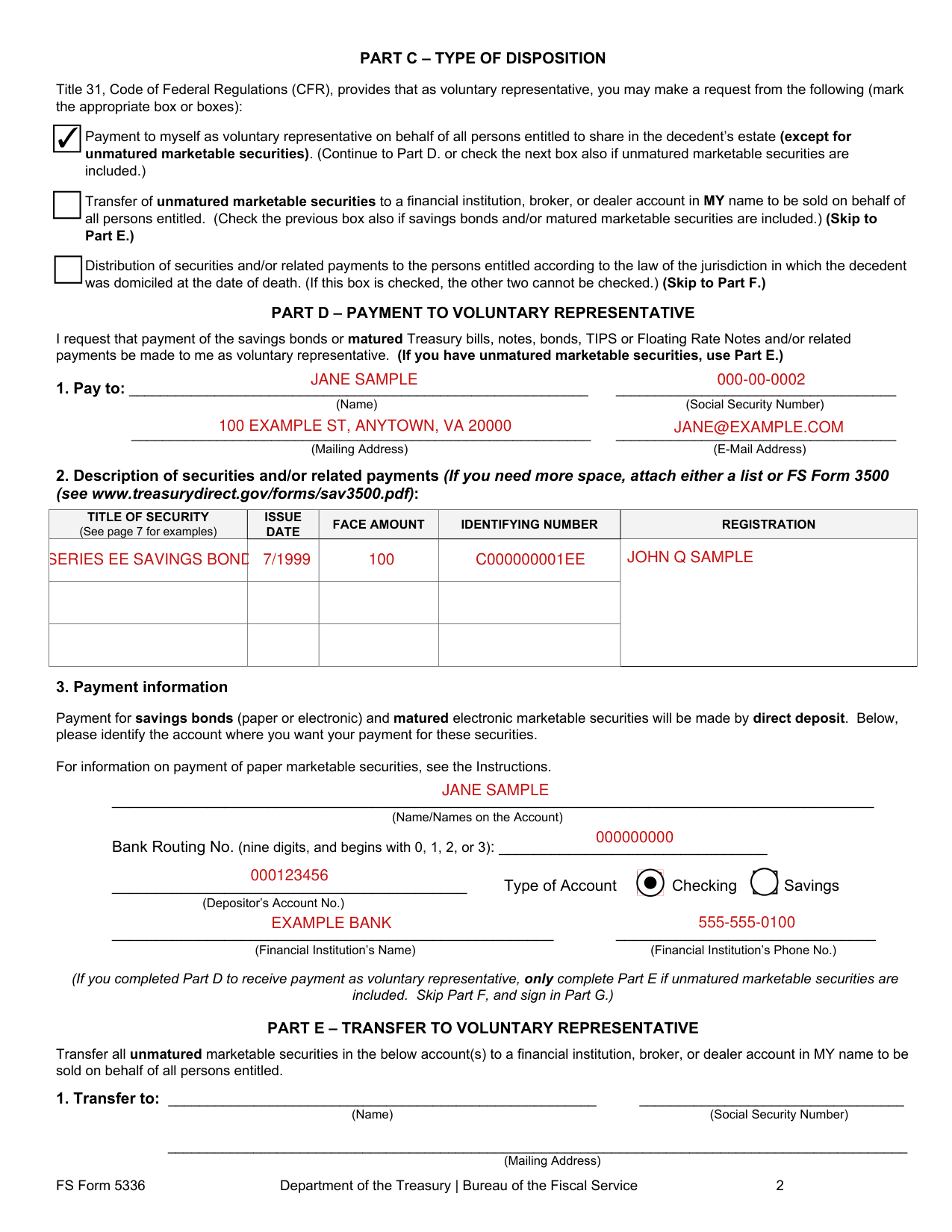
A filled-in FS Form 5336 example: a widow asks for payment of her husband's savings bond
How to fill out FS Form 5336, box by box
Part A - Estate information

PART A - ESTATE INFORMATION Provide the requested information regarding the decedent.
If more than one deceased person is named on the securities, provide the information for the person who died last.
Insert the decedent's Social Security Number and the jurisdiction (state, district, or territory) of the decedent's last legal residence.
Part B - Person qualified to act as voluntary representative
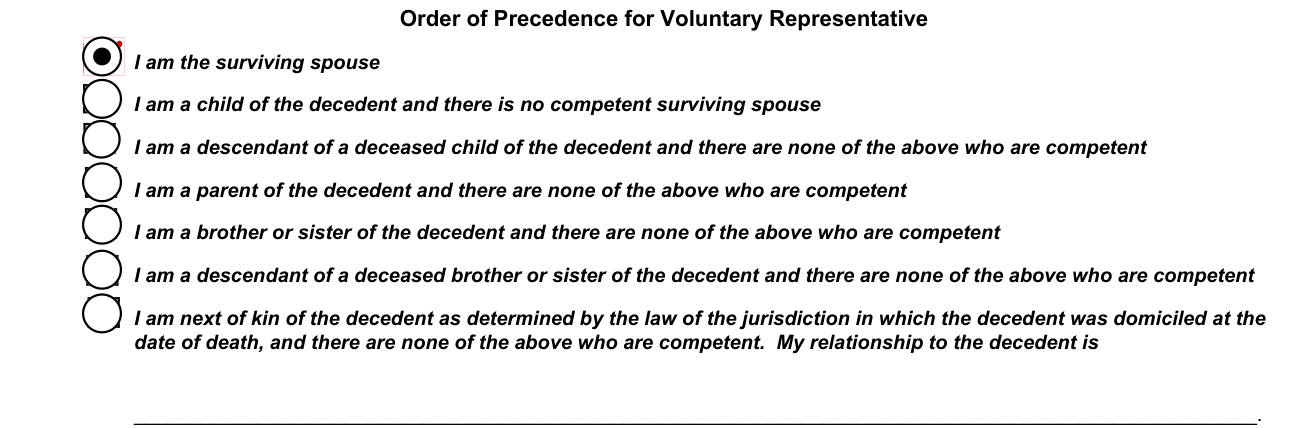
To be qualified to act as voluntary representative, a person must be competent and eighteen years of age or older and be eligible according to the Order of Precedence for Voluntary Representative.
Starting at the top, read down the Order of Precedence until you find the situation that applies to you. Mark the box that represents your eligibility to act as voluntary representative.
If the last box is marked, show your relationship to the decedent.
Part C - Type of disposition
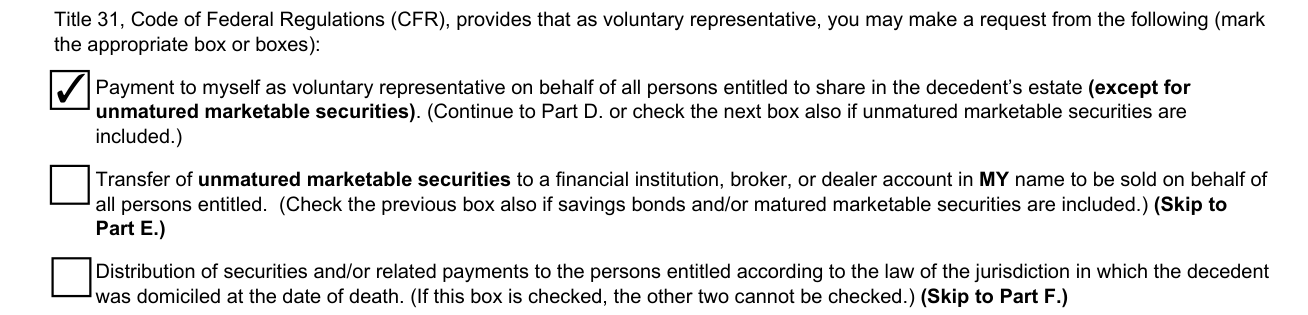
PART C - TYPE OF DISPOSITION Mark the appropriate box.
Payment to myself as voluntary representative on behalf of all persons entitled to share in the decedent's estate (except for unmatured marketable securities). Continue to Part D, or check the next box also if unmatured marketable securities are included.
Transfer of unmatured marketable securities to a financial institution, broker, or dealer account in MY name to be sold on behalf of all persons entitled. Check the previous box also if savings bonds and/or matured marketable securities are included. Skip to Part E.
Distribution of securities and/or related payments to the persons entitled according to the law of the jurisdiction in which the decedent was domiciled at the date of death. If this box is checked, the other two cannot be checked. Skip to Part F.
Part D - Payment to voluntary representative
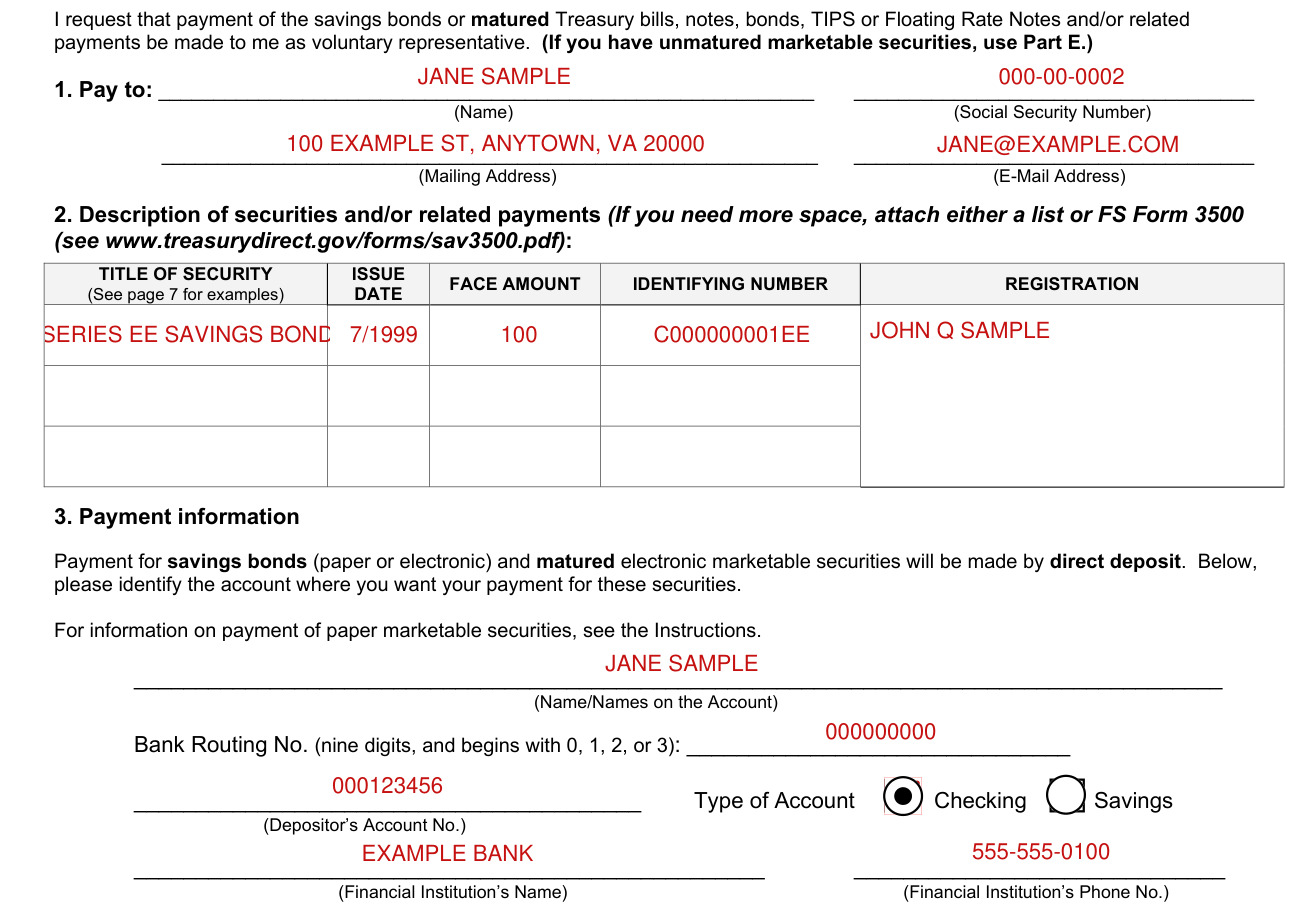
PART D - PAYMENT TO VOLUNTARY REPRESENTATIVE Complete this part to receive payment as voluntary representative for savings bonds or matured marketable securities.
Request that payment of the savings bonds or matured Treasury bills, notes, bonds, TIPS or Floating Rate Notes and/or related payments be made to you as voluntary representative. If you have unmatured marketable securities, use Part E.
Provide your name, Social Security Number, and mailing address.
TITLE OF SECURITY - Identify each security by series, interest rate, type, CUSIP, and call and maturity date, as appropriate.
REGISTRATION - Provide the registration of each security, check, or account; also provide the account number, if any.
Payment for savings bonds (paper or electronic) and matured electronic marketable securities will be made by direct deposit. To receive payment for these securities, please provide the requested information.
The bank routing number has nine digits, and begins with 0, 1, 2, or 3. If you don't know the routing number of your financial institution, the financial institution can give it to you.
If you completed Part D to receive payment as voluntary representative, only complete Part E if unmatured marketable securities are included. Skip Part F, and sign in Part G.
Part E - Transfer to voluntary representative

PART E - TRANSFER TO VOLUNTARY REPRESENTATIVE Complete this part to transfer the unmatured marketable securities to a financial institution, broker, or dealer account in YOUR name to receive payment on behalf of all persons entitled.
Part E - Securities identification and transfer
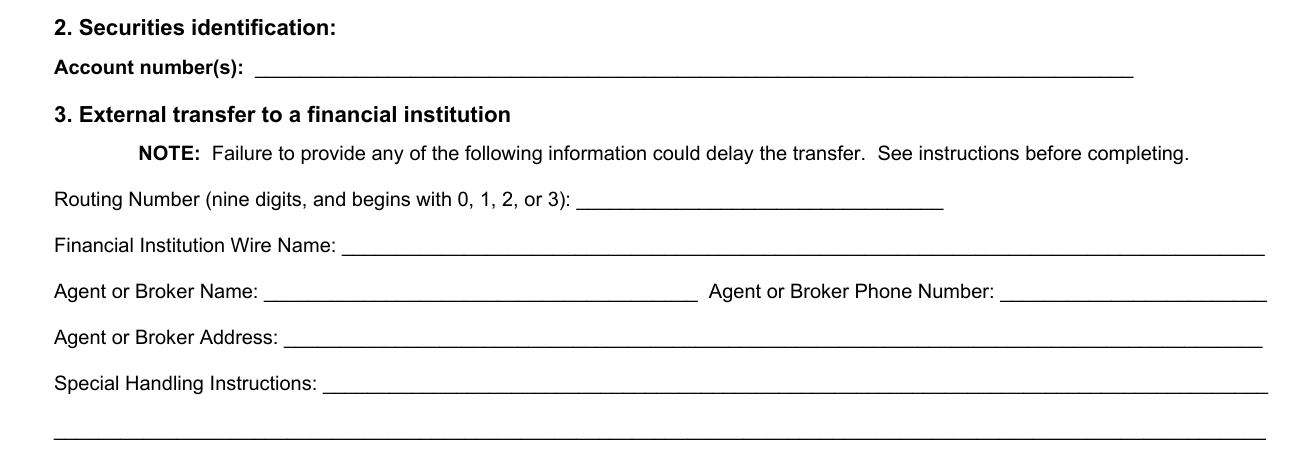
Securities Identification Provide the information requested. All required information is listed on the Legacy Treasury Direct statement of account or in the TreasuryDirect account of the decedent.
Securities CANNOT be transferred to a checking or savings account since they can only accept money.
FINANCIAL INSTITUTION WIRE NAME - Provide the financial institution's "Book-Entry" delivery instructions.
If you completed Part E to transfer as voluntary representative, only complete Part D if matured marketable securities and/or savings bonds are also included. Skip Part F, and sign in Part G.
Part F - Distribution to the first person entitled

Enter the name, Social Security Number, address, and phone number of only one distributee in each Part F, Item 1. (Complete a separate Part F for each distributee.)
Describe only the securities and/or checks that the person shown in Item 1 is to receive.
Individual savings bonds (Series EE, E, I, HH, and H) may not be split. Each savings bond must be distributed, in its entirety, to an entitled individual. Marketable securities may be distributed in full or in increments of $100. Savings bonds issued in electronic form must be at least $25. (checked November 2, 2026)
The distributee must complete IRS Form W-9.
Part G - Signature and certification
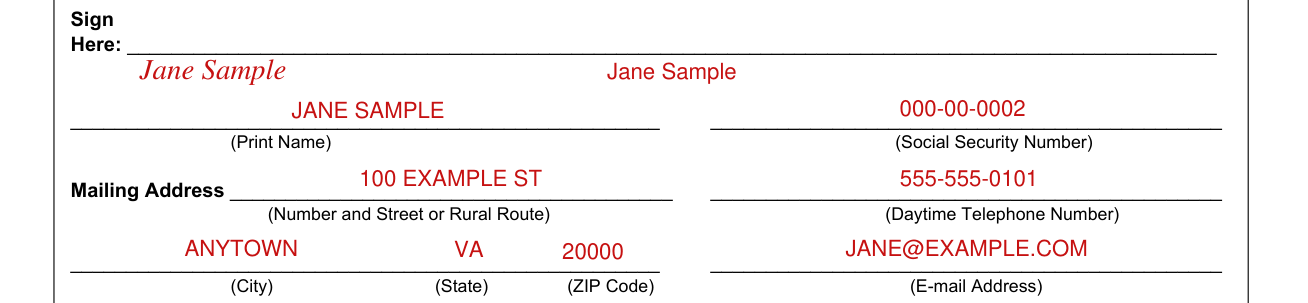
By signing you certify under penalty of perjury that the information provided herein is true and correct to the best of your knowledge and belief and that you are eligible to act as voluntary representative.
More rules for FS Form 5336
If you need more space for any item, use a plain sheet of paper or make a photocopy of the relevant section, and attach to the form.
If your situation is different
Treasury regulations require that the estate be administered through the court
If the decedent's securities and/or related payments are worth over $100,000 redemption and/or par value as of the date of death, Treasury regulations require that the estate be administered through the court; in that event, this form may not be used. (checked November 2, 2026)
Distribute bonds or make payment to a trust
You cannot use this form to distribute bonds or to make payment to a trust.
Common questions about FS Form 5336
Does it need a notary?
You must appear before and establish identification to the satisfaction of an authorized certifying officer or, if your transaction is for paper savings bonds only, you may choose to appear before a notary instead. The form must be signed in the presence of the notary or officer. A notary may certify only for a transaction that involves just paper savings bonds.
Where do I file it?
Unless otherwise instructed in accompanying correspondence, mail this form (without instruction pages), mail all securities and/or related checks, and mail any necessary evidence to Treasury Retail Securities Services, P.O. Box 9150, Minneapolis, MN 55480-9150.
Is there a penalty?
Making any false, fictitious, or fraudulent claim or statement to the United States is a crime and may be prosecuted.
What am I certifying when I sign?
By signing this form, you certify that a legal representative has not been and will not be appointed through the court and that the estate will not be settled in accordance with the law of the decedent's domicile (such as Summary Administration, Small Estates Act, Texas Muniment of Title, Louisiana Judgment of Possession, etc.). If that statement does not apply, do not complete this form.
When is this form not the right one?
If a legal representative has been appointed by the court, if the estate has been administered and is now closed, or if you have a document establishing entitlement to the estate (other than an unprobated will), do not complete this form. Instead, send the securities and all evidence and/or documentation concerning the estate to the address in WHERE TO SEND.
Sources
[1] FS Form 5336 (Revised April 2026), Disposition of Treasury Securities Belonging to a Decedent's Estate Being Settled Without Administration, Bureau of the Fiscal Service (the Official source link on this page).