
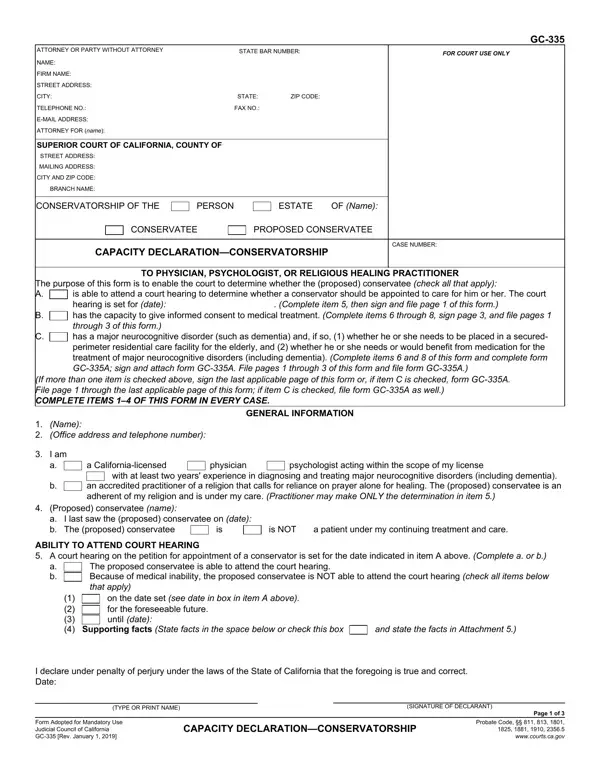
Form GC-335 at a glance
What it is: GC-335 is the Confidential Capacity Assessment and Declaration-Probate Conservatorship.
Where and when to file: FILE IN CONFIDENTIAL FOLDER
This form is intended to record the results of a capacity assessment of the person named in item 2, to describe the assessing clinician's conclusions about the person's mental functioning and capacity, and to submit the results and conclusions under oath to the court. The petitioner completes items 1 and 2 to give instructions to the clinician. The clinician completes the remainder of the form.
A filled-in Form GC-335 example: a physician assesses a proposed conservatee
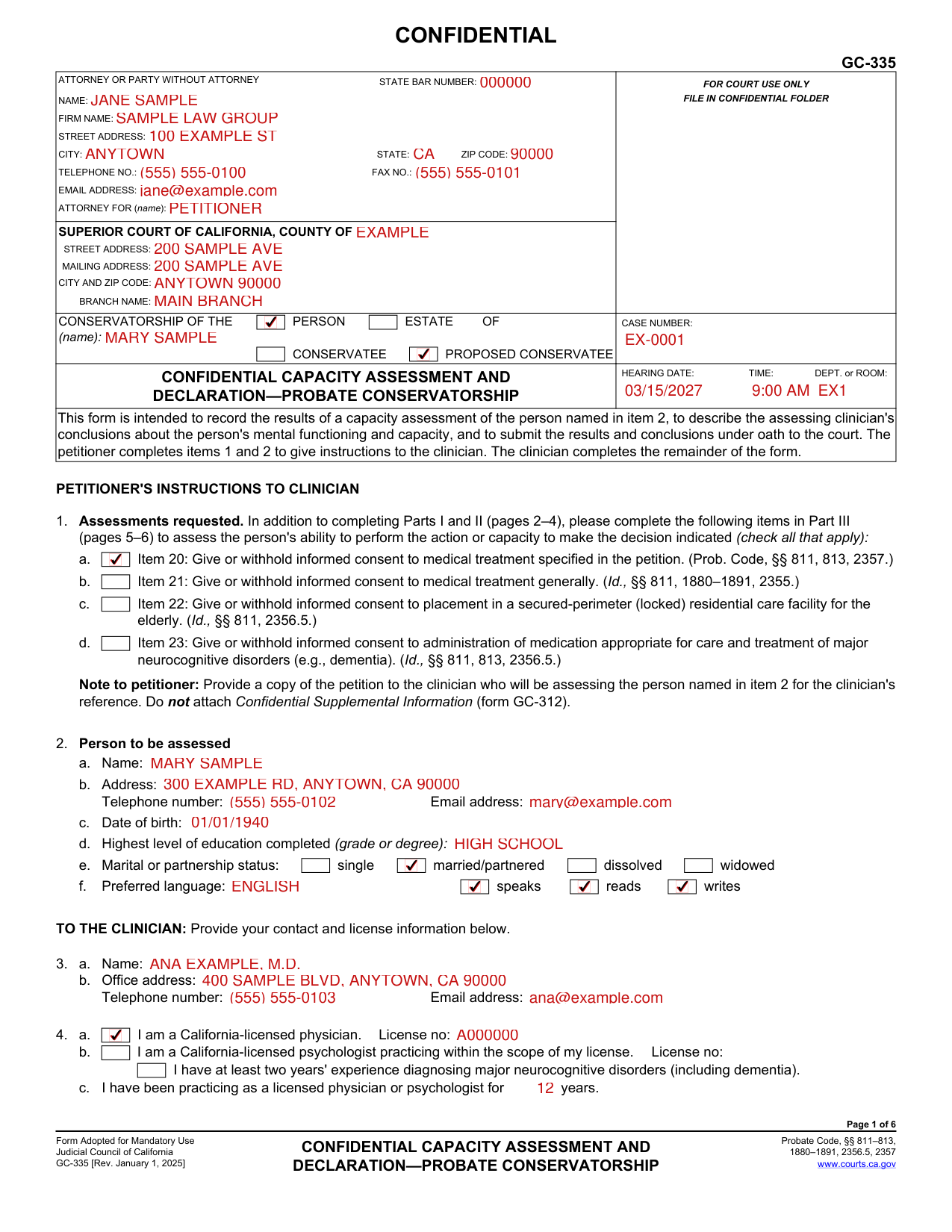
How to fill out Form GC-335, box by box
Attorney or party without attorney
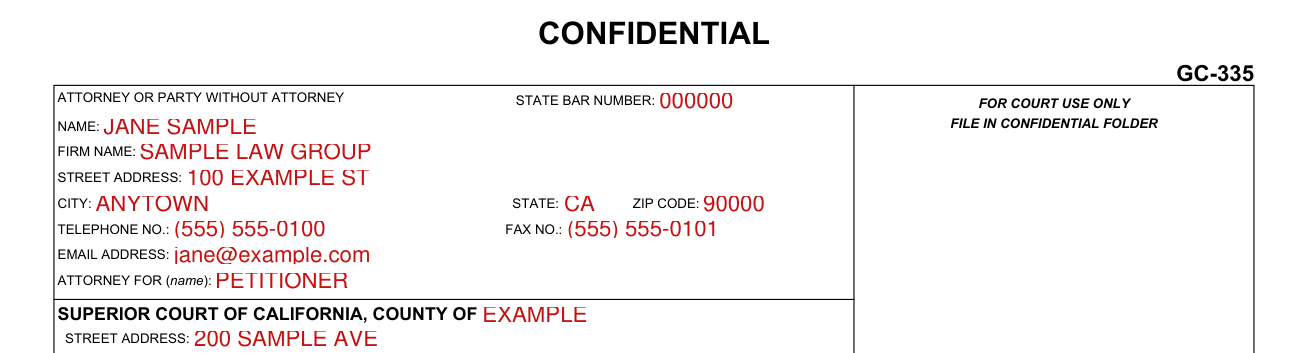
Enter the Attorney or party without attorney: State Bar number, Name, Firm name, Street address, City, State, Zip code, Telephone no., Fax no., Email address and Attorney for (name).
Court, case and hearing
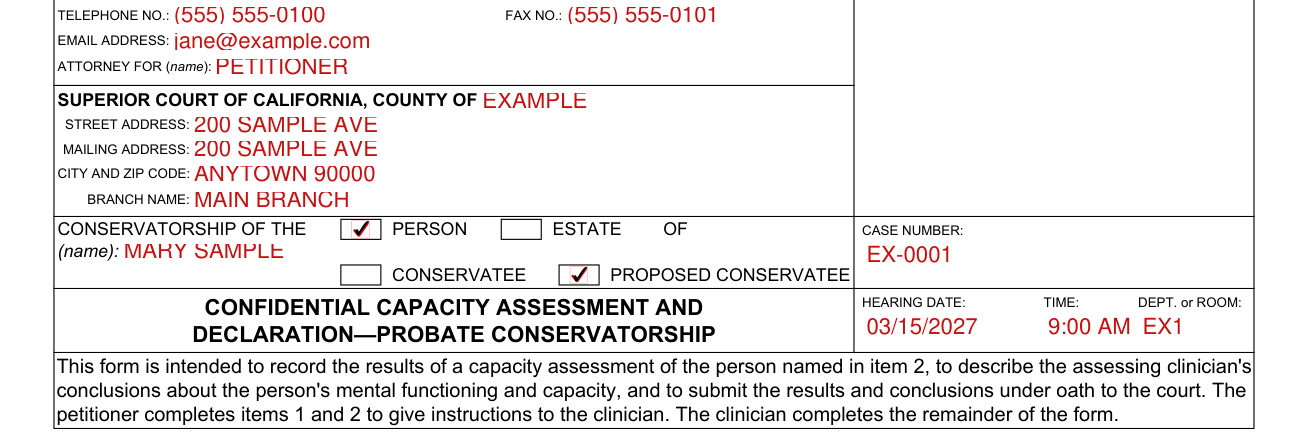
Enter the Superior Court of California, County of, with its Street address, Mailing address, City and zip code and Branch name. Mark Conservatorship of the Person or Estate of (name), enter the name, mark Conservatee or Proposed conservatee, and enter the Case number, Hearing date, Time and Dept. or room.
Assessments requested
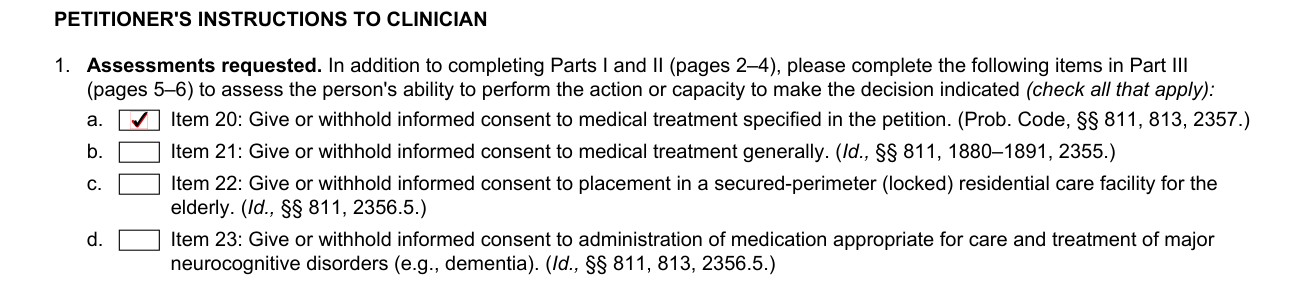
In addition to completing Parts I and II (pages 2-4), please complete the following items in Part III (pages 5-6) to assess the person's ability to perform the action or capacity to make the decision indicated (check all that apply):
a. Item 20: Give or withhold informed consent to medical treatment specified in the petition. (Prob. Code, §§ 811, 813, 2357.) b. Item 21: Give or withhold informed consent to medical treatment generally. (Id., §§ 811, 1880-1891, 2355.) c. Item 22: Give or withhold informed consent to placement in a secured-perimeter (locked) residential care facility for the elderly. (Id., §§ 811, 2356.5.) d. Item 23: Give or withhold informed consent to administration of medication appropriate for care and treatment of major neurocognitive disorders (e.g., dementia). (Id., §§ 811, 813, 2356.5.)
Person to be assessed
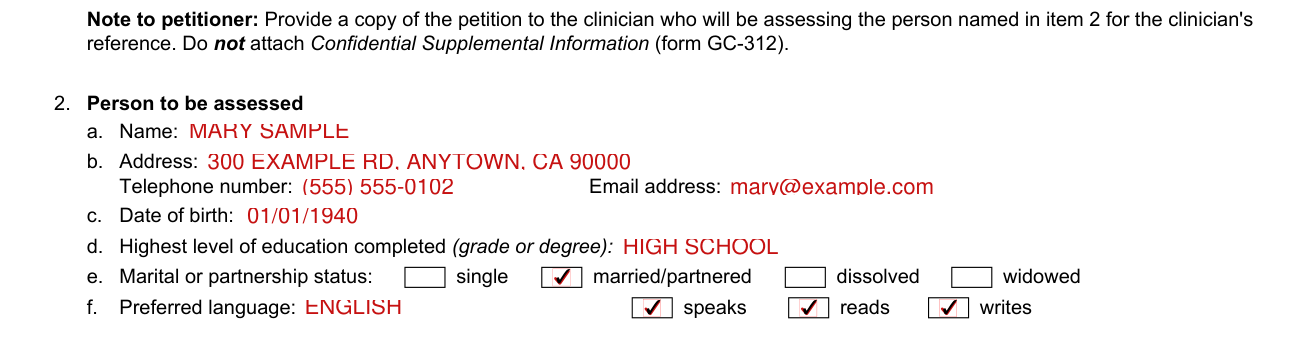
For the person to be assessed, enter Name, Address, Telephone number, Email address, Date of birth and Highest level of education completed (grade or degree).
Mark Marital or partnership status: single, married/partnered, dissolved or widowed. For Preferred language, enter the language and mark speaks, reads or writes.
Your contact and license information
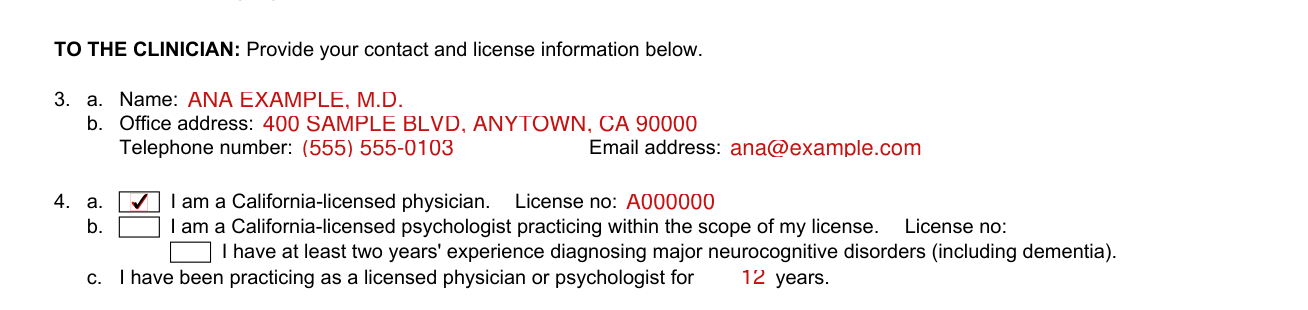
TO THE CLINICIAN: Provide your contact and license information: 3. a. Name: b. Office address: Telephone number and Email address.
4. Mark I am a California-licensed physician and enter the License no, or mark I am a California-licensed psychologist practicing within the scope of my license and I have at least two years' experience diagnosing major neurocognitive disorders (including dementia), and enter the License no. Enter the years you have been practicing as a licensed physician or psychologist.
More rules for Form GC-335
If a question or prompt does not apply to an ability or capacity checked in item 1 or your assessment does not address a question or prompt, check the appropriate box in that item or, if there is no box, leave the item blank.
If your situation is different
Information about the assessment
Mark is or is not: The person named in item 2 is or is not a patient under my continuing care and treatment. Specify the length of time in months or years that you have known this person.
Enter the date of the examination on which this assessment is based or, if based on multiple examinations, the date you most recently examined the person, and the time spent in the most recent examination.
7. My responses to the questions and prompts on this form are based on (check all that apply): my examination of this person for the purpose of assessing the person's abilities and capacities. Multiple examinations of this person for purposes of general health care and medical treatment. Administration of standardized examinations or tools that measure the person's mental functioning. My review of the person's medical records. Discussions with other practitioners responsible for providing health care to the person. Discussions with team members or other professionals who participated in the person's assessment. Discussions with the person's family or friends. Other sources of information.
Overall physical health and overall mental health
Overall physical health is: Excellent, Good, Fair, Poor or I don't know. Overall physical health is likely to: Improve, Remain stable, Deteriorate or I don't know. Enter the number of weeks in which the person should be reevaluated.
Overall mental health is: Excellent, Good, Fair, Poor or I don't know. Overall mental health is likely to: Improve, Remain stable, Deteriorate or I don't know. Enter the number of weeks for reevaluation here the same way.
Part II. Mental functioning
Deficits are indicated in items 10-14 as follows: a = no deficit; b = mild deficit; c = moderate deficit; d = major deficit or no function; e = not applicable or not assessed.
Capacity to give or withhold informed consent to medical treatment specified in the petition
Capacity to give or withhold informed consent to medical treatment specified in the petition (Probate Code, § 2357.) Describe the medical treatment recommended for the person. Based on your assessment of the person's applicable mental functions and abilities, give your professional opinion, or mark: I do not have enough information to form an opinion on this issue.
Capacity to give or withhold informed consent to medical treatment generally
Capacity to give or withhold informed consent to medical treatment generally (Probate Code, §§ 811, 1881.) Mark the last box only if this applies to the person. The person lacks the capacity to give or withhold informed consent to any form of medical treatment because either (1) the person is unable to respond knowingly and intelligently to questions about their medical treatment or (2) the person is unable to participate in treatment decisions by means of a rational thought process, which means the person cannot understand at least one of the following: (A) the nature and seriousness of any illness, disorder, or defect that they have or may develop. (B) the nature of any medical treatment that is or may be recommended by their health-care providers. (C) the probable degree and duration of any benefits and risks of any medical intervention that is or may be recommended by the person's health-care providers and the consequences of lack of treatment. (D) the nature, risks, and benefits of any reasonable alternatives. Then mark: The person's lack of capacity to give or withhold informed consent is linked to one or more mental function deficits described in Part II.
Capacity to give or withhold informed consent to placement in a secured-perimeter residential facility
22. Capacity to give or withhold informed consent to placement in a secured-perimeter residential facility for persons with major neurocognitive disorders (Probate Code, § 2356.5.) Mark if it applies: The person has a major neurocognitive disorder (such as dementia) as defined in the current edition of the Diagnostic and Statistical Manual of Mental Disorders. See Part I of this form for more information. Mark if it applies: The person needs or would benefit from placement in a restricted and secure environment for the reasons (for example, wandering, violence, or rejecting care) explained in Attachment 22b. The proposed placement in a locked or secured-perimeter facility is or is not the least restrictive environment appropriate to the person's needs.
Capacity to give or withhold informed consent to administration of medication for treatment of major neurocognitive disorders
23. Capacity to give or withhold informed consent to administration of medication for treatment of major neurocognitive disorders (Probate Code, § 2356.5.) Mark if it applies: The person needs or would benefit from appropriate medications for the care and treatment of major neurocognitive disorders (including dementia).
Before you go
Note to petitioner: Provide a copy of the petition to the clinician who will be assessing the person named in item 2. Do not attach Confidential Supplemental Information (form GC-312).
The petitioner completes items 1 and 2. The clinician: Secure or destroy your copy of the petition. Do not send it to the court.
Common questions about Form GC-335
What is a GC 335 form?
GC-335 is the Confidential Capacity Assessment and Declaration-Probate Conservatorship. Part III documents the professional conclusions about each issue checked in item 1. The conclusions are based on the assessment of the level of the person's mental functions described in Part II.
Who signs it?
The petitioner completes items 1 and 2. The clinician completes the remainder of the form: enter the Number of pages attached, enter the Date, type or print the name and sign as declarant.
Where do I file it?
FILE IN CONFIDENTIAL FOLDER
What am I certifying when I sign?
Sign the declaration: "I declare under penalty of perjury under the laws of the State of California that the foregoing is true and correct."
Sources
[1] Form GC-335 (Rev. January 1, 2025), Confidential Capacity Assessment and Declaration-Probate Conservatorship, Judicial Council of California (the Official source link on this page).