

HVAC Checklist - Short Form at a glance
What it is: HVAC Checklist - Short Form: Sections 2, 4 and 6 and Appendix B discuss the relationships between the HVAC system and indoor air quality.
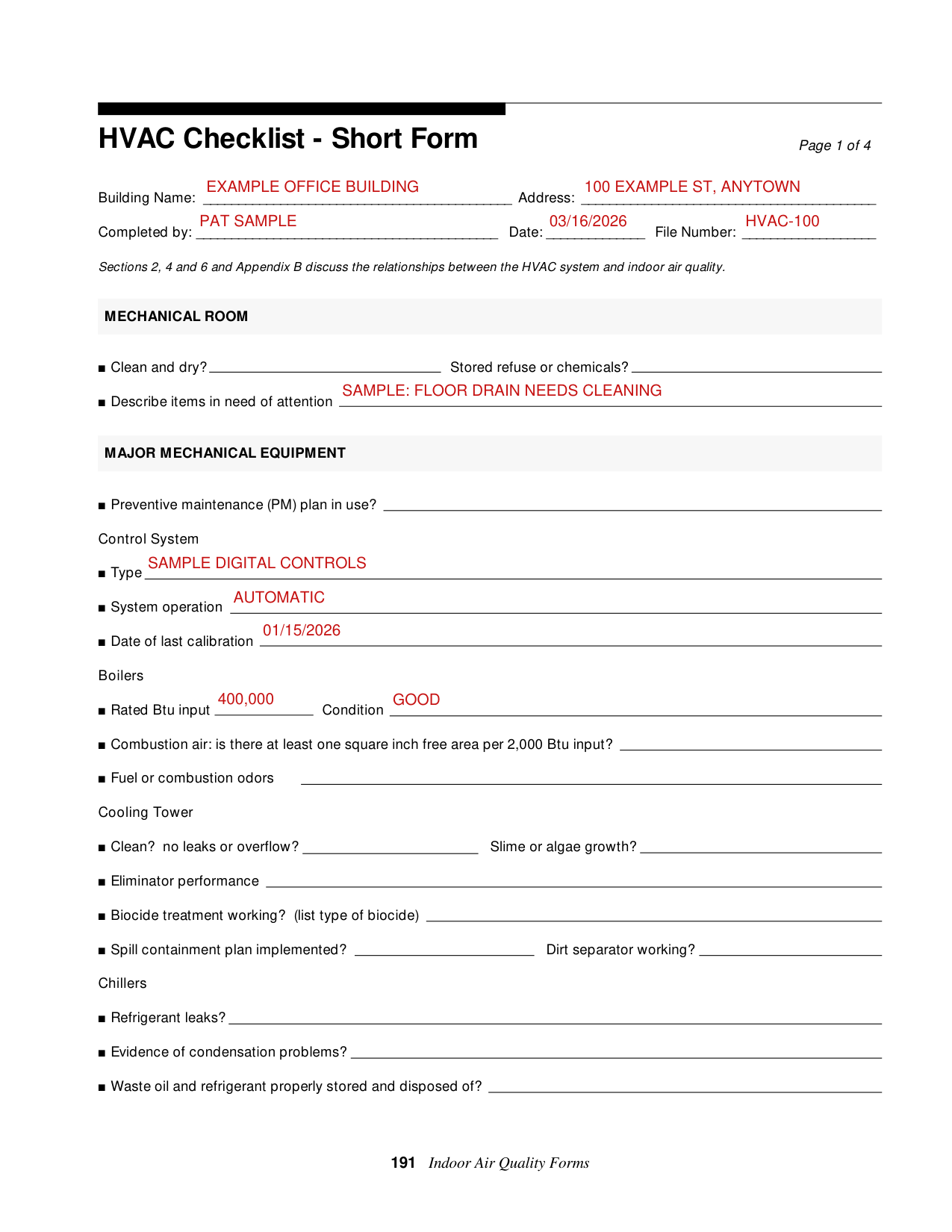
A filled-in HVAC Checklist - Short Form example: a building manager fills page 1
How to fill out HVAC Checklist - Short Form, box by box
Building Name, Address and File Number

Enter the Building Name, Address, Completed by, Date and File Number.
Mechanical room and major equipment

Under MECHANICAL ROOM, enter Clean and dry? and Stored refuse or chemicals?
Under MECHANICAL ROOM, describe items in need of attention.
Under MAJOR MECHANICAL EQUIPMENT, enter Preventive maintenance (PM) plan in use?
Control System

Under Control System, enter the Type, the System operation and the Date of last calibration.
Boilers

Under Boilers, enter the Rated Btu input and the Condition.
Under Boilers, enter Combustion air: is there at least one square inch free area per 2,000 Btu input?
Under Boilers, enter Fuel or combustion odors.
Cooling Tower and Chillers
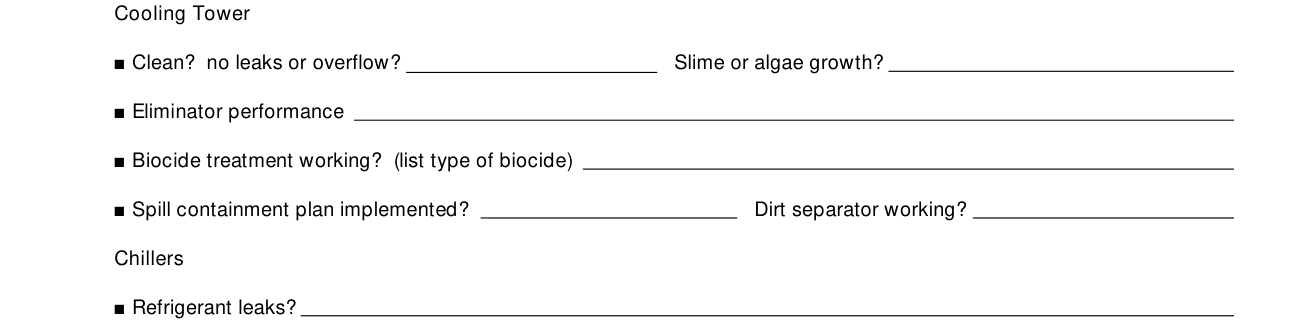
Under Cooling Tower, enter Clean? no leaks or overflow? Slime or algae growth?
Under Cooling Tower, enter the Eliminator performance and enter Biocide treatment working? (list type of biocide).
Under Cooling Tower, enter Spill containment plan implemented? Dirt separator working?
Under Chillers, enter Refrigerant leaks? and Evidence of condensation problems?
Under Chillers, enter Waste oil and refrigerant properly stored and disposed of?
Air handling unit

Under AIR HANDLING UNIT, enter the Unit identification and the Area served.
Under Outdoor Air Intake, Mixing Plenum, and Damper, enter the Outdoor air intake location, enter Nearby contaminant sources? (describe) and enter Bird screen in place and unobstructed?
Enter the Design total cfm outdoor air (O.A.) cfm, the date last tested and balanced, the Minimum % O.A. (damper setting) and the Minimum cfm O.A.
Enter the Current O.A. damper setting (date, time, and HVAC operating mode), the Damper control sequence (describe) and the Condition of dampers and controls (note date).
Under Fans, enter the Control sequence and the Condition (note date).
Under Fans, enter the Indicated temperatures and the Actual temperatures: supply air, mixed air, return air and outdoor air.
Under Coils, enter the Heating fluid discharge temperature ∆T and the cooling fluid discharge temperature ∆T.
Under Coils, enter the Controls (describe) and the Condition (note date).
Under Humidifier, enter the Type; if biocide is used, note type.
Under Humidifier, enter Condition (no overflow, drains trapped, all nozzles working?) and No slime, visible growth, or mineral deposits?
Distribution system and filters
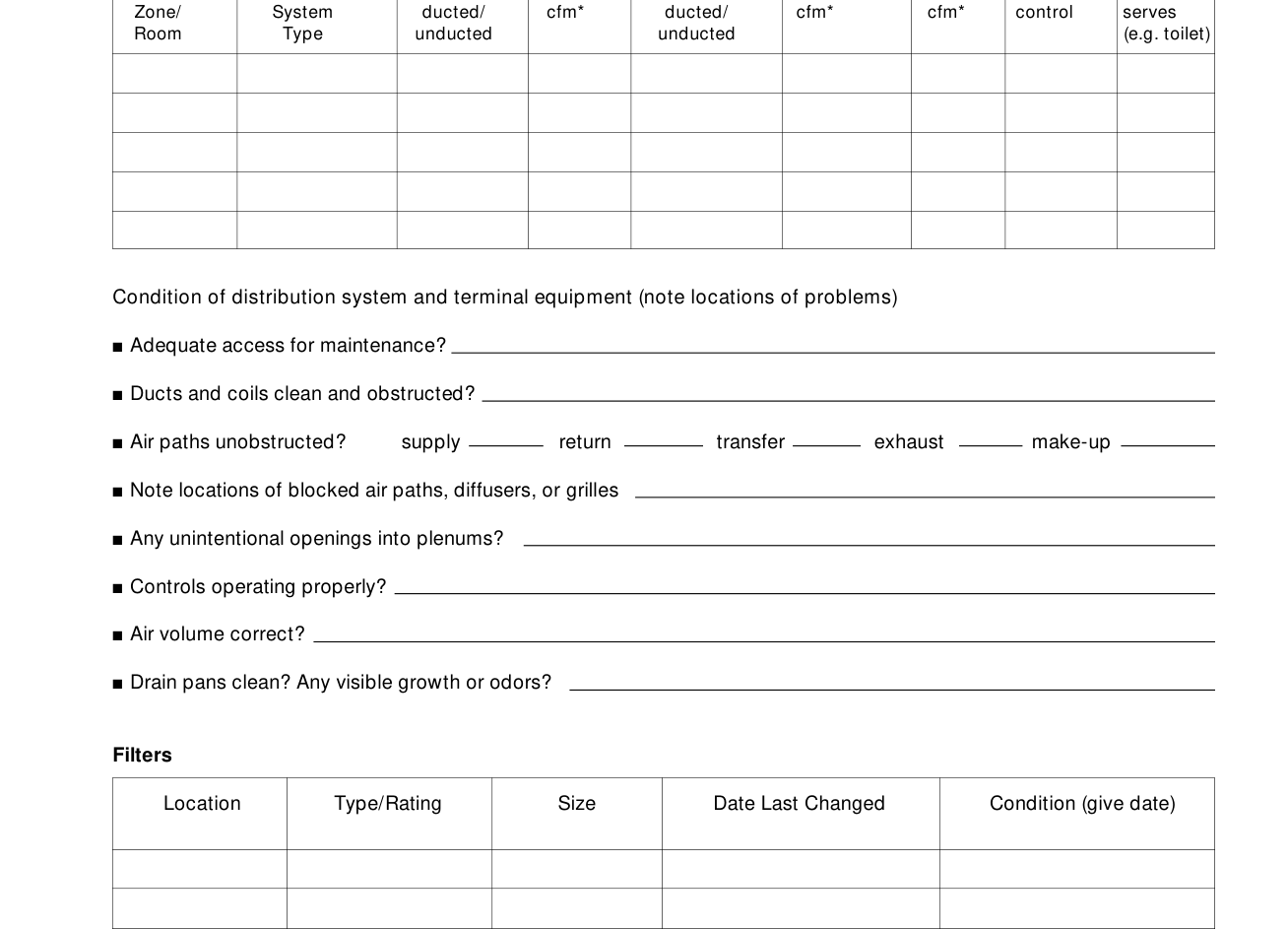
Under DISTRIBUTION SYSTEM, enter the Zone/ Room and System Type, then the Supply Air ducted/ unducted and cfm*, the Return Air ducted/ unducted and cfm*, and the Power Exhaust cfm*, control and serves (e.g. toilet).
Under Condition of distribution system and terminal equipment (note locations of problems), enter Adequate access for maintenance? and Ducts and coils clean and obstructed?, and Air paths unobstructed? supply return transfer exhaust make-up.
Under Condition of distribution system and terminal equipment (note locations of problems), note locations of blocked air paths, diffusers, or grilles, and enter Any unintentional openings into plenums? Controls operating properly? Air volume correct? Drain pans clean? Any visible growth or odors?
Under Filters, enter the Location, Type/Rating, Size, Date Last Changed and Condition (give date).
Occupied space
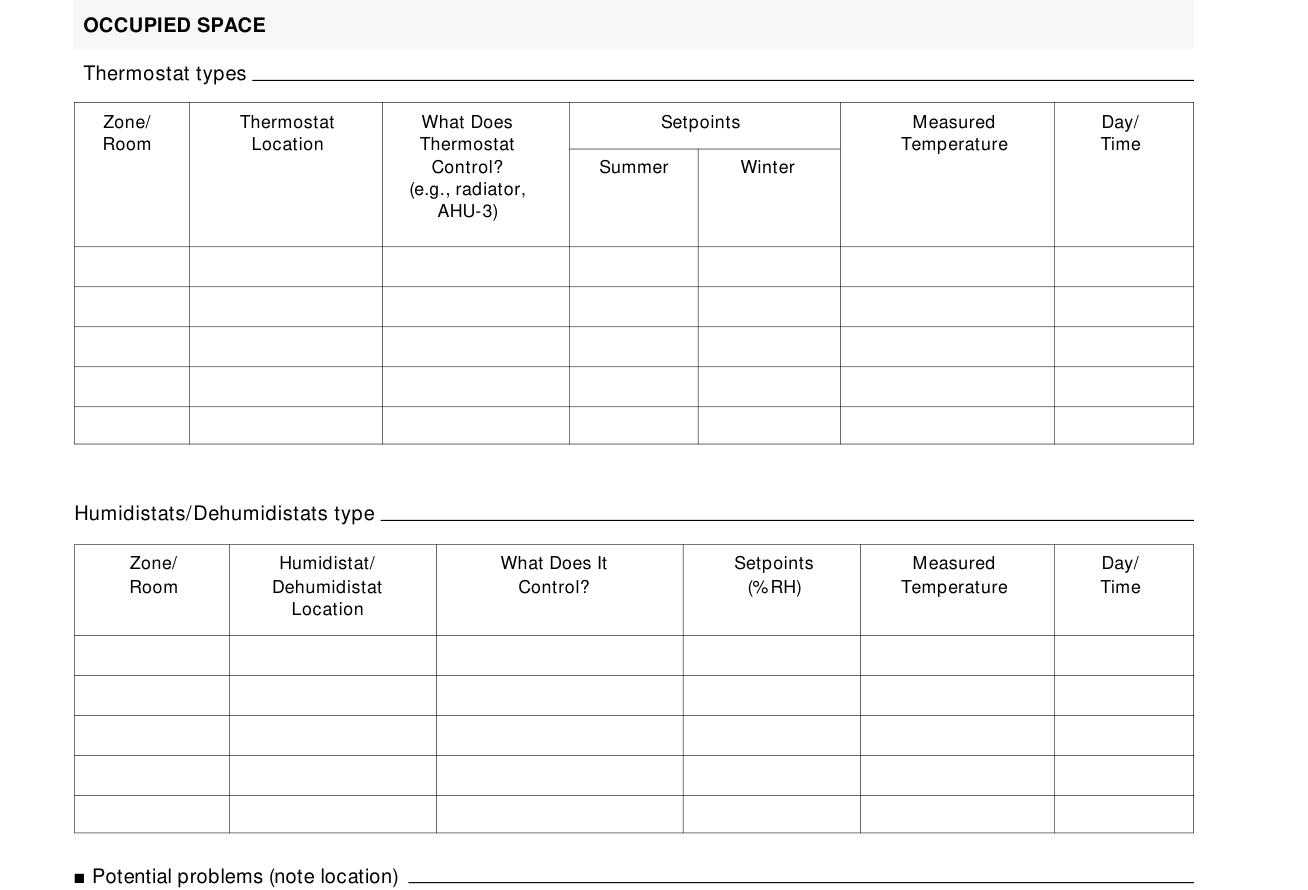
Under OCCUPIED SPACE, enter the Thermostat types and, for each thermostat, the Zone/ Room, Thermostat Location, What Does Thermostat Control? (e.g., radiator, AHU-3), Setpoints Summer and Winter, Measured Temperature and Day/ Time.
Under Humidistats/Dehumidistats type, enter the Zone/ Room, Humidistat/ Dehumidistat Location, What Does It Control?, Setpoints (%RH), Measured Temperature and Day/ Time.
Under Potential problems (note location), note Thermal comfort or air circulation (drafts, obstructed airflow, stagnant air, overcrowding, poor thermostat location), Malfunctioning equipment, and Major sources of odors or contaminants (e.g., poor sanitation, incompatible uses of space).
Sources
[1] HVAC Checklist - Short Form, Indoor Air Quality Forms.
