

ICF Checklist Version 2.1a at a glance
What it is: The ICF Checklist Version 2.1a is a Clinician Form, a practical tool to elicit and record information on the functioning and disability of an individual.
This version (2.1a) is for use by a clinician, health or social care professional.
A filled-in ICF Checklist Version 2.1a example: a clinician records one problem
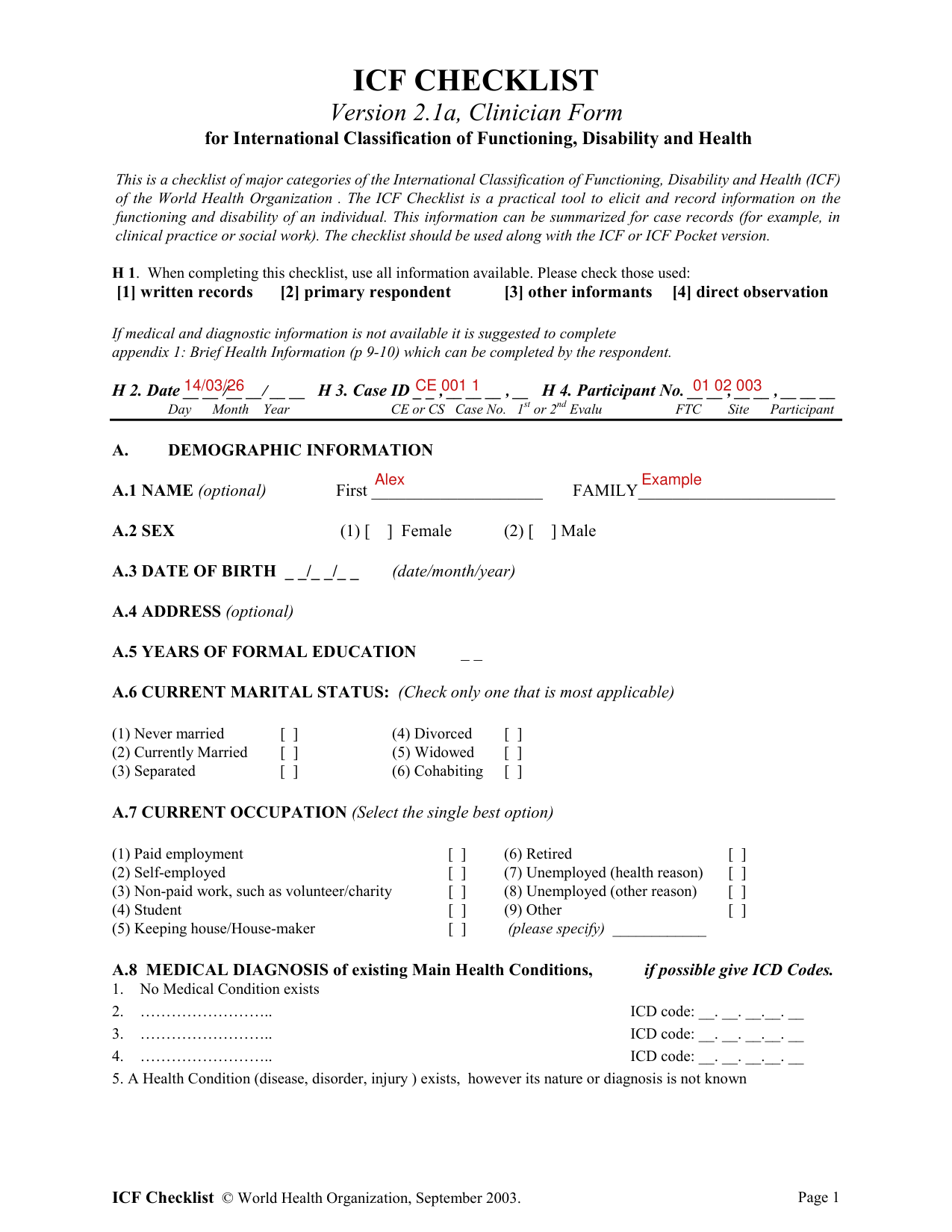
How to fill out ICF Checklist Version 2.1a, box by box
H 2. Date, H 3. Case ID and H 4. Participant No.

When completing this checklist, use all information available. Please check those used: written records, primary respondent, other informants, direct observation. Please record all sources of information used on the first page.
Enter the Date as day, month and year, the Case ID and the Participant No.
A.1 NAME (optional)

A.1 NAME (optional) has First and FAMILY lines, and A.4 ADDRESS is also optional.
Body functions Qualifier
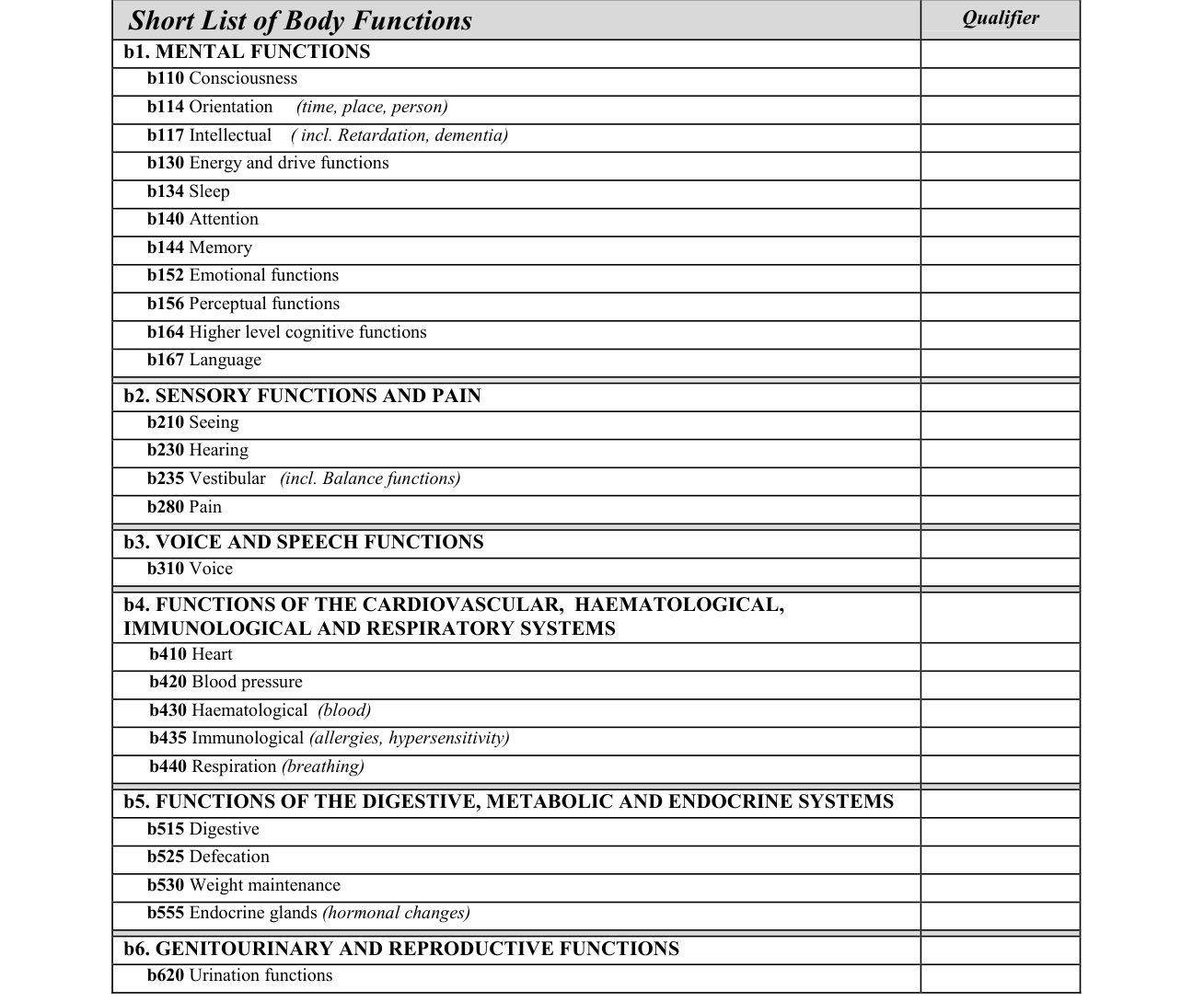
Parts 1 to 3 should be filled in by writing the qualifier code against each of the function, structure, activity and participation term that shows some problem for the case being evaluated. Appropriate codes for the qualifiers are given on the relevant pages.
Body functions are the physiological functions of body systems (including psychological functions). Impairments are problems in body function as a significant deviation or loss.
First Qualifier: Extent of impairments 0 No impairment means the person has no problem 1 Mild impairment means a problem that is present less than 25% of the time, with an intensity a person can tolerate and which happens rarely over the last 30 days.
2 Moderate impairment means that a problem that is present less than 50% of the time, with an intensity, which is interfering in the persons day to day life and which happens occasionally over the last 30 days.
3 Severe impairment means that a problem that is present more than 50% of the time, with an intensity, which is partially disrupting the persons day to day life and which happens frequently over the last 30 days.
4 Complete impairment means that a problem that is present more than 95% of the time, with an intensity, which is totally disrupting the persons day to day life and which happens every day over the last 30 days.
8 Not specified means there is insufficient information to specify the severity of the impairment.
9 Not applicable means it is inappropriate to apply a particular code (e.g. b650 Menstruation functions for woman in pre-menarche or post-menopause age).
More rules for ICF Checklist Version 2.1a
In A.6 CURRENT MARITAL STATUS, check only one that is most applicable.
In A.7 CURRENT OCCUPATION, select the single best option.
In A.8 MEDICAL DIAGNOSIS of existing Main Health Conditions, if possible give ICD Codes.
If medical and diagnostic information is not available it is suggested to complete appendix 1: Brief Health Information (p 9-10) which can be completed by the respondent.
Body structures are anatomical parts of the body such as organs, limbs and their components. Impairments are problems in structure as a significant deviation or loss.
Second Qualifier: Nature of the change: 0 No change in structure 1 Total absence 2 Partial absence 3 Additional part 4 Aberrant dimensions 5 Discontinuity 6 Deviating position 7 Qualitative changes in structure, including accumulation of fluid 8 Not specified 9 Not applicable
Activity is the execution of a task or action by an individual. Activity limitations are difficulties an individual may have in executing activities.
Participation is involvement in a life situation. Participation restrictions are problems an individual may have in involvement in life situations.
The Performance qualifier indicates the extent of Participation restriction by describing the persons actual performance of a task or action in his or her current environment. The Performance qualifier measures the difficulty the respondent experiences in doing things, assuming that they want to do them.
The Capacity qualifier indicates the extent of Activity limitation by describing the person ability to execute a task or an action. The Capacity qualifier focuses on limitations that are inherent or intrinsic features of the person themselves. These limitations should be direct manifestations of the respondent's health state, without the assistance.
The level of capacity should be judged relative to that normally expected of the person, or the person's capacity before they acquired their health condition.
Use Appendix 2 if needed to elicit information on the Activities and Participation of the individual.
0 No difficulty means the person has no problem 1 Mild difficulty means a problem that is present less than 25% of the time, with an intensity a person can tolerate and which happens rarely over the last 30 days.
2 Moderate difficulty means that a problem that is present less than 50% of the time, with an intensity, which is interfering in the persons day to day life and which happens occasionally over the last 30 days.
3 Severe difficulty means that a problem that is present more than 50% of the time, with an intensity, which is partially disrupting the persons day to day life and which happens frequently over the last 30 days.
4 Complete difficulty means that a problem that is present more than 95% of the time, with an intensity, which is totally disrupting the persons day to day life and which happens every day over the last 30 days.
Environmental factors make up the physical, social and attitudinal environment in which people live and conduct their lives.
Qualifier in environment: 0 No barriers 0 No facilitator Barriers or facilitator 1 Mild barriers +1 Mild facilitator 2 Moderate barriers +2 Moderate facilitator 3 Severe barriers +3 Substantial facilitator 4 Complete barriers +4 Complete facilitator
For all positive qualifier codes, please use a plus (+) sign before the code.
1 Give a thumbnail sketch of the individual and any other relevant information.
4.2 Include any Personal Factors as they impact on functioning (e.g. lifestyle, habits, social background, education, life events, race/ethnicity, sexual orientation and assets of the individual).
If you need to use a category that you do not find listed here, use the space at the end of each dimension to record these.
Comments can be made regarding any information that can serve as the additional qualifier or that is thought to be significant for the case being evaluated.
Common questions about ICF Checklist Version 2.1a
What is an ICF checklist?
The ICF Checklist Version 2.1a is a Clinician Form, a practical tool to elicit and record information on the functioning and disability of an individual. The checklist should be used along with the ICF or ICF Pocket version.
Sources
[1] ICF Checklist Version 2.1a, Clinician Form for International Classification of Functioning, Disability and Health, World Health Organization (the Official source link on this page).
