
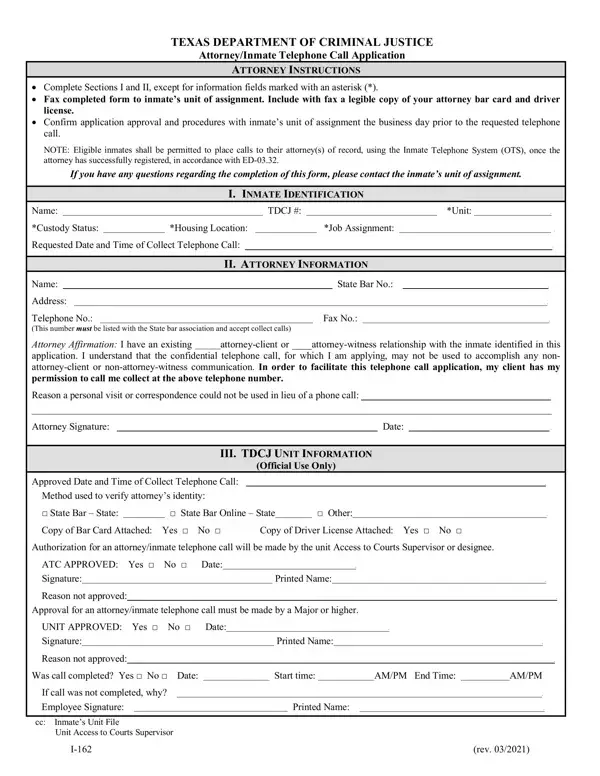
Include with email a legible copy of your state bar card/United States Department of State Identification Card and a valid government issued ID which includes a photograph.
Before the call: confirm application approval and procedures with inmate's unit of assignment the business day prior to the requested telephone call.
Section I: complete it, except for information fields marked with an asterisk (*).
Designated representative: the telephone number must be listed on the I-164.
Eligible inmates: shall be permitted to place calls to their attorney(s) of record, using the Inmate Telephone System, once the attorney has successfully registered.
| Question | Answer |
|---|---|
| Form Name | I-162 |
| Form Length | 2 pages |
| Fillable? | Yes |
| Fillable fields | 19 |
| Avg. time to fill out | 4 min |
| Other names | I-162, I162, I 162, Form I-162, TDCJ I-162, Attorney, Consul, or Designated Representative/Inmate Telephone Call Request |
| Edition | 11/2025 |
| Issuing agency | Texas Department of Criminal Justice |
| Where to send | Email completed form to inmate's unit of assignment |
| Official source | I-162 (Rev 11/2025), Texas Department of Criminal Justice |
I-162 Form isn’t the one you’re looking for?