
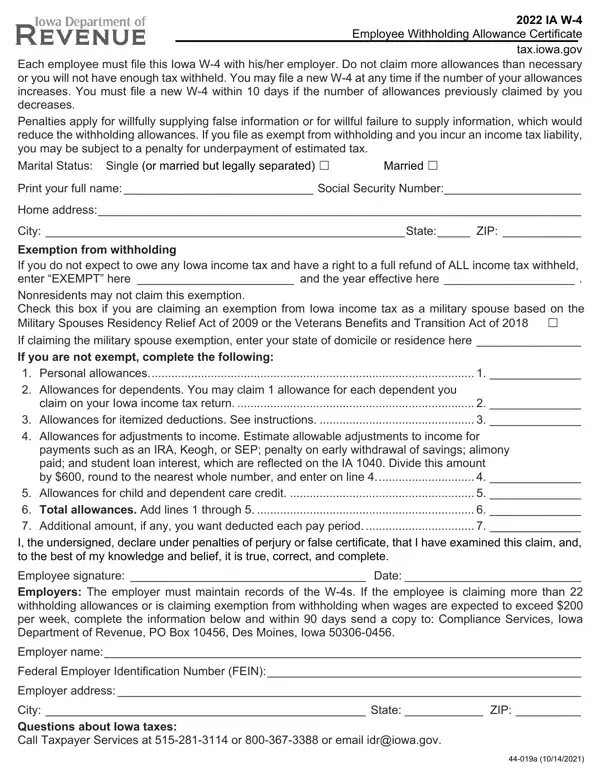

IA W-4 at a glance
What it is: The 2026 IA W-4 is the Employee Withholding Allowance Certificate.
Who signs: Employee signature and Date.
Each employee must file this IA W-4 with their employer.
A filled-in IA W-4 example: a single employee fills out the IA W-4
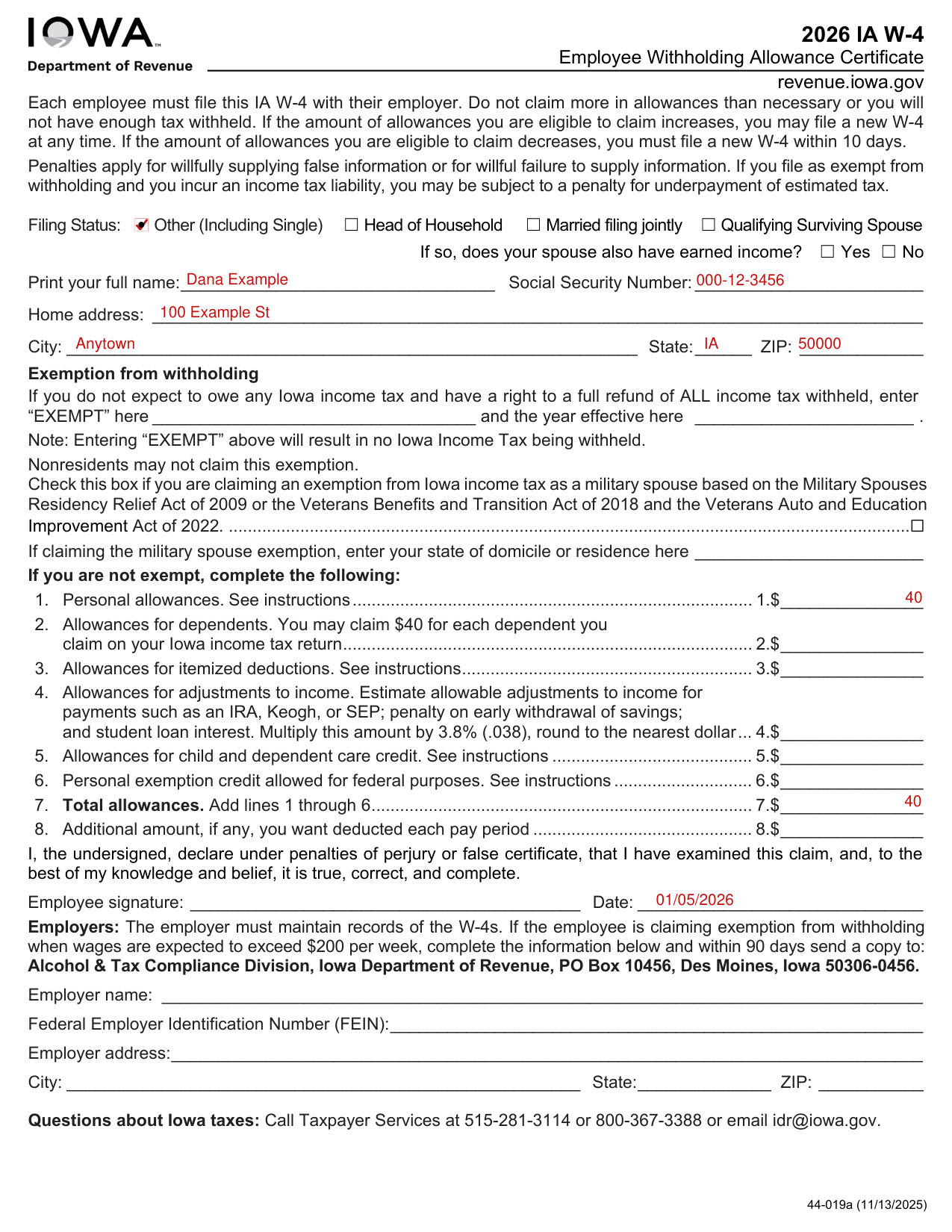
How to fill out IA W-4, box by box
Filing Status

Select the applicable filing status: Other (Including Single), Head of Household, Married filing jointly or Qualifying Surviving Spouse.
“Other” includes taxpayers who use the single filing status, Married filing separately, or married taxpayers wanting to withhold as a taxpayer with a filing status of Single.
“Married filing jointly” includes taxpayers who are married filing jointly and qualified surviving spouses.
If you select “Married filing jointly” and also select “Yes” for your spouse having earned income, the withholding calculation will be completed as if you are using filing status single. This means the deduction for taxpayers using the filing status single will be used in the calculation. If your spouse selects both of those selections on their IA W-4, their withholding will be calculated in the same way.
If you do not wish to have the withholding calculation done using the single deduction, you should select “Married filing jointly” and also select “No” for your spouse having earned income.
Name and home address
Print your full name and Social Security Number, then the home address, City, State and ZIP.
Exemption from withholding
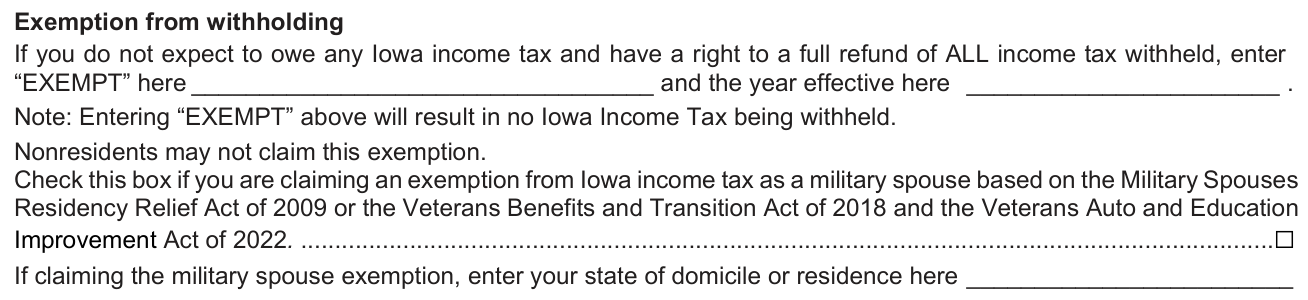
If you do not expect to owe any Iowa income tax and have a right to a full refund of ALL income tax withheld, enter “EXEMPT” here and the year effective here. Entering “EXEMPT” will result in no Iowa Income Tax being withheld. Nonresidents may not claim this exemption.
Claim exemption from withholding if you are an Iowa resident and both of the following situations apply: (1) for 2025 you had a right to a refund of all Iowa income tax withheld because you had no tax liability, and, (2) for 2026 you expect a refund of all Iowa income tax withheld because you expect to have no Iowa tax liability.
You must complete a new W-4 within 10 days from the day you anticipate you will incur an Iowa income tax liability for the calendar year (or your fiscal year).
If you want to claim an exemption from withholding next year, you must file a new W-4 with your employer on or before February 15.
Military personnel in active duty status, as defined in Title 10 of the U.S. Code, are exempt from withholding.
Check this box if you are claiming an exemption from Iowa income tax as a military spouse based on the Military Spouses Residency Relief Act of 2009 or the Veterans Benefits and Transition Act of 2018 and the Veterans Auto and Education Improvement Act of 2022. If claiming the military spouse exemption, enter your state of domicile or residence here.
If you claim this exemption, check the appropriate box, enter the state other than Iowa you are claiming as your state of domicile or residence, and include a copy of your spousal military identification card to the IA W-4 provided to your employer.
Personal allowances and allowances for dependents

If you are not exempt, complete the following:
Line 1. Personal allowances: You can claim the following personal allowances: $40 allowance for yourself or $80 allowance if you are unmarried and eligible to claim head of household status (checked October 20, 2026).
Add $20 additional allowance if you are 65 or older, and $20 additional allowance if you are blind (checked October 20, 2026).
If you are married and your spouse either does not work or is not claiming allowances on a separate W-4, you may claim the following allowances for them: $40 for your spouse, $20 additional allowance if your spouse is 65 or older, and $20 additional allowance if your spouse is blind (checked October 20, 2026).
To have the highest amount of tax withheld claim "$0" on line 1 (checked October 20, 2026).
Line 2. Allowances for dependents. You may claim $40 for each dependent you claim on your Iowa income tax return (checked October 20, 2026).
Allowances for itemized deductions and adjustments to income

Line 3. Allowances for itemized deductions: (a) Enter total amount of estimated federal itemized deductions.
(b) Enter amount of your federal standard deduction using the following information: If single or married filing separate returns, enter $16,100; if unmarried head of household, enter $24,150; if married filing a joint return or qualifying surviving spouse, enter $32,200 (checked October 20, 2026). (c) Subtract line b from line a and enter the difference or zero, whichever is greater. (d) Multiply the amount on line (c) by 3.8% (.038), round to the nearest whole dollar and enter on line 3.
Line 4. Allowances for adjustments to income. Estimate allowable adjustments to income for payments such as an IRA, Keogh, or SEP; penalty on early withdrawal of savings; and student loan interest. Multiply this amount by 3.8% (.038), round to the nearest dollar.
Allowances for child and dependent care credit and personal exemption credit

Line 5. Allowances for child and dependent care credit: Persons having child/dependent care expenses qualifying for the federal and Iowa child and dependent care credit may claim additional Iowa withholding allowance amounts based on their total incomes.
Taxpayers with a total income of $90,000 or more cannot claim withholding allowances for the child and dependent care credit (checked October 20, 2026).
Total allowances for child and dependent care that you and your spouse may claim cannot exceed the total allowances shown on page 3. Iowa total income between $0 - $19,999 Allowances: $200; Iowa total income between $20,000 - $34,999 Allowances: $160; Iowa total income between $35,000 - $44,999 Allowances: $120; Iowa total income between $45,000 - $89,999 Allowances: $40 (checked October 20, 2026).
Line 6. Personal exemption credit allowed for federal purposes: For tax years beginning on or after January 1, 2025 taxpayers age 65 or older may be eligible for a personal exemption of up to $6,000 (checked October 20, 2026).
Multiply the amount of the estimated allowable federal personal exemption by 3.8% (.038), then round this amount to the nearest whole dollar. Report this amount on line 6.
Total allowances and additional amount

Line 7. Total allowances. Add lines 1 through 6.
Line 8. Additional amount, if any, you want deducted each pay period. Additional amount of withholding deducted: You may need to have additional tax withheld if you have more than one employer or are a nonresident alien.
Employee signature and date

The undersigned declares under penalties of perjury or false certificate that they have examined this claim and, to the best of their knowledge and belief, it is true, correct, and complete.
Employee signature and Date.
Employer name, FEIN and address
Employers: The employer must maintain records of the W-4s. If the employee is claiming exemption from withholding when wages are expected to exceed $200 per week (checked October 20, 2026), complete the employer name, Federal Employer Identification Number (FEIN), address, City, State and ZIP and within 90 days send a copy to: Alcohol & Tax Compliance Division, Iowa Department of Revenue, PO Box 10456, Des Moines, Iowa 50306-0456.
More rules for IA W-4
Do not claim more in allowances than necessary or you will not have enough tax withheld.
If the amount of allowances you are eligible to claim increases, you may file a new W-4 at any time. If the amount of allowances you are eligible to claim decreases, you must file a new W-4 within 10 days.
Questions about Iowa taxes: Call Taxpayer Services at 515-281-3114 or 800-367-3388 or email idr@iowa.gov.
IA W-4 Employee Withholding Allowance Certificate Instructions, page 1 44-019b (11/13/2025); page 2 44-019c (11/13/2025).
Common questions about IA W-4
Is there a penalty?
Penalties apply for willfully supplying false information or for willful failure to supply information. If you file as exempt from withholding and you incur an income tax liability, you may be subject to a penalty for underpayment of estimated tax.
Sources
[1] IA W-4 (11/13/2025), Employee Withholding Allowance Certificate, Iowa Department of Revenue (the Official source link on this page).