Please rate Irs Form 4421

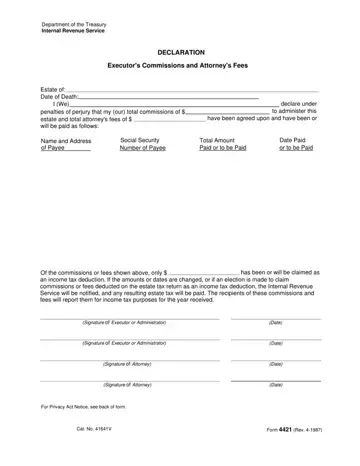
Understanding the complexities of the IRS Form 4421 can be essential for executors and administrators managing an estate. This form, officially titled as the Declaration for Executor's Commissions and Attorney's Fees, serves as a formal document through which the individuals responsible for managing an estate declare the total commissions and attorney's fees that have been or will be paid from the estate's assets. It requires a detailed listing, including the name and address of the payee, their Social Security Number, the total amount paid or to be paid, and the date of such payments. Form 4421 is significant not only because it outlines the payments agreed upon for administering the estate, but it also delineates which portion of these payments will be claimed as an income tax deduction. The form emphasizes the responsibility of the executor or administrator and the attorney to notify the Internal Revenue Service (IRS) of any changes in the reported amounts or dates, and highlights the implications of such changes for the estate tax. Additionally, the form serves as a reminder of the privacy protocols as stipulated by the Privacy Act of 1974, underlining the legal basis for information collection, the primary uses of the collected information, and the potential consequences of non-compliance. By completing this form, executors and administrators take a crucial step in complying with federal regulations, ensuring that the financial management of the estate is transparent and accountable.
| Question | Answer |
|---|---|
| Form Name | Irs Form 4421 |
| Form Length | 2 pages |
| Fillable? | No |
| Fillable fields | 0 |
| Avg. time to fill out | 30 sec |
| Other names | af form 724, af epubs, irs 4421 form, irs 4421 |
Irs Form 4421 isn’t the one you’re looking for?
Please rate Irs Form 4421