
Judge-Your-Neighbor Worksheet at a glance
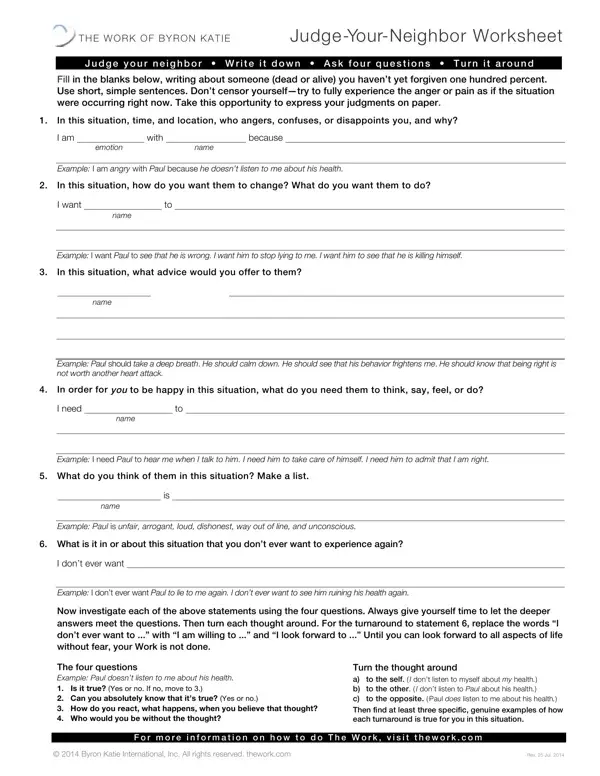
What it is: The Work of Byron Katie Judge-Your-Neighbor Worksheet.
A filled-in Judge-Your-Neighbor Worksheet example: a reader works through an argument
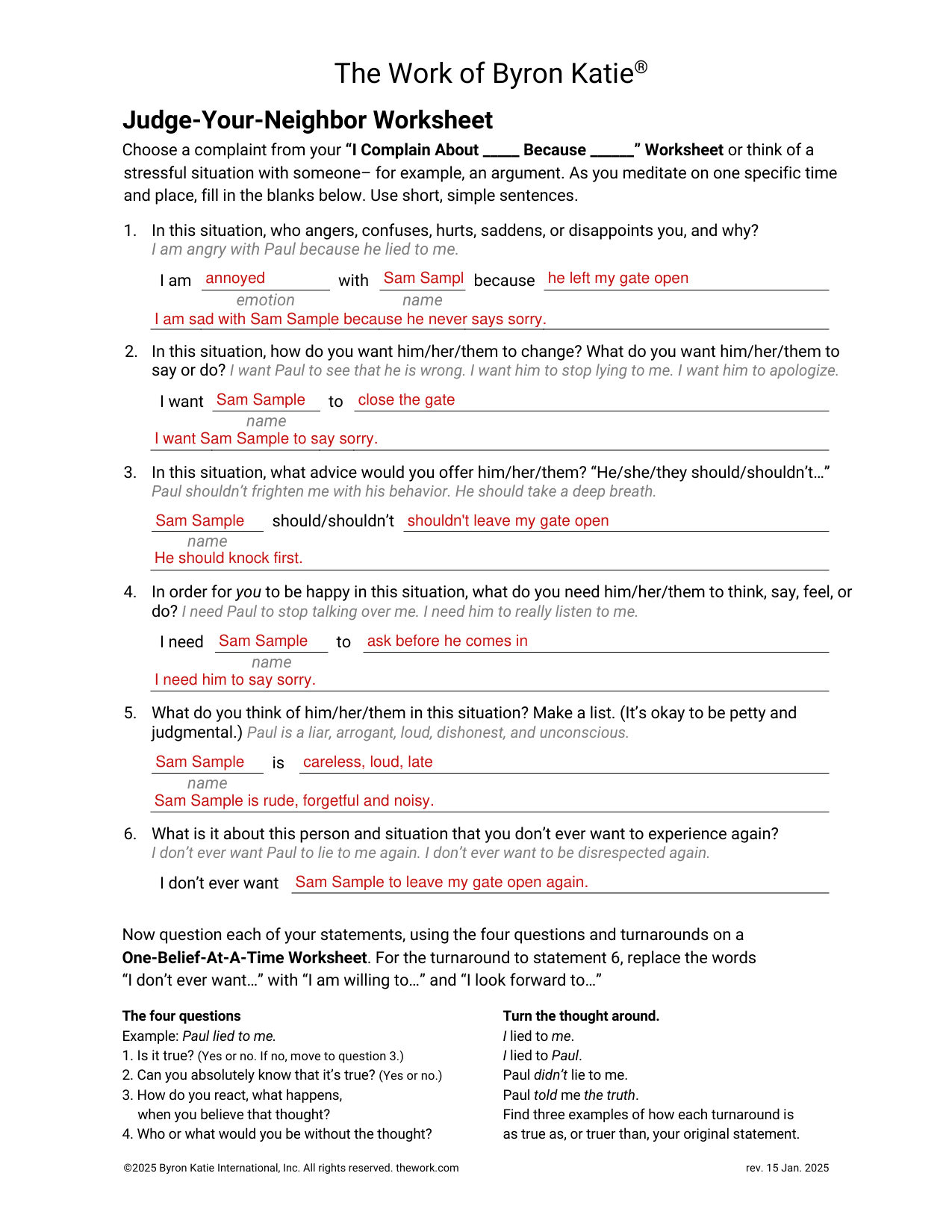
How to fill out Judge-Your-Neighbor Worksheet, box by box
1. In this situation, who angers, confuses, hurts, saddens, or disappoints you, and why?

In box 1, say who angers, confuses, hurts, saddens, or disappoints you, and why: I am (emotion) with (name) because.
2. In this situation, how do you want him/her/them to change?

In box 2, say how you want him/her/them to change, and what you want him/her/them to say or do.
3. In this situation, what advice would you offer him/her/them?

In box 3, say what advice you would offer him/her/them: “He/she/they should/shouldn't…” (name) should/shouldn't.
4. In order for you to be happy in this situation, what do you need him/her/them to think, say, feel, or do?

In box 4, say what you need him/her/them to think, say, feel, or do for you to be happy in this situation: I need (name) to.
5. What do you think of him/her/them in this situation?

In box 5, make a list of what you think of him/her/them in this situation: (name) is. It's okay to be petty and judgmental.
6. What is it about this person and situation that you don't ever want to experience again?

In box 6, say what it is about this person and situation that you don't ever want to experience again, after I don't ever want.
More rules for Judge-Your-Neighbor Worksheet
Now question each of your statements, using the four questions and turnarounds on a One-Belief-At-A-Time Worksheet. For the turnaround to statement 6, replace the words “I don't ever want…” with “I am willing to…” and “I look forward to…”
The four questions: 1. Is it true? (Yes or no. If no, move to question 3.) 2. Can you absolutely know that it's true? (Yes or no.) 3. How do you react, what happens, when you believe that thought? 4. Who or what would you be without the thought?
Turn the thought around. Find three examples of how each turnaround is as true as, or truer than, your original statement.
Before you go
Choose a complaint from your “I Complain About _____ Because ______” Worksheet or think of a stressful situation with someone, for example an argument. As you meditate on one specific time and place, fill in the blanks. Use short, simple sentences.
Sources
[1] Judge-Your-Neighbor Worksheet (rev. 15 Jan. 2025), The Work of Byron Katie (the Official source link on this page).