
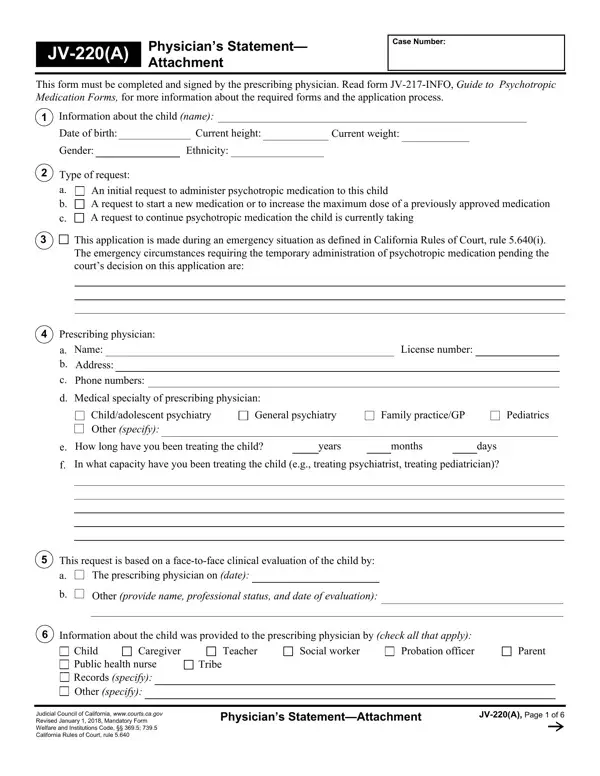

Form JV-220(A) at a glance
What it is: Form JV-220(A) is the Physician's Statement-Attachment.
Who signs: This form must be completed and signed by the prescribing physician. Read form JV-217-INFO, Guide to Psychotropic Medication Forms, for more information about the required forms and the application process.
What to bring and attach to Form JV-220(A)
Mandatory Information Attached: Significant side effects, warnings/contraindications, drug interactions (including those with continuing psychotropic medication and all nonpsychotropic medication currently taken by the child), and withdrawal symptoms for each recommended medication are included in the attached material.
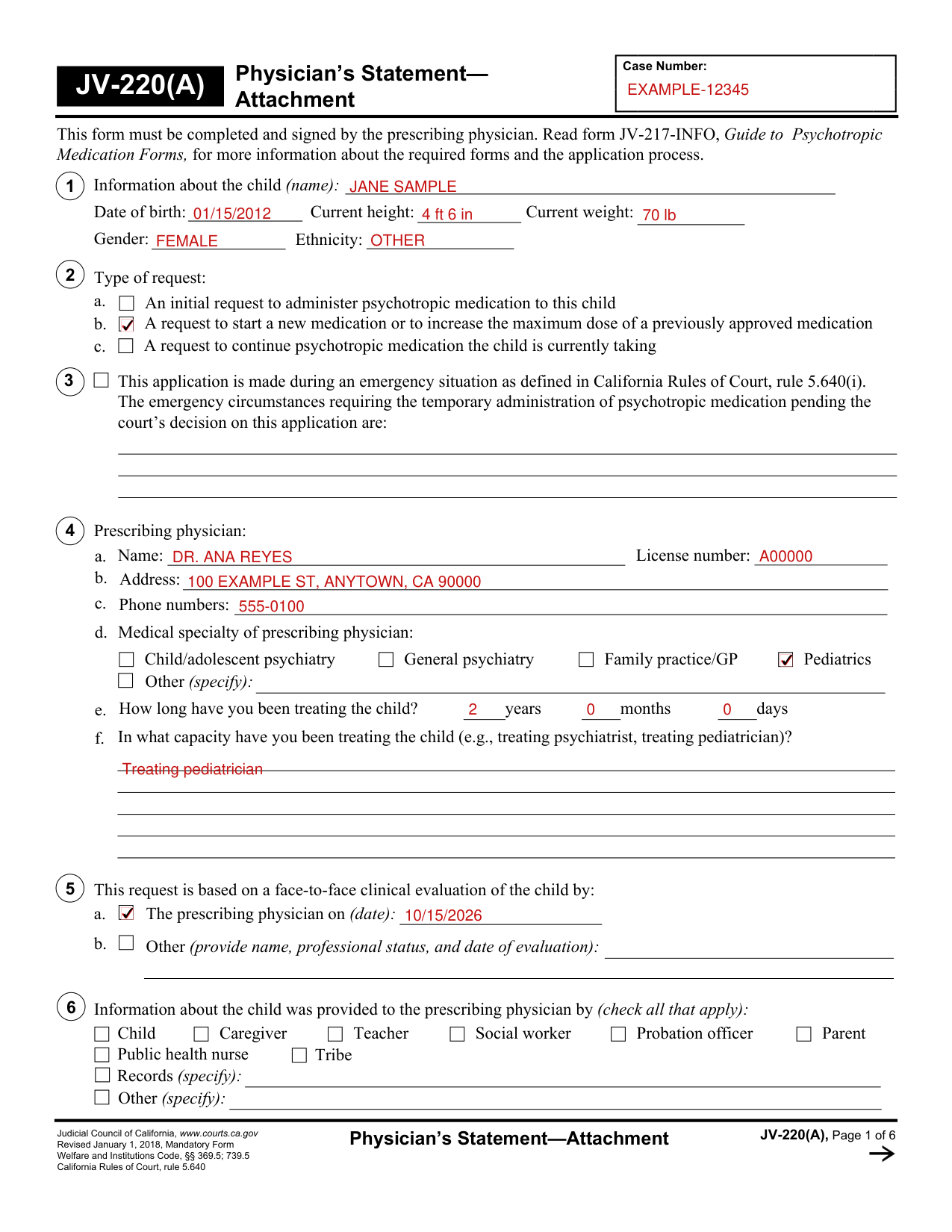
A filled-in Form JV-220(A) example: a pediatrician asks to start a new medication
How to fill out Form JV-220(A), box by box
Information about the child
Enter the Information about the child (name), Date of birth, Current height, Current weight, Gender and Ethnicity.
Type of request and emergency
Type of request: An initial request to administer psychotropic medication to this child; A request to start a new medication or to increase the maximum dose of a previously approved medication; A request to continue psychotropic medication the child is currently taking.
This application is made during an emergency situation as defined in California Rules of Court, rule 5.640(i). The emergency circumstances requiring the temporary administration of psychotropic medication pending the court's decision on this application are:
The prescribing physician
Under Prescribing physician, enter the Name, License number, Address and Phone numbers.
Medical specialty of prescribing physician: Child/adolescent psychiatry General psychiatry Family practice/GP Pediatrics Other (specify):
How long have you been treating the child? years months days In what capacity have you been treating the child (e.g., treating psychiatrist, treating pediatrician)?
The evaluation and who provided information about the child
This request is based on a face-to-face clinical evaluation of the child by: The prescribing physician on (date): Other (provide name, professional status, and date of evaluation):
Information about the child was provided to the prescribing physician by (check all that apply): Child Caregiver Teacher Social worker Probation officer Parent Public health nurse Tribe Other (specify): Records (specify):
Mental health, symptoms and response to medication
Provide to the court your assessment of the child's overall mental health. I don't know.
Describe the child's symptoms, including duration, and the child's treatment plan.
Describe the child's response to any current psychotropic medication.
Describe the symptoms not alleviated or ameliorated by other current or past treatment efforts.
Treatment alternatives, past medications and diagnoses
Have nonpharmacological treatment alternatives to the proposed medications been tried in the last six months? Yes No I don't know. If yes, describe the treatment and the child's response. If no, explain why not. Have other pharmacological treatment alternatives to the proposed medications been tried in the last six months? Yes No I don't know. If yes, describe the treatment and the child's response. If no, explain why not.
List the psychotropic medications that you know were taken by the child in the past and the reason or reasons these were stopped if the reasons are known to you. Medication name (generic or brand) Reason for stopping
Diagnoses from Diagnostic and Statistical Manual of Mental Disorders, Fifth Edition (DSM-5):
Medical history and laboratory tests
Relevant medical history (describe, specifying significant medical conditions, all current nonpsychotropic medications, date of last physical examination, and any recent abnormal laboratory results): I don't know.
All essential laboratory tests were performed. All essential laboratory tests were not performed (explain what laboratory tests were not done and why).
Informing the child
The child was told in an age-appropriate manner about the recommended medications, the anticipated benefits, the possible side effects, and that a request to the court for permission to begin and/or continue the medication will be made and that he or she may oppose the request. The child's response was agreeable not agreeable Briefly describe child's response:
The child has not been informed of this request, the recommended medications, their anticipated benefits, and their possible adverse reactions because: The child lacks the capacity to provide a response (explain): other (explain):
Therapeutic services
Therapeutic services, other than medication, in which the child is enrolled in or is recommended to participate during the next six months (check all that apply; include frequency for therapy on blank line).
Group therapy. Individual therapy. Milieu therapy (explain). Therapeutic Behavioral Services (TBS). Therapy for children on the autism spectrum. Art therapy. Cognitive behavioral therapy (CBT). Wraparound services.
American Indian/Alaska Native healing and cultural traditions. Speech therapy. In Home Behavioral Services (IHBS). Other modality (explain).
Informing the caregiver and the medication plan
The caregiver was informed of the mandatory information, which is attached. The caregiver's response was agreeable other (explain):
Enter additional information regarding medication treatment plan and follow-up.
The medications to begin, continue or stop
List all psychotropic medications currently administered that you propose to continue and all psychotropic medications you propose to begin administering. Mark each psychotropic medication as New (N) or Continuing (C).
Medication name (generic/brand) and class, and symptoms targeted by each medication's anticipated benefit to child. Maximum total mg/day. Treatment duration* 6-month maximum. *Authorization to administer the medication is limited to this time frame or six months from the date the order is issued, whichever occurs first.
Administration schedule: Initial and target schedule for new medication; Current schedule for continuing medication; Provide mg/dose and # of doses/day; If PRN, provide conditions and parameters for use
Enter other information about the prescribed medication that you want the court to know (e.g., reasons for prescribing more than one medication in a class, prescribing outside the approved range, or prescribing medication not approved for a child of this age).
List all psychotropic medications currently administered that will be stopped if this application is granted. Medication name (generic or brand) Reason for stopping Stop immediately or over period of time? (specify, including time)
Signing
Type or print name of prescribing physician. Signature of prescribing physician. Date:
Sources
[1] Form JV-220(A) (Revised January 1, 2018), Physician's Statement-Attachment, Judicial Council of California (the Official source link on this page).