
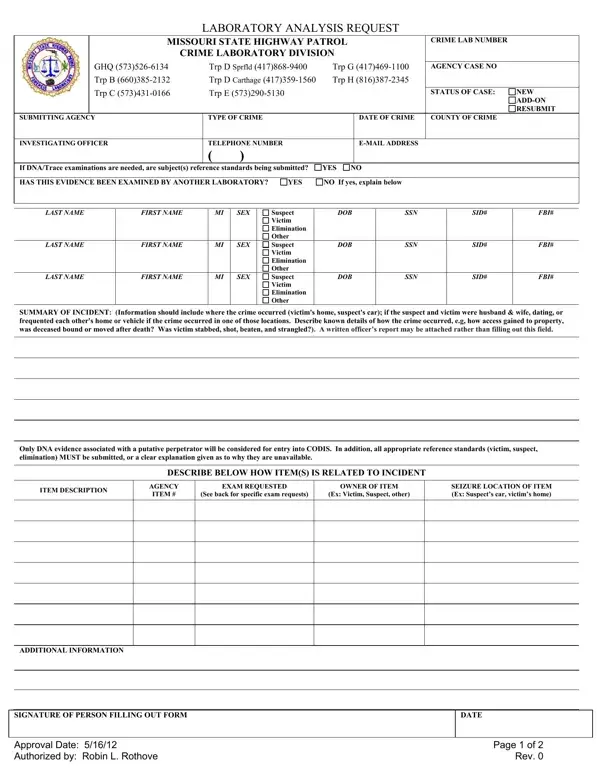

Laboratory Analysis Request at a glance
What it is: The Laboratory Analysis Request is a form of the Missouri State Highway Patrol Crime Laboratory Division.
Who signs: The person filling out the form signs.
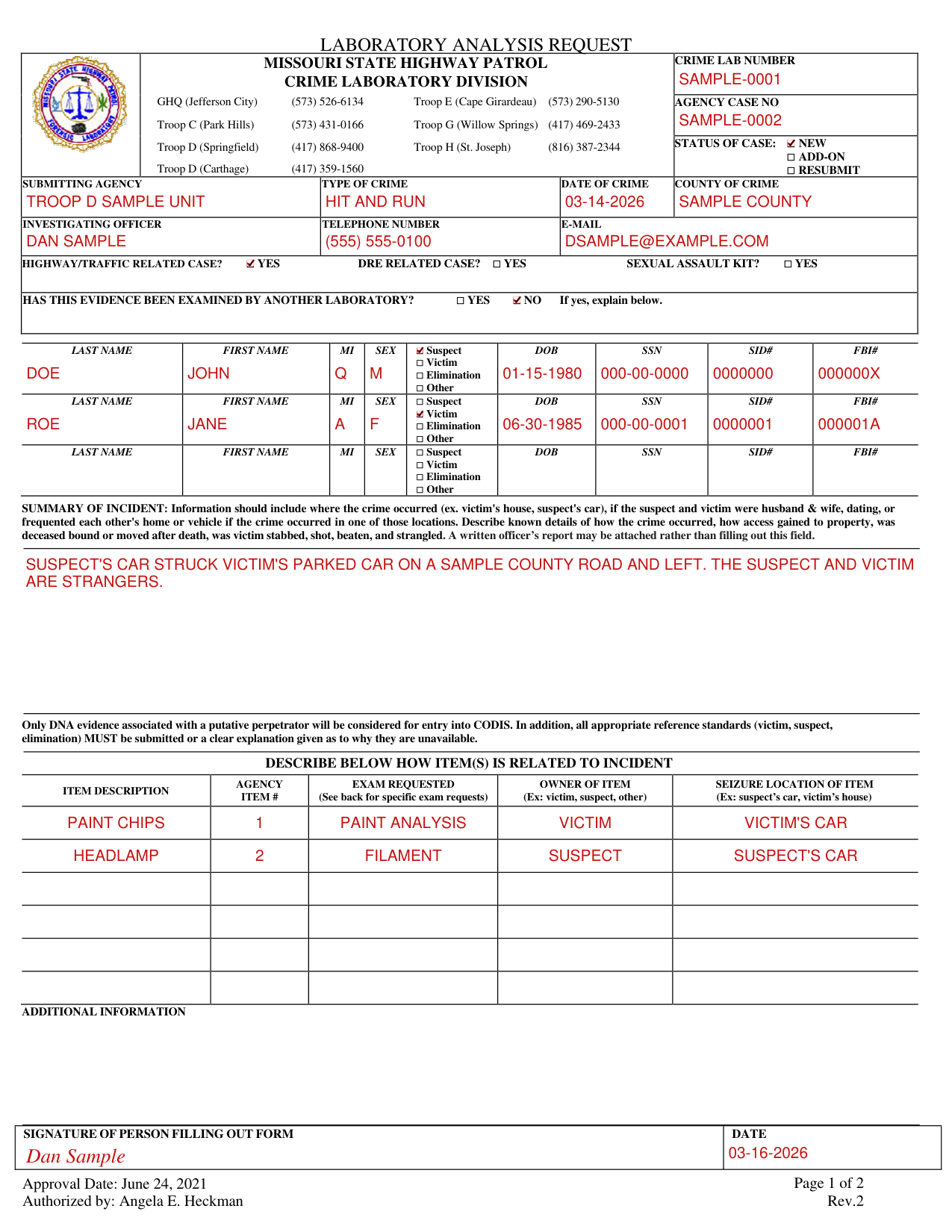
A filled-in Laboratory Analysis Request example: a trooper submits paint chips and a headlamp
How to fill out Laboratory Analysis Request, box by box
Crime lab number, agency case no and status of case

Enter the CRIME LAB NUMBER and the AGENCY CASE NO.
Under STATUS OF CASE, mark NEW, ADD-ON or RESUBMIT.
Submitting agency, type of crime and investigating officer

Enter the SUBMITTING AGENCY, TYPE OF CRIME, DATE OF CRIME and COUNTY OF CRIME.
Enter the INVESTIGATING OFFICER, TELEPHONE NUMBER and E-MAIL.
Highway/traffic related case, DRE related case and sexual assault kit

Mark YES for HIGHWAY/TRAFFIC RELATED CASE?, DRE RELATED CASE? or SEXUAL ASSAULT KIT? if yes.
Has this evidence been examined by another laboratory

Mark YES or NO for "Has this evidence been examined by another laboratory?" If yes, explain in the "If yes, explain below" box.
Last name, first name, MI, sex, suspect, victim, elimination and other

Enter the LAST NAME, FIRST NAME, MI and SEX, and mark Suspect, Victim, Elimination or Other.
Enter the DOB, SSN, SID# and FBI#.
Only DNA evidence associated with a putative perpetrator will be considered for entry into CODIS. In addition, all appropriate reference standards (victim, suspect, elimination) MUST be submitted or a clear explanation given as to why they are unavailable.
Summary of incident
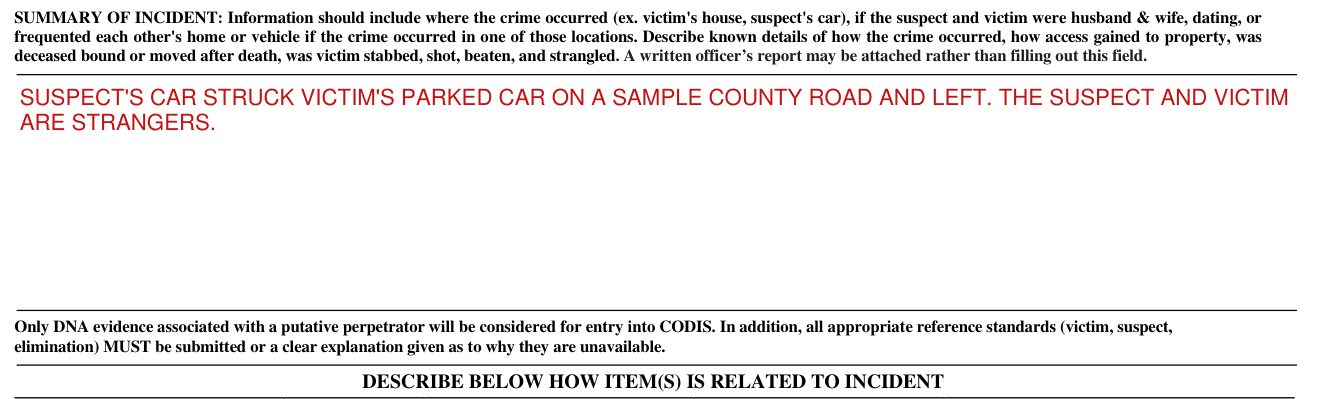
Information in the SUMMARY OF INCIDENT should include where the crime occurred (ex. victim's house, suspect's car), if the suspect and victim were husband & wife, dating, or frequented each other's home or vehicle if the crime occurred in one of those locations. Describe known details of how the crime occurred, how access gained to property, was deceased bound or moved after death, was victim stabbed, shot, beaten, and strangled. A written officer's report may be attached rather than filling out this field.
Item description, exam requested, owner of item and seizure location of item
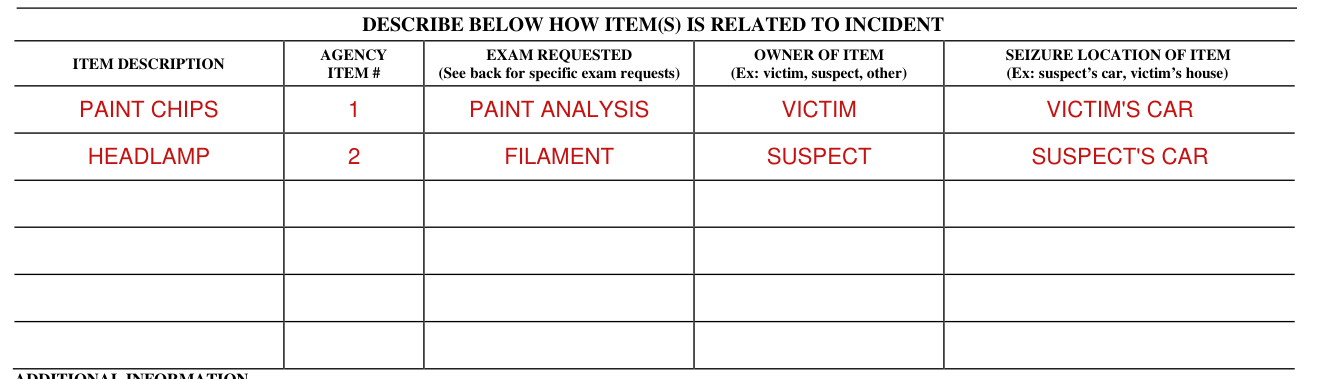
Describe how the item(s) is related to the incident.
Enter the ITEM DESCRIPTION and the AGENCY ITEM #.
Under EXAM REQUESTED, see back for specific exam requests.
Enter the OWNER OF ITEM (Ex: victim, suspect, other).
Enter the SEIZURE LOCATION OF ITEM (Ex: suspect's car, victim's house).
Signature of person filling out form and date

Sign on the SIGNATURE OF PERSON FILLING OUT FORM line and enter the DATE.
More rules for Laboratory Analysis Request
The CRIME LABORATORY DIVISION lists GHQ (Jefferson City) (573) 526-6134, Troop E (Cape Girardeau) (573) 290-5130, Troop C (Park Hills) (573) 431-0166, Troop G (Willow Springs) (417) 469-2433, Troop D (Springfield) (417) 868-9400, Troop H (St. Joseph) (816) 387-2344 and Troop D (Carthage) (417) 359-1560.
If your situation is different
DNA
DNA Analysis: items from a crime scene and/or subject that does not require analysis for biological fluid stains (ex. blood/semen detection).
Blood Detection and Semen Detection: items to be examined for the presence of blood or semen that will be tested for DNA.
Drug Chemistry
Drug Analysis: items suspected of containing a controlled substance (excluding cannabis).
Marihuana Analysis: items suspected of containing cannabis.
Firearms/Toolmarks
Firearm/Ammunition Examination: firearm examinations and comparisons of ammunition components.
Tool Mark Examination: comparison of tools to toolmarks.
Serial Number Restoration: items with serial numbers to be restored.
Impression
Impression (tire/footwear examination): examination of tire/footwear impressions.
Latent Prints
Fingerprint (processing): items to be processed for latent prints. Latent comparisons and/or database searches are assumed if latent prints of value are developed.
Fingerprint (latent comparison): comparisons of latent prints developed at the scene with known exemplars. Database searches are assumed if manual comparisons with known exemplars yield negative results or no known subjects are listed.
Postmortem Identification: comparisons and/or database searches of postmortem prints.
AFIS Entry: latent prints to be searched through AFIS and/or NGI databases. This is to be selected only for GHQ lab by agencies who employ latent print examiners to conduct manual comparisons with generated candidate(s).
Toxicology
Blood Alcohol Analysis: blood products to be analyzed for volatiles (i.e., ethanol).
Urine Drug Analysis: urine samples to be analyzed for drugs.
Blood Drug Analysis: blood products to be analyzed for drugs.
Alcoholic Beverage Analysis: non-biological liquids to be analyzed for alcohol content.
Trace Evidence
Fracture Match (broken/torn): broken or torn items to determine if originally one piece.
Glass (processing/analysis): detection and comparison of glass standards and questioned glass particles from shoes, clothes, or other sources.
Gunshot Residue Kit Analysis: kits taken from hands or other surfaces. Kits from shooting victims are not routinely analyzed.
Gunshot Residue (except kits): items that need to be sampled for the presence of gunshot residue. Clothing is typically limited to gloves, long sleeve shirts, and jackets.
Filament (on/off in accident)
Lamps from automobiles and boats to determine if on/off at the time of accident.
Flammable (fire investigation)
Identification of flammable liquids/residues on fire debris.
Substance ID (unknown/tampering)
Substances suspected of being harmful or causing property damage that may be found in beverages, food, mail, or on damaged property.
Explosives Analysis
Identification of explosives from pre-blast and post-blast items.
Paint Analysis
Comparison of paint standards and transfers that may arise from a hit and run, burglary, or other incidents.
Soil (processing/examination)
Detection, identification, and comparison of soil standards and questioned soil samples from shoes, clothes, or other sources.
Physical Characteristics Comparison
Comparison of items such as tape, wood, plastics and other miscellaneous materials.
Hair (with DNA)
Items requiring DNA examinations that may need subsequent examinations for hair.
Hair/Fiber (Trace exams only)
Trace exams only: detection, identification, and comparison of hairs/fibers from tape lifts, shoes, clothes, or other sources. DNA exams will subsequently be performed on hair if possible or necessary.
Sources
[1] Laboratory Analysis Request (Rev.2, approval date June 24, 2021), Missouri State Highway Patrol Crime Laboratory Division (the Official source link on this page).