
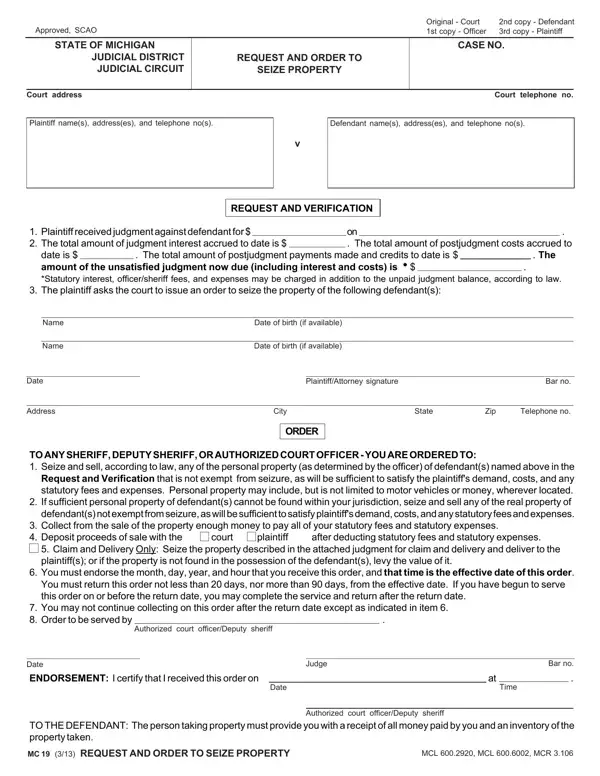
Form MC 19 at a glance
What it is: SCAO Form MC 19 is the REQUEST AND ORDER TO SEIZE PROPERTY of the STATE OF MICHIGAN.
Who signs: Sign the Plaintiff/Attorney signature, and enter the Date, the Bar no., and the Address, City, State, Zip and Telephone no.
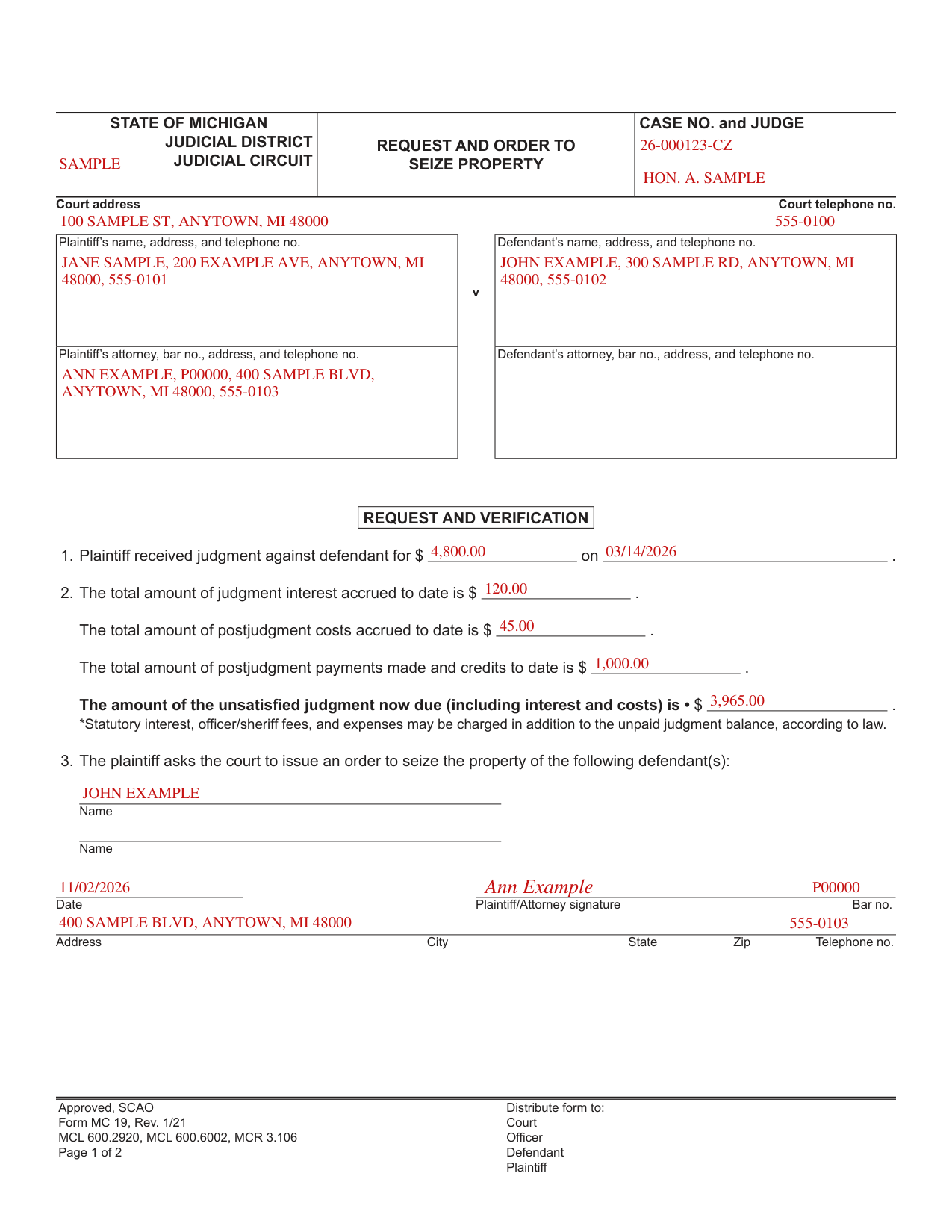
A filled-in Form MC 19 example: an attorney requests an order to seize property
How to fill out Form MC 19, box by box
Court, CASE NO. and JUDGE, Plaintiff and Defendant
Enter the CASE NO. and JUDGE, the JUDICIAL DISTRICT or JUDICIAL CIRCUIT, the Court address and the Court telephone no.
Enter the Plaintiff's name, address, and telephone no. and the Defendant's name, address, and telephone no.
Enter the Plaintiff's attorney, bar no., address, and telephone no. and the Defendant's attorney, bar no., address, and telephone no.
REQUEST AND VERIFICATION
In the REQUEST AND VERIFICATION, box 1, enter: Plaintiff received judgment against defendant for $ on .
In box 2, enter the total amount of judgment interest accrued to date.
Enter the total amount of postjudgment costs accrued to date.
Enter the total amount of postjudgment payments made and credits to date.
Enter the amount of the unsatisfied judgment now due (including interest and costs). Statutory interest, officer/sheriff fees, and expenses may be charged in addition to the unpaid judgment balance, according to law.
The plaintiff asks the court to seize the property
In box 3, the plaintiff asks the court to issue an order to seize the property of the following defendant(s); write each defendant's Name.
Sign the Plaintiff/Attorney signature, and enter the Date, the Bar no., and the Address, City, State, Zip and Telephone no.
Deposit proceeds of sale
To the sheriff, deputy sheriff or authorized court officer: deposit proceeds of sale with the court or plaintiff after deducting statutory fees and statutory expenses.
Claim and Delivery Only
To the sheriff, deputy sheriff or authorized court officer, for Claim and Delivery Only: seize the property described in the attached judgment for claim and delivery and deliver to the plaintiff(s); or if the property is not found in the possession of the defendant(s), levy the value of it.
Order to be served by
Order to be served by the Authorized court officer/Deputy sheriff.
ORDER: Judge signature and date.
ENDORSEMENT
The authorized court officer or deputy sheriff must endorse the month, day, year, and hour that the officer receives this order, and that time is the effective date of this order.
ENDORSEMENT: "I certify that I received this order on" the Date and time, for the Authorized court officer/Deputy sheriff.
More rules for Form MC 19
Distribute form to: Court, Officer, Defendant, Plaintiff.
To any sheriff, deputy sheriff, or authorized court officer, you are ordered to: seize and sell, according to law, any of the personal property (as determined by the officer) of defendant(s) named in the Request and Verification that is not exempt from seizure, as will be sufficient to satisfy the plaintiff's demand, costs, and any statutory fees and expenses.
Personal property may include, but is not limited to motor vehicles or money, wherever located.
If sufficient personal property of defendant(s) cannot be found within your jurisdiction, seize and sell any of the real property of defendant(s) not exempt from seizure, as will be sufficient to satisfy plaintiff's demand, costs, and any statutory fees and expenses.
Collect from the sale of the property enough money to pay all of your statutory fees and statutory expenses.
TO THE DEFENDANT: The person taking property must provide you with a receipt of all money paid by you and an inventory of the property taken. You may send the plaintiff a request to review postjudgment costs and fees.
Common questions about Form MC 19
Is there a deadline?
The authorized court officer or deputy sheriff must return this order not less than 20 days, nor more than 90 days, from the effective date. If the officer has begun to serve this order on or before the return date, the officer may complete the service and return after the return date. The officer may not continue collecting on this order after the return date except as indicated in item 6.
Sources
[1] SCAO Form MC 19 (Rev. 1/21), Request and Order to Seize Property, State of Michigan (the Official source link on this page).