
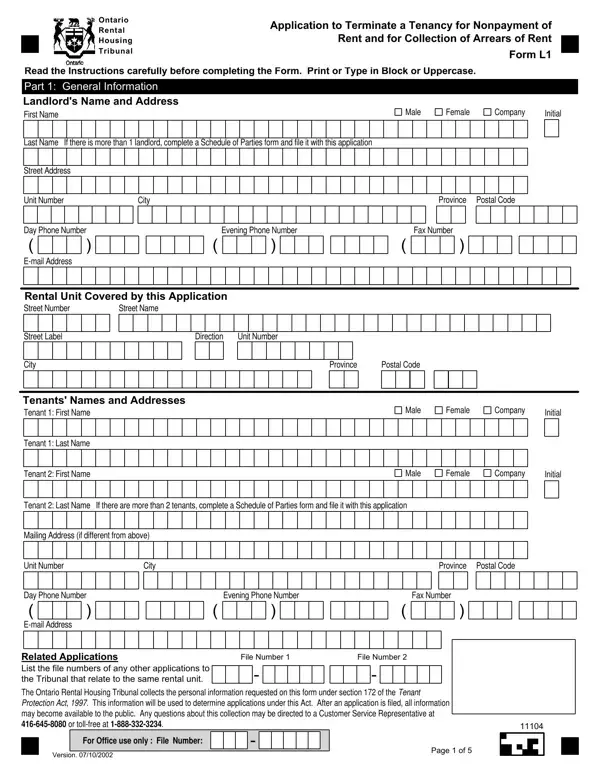
Form L1 at a glance
What it is: Landlords use Form L1 to apply for an order to end a tenancy and evict a tenant after they give the tenant an N4 Notice to End Your Tenancy for Non-payment of Rent.
Who signs: Who has signed the application? Shade the circle next to your answer. Landlord Legal Representative
What to bring and attach to Form L1
Have you included a copy of the N4 notice and a Certificate of Service for that notice with your application? You must include a copy of these two documents when you file your application; if you do not, your application will not be accepted. Be sure to keep copies of these documents for your records.
Also file a Certificate of Service showing how and when you served the tenant the N4 Notice.
A filled-in Form L1 example: a landlord claims three months of unpaid rent
How to fill out Form L1, box by box
Checklist
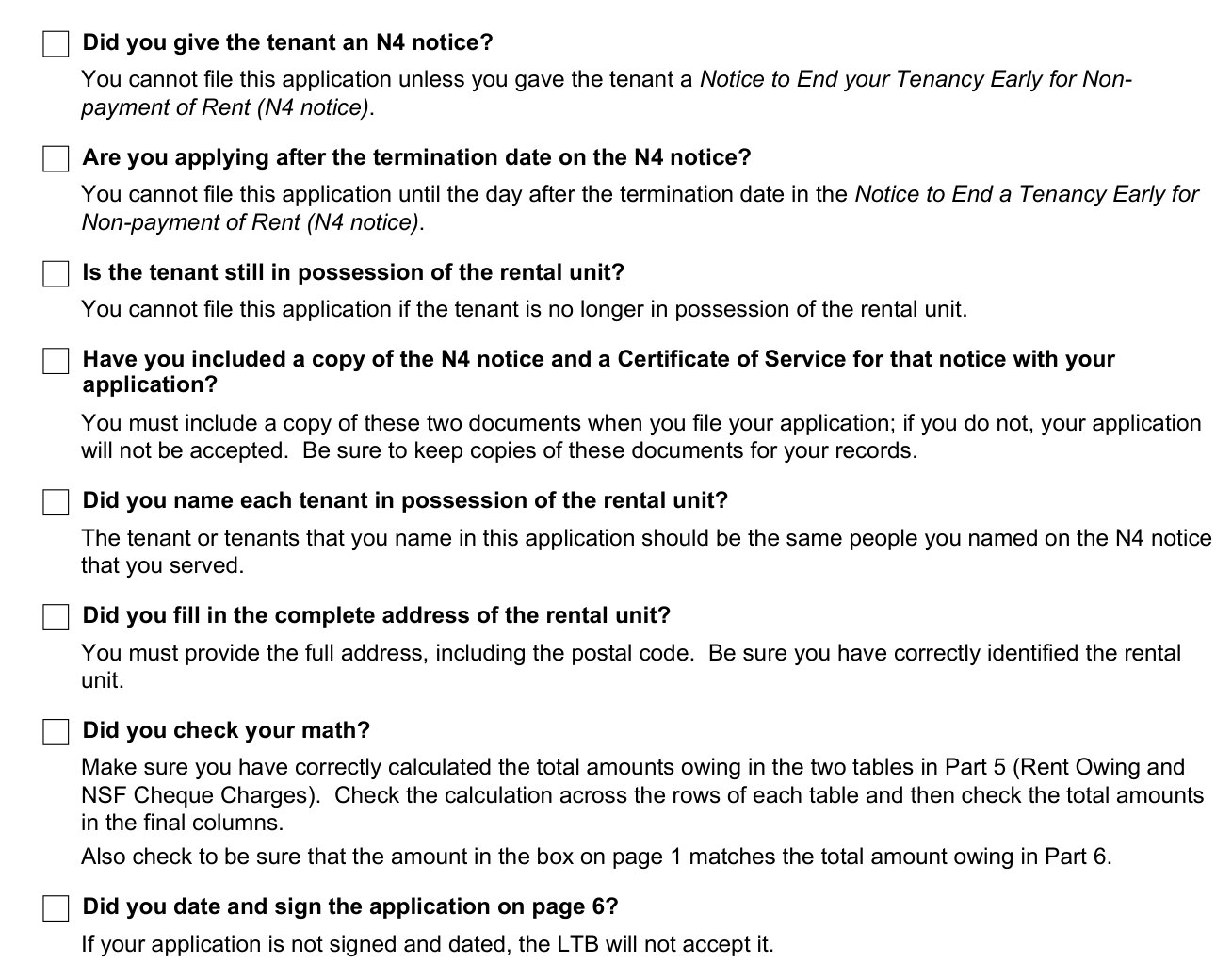
Before you file the attached application with the Landlord and Tenant Board, make sure you can answer YES to each of the following questions. If not, your application to the LTB may be dismissed, which means you may have to start over.
You cannot file this application unless you gave the tenant a Notice to End your Tenancy Early for Non-payment of Rent (N4 notice).
You cannot file this application until the day after the termination date in the Notice to End a Tenancy Early for Non-payment of Rent (N4 notice).
You cannot file this application if the tenant is no longer in possession of the rental unit.
The tenant or tenants that you name in this application should be the same people you named on the N4 notice that you served.
Do not include the checklist when you file the application.
Part 1: Address of the Rental Unit

You must provide the full address, including the postal code. Be sure you have correctly identified the rental unit.
Part 2: Total Amount

I believe that you owe me a total of $ as of (dd/mm/yyyy). This amount includes the filing fee for this application.
Part 3: Landlord's Name and Address
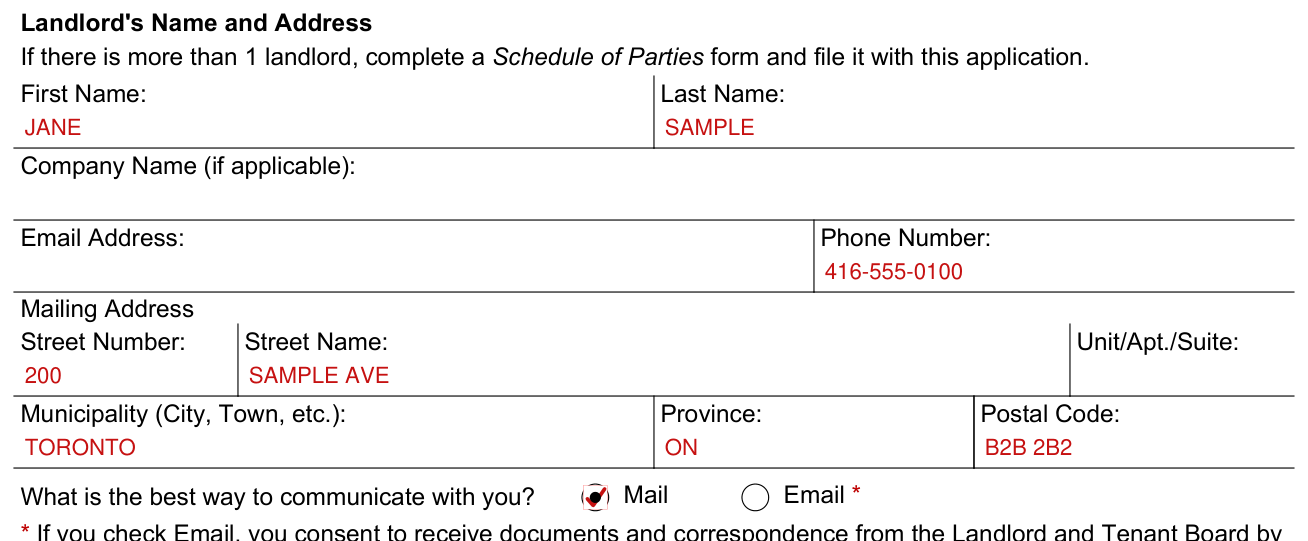
Print or type in capital letters in Mailing Address Street Number: Street Name: Unit/Apt./Suite:
If there is more than 1 landlord, complete a Schedule of Parties form and file it with this application.
What is the best way to communicate with you? Mail Email. If you check Email, you consent to receive documents and correspondence from the Landlord and Tenant Board by email.
Providing consent to email means that the LTB will communicate and send documents by email to all of the applicants.
Do not check the Email box if there are multiple applicants and some want to receive documents by regular mail instead of email.
Part 3: Tenant Names and Address
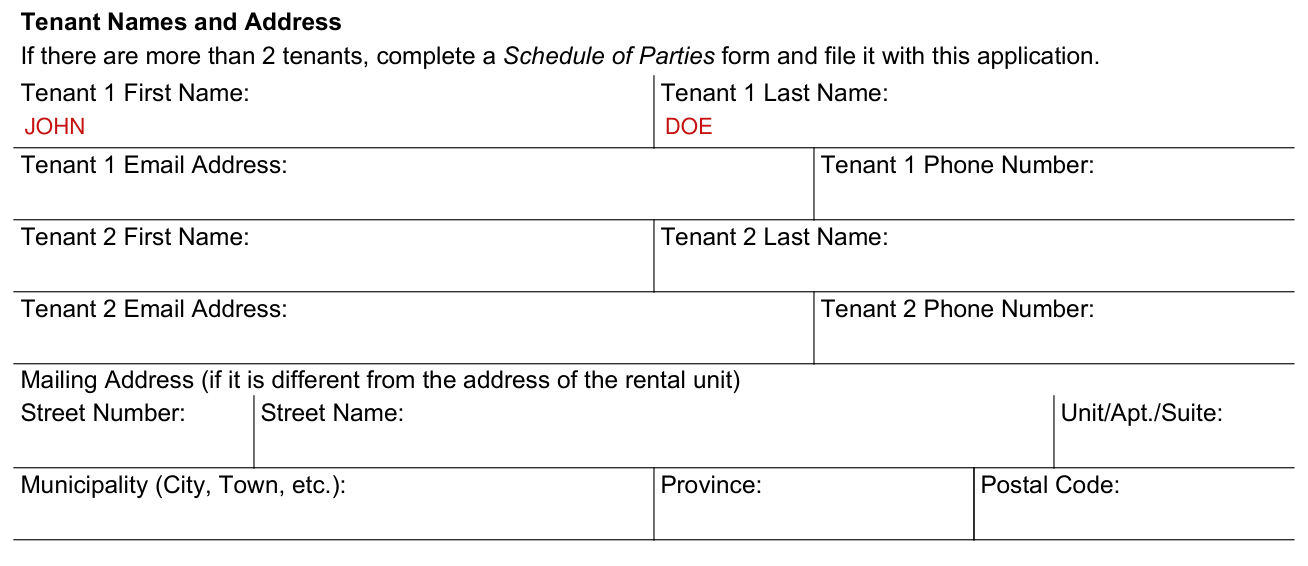
If there are more than 2 tenants, complete a Schedule of Parties form and file it with this application. Mailing Address (if it is different from the address of the rental unit) Street Number: Street Name: Unit/Apt./Suite:
Part 4: Reasons for your Application
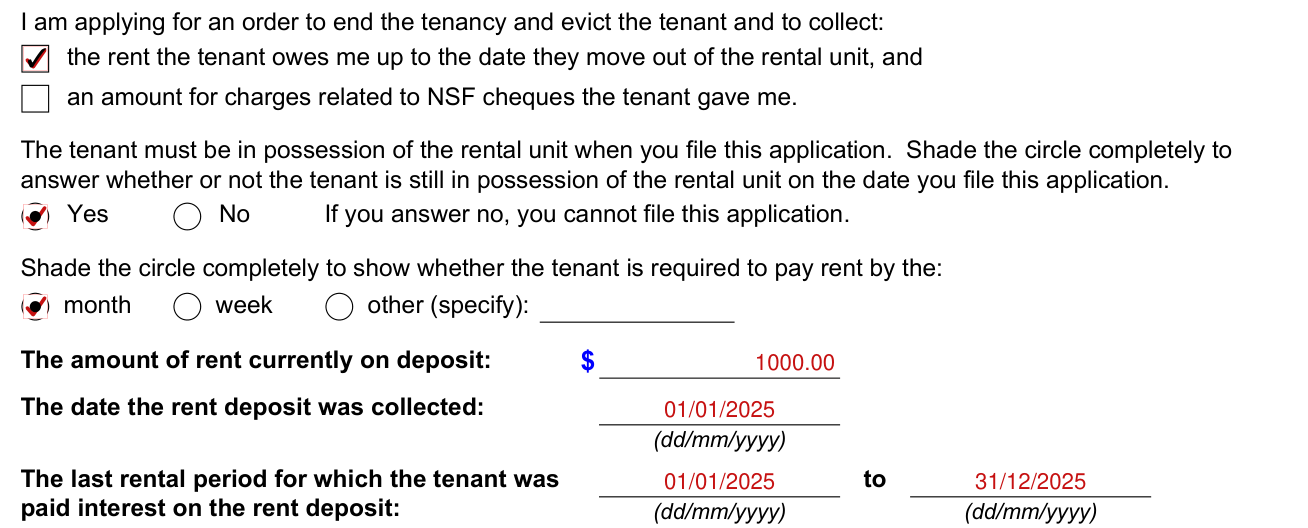
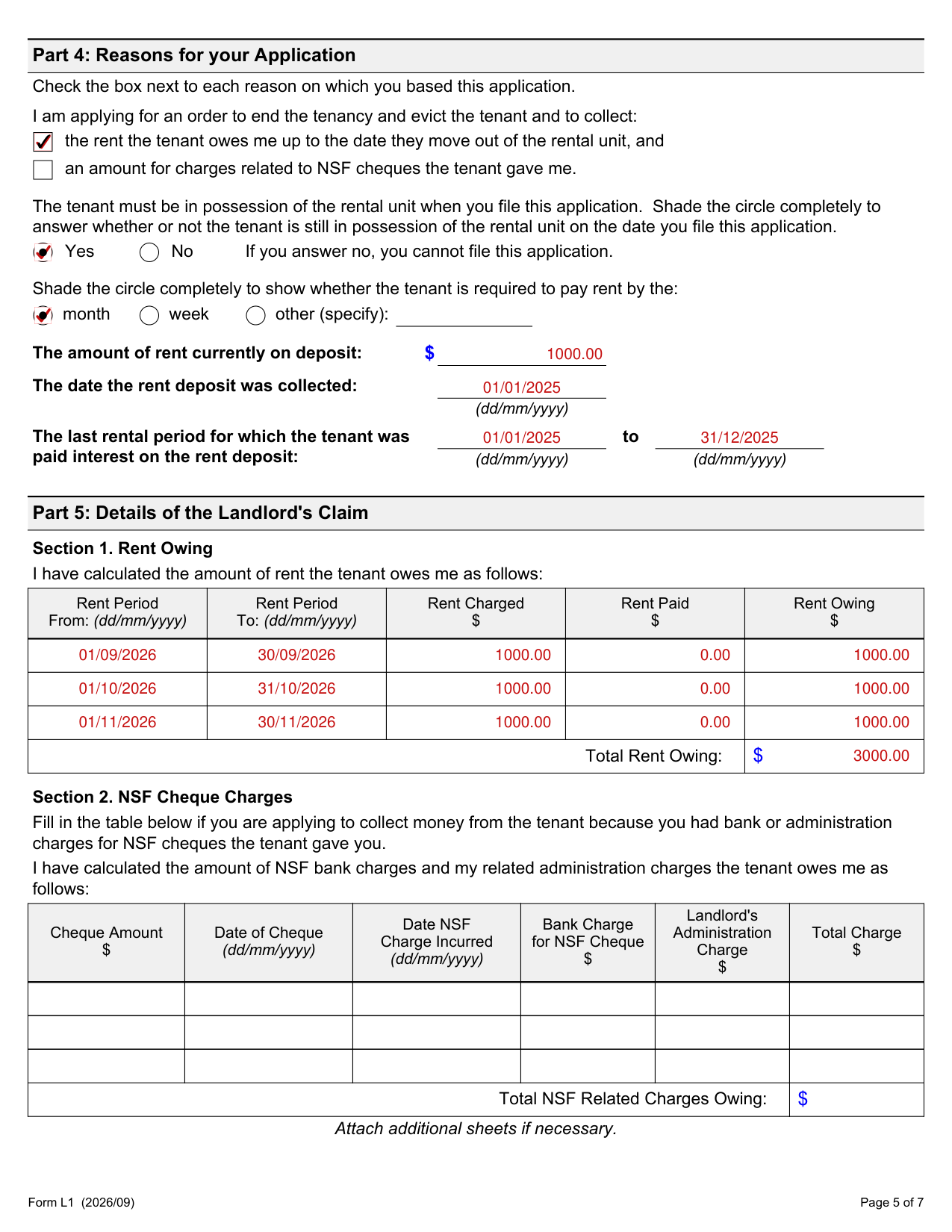
Check the box next to each reason on which you based this application.
I am applying for an order to end the tenancy and evict the tenant and to collect: the rent the tenant owes me up to the date they move out of the rental unit, and an amount for charges related to NSF cheques the tenant gave me.
The tenant must be in possession of the rental unit when you file this application.
Shade the circle completely to answer whether or not the tenant is still in possession of the rental unit on the date you file this application. If you answer no, you cannot file this application.
Shade the circle completely to show whether the tenant is required to pay rent by the: month week other (specify):
Part 5, Section 1: Rent Owing
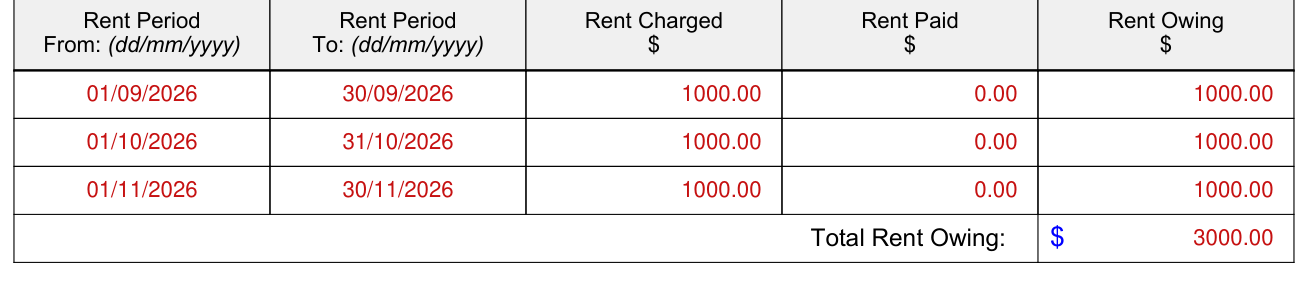
Make sure you have correctly calculated the total amounts owing in the two tables in Part 5 (Rent Owing and NSF Cheque Charges). Check the calculation across the rows of each table and then check the total amounts in the final columns. Also check to be sure that the amount in the box on page 1 matches the total amount owing in Part 6.
Part 5, Section 2: NSF Cheque Charges

NSF Cheque Charges Fill in the table if you are applying to collect money from the tenant because you had bank or administration charges for NSF cheques the tenant gave you. I have calculated the amount of NSF bank charges and my related administration charges the tenant owes me.
Attach additional sheets if necessary.
Part 6: Application Fee
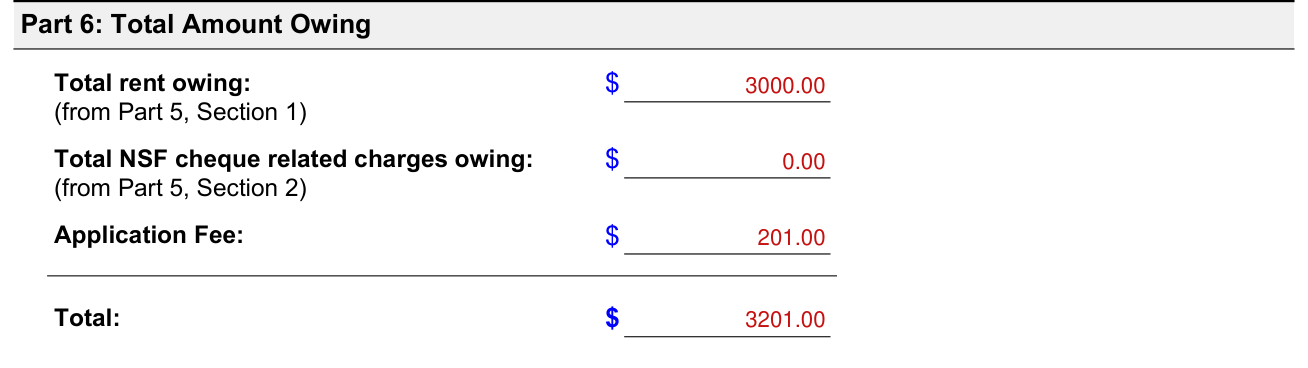
Pay the application fee of $201 to the LTB at the same time as you file the application (or $186 if you use the Tribunals Ontario Portal) (checked November 9, 2026).
The LTB will not process your application unless you pay the fee.
If you cannot afford the fee, you can submit a Fee Waiver Request.
Part 7: Signature
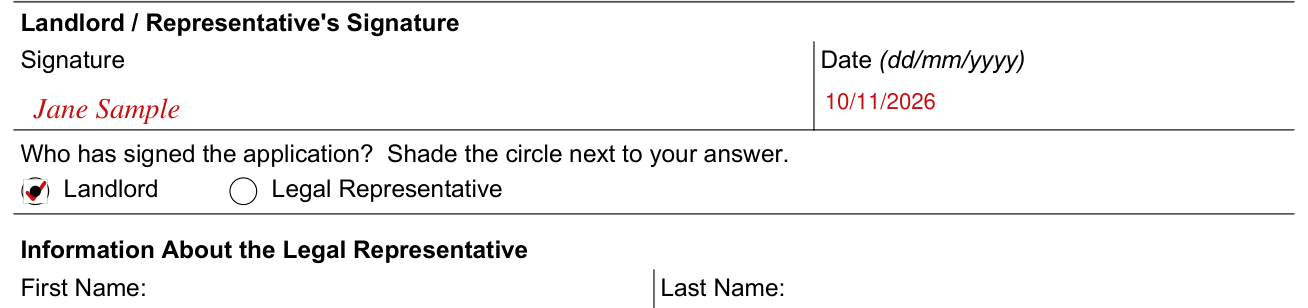
If your application is not signed and dated, the LTB will not accept it.
It is an offence under the Residential Tenancies Act, 2006 to file false or misleading information with the Landlord and Tenant Board.
The LTB can order either the landlord or the tenant to pay the other's costs related to the application.
How you are paying the application fee

Select how you are paying the application fee:
If you mail or courier the application, you can pay the filing fee by money order, certified cheque, or by credit card.
You can't pay with cash or debit card if you file by mail or courier.
Money orders and certified cheques must be made payable to the "Minister of Finance".
If you are paying by credit card and filing your application by mail or courier, you must complete the Credit Card Payment Form and submit it with your application.
Common questions about Form L1
Where do I file it?
File all pages of the application, not including the Important Information page, with the LTB along with a copy of the N4 Notice to End Your Tenancy for Non-payment of Rent you gave the tenant.
Where to get help with Form L1
Contact the LTB if you have any questions or need more information: 416-645-8080 or 1-888-332-3234 (toll free), or tribunalsontario.ca/LTB.
Sources
[1] Application to Evict a Tenant for Non-payment of Rent and to Collect Rent the Tenant Owes, Form L1 (2026/09), Landlord and Tenant Board, Tribunals Ontario (the Official source link on this page).