
Updated:
Get Form Now
A reference check form is a questionnaire about a candidate's past work. According to the U.S. Office of Personnel Management, reference checking evaluates past performance through supervisors, peers and subordinates. Hiring managers send this employee reference form to former employers before making an offer.
This page gives you a fillable reference check template that you can complete online or print, a guide to each part of it, sample questions, and a request email you can copy.
A reference check form is a written set of questions that a former supervisor, coworker, or director answers about a job candidate's work, skills, and conduct. The employer reads the answers next to the resume and the interview notes before deciding on an offer.
The U.S. Office of Personnel Management describes reference checking as "an objective evaluation of an applicant's past job performance based on information collected from key individuals (e.g., supervisors, peers, subordinates) who have known and worked with the applicant." The form puts that evaluation on paper, so every reference answers the same questions in the same order.
The same document goes by other names. Employers also call it an employee reference form, a job reference form, a reference questionnaire, or a pre-employment reference check form. A personal reference check form is a variant that asks a friend or neighbor about character instead of a manager about work.
A reference check form includes the people involved, the candidate's employment details, a ratings table of work qualities, and open questions from the new employer. The FormsPal template follows that order.
Many employers add a rehire question to the open part: would the reference hire or work with the candidate again?
Ask the reference to back up each rating with a short example. A rating without an example tells you little, while one sentence about a real project shows how the candidate works.
To fill out a reference check form, the reference completes the sections in order: the main information, the employment details, the ratings table, and the open questions. Open the template in the FormsPal PDF editor to fill it in on your screen, or print it and fill it in by hand.
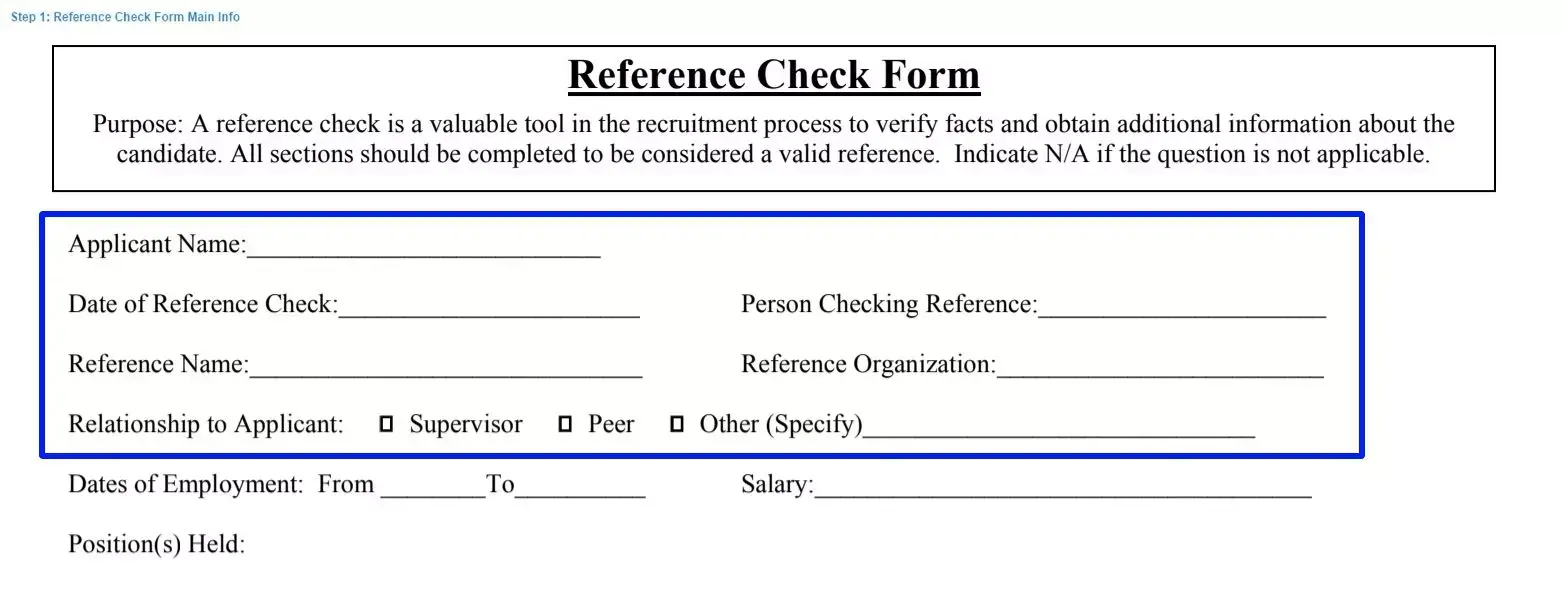
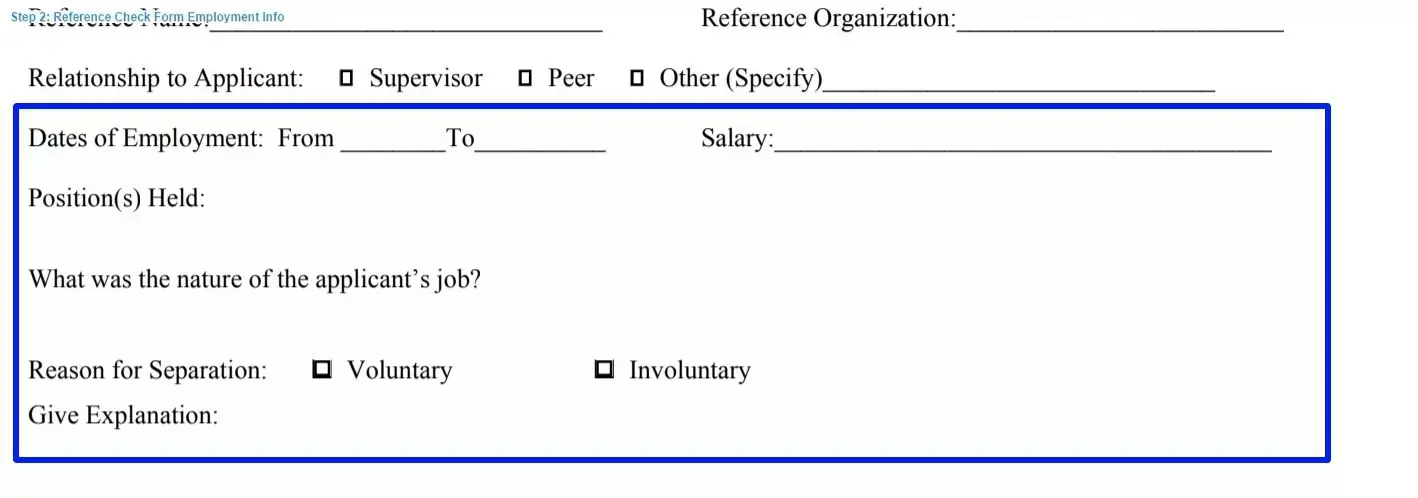
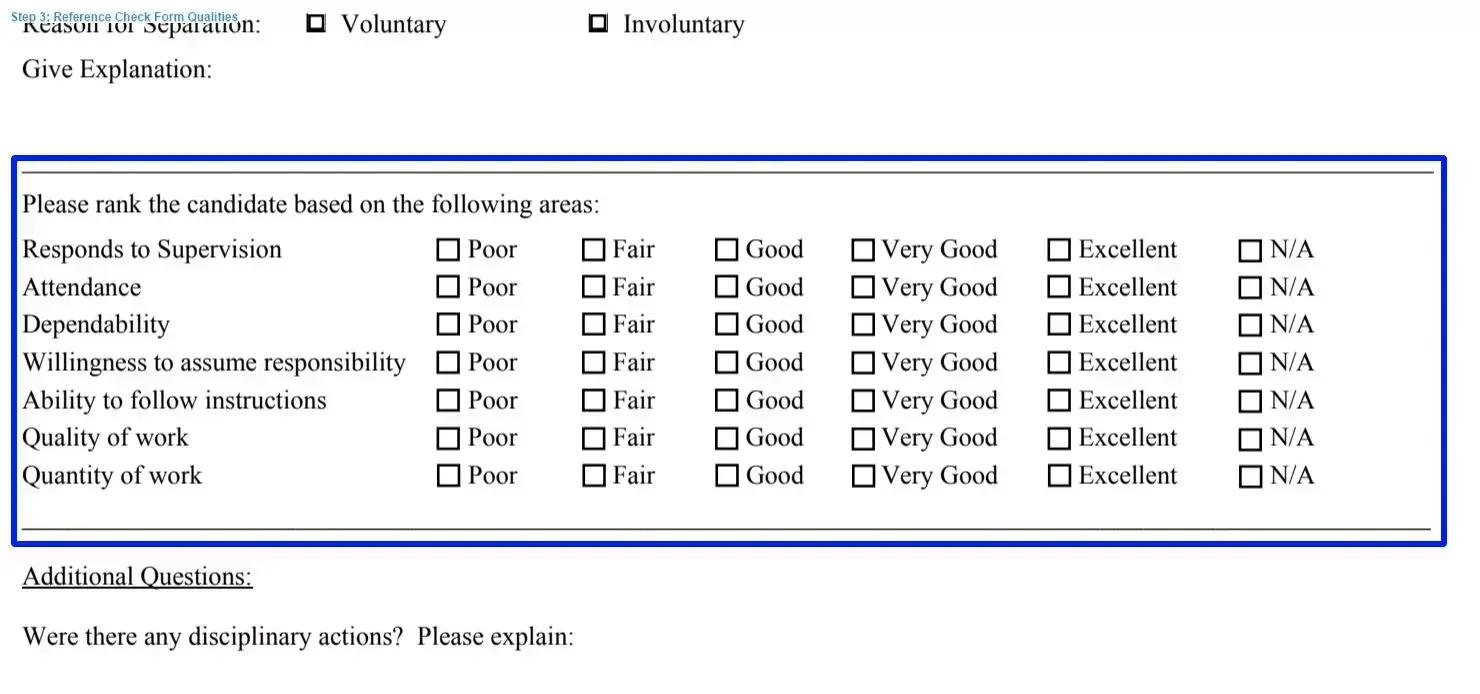
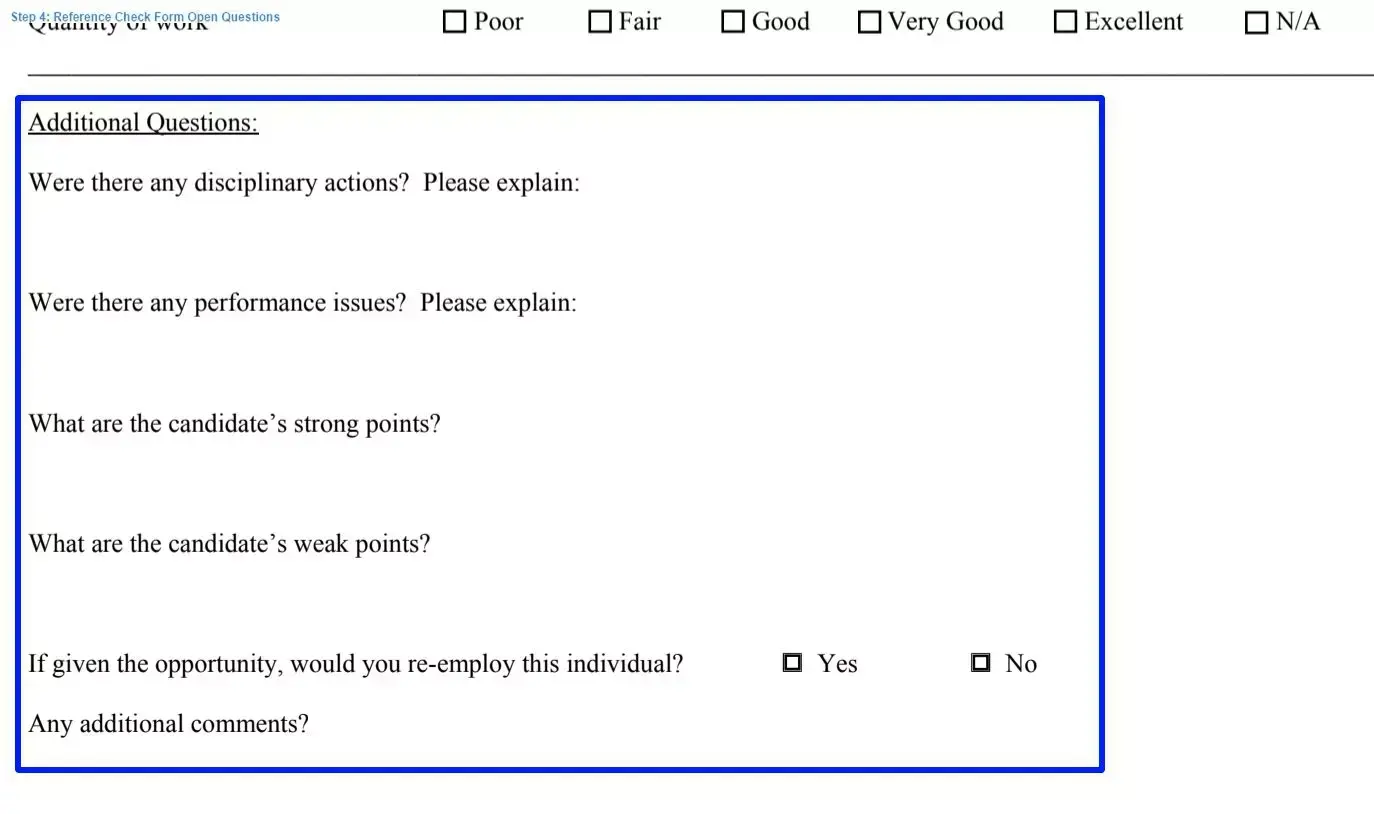
When the form is complete, the reference adds the date and sends it back by the route the employer chose, such as email or an upload link.
Example of a filled-in open answer: "Jordan led our weekend shift for most of last year. Orders went out on time, and the new hires Jordan trained stayed with us. Jordan sometimes took on too much herself instead of handing tasks off."
The reference check process runs either through the candidate, who passes the form to a former manager, or through the employer, who sends it to the reference directly. Both routes end with a completed form in the hiring team's hands.
The U.S. Office of Personnel Management notes that reference checking "is usually conducted near the end of the selection process after the field of applicants has been narrowed to only a few competitors." In practice, the form goes out after the final interview and before the offer.
A form sent straight from the reference to the employer leaves no doubt about who wrote the answers, so ask for that route even when the candidate starts the request.
Good reference check questions ask about facts first, then skills and teamwork, and end with an open question about fit. Ask about what the candidate did, not what they might do. Here are sample questions you can add to the template or swap in for the ones it has.
The U.S. Office of Personnel Management lists "basing questions on a job analysis, asking applicants the same set of questions" among the ways to structure reference checking. Use one question set per role, so the answers for different candidates line up.
Questions to leave out of a reference check form are the ones that do not bear on whether the candidate can do the job. The U.S. Equal Employment Opportunity Commission says pre-employment information "should be limited to those essential for determining if a person is qualified for the job" (EEOC, Prohibited Employment Policies/Practices).
Federal guidance from the EEOC states that "Employers are explicitly prohibited from making pre-offer inquiries about disability" (EEOC, Prohibited Employment Policies/Practices). Do not ask a reference about the candidate's health, medical leave, or disability before an offer.
The same EEOC page calls information about race, sex, national origin, age, and religion "irrelevant in such determinations" (EEOC, Prohibited Employment Policies/Practices). Keep each question tied to a duty of the role, such as handling customers or meeting deadlines.
Some states also limit questions about past pay. Under 19 Del. C. § 709B, a Delaware employer may not "seek the compensation history of an applicant from the applicant or a current or former employer," unless an offer with pay terms has been extended and accepted, and then only to confirm that history. Other states set their own rules, so check the law where the job is before you ask a reference about pay.
A reference check asks for an opinion of how the candidate worked, while employment verification confirms facts such as the job title and the dates of work. Many employers use both, and they are easy to mix up.
| Reference check | Employment verification | |
|---|---|---|
| What it confirms | Skills, conduct, and the reference's opinion | Job title, dates of work, and similar facts |
| Who answers | A former supervisor, coworker, or director | Often the former employer's HR team |
| Typical questions | Strengths, weak points, would you rehire | Did this person work here, and when |
| Best for | Judging how the candidate works with others | Checking the facts on a resume |
If you only need to confirm dates and job titles, the employment verification form is the better fit.
A written reference check form gives every reference the same questions and leaves the hiring team with a signed copy of the answers. That makes it easier to compare candidates than notes from a series of calls.
A written form has a cost too: some references reply slowly or not at all. Plan a short follow-up call for the answers you need most, and use the form to keep that call focused.
A reference request email asks the reference to complete the form, says who the candidate is, and gives a reply date. Keep it short and attach the form or link to it.
Subject: Reference request for Jordan Lee
Hello Ms. Ortiz,
Jordan Lee has applied for the shift supervisor role at Harbor Foods and named you as a reference. Jordan has agreed that we may contact you. Could you fill in the attached reference check form by Friday, May 8? It covers Jordan's role, a short ratings table, and a few open questions.
If you would rather talk, reply with a good time to call. Thank you for your help.
Sam Patel, Hiring Manager, Harbor Foods
A candidate asking a former manager can send the same email in their own name and say which role they applied for.
A former supervisor, director, or coworker of the candidate fills out a reference check form. The candidate can ask this person directly, or the new employer can send the form. The reference rates the candidate's qualities and answers the open questions.
Yes, a reference can decline to fill in the form or leave single questions blank. Some companies route reference requests to HR, which may confirm only the job title and dates; in that case, ask the candidate for another contact.
Yes, an employer can weigh what a reference says when deciding on an offer. The EEOC states that "It is illegal for an employer to give a negative or false employment reference (or refuse to give a reference) because of a person's race, color, religion, sex", among other protected traits (EEOC, Prohibited Employment Policies/Practices).
A friend works as a personal reference, which speaks to character, but an employer who asks for professional references wants people who saw your work. Name a friend only if the employer asks for a personal reference or you worked together.
A reference should describe what they saw at work: the duties, the results, and a short example for each rating. Stick to facts you know firsthand, and say so when you did not see something.
Yes. The template has common questions, such as performance issues and weak points, and you can edit them. You can also change the characteristics in the ratings table so they match the job you are hiring for.
Yes. Open the fillable reference check template in the FormsPal PDF editor, type your answers into the fields, and download the finished copy. You can also print the form and fill it in by hand.
General information, not legal or tax advice.
