
Form RUT-7 at a glance
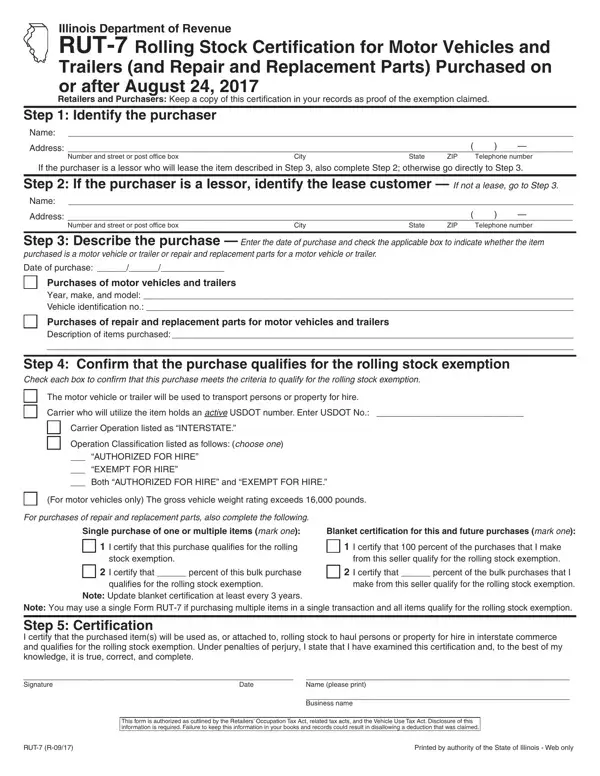
What it is: Form RUT-7 is the Rolling Stock Certification for Motor Vehicles and Trailers (and Repair and Replacement Parts) Purchased on or after August 24, 2017, of the Illinois Department of Revenue.
Where and when to file: A purchaser claiming the rolling stock exemption on a motor vehicle or trailer should provide to the seller a signed, properly completed Form RUT-7 at the time of sale.[2]
To claim a rolling stock exemption, you must be an owner, lessor, or shipper purchasing tangible personal property that will be utilized by interstate carriers for hire for use as rolling stock moving in interstate commerce.[2]
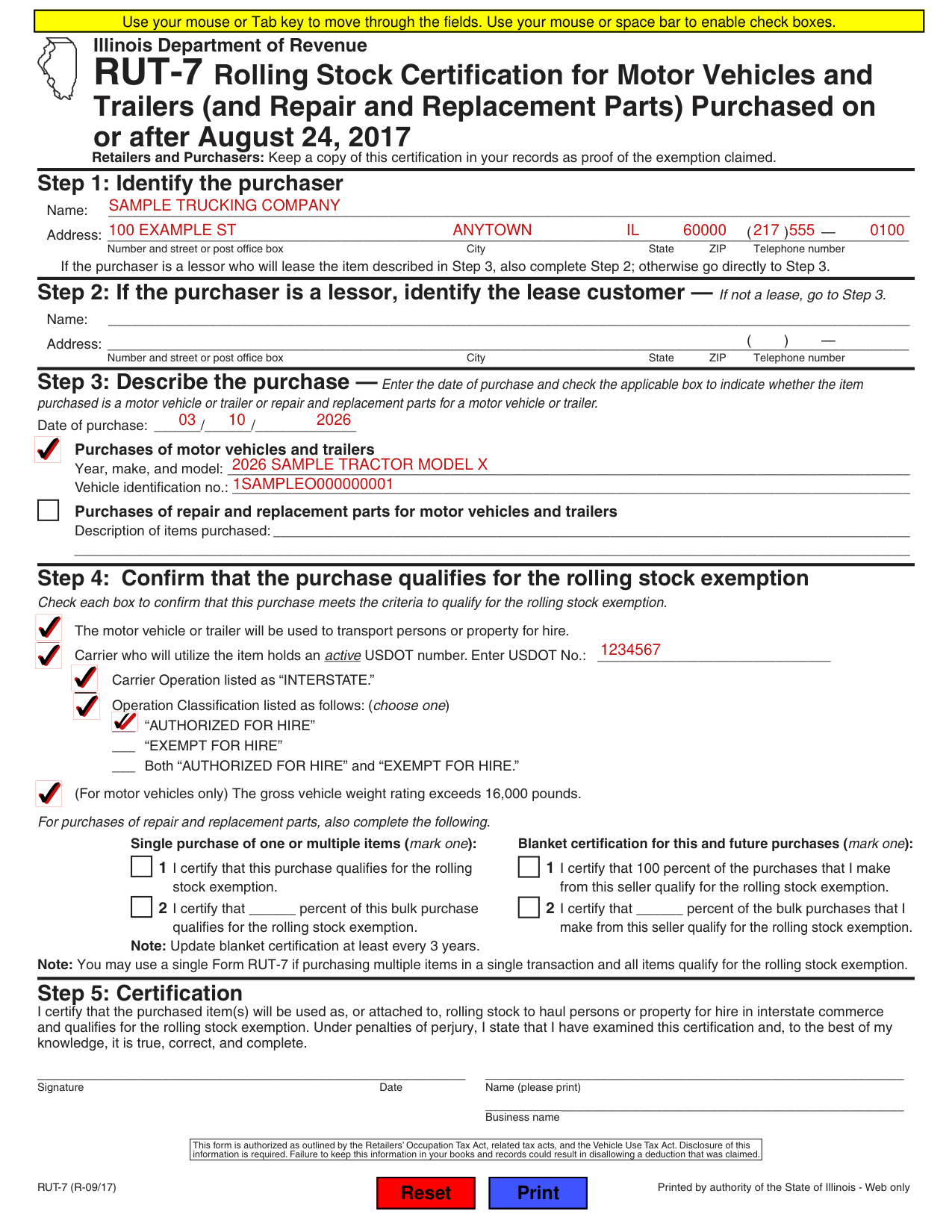
A filled-in Form RUT-7 example: a trucking company buys a tractor
How to fill out Form RUT-7, box by box
The purchaser

If the purchaser is a lessor who will lease the item, also complete Step 2. If the item is not being purchased for purposes of a lease, proceed directly to Step 3.[2]
The lease customer

Step 2: Enter the name, address, and telephone number of the lease customer if the purchaser is a lessor.
Complete Step 2 only if the purchaser is a lessor who will lease the item to an interstate carrier for hire who will use the item under lease as rolling stock in interstate commerce; otherwise skip Step 2 and proceed directly to Step 3.[2]
Describe the purchase
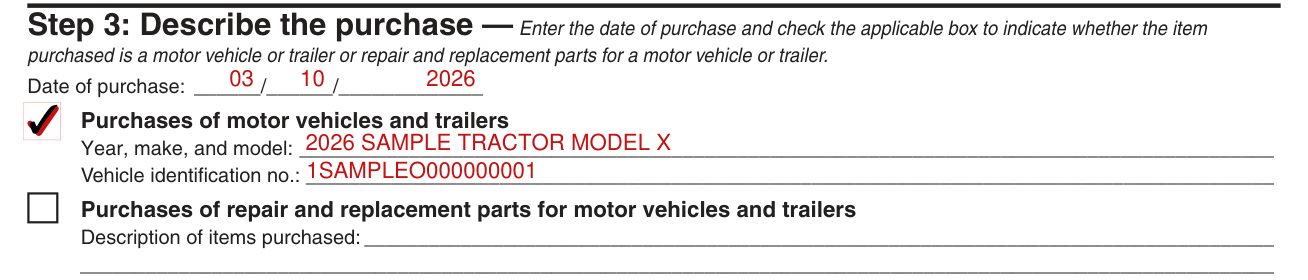
Step 3: Describe the purchase - Enter the date of purchase and check the applicable box to indicate whether the item purchased is a motor vehicle or trailer or repair and replacement parts for a motor vehicle or trailer.
For purchases of motor vehicles and trailers, enter the year, make, model, and the vehicle identification number (VIN) for the motor vehicle or trailer purchased.[2]
Purchases of repair and replacement parts
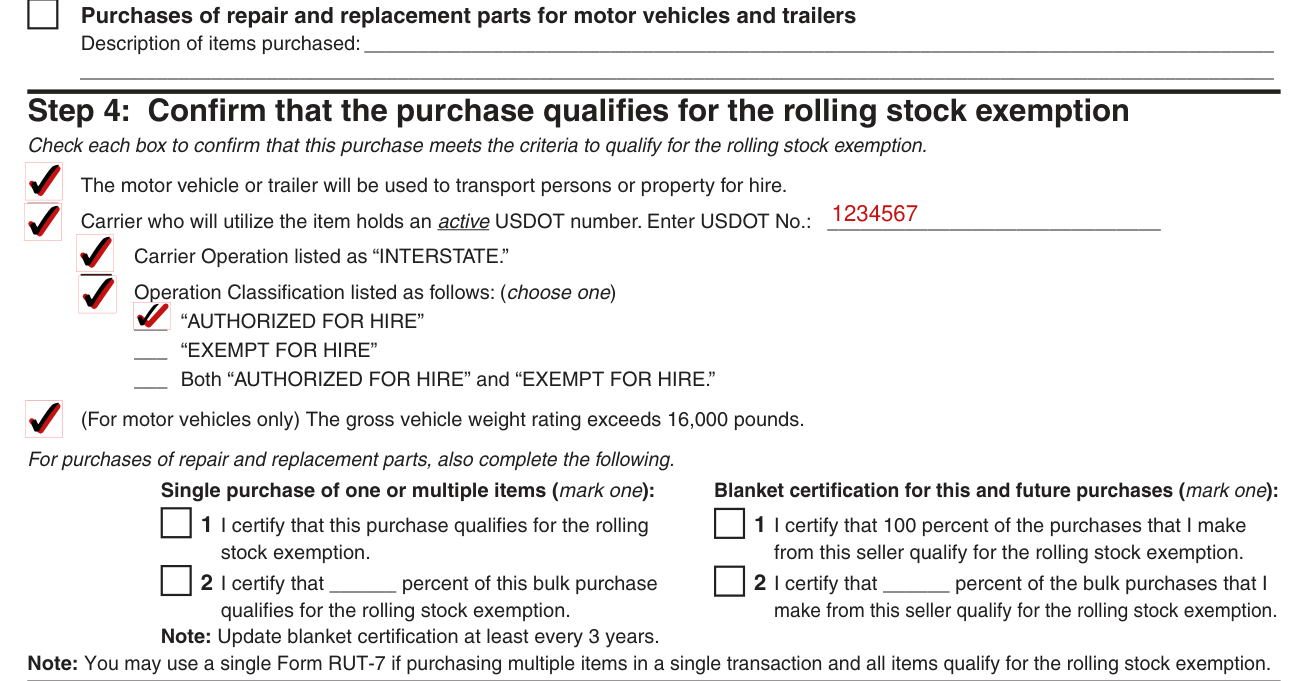
For purchases of repair and replacement parts, you must provide a description of items purchased.
For purchases of repair and replacement parts, you must also select either 1 or 2 under either Single purchase or Blanket certification to indicate whether the full purchase is exempt or whether a percentage of the purchase is exempt.
If 2 is selected, enter the percentage of the purchase that qualifies or will qualify for a rolling stock exemption.
Blanket certifications expire after three years.[2]
Confirm that the purchase qualifies
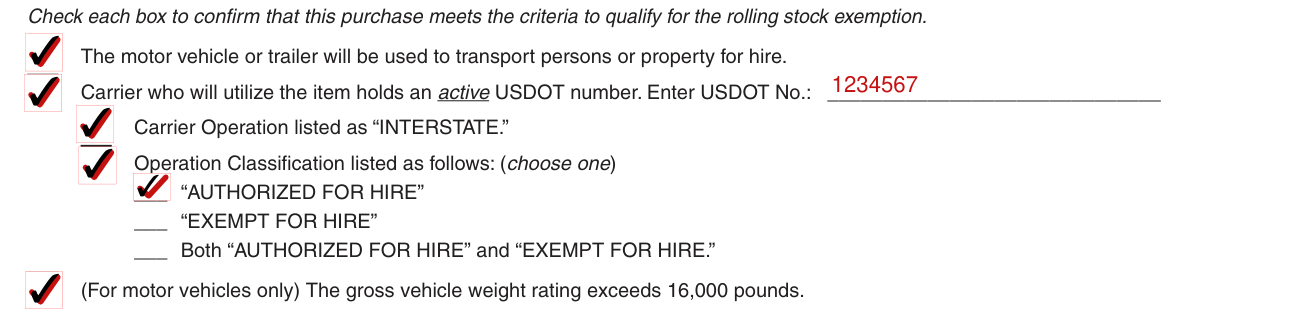
Step 4: Confirm that the purchase qualifies for the rolling stock exemption. Whether you are purchasing a motor vehicle or trailer or repair and replacement parts for a motor vehicle or trailer, check each box to confirm that this purchase meets the criteria to qualify for the rolling stock exemption.
The motor vehicle or trailer will be used to transport persons or property for hire.
A purchase that otherwise meets the requirements for exemption will only qualify if the purchaser can supply an active USDOT number of the interstate carrier with the carrier operation listed as “interstate” and the operation classification listed as “authorized for hire,” “exempt for hire,” or both (except for motor vehicles or trailers used at an airport to support the operation of an aircraft moving in interstate commerce).
(For motor vehicles only) The gross vehicle weight rating exceeds 16,000 pounds.[2]
More rules for Form RUT-7
Use Form RUT-7-A, Rolling Stock Certification for Aircraft, Watercraft, Limousines, and Rail Carrier Items, to claim a rolling stock exemption on qualified purchases of aircraft, watercraft, limousines, and rail carrier items.[2]
When the motor vehicle or trailer no longer continues to be used as rolling stock, including no longer being leased for use as rolling stock, the purchaser must pay Use Tax on the selling price, allowing for a reasonable depreciation for the period during which the item qualified for the exemption.[2]
Use tax must be paid directly to the Illinois Department of Revenue on or before the last day of the calendar month following the month in which the item is no longer used as rolling stock.[2]
Both the purchaser and seller should keep a copy in their records to document the exemption.[2]
Failure to keep this information in your books and records could result in disallowing a deduction that was claimed.
Common questions about Form RUT-7
What is Rut 7?
Form RUT‑7, Rolling Stock Certification for Motor Vehicles and Trailers (and Repair and Replacement Parts) Purchased on or after August 24, 2017, allows a purchaser to certify to the seller that the purchaser is allowed an exemption from Sales and Use Tax on certain motor vehicles and trailers that are utilized by interstate carriers for hire for use as rolling stock moving in interstate commerce.[2]
Who signs it?
Step 5: Certification. The individual making the purchase must sign and date the certification, print his or her signed name, and as appropriate, provide the purchaser's business name.[2]
When is this form not the right one?
Only those items specifically used as rolling stock may qualify for the exemption. Items do not qualify for use as rolling stock when they are used only to transport company officers, employees, customers or others not for hire (even if the persons cross state lines); or to transport property a business owns or is selling and delivering to customers (even if the items cross state lines).[2]
Sources
[1] Form RUT-7 (R-09/17), Rolling Stock Certification for Motor Vehicles and Trailers (and Repair and Replacement Parts) Purchased on or after August 24, 2017, Illinois Department of Revenue (the Official source link on this page).
[2] Form RUT-7 Instructions (R-09/17), Illinois Department of Revenue.