

Sailing Boat Inspection Checklist at a glance
What it is: Sailing Boat Inspection Checklist: items to check on a sailing boat, in 2 parts; you get what you inspect, not what you expect, if you invest a little time before you embark.
A filled-in Sailing Boat Inspection Checklist example: a charterer checks the radio and tanks
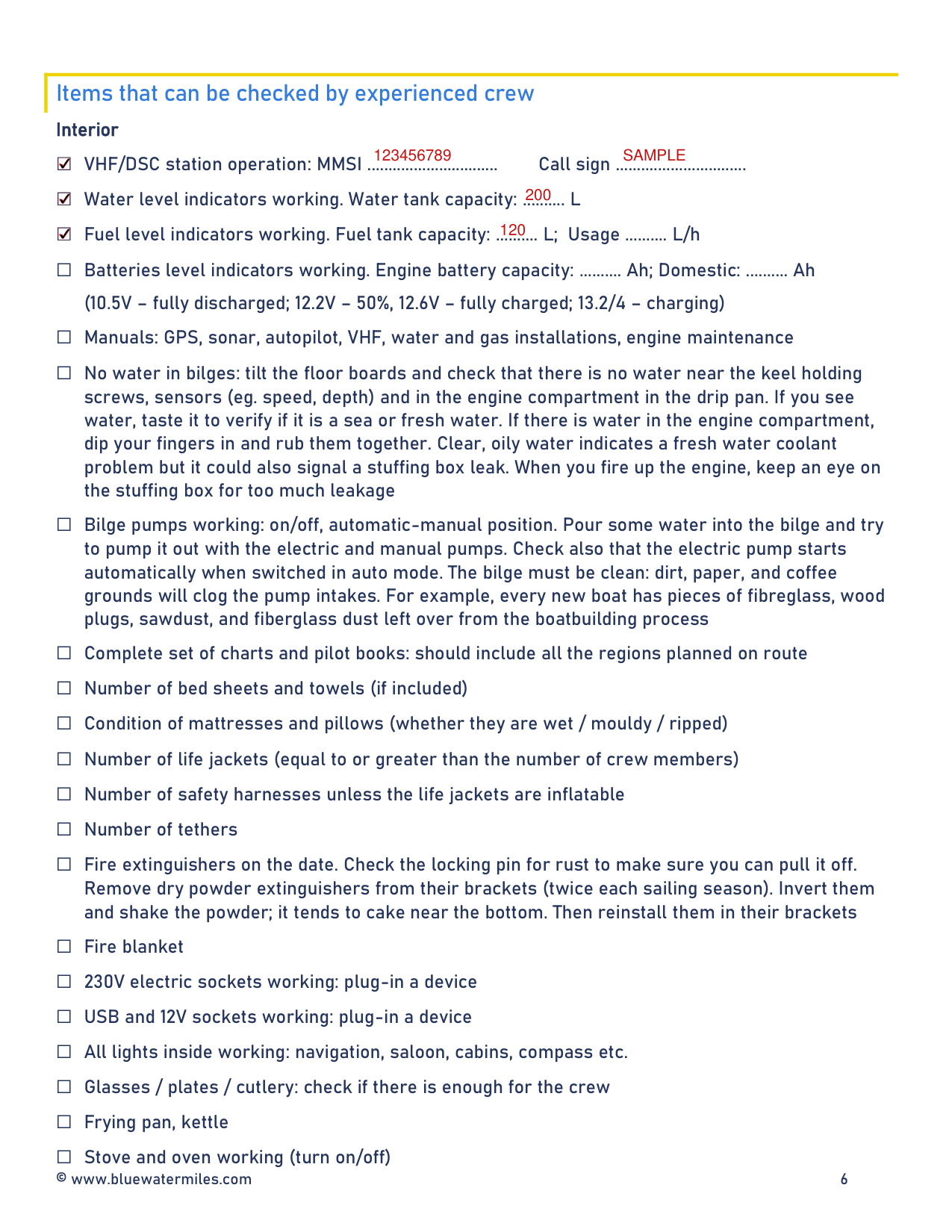
How to fill out Sailing Boat Inspection Checklist, box by box
Items that can be checked by experienced crew
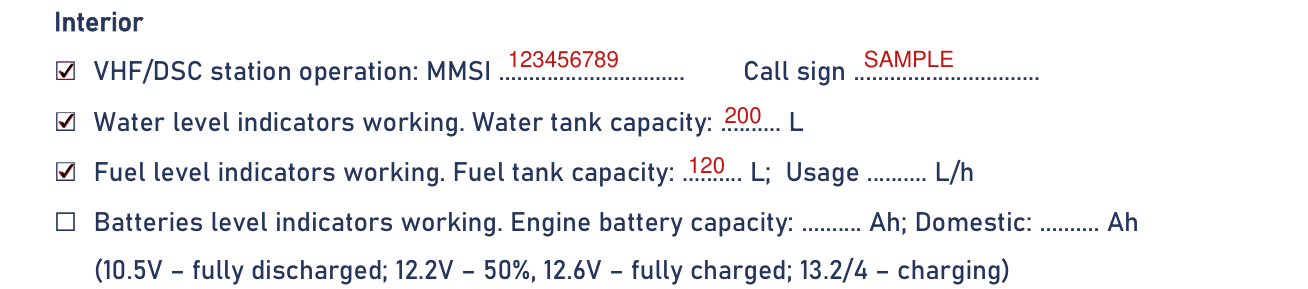
For the items that can be checked by experienced crew: VHF/DSC station operation, with the MMSI and the Call sign.
Water level indicators working, with the Water tank capacity in L. Fuel level indicators working, with the Fuel tank capacity in L.
If your situation is different
A list of items to check on a sailing boat for offshore passages
You get what you inspect, not what you expect. If you invest a little bit of time to check the boat before you embark, you will have a good time out on the water. This is a list of items to check on a sailing boat for offshore passages. It is divided into 2 parts (skipper and experienced crew) which can be run in parallel by 2 people to speed up the process.
Amount of oil in the engine
Amount of oil in the engine (should be full). You cannot judge it by its colour, it is normal to have it black/dark grey due to detergents and combustion by-products.
Amount of cooling water (should be full).
Fuel filter check (no water or dirt in the glass bowl of racor - water separating pre-filter). If the filter does not have a transparent bowl, you must drain it either via a small stopcock or drain plug. Place a suitable container underneath the filter, and drain it until the fuel is running clear.
Belt drive for the water pump and the alternator (no big slack when pressing on its longest span and no fraying). "V" type belt's tension should allow you to deflect it by about 10-12mm, when correctly tensioned it should just be possible to twist flat belts through 90o.
Move the rudder
Move the rudder laterally as well as fore and aft (might only be possible with the boat out of the water), any movement more than half-inch would indicate a ware problem.
Pivot the rudder, which should move smoothly without a lot of resistance.
Inspect the stuffing box (packing gland) - wraps around the propeller shaft where it exits the hull to keep the water out. Get a flashlight and shine it onto the packing and lock nuts to ensure no water leaks. Excessive leaks indicate worn or missing packing. This has to be addressed right away before casting off.
Check for wear, damage, and leaks in hoses (e.g. engine and cooling systems), fittings, bilge blowers and vents. A boat with a gasoline engine must have a bilge blower: one with a diesel engine should have one.
Battery's location, rigging and gas bottles
Battery's location (engine and domestic). Each battery must have a cover and a strong tie-down to prevent movement when you heel, roll or pitch. Test the cables for tight contact with the battery terminals.
Inspect rigging: In general, the aluminium profiles should be checked for corrosion and cracks.
Check shrouds for broken strands at the terminals (run your hand down the shroud feeling any deformation).
Check mast for fractures and fatigue, especially around fittings.
While inspecting wire of any kind run a cloth over it to find sharp edges or burrs, which can cut lines, sails, or skin.
Gas bottles securely stowed and properly vented in a gas locker.
Gas hoses and connections in good order (check pipe joints by brushing on soapy water and watching for gas bubbles).
Engine cooling
Engine operation: on/off, forward & reverse running, clutch.
Engine cooling: rhythmic discharge of cooling water coming out from the exhaust pipe with gas colourless, almost invisible.
Location of the fuel shut-off valve. Test the valve to make sure you can turn it off and on with moderate pressure.
No water in bilges
No water in bilges: tilt the floor boards and check that there is no water near the keel holding screws, sensors (eg. speed, depth) and in the engine compartment in the drip pan.
Bilge pumps working: on/off, automatic-manual position. Pour some water into the bilge and try to pump it out with the electric and manual pumps. Check also that the electric pump starts automatically when switched in auto mode. The bilge must be clean: dirt, paper, and coffee grounds will clog the pump intakes.
Number of life jackets (equal to or greater than the number of crew members).
Number of safety harnesses unless the life jackets are inflatable.
Exercise all seacocks. Every seacock aboard must have a handle that works and can close the valve to the sea. Test each handle in the shut-off (90 degrees to the hose) and open (in line to the hose) position.
Liferaft with an in-date service sticker and painter secured to the boat.
Navigation lights working: stern, bow, masthead, deck.
When you think that something is not right
Close all hatches and give the deck (including hatches and ports) a hard spray from a water hose to make sure there are no leaks through the deck parts.
When you think that something is not right, and the representative of the shipowner "waves his hand" to it, it is worth making a remark in the yacht check-in form, and additionally photographing the given element for your own peace of mind.
Sources
[1] Sailing Boat Inspection Checklist (served form, no issuer file) (the Official source link on this page).