

How to Respond to a Summons and Complaint at a glance
What it is: How to Respond to a Summons and Complaint, from the Help Center of the Supreme Court, Civil Branch, New York County.
Who signs: In any event, the answer must be signed by defendant's attorney or by defendant if unrepresented.
A corporation must appear through an attorney. See Civil Practice Law and Rules (CPLR) 321(a).
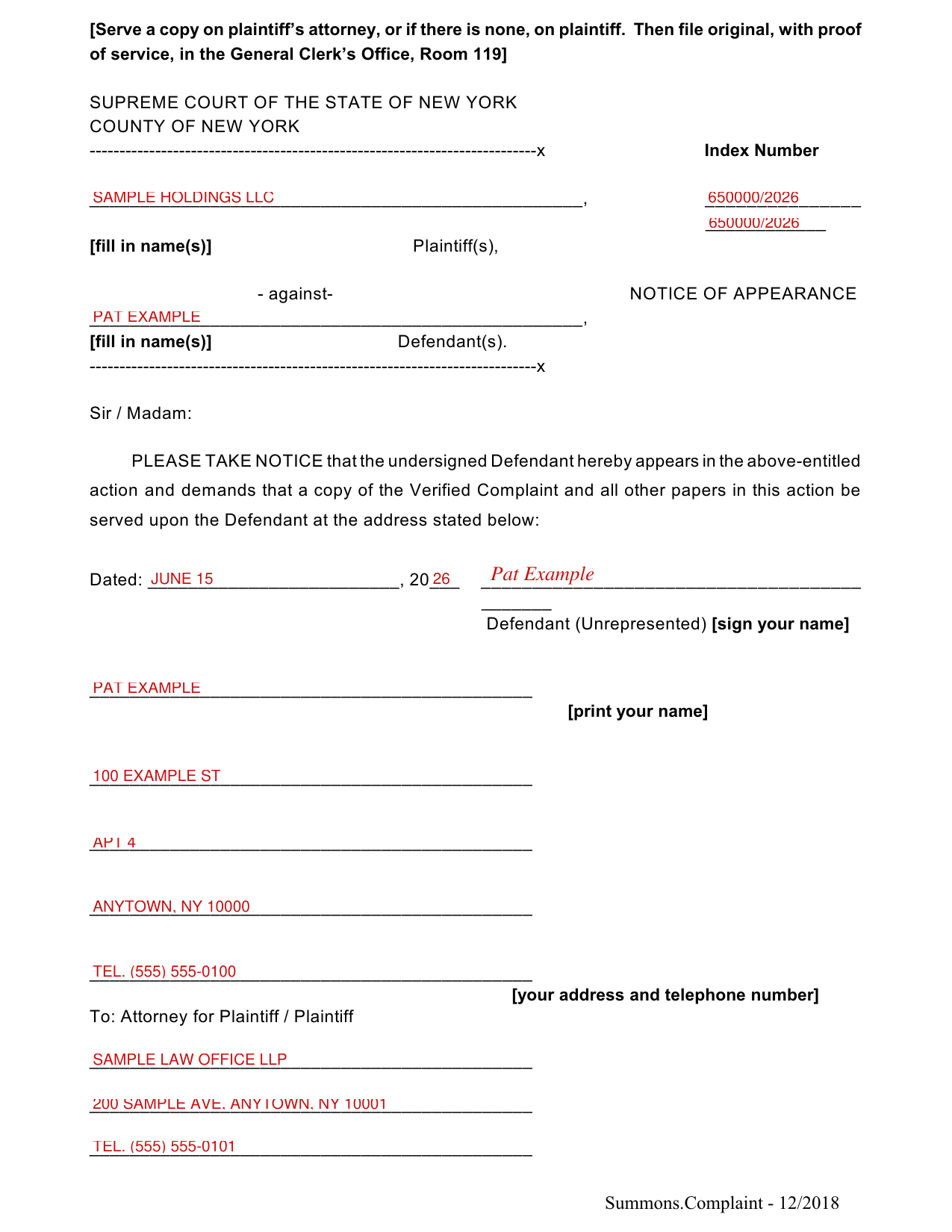
A filled-in How to Respond to a Summons and Complaint example: an unrepresented defendant appears
How to fill out How to Respond to a Summons and Complaint, box by box
Notice of Appearance
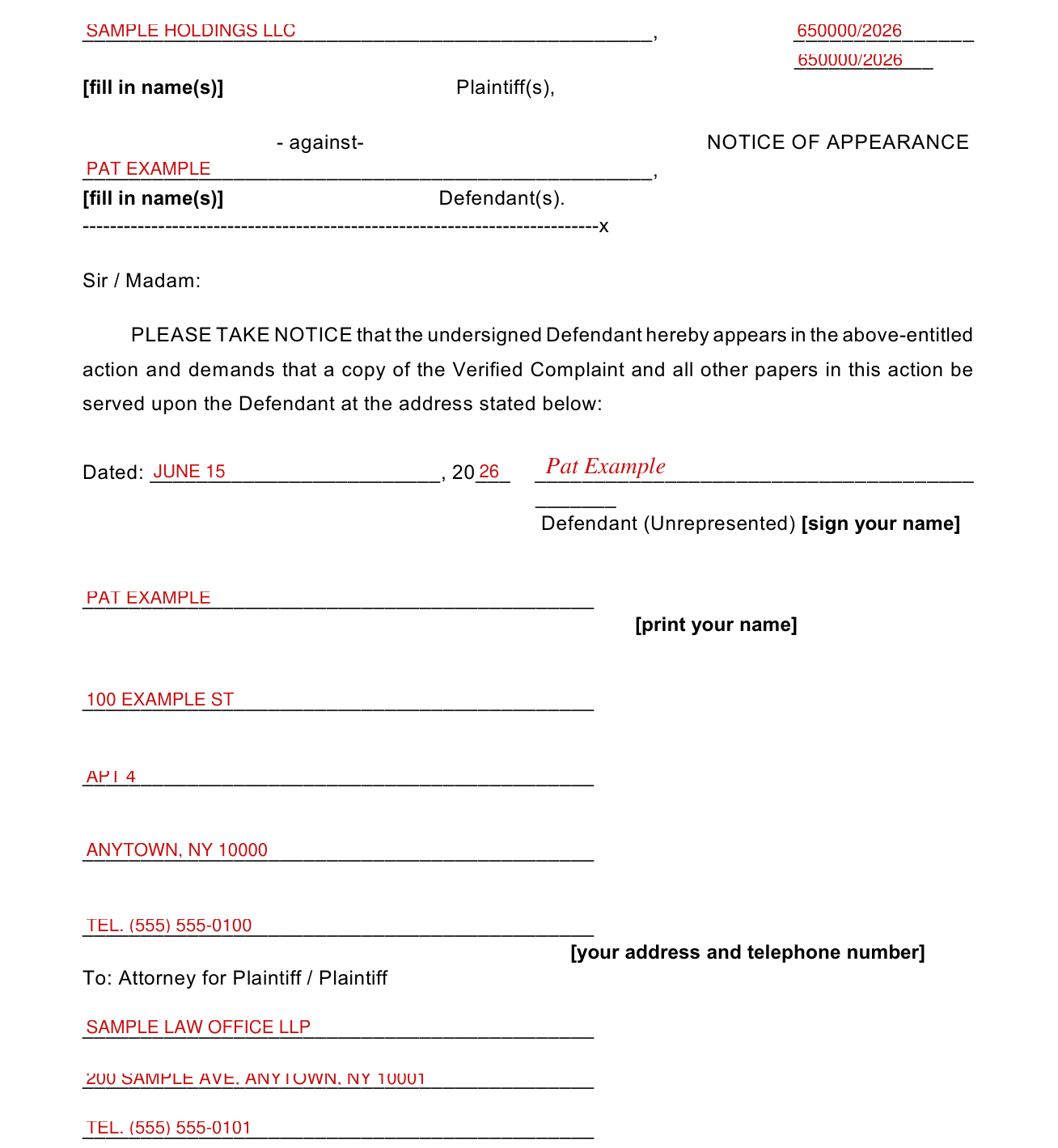
A notice of appearance indicates that defendant will appear on his or her own behalf.
A summons with notice lacks details about the plaintiff's claims. Therefore, the defendant's notice of appearance usually includes a demand for a complaint. The complaint describes the plaintiff's case in detail. This demand requires the complaint to be served within 20 days from the date of service of the demand.
Under SUPREME COURT OF THE STATE OF NEW YORK COUNTY OF NEW YORK, enter the Index Number and fill in name(s) of the Plaintiff(s) and of the Defendant(s).
After Dated, enter the date. In the Defendant (Unrepresented) box, sign your name, and print your name in the print your name box.
Enter your address and telephone number. After To: Attorney for Plaintiff / Plaintiff, enter the name, address and telephone number.
Serve a copy on plaintiff's attorney, or if there is none, on plaintiff.
A defendant must have plaintiff served with a copy of the notice of appearance. The original, with proof of service, must be timely filed in the General Clerk's Office, 60 Centre Street, Room 119, 1st floor to avoid defaulting.
The Answer
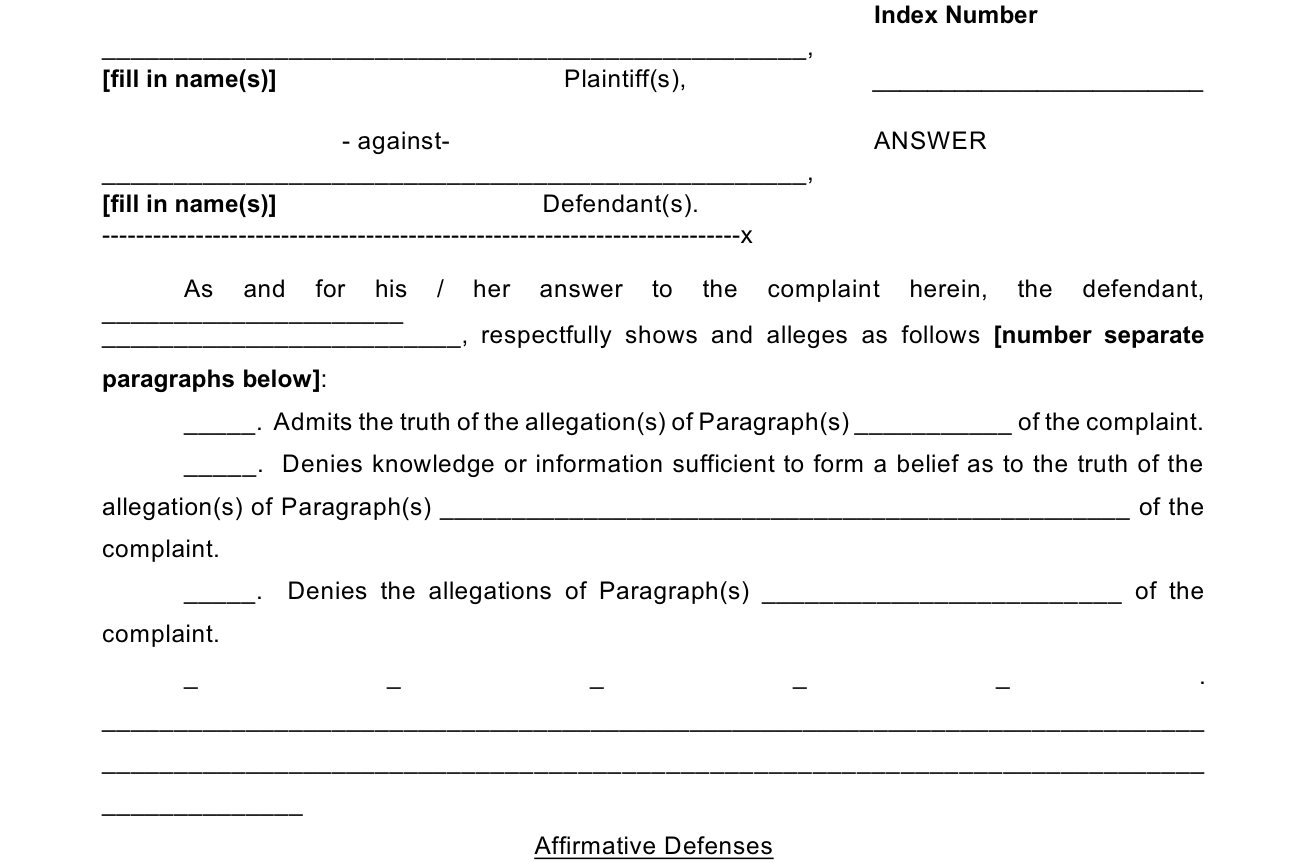
An answer, like a complaint, states a party's position regarding the case.
This is only a sample of the form for an answer. Anyone seeking to serve an answer to a complaint must draft his / her own answer using the facts of his / her own case and the relevant law. Print or type, double spaced, using black ink only.
First, the answer contains the caption of the case. The body of the answer consists of a series of numbered paragraphs.
A defendant must respond to each allegation in the complaint by either: a) admitting its truth; or b) denying its truth; or c) denying that the defendant has sufficient knowledge or information to know whether the allegation is true or false. The law treats each allegation of a complaint that is not responded to as having been admitted.
For the ANSWER, enter the Index Number and fill in name(s) of the Plaintiff(s) and of the Defendant(s).
After As and for his / her answer to the complaint herein, the defendant, enter your name; number separate paragraphs of the answer.
To admit, enter the paragraph number and the Paragraph(s) of the complaint in Admits the truth of the allegation(s) of Paragraph(s).
In Denies knowledge or information sufficient to form a belief as to the truth of the allegation(s) of Paragraph(s), enter the paragraph number and the Paragraph(s) of the complaint.
In Denies the allegations of Paragraph(s), enter the paragraph number and the Paragraph(s) of the complaint.
Affirmative Defenses and Counterclaims
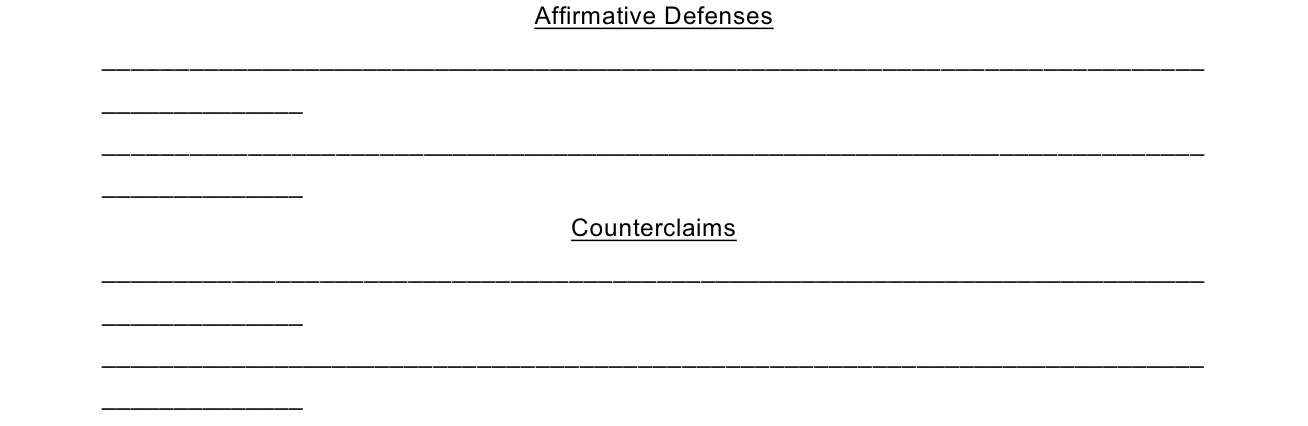
The answer may, and sometimes must, contain affirmative defenses. A defendant needs to be careful not to waive (give up) any defenses. See CPLR 3018(b) and CPLR 3211(e).
An answer to the complaint may also contain a counterclaim. A counterclaim seeks relief (for example, money damages) against the plaintiff.
Counterclaims should be set forth in a separate section titled “COUNTERCLAIMS” after the portion of the answer described. Counterclaims resemble the format of a complaint.
Cross Claims

A defendant may assert claims against a fellow defendant or several defendants. These are known as cross claims and also follow the initial responses contained in the answer.
There shall be a response (a reply) to a counterclaim designated as such and to a cross claim (an answer) if the cross claim contains a demand therefor.
WHEREFORE and the signature
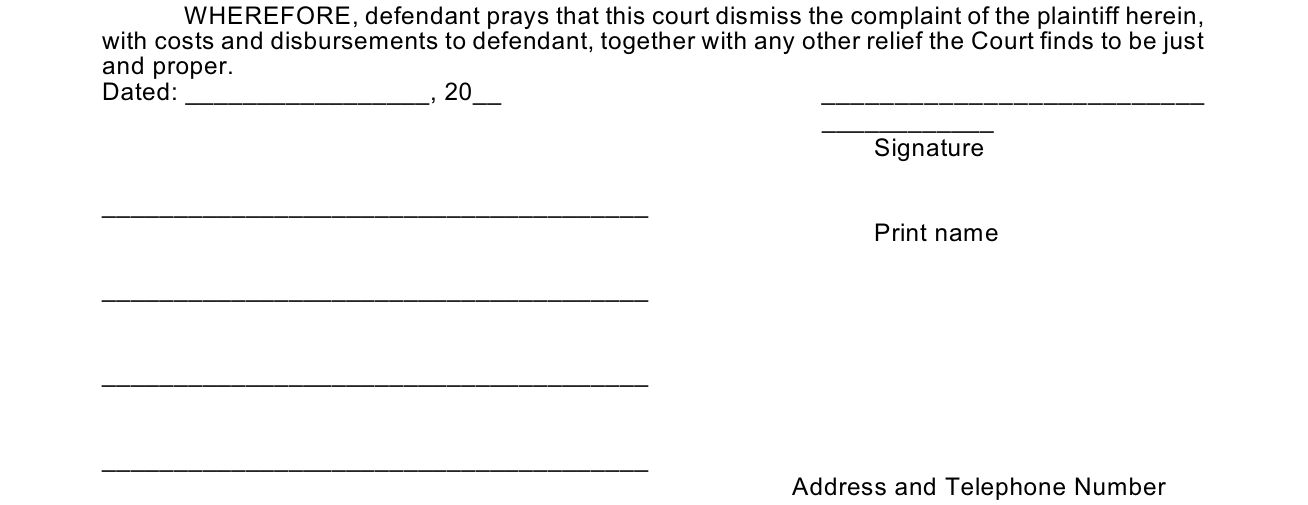
WHEREFORE, defendant prays that this court dismiss the complaint of the plaintiff herein, with costs and disbursements to defendant, together with any other relief the Court finds to be just and proper.
After Dated, enter the date. Sign in the Signature box, print your name in the Print name box and enter your Address and Telephone Number.
VERIFICATION
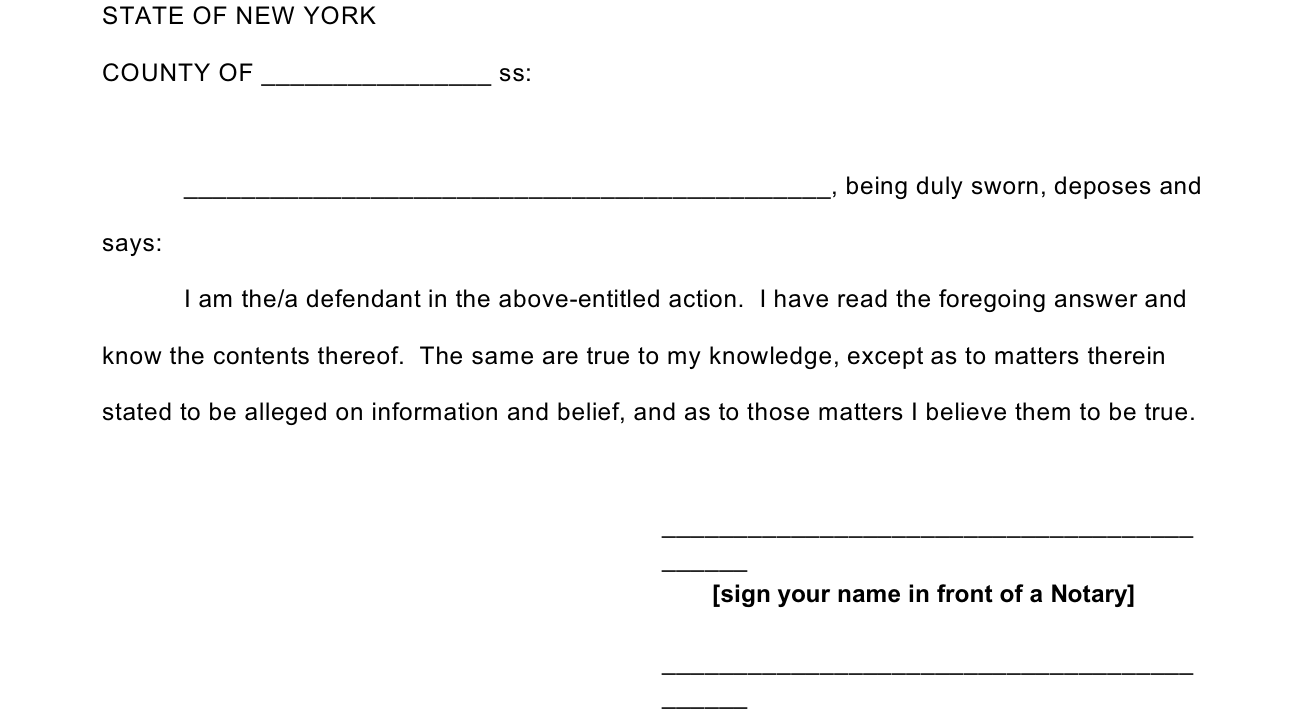
Generally, if the complaint has been sworn to (verified), then the answer must be verified as well. See CPLR 3020.
After COUNTY OF, enter the county, and enter your name before being duly sworn, deposes and says.
I am the/a defendant in the action. I have read the answer and know the contents thereof. The same are true to my knowledge, except as to matters therein stated to be alleged on information and belief, and as to those matters I believe them to be true.
Sign your name in front of a Notary and print your name.
Sworn to before me this

Sworn to before me this, the day of and 20, and the Notary Public line are for the Notary.
AFFIDAVIT OF SERVICE AFTER COMMENCEMENT OF LITIGATION
A copy of the answer must be served upon the plaintiff's attorney or upon an unrepresented plaintiff and upon all other parties.
Unlike service of papers initiating a lawsuit, an answer may be served by mail by someone (not you) over the age of eighteen, who is not a party to the case. See CPLR 2103(a).
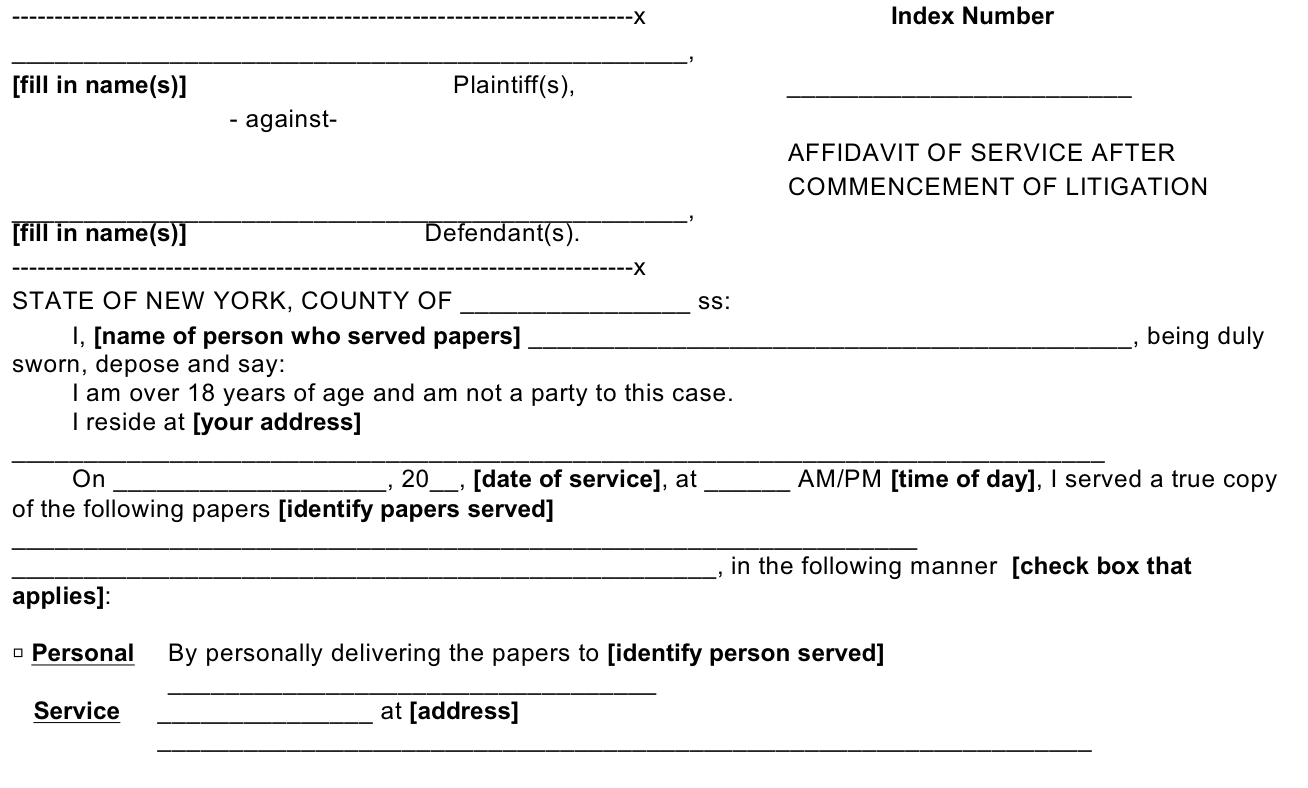
A sample of an affidavit of service is attached.
Although it is not required, it is permissible for the defendant to file the original answer with the original affidavit of service annexed in the County Clerk's Office, 60 Centre Street, Room 141B, in the basement.
Enter the Index Number and fill in name(s) of the Plaintiff(s) and of the Defendant(s), and enter the county. After I, enter the name of the person who served papers, who states: I am over 18 years of age and am not a party to this case. Enter the address where the person resides, the date of service after On ___, 20__, the time of day, and the papers served, then check the box that applies for the manner of service.
Mail and Overnight Delivery
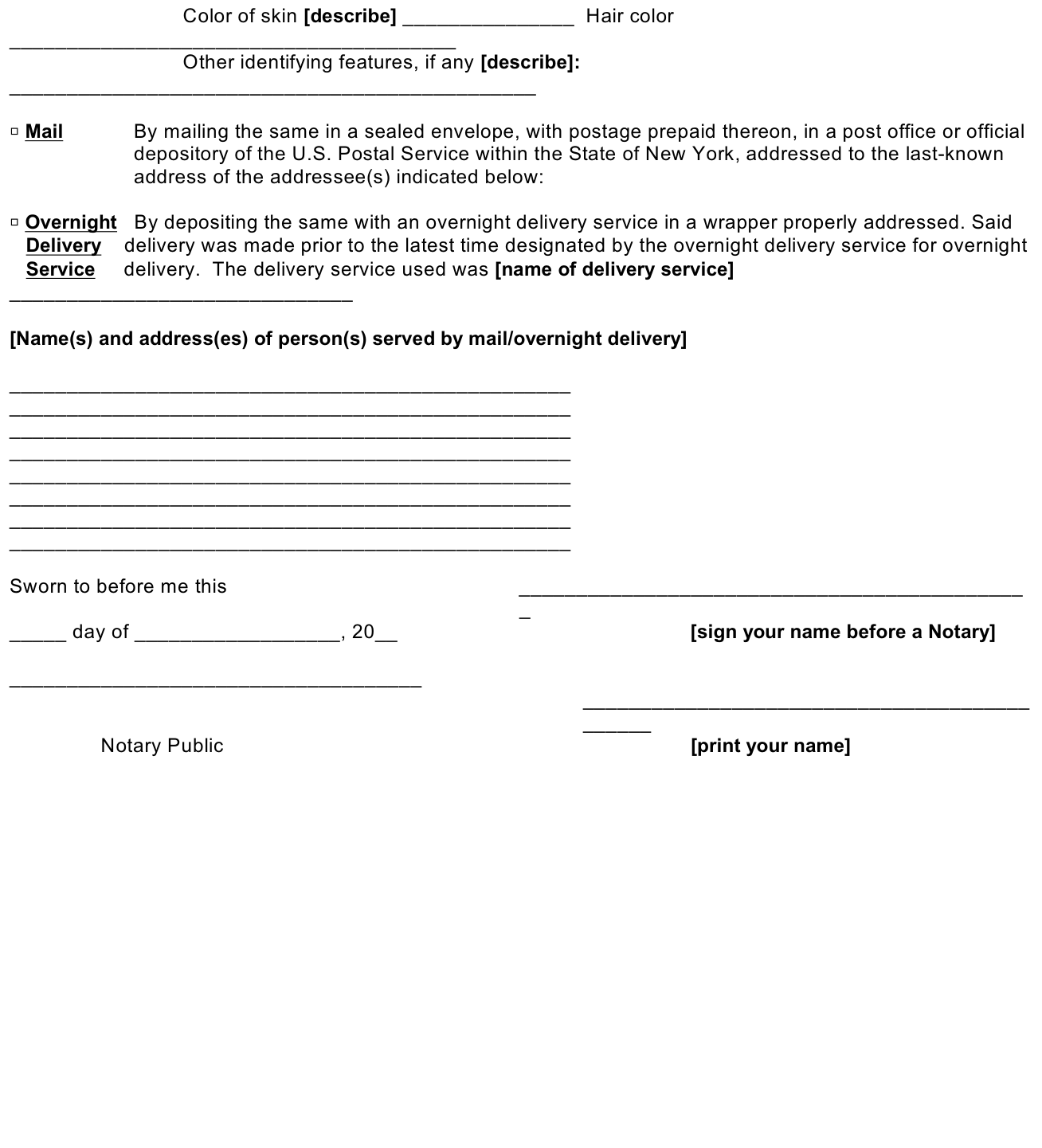
Mail: by mailing the same in a sealed envelope, with postage prepaid thereon, in a post office or official depository of the U.S. Postal Service within the State of New York. Overnight: by depositing the same with an overnight delivery service in a wrapper properly addressed. For overnight, enter the name of the delivery service, and enter the name(s) and address(es) of the person(s) served by mail or overnight delivery.
The person who served papers, who states: I am over 18 years of age and am not a party to this case, signs before a Notary and prints the name. The Notary Public line is for the Notary.
A default and a motion to dismiss
How to Avoid a Default
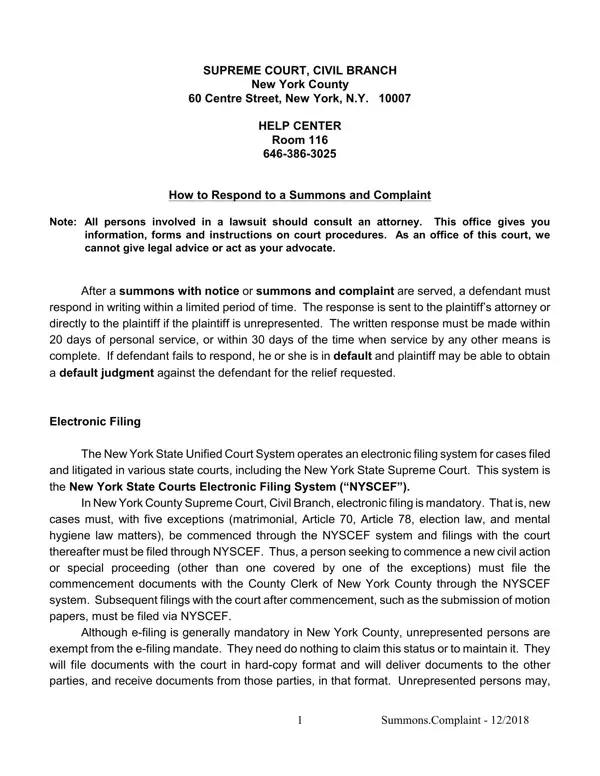
After a summons with notice or summons and complaint are served, a defendant must respond in writing within a limited period of time. The response is sent to the plaintiff's attorney or directly to the plaintiff if the plaintiff is unrepresented. The written response must be made within 20 days of personal service, or within 30 days of the time when service by any other means is complete. If defendant fails to respond, he or she is in default and plaintiff may be able to obtain a default judgment against the defendant for the relief requested.
To avoid a default, where a summons with notice was served, a defendant must prepare a notice of appearance and have it served on plaintiff or plaintiff's attorney within the applicable deadline.
Once a complaint has been served, whether with a summons at the outset or in response to a demand, the defendant must respond by having the plaintiff served with an answer or a motion, usually, a motion to dismiss.
The Motion to Dismiss
A $45 filing fee is required to be paid by the party making a motion when submitting motion papers to the court (checked October 31, 2026).
Instead of responding to the complaint with an answer, the defendant may make a motion to dismiss the complaint. This motion must be made in timely fashion or the defendant will be in default.
A timely motion to dismiss pursuant to CPLR 3211(a) extends a defendant's time to serve the answer. If the motion is denied, the case will continue, and the defendant must prepare an answer and have it served within 10 days from the date that the order denying the motion is served by the plaintiff upon the defendant with notice of entry. See CPLR 3211(f).
Sources
[1] How to Respond to a Summons and Complaint (12/2018), Help Center, Supreme Court, Civil Branch, New York County (the Official source link on this page).