

Form C 3 at a glance
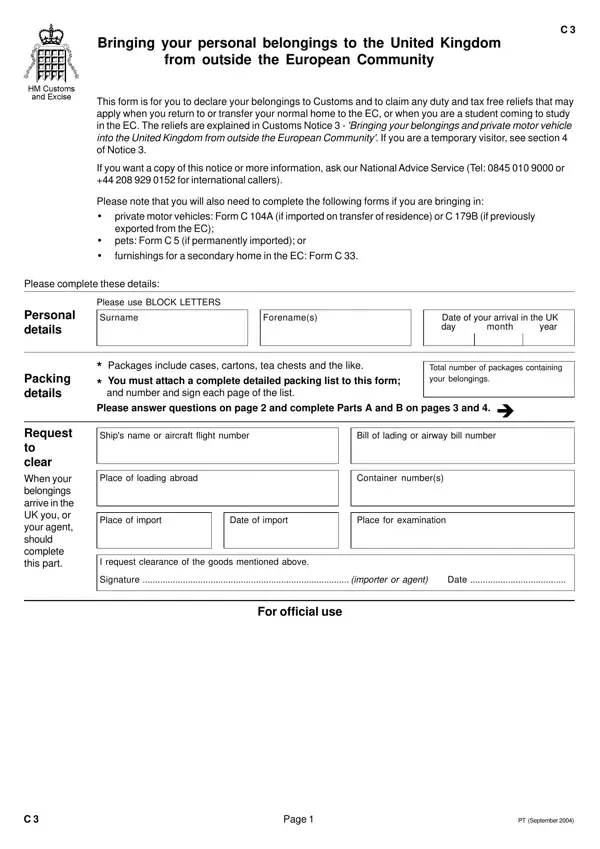
What it is: C 3 is for bringing your personal belongings to the United Kingdom from outside the European Community.
Who signs: This must be signed by the importer of the goods and NOT by an agent.
This form is for you to declare your belongings to Customs and to claim any duty and tax free reliefs that may apply when you return to or transfer your normal home to the EC, or when you are a student coming to study in the EC.
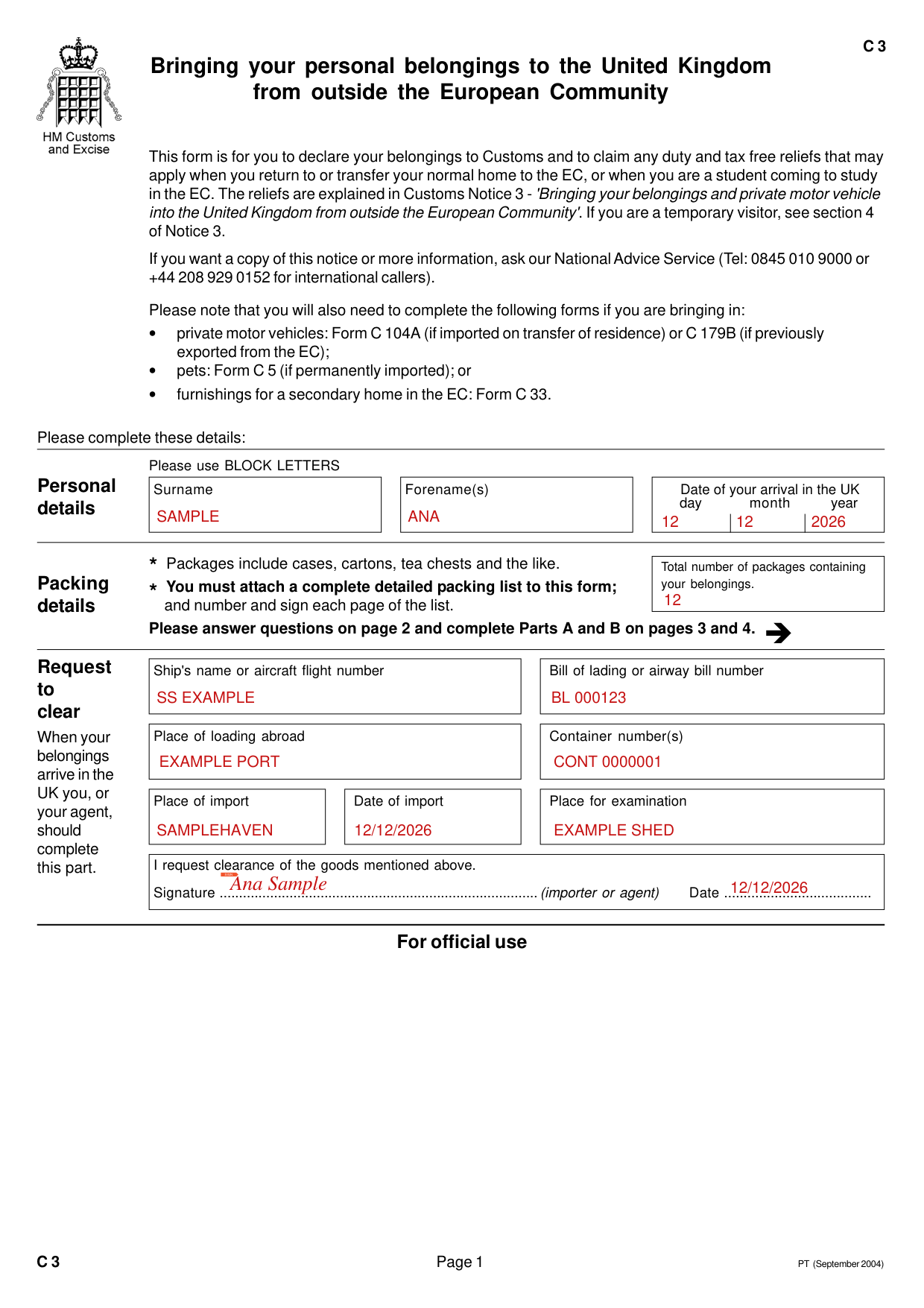
A filled-in Form C 3 example: a person declares belongings on page 1
How to fill out Form C 3, box by box
Personal details

Use BLOCK LETTERS. Enter your Surname, your Forename(s) and the Date of your arrival in the UK with its day, month and year.
Packing details

Enter the total number of packages containing your belongings. Packages include cases, cartons, tea chests and the like. You must attach a complete detailed packing list to this form; and number and sign each page of the list. Please answer questions on page 2 and complete Parts A and B on pages 3 and 4.
Request to clear
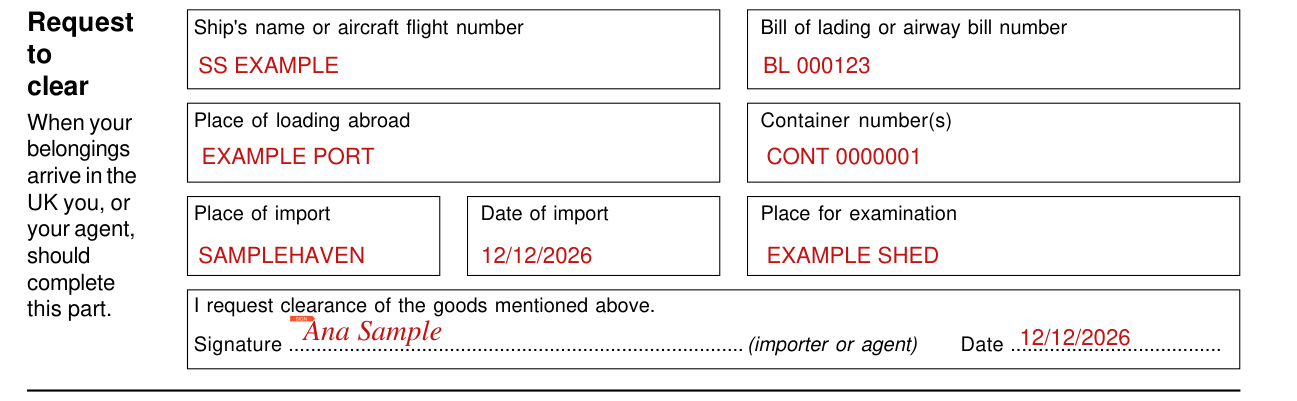
When your belongings arrive in the UK you, or your agent, should complete this part.
Enter the Ship's name or aircraft flight number, the Bill of lading or airway bill number, the Place of loading abroad and the Container number(s).
Enter the Place of import, the Date of import and the Place for examination.
Sign on the Signature line (importer or agent) and enter the Date to request clearance of the goods.
More rules for Form C 3
You will also need to complete the following forms if you are bringing in private motor vehicles: Form C 104A (if imported on transfer of residence) or C 179B (if previously exported from the EC); pets: Form C 5 (if permanently imported); or furnishings for a secondary home in the EC: Form C 33.
Relief is freedom from paying duty and tax when you meet the relevent conditions explained in Customs Notice 3.
Your belongings are the goods kept by you or your immediate family for household or personal use.
Although they have close links with the EC, the following are regarded as outside the EC for tax purposes: the Åland Islands, Andorra, the Canary Islands, the Channel Islands, French Guiana, Guadeloupe, Martinique, Mount Athos, Reunion, San Marino and Turkey. Any area of Cyprus not under the control of the Government of the Republic of Cyprus is treated as outside the EC.
If your situation is different
Returning to, or transferring your normal home to, the EC
If you are returning to or transferring your normal home to the EC, or a student coming to study in the EC, complete '1' or '2' as appropriate.
Tick the correct box and answer all questions unless directed otherwise.
Your normal home is where you usually live, that means where you spend 185 days or more in a period of 12 months because of your work and personal connections. But if you have no work connections or your work and personal connections are in different countries, then you usually live where your personal connections are. However if you are a UK citizen and you are working outside the EC, your normal home can be where you are working so long as you have lived there for 185 days or more in a period of 12 months.
Have you had your normal home outside the EC for a continuous period of 12 months? If No, go to b. If Yes, enter in which country, how long you have lived there, the date of moving, how many persons are moving and how many are under age 17.
Returning to the EC after a temporary visit outside
Are you returning to the EC after a temporary visit outside? If No, go to c. If Yes, enter how long your visit was, list in Part B all goods purchased or obtained during the visit, including any obtained in a duty free shop on the way out from the EC and brought back, and go to Part A.
Moving your normal home to the EC on marriage
Are you moving your normal home to the EC on marriage? If No, go to d. If Yes, give the date of marriage and go to Part A; if your marriage has already taken place, attach a copy of the marriage certificate.
Goods possessed and used for less than 6 months
If you are moving your normal home from outside the EC, do your belongings include any goods which you have possessed and used for less than 6 months? If No, go to e. If Yes, list these goods in Part B and go to e.
Goods obtained under a tax-free scheme
Do your belongings include any goods obtained under a tax-free scheme and on which duty and/or tax remain unpaid? If Yes, list these goods in Part B and answer the following: when you took delivery of the goods, were you a diplomat, a member of an officially recognised international organisation, or a member of NATO forces or civilian component? Are you able to provide evidence of this? Now go to Part A.
Coming to study in the EC
Are you coming to the EC for full time study at an educational establishment? Are your belongings for you to wear, furnish your room or use for the purpose of your studies? List any goods not for these purposes in Part B. Now go to Part A.
Part A
You must list these goods in Part A, even if they are already specified on a packing list: Tobacco products (cigarettes, cigarillos, cigars, other tobacco); Spirits (including liqueurs); Wine; Perfume/Toilet Water; Tools of trade; Goods for commercial use (including goods intended for sale in the UK); Prohibited and restricted goods.
For each type of goods enter the Description of goods, Quantity (eg Number of bottles), Country where obtained and if duty/tax free, Price paid, Present value, How long you have had these, and Marks or description of packages in which packed. If none, write "NONE".
For Spirits put brand name, strength, bottle size and quantity remaining. For Wine put type, bottle size and quantity remaining. For Perfume/Toilet Water put type, bottle size and quantity remaining.
Prohibited and restricted goods include controlled drugs such as opium, heroin, cocaine, MDMA (Ecstasy), morphine, cannabis, amphetamines and lysergide (LSD). Counterfeit currency. Radio transmitters (walkie-talkies, Citizen Band Radios, cordless telephones etc.) not approved for use in the UK. Firearms (including gas pistols, electric shock batons, stun guns and similar weapons), ammunition and explosives (including flares incorporating a barrel). Meat and poultry, and many other animal products. Plants and plant produce including trees and shrubs, potatoes and certain other vegetables, fruit, bulbs and seeds. Indecent or obscene material featuring children. Pornographic material that cannot be freely purchased in the UK. Animals, birds and fish, whether alive or dead (eg stuffed), parts and articles derived from protected species including furskins, ivory, reptile leather, stony corals and goods made from them. Flick knives, butterfly knives and certain other offensive weapons and some martial arts weapons.
Other goods which may be liable to import charges
Part B is for other goods which may be liable to import charges and not already listed in Part A. Complete this Part if required by Section 1 or 2 on page 2.
For each good enter the Description of goods, Quantity, Country where obtained and if duty/tax free, Date obtained, Price paid, Present value, Period of use and Marks or description of packages in which packed. If you have no goods to list, write 'NONE'.
If you have used all the space, add continuation sheet(s). Please number and sign each sheet.
Declaration
Sign on the Signature line and enter the Date.
Declaration: you declare that you have read the notes on this form; all the answers given on this form, the packing list and on the continuation sheet(s) numbered are true and complete; and you are personally aware of what is contained in the packages totalled on the first page, and as specified on the attached packing list.
Enter your Address in the UK and your Telephone number.
Common questions about Form C 3
What is a form C3?
C 3 is for bringing your personal belongings to the United Kingdom from outside the European Community. The reliefs are explained in Customs Notice 3, 'Bringing your belongings and private motor vehicle into the United Kingdom from outside the European Community'.
Where do I file it?
When you have completed this form, send it with any continuation sheet(s), packing list, relevant invoices and the keys for any locked packages to the agent, airline or shipping company that is clearing your belongings through UK Customs.
Is there a penalty?
Imports are examined by Customs and there are heavy penalties for making false declarations including possible forfeiture of goods.
When is this form not the right one?
If you are a temporary visitor, see section 4 of Notice 3. Private motor vehicles are not covered by this form.
Sources
[1] Form C 3 (September 2004), Bringing your personal belongings to the United Kingdom from outside the European Community (the Official source link on this page).