
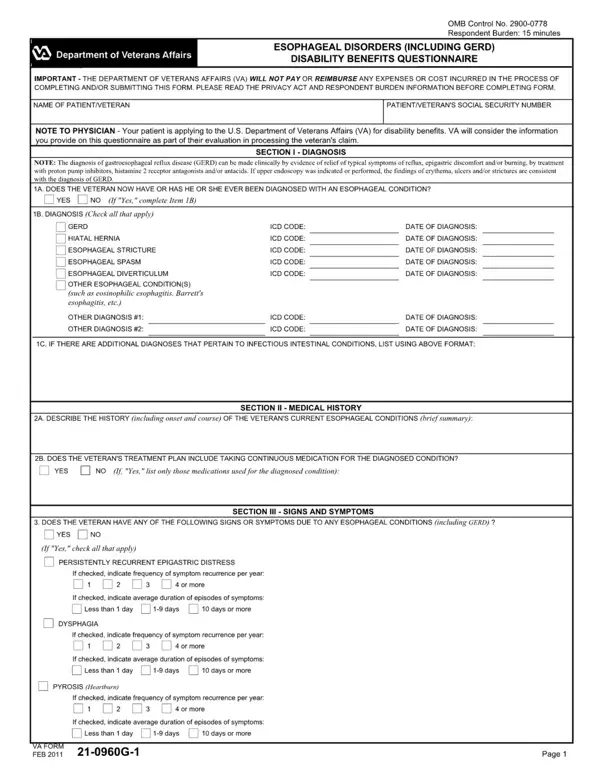

Esophageal Conditions Disability Benefits Questionnaire at a glance
What it is: The Esophageal Conditions Disability Benefits Questionnaire is intended to be completed by the Veteran's healthcare provider, and VA may obtain additional medical information if necessary.
Who signs: The Examiner signs 9A, Examiner's signature.
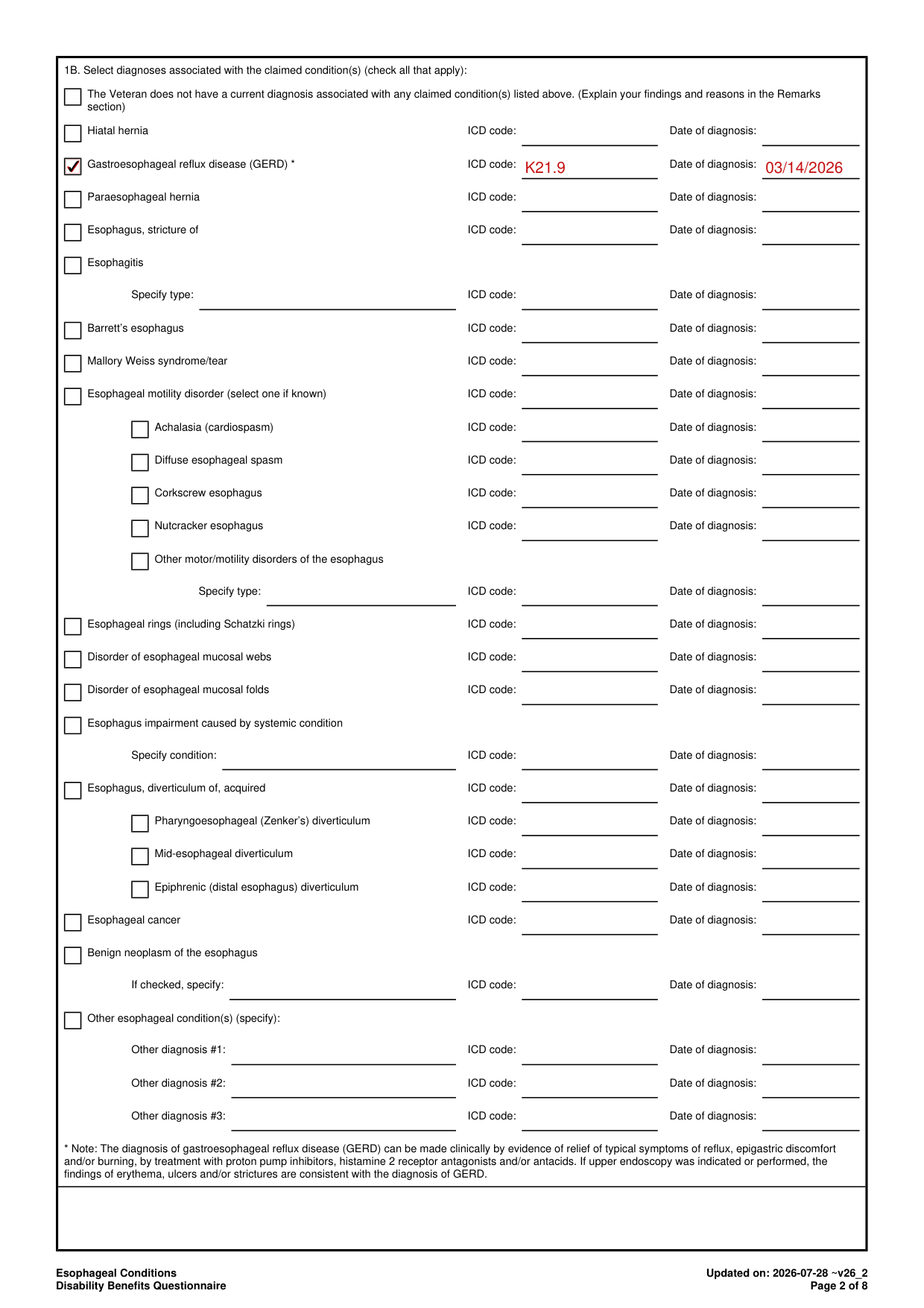
A filled-in Esophageal Conditions Disability Benefits Questionnaire example: a doctor records a GERD diagnosis in 1B
How to fill out Esophageal Conditions Disability Benefits Questionnaire, box by box
1B. Select diagnoses associated with the claimed condition(s)
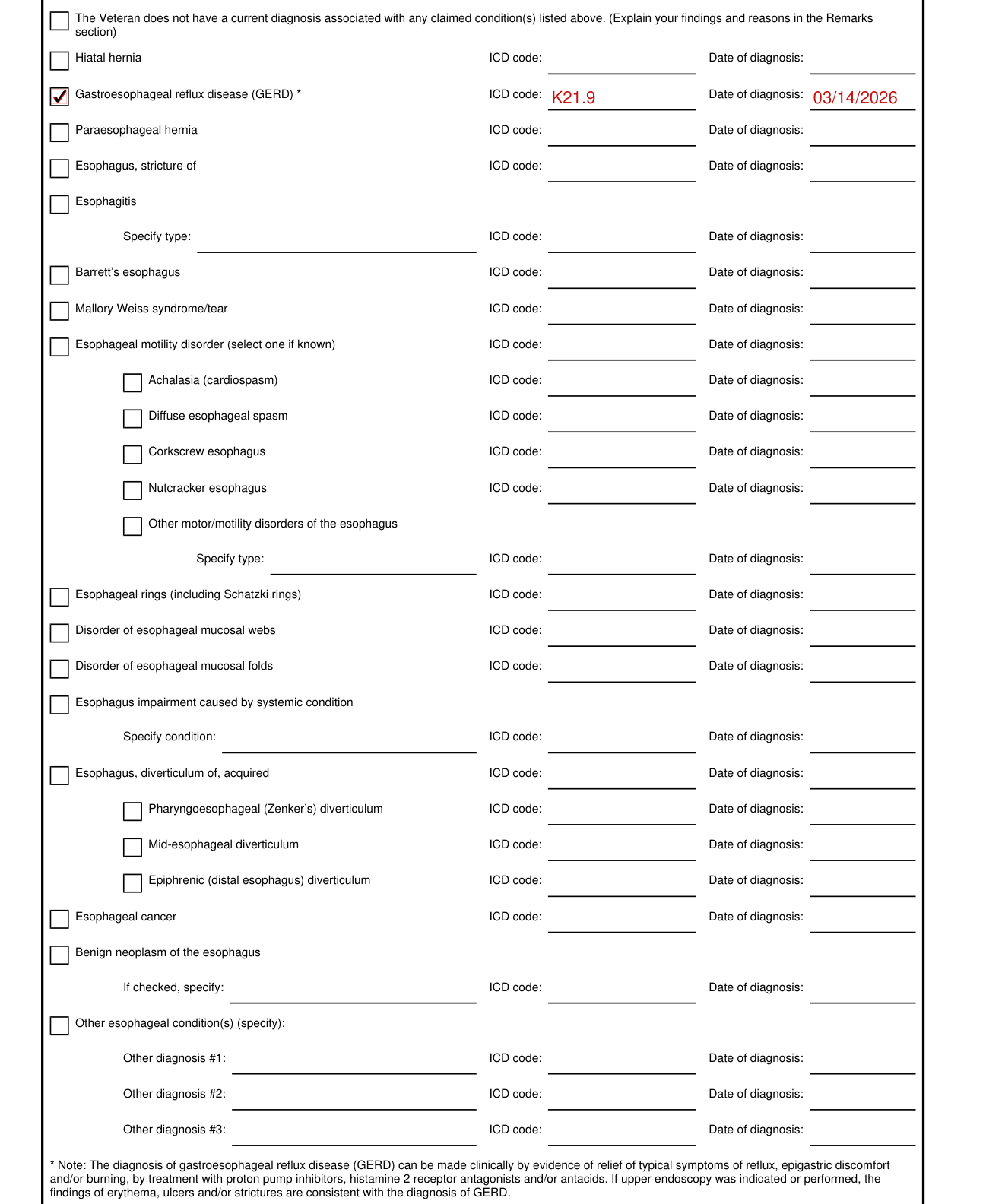
1B. Select diagnoses associated with the claimed condition(s) (check all that apply). If the Veteran does not have a current diagnosis associated with any claimed condition(s) listed in 1A, check the box for that, and explain your findings and reasons in the Remarks section.
The diagnoses listed are Hiatal hernia, Gastroesophageal reflux disease (GERD), Paraesophageal hernia, Esophagus, stricture of, Esophagitis, Barrett's esophagus, Mallory Weiss syndrome/tear, Esophageal motility disorder (select one if known), Esophageal rings (including Schatzki rings), Esophageal cancer, Benign neoplasm of the esophagus and Other esophageal condition(s) (specify), each with ICD code and Date of diagnosis.
The diagnosis of gastroesophageal reflux disease (GERD) can be made clinically by evidence of relief of typical symptoms of reflux, epigastric discomfort and/or burning, by treatment with proton pump inhibitors, histamine 2 receptor antagonists and/or antacids. If upper endoscopy was indicated or performed, the findings of erythema, ulcers and/or strictures are consistent with the diagnosis of GERD.
More rules for Esophageal Conditions Disability Benefits Questionnaire
The Veteran is applying to the U.S. Department of Veterans Affairs (VA) for disability benefits, and VA will consider the information you provide on this questionnaire as part of their evaluation in processing the Veteran's claim. VA may obtain additional medical information, including an examination, if necessary, to complete VA's review of the Veteran's application. VA reserves the right to confirm the authenticity of ALL completed questionnaires.
VA will not pay or reimburse any expenses or cost incurred in the process of completing and/or submitting this form.
Under "Are you completing this Disability Benefits Questionnaire at the request of:", mark Veteran/Claimant, Third party (list the name(s) of organization(s) or individual(s)) or Other: describe.
Mark Yes or No for: Are you a VA Healthcare provider? Is the Veteran regularly seen as a patient in your clinic? Was the Veteran examined in person? If no, how was the examination conducted?
Under EVIDENCE REVIEW, mark Evidence reviewed: No records were reviewed or Records reviewed. For Records reviewed, identify the evidence reviewed (e.g. service treatment records, VA treatment records, private treatment records) and the date range.
In SECTION 1 - DIAGNOSIS, 1A: list the claimed condition(s) that pertain to this questionnaire. These are condition(s) for which an evaluation has been requested on the exam request form (Internal VA) or for which the Veteran has requested medical evidence be provided for submission to VA.
The diagnoses are those determined during this current evaluation of the claimed condition(s) listed in 1A. If there is no diagnosis, if the diagnosis is different from a previous diagnosis for this condition, or if there is a diagnosis of a complication due to the claimed condition(s), explain your findings and reasons in the Remarks section. Date of diagnosis can be the date of the evaluation if the clinician is making the initial diagnosis or an approximate date determined through record review or reported history.
1C. If there are additional diagnoses that pertain to esophageal disorders, list them in the format of 1B.
In SECTION 2 - MEDICAL HISTORY, 2A: describe the history (including onset and course) of the Veteran's esophageal condition(s) (brief summary).
2B. Mark Yes or No: Does the Veteran's treatment plan include taking daily prescribed medication for the diagnosed condition(s)? If yes, list only those medications used for the diagnosed condition(s).
In SECTION 3 - SIGNS AND SYMPTOMS, 3A: mark Yes or No: Does the Veteran have any of the following signs, symptoms, or treatment requirements due to any esophageal condition(s) (including GERD and hiatal hernia)? If yes, check all that apply: Without daily symptoms, Without requirement for daily medication, Dysphagia (difficulty swallowing), Requiring daily medication to control dysphagia.
If you check Documented history of esophageal stricture(s) (see Note 1), indicate if recurrent or refractory by marking Yes or No for Has the esophageal stricture(s) been recurrent or refractory? Note 1: Findings must be documented by barium swallow, computerized tomography (CT), or esophagogastroduodenoscopy (EGD).
If you check Requiring dilatation, indicate frequency: No more than 2 times a year or 3 or more times a year. Mark Yes or No for Was there dilatation utilizing steroids at least 1 time per year? List most recent dates under Date of dilatation.
Also check, as they apply: Requiring esophageal stent placement (see 3C), Aspiration, Undernutrition (see Note 3), Substantial weight loss (see Note 4), Treatment with surgical correction (see 3C and 3D), Treatment with a percutaneous esophago-gastrointestinal tube (PEG tube) (see 3C and 3D), and Other, symptom(s): Specify.
3B. Mark Yes or No: Does the Veteran have Barrett's esophagus documented by pathologic diagnosis? If yes, please answer remainder of questions in 3B: specify severity of dysplasia (High-grade dysplasia, Low-grade dysplasia or No dysplasia), mark Yes or No: Did Barrett's esophagus cause esophageal stricture(s)? and mark Yes or No: Has the Barrett's esophagus been resolved via surgery, radiofrequency ablation, or other treatment? If yes, give type of procedure and date.
3C. Mark Yes or No: Did the Veteran have surgery or other procedure performed for an esophageal condition(s) (other than Barret's esophagus) or hiatal hernia? If yes, give type(s) and date(s).
3D. Mark Yes or No: Does the Veteran have chronic complications of esophageal or hiatal hernia surgery as identified in 3B and/or 3C? If yes, check all that apply (if appropriate): Post-operative, asymptomatic; Requiring continuous total parenteral nutrition (TPN) for a period longer than 30 consecutive days in the last six months; Requiring continuous tube feeding for a period longer than 30 consecutive days in the last six months.
In SECTION 4 - TUMORS AND NEOPLASMS, 4A: mark Yes or No: Does the Veteran currently have, or has had, a benign or malignant neoplasm or metastases related to any condition in the diagnosis section? If yes, complete the following section. 4B: Is the neoplasm Benign or Malignant? If malignant complete the following.
In SECTION 5, 5A: mark Yes or No: Does the Veteran have any other pertinent physical findings, complications, conditions, signs or symptoms related to any conditions listed in the diagnosis section above? if yes, describe (brief summary). 5B: mark Yes or No: Does the Veteran have any scars or other disfigurement (of the skin) related to any conditions or to the treatment of any conditions listed in the diagnosis section? If yes, also complete the appropriate dermatological questionnaire.
In SECTION 6 - DIAGNOSTIC TESTING, if testing has been performed and reflects Veteran's current condition, no further testing is required for this examination report. Esophageal stricture must be documented by barium swallow, CT, or EGD. 6A: mark Yes or No: Have clinically relevant diagnostic imaging studies or other diagnostic procedures been performed or reviewed in conjunction with this examination? If yes, check all that apply.
In SECTION 7 - FUNCTIONAL IMPACT, provide the impact of only the diagnosed condition(s), without consideration of the impact of other medical conditions or factors, such as age. 7A: mark Yes or No: Regardless of the Veteran's current employment status, do the conditions listed in the diagnosis section impact his/her ability to perform any type of occupational task (such as standing, walking, lifting, sitting, etc.)? If yes, describe the functional impact of each condition, providing one or more examples.
In SECTION 8 - REMARKS, 8A: add remarks (if any - please identify the section to which the remark pertains when appropriate).
Common questions about Esophageal Conditions Disability Benefits Questionnaire
Who signs it?
In SECTION 9 - EXAMINER'S CERTIFICATION AND SIGNATURE, enter 9A. Examiner's signature, 9B. Examiner's printed name and title (e.g. MD, DO, DDS, DMD, Ph.D, Psy.D, NP, PA-C), 9C. Examiner's area of practice/specialty (e.g. Cardiology, Orthopedics, Psychology/Psychiatry, General Practice), 9D. Date signed, 9E. Examiner's phone/fax numbers, 9F. National Provider Identifier (NPI) number, 9G. Medical license number and state, and 9H. Examiner's address.
Is there a penalty?
PENALTY: The law provides severe penalties which include fine or imprisonment, or both, for the willful submission of any statement or evidence of a material fact, knowing it to be false, or for the fraudulent acceptance of any payment to which you are not entitled.
What am I certifying when I sign?
CERTIFICATION - To the best of my knowledge, the information contained herein is accurate, complete, and current.
Sources
[1] Esophageal Conditions Disability Benefits Questionnaire (Updated on: 2026-07-28), U.S. Department of Veterans Affairs (the Official source link on this page).