

VA Form 4092 at a glance
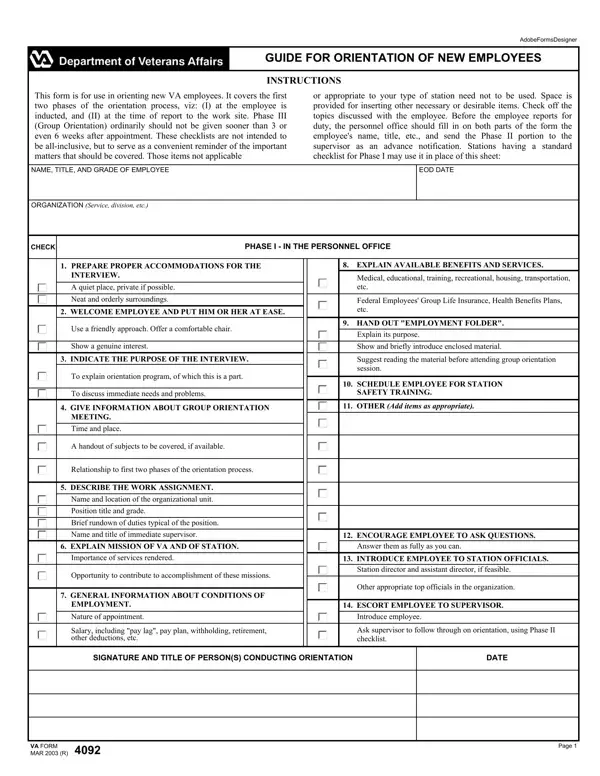
What it is: VA Form 4092, Guide for Orientation of New Employees, has Phase I in the personnel office and Phase II at the work site.
Who signs: SIGN: the DATE and SIGNATURE AND TITLE OF PERSON(S) CONDUCTING ORIENTATION. SIGN: the DATE and SIGNATURE AND TITLE OF SUPERVISOR(S) CONDUCTING ORIENTATION.
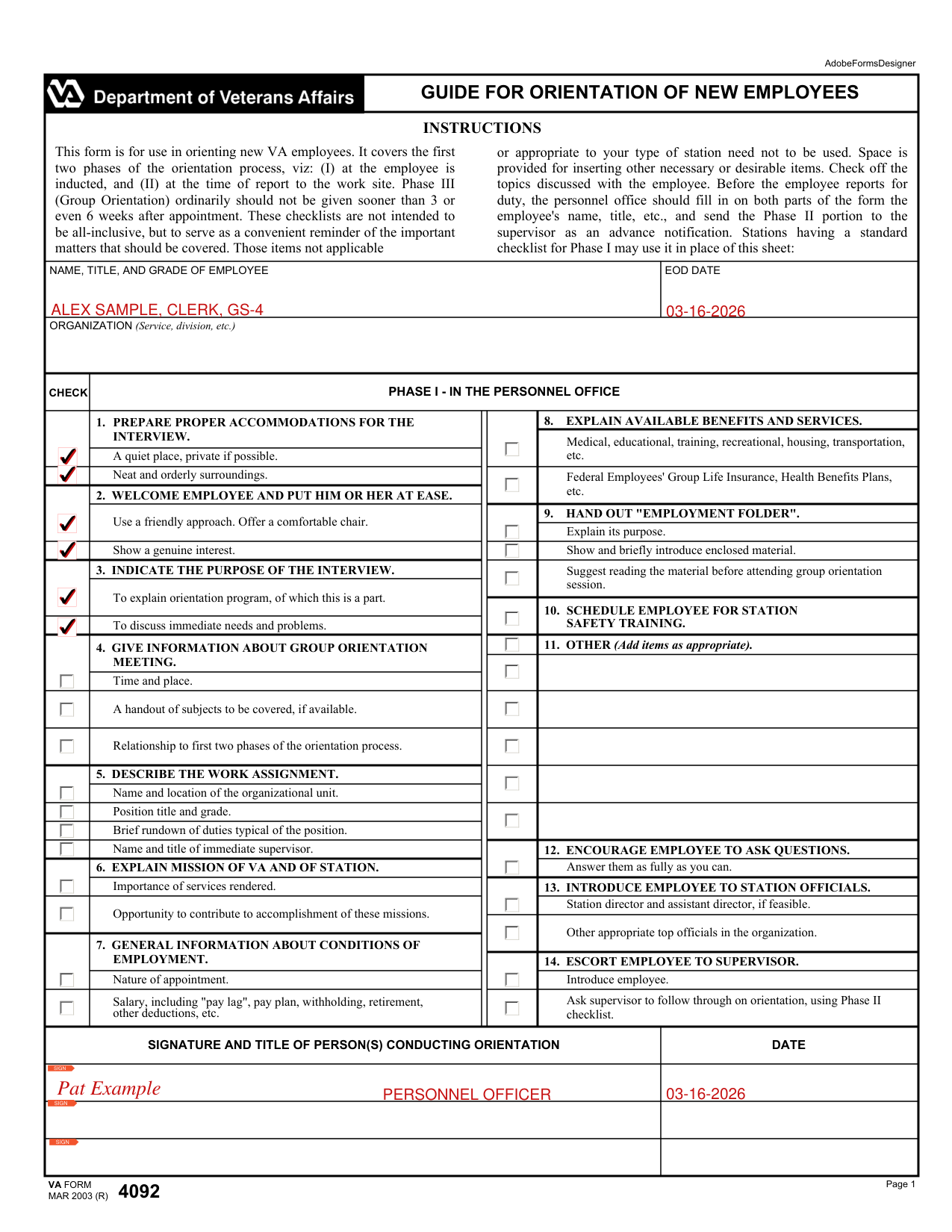
A filled-in VA Form 4092 example: a personnel officer completes Phase I
How to fill out VA Form 4092, box by box
Employee name, title, grade and EOD date

Fill in the EOD DATE and the NAME, TITLE, AND GRADE OF EMPLOYEE. Before the employee reports for duty, the personnel office should fill in on both parts of the form the employee's name, title, etc., and send the Phase II portion to the supervisor as an advance notification. Check off the topics discussed with the employee. Stations having a standard checklist for Phase I may use it in place of this sheet. Those items not applicable or appropriate to your type of station need not be used. This form is for use in orienting new VA employees. Phase III (Group Orientation) ordinarily should not be given sooner than 3 or even 6 weeks after appointment.
Items 1 to 3: accommodations, welcome and purpose
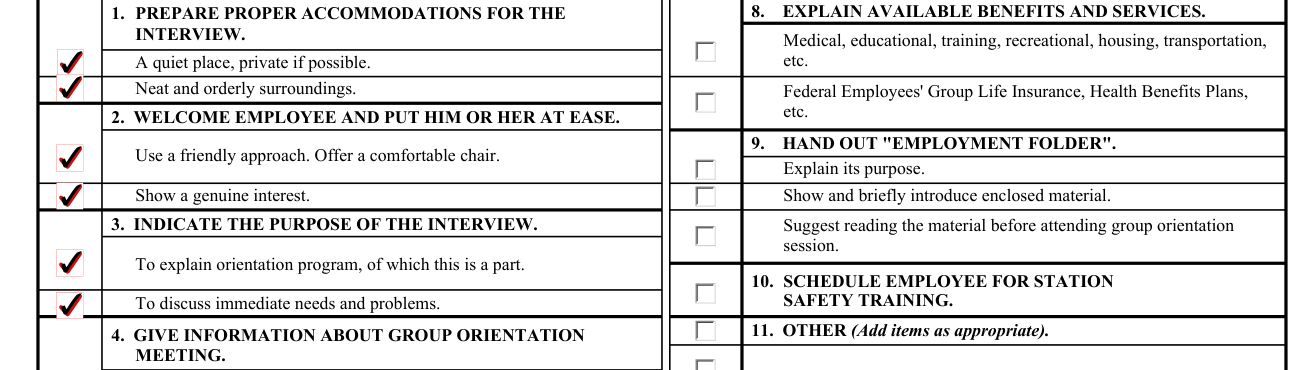
1. Prepare proper accommodations for the interview: a quiet place, private if possible; neat and orderly surroundings.
2. Welcome employee and put him or her at ease: use a friendly approach; offer a comfortable chair; show a genuine interest.
3. Indicate the purpose of the interview: to explain orientation program, of which this is a part; to discuss immediate needs and problems.
Items 4 to 14: group orientation, work assignment, mission, conditions, benefits and escort
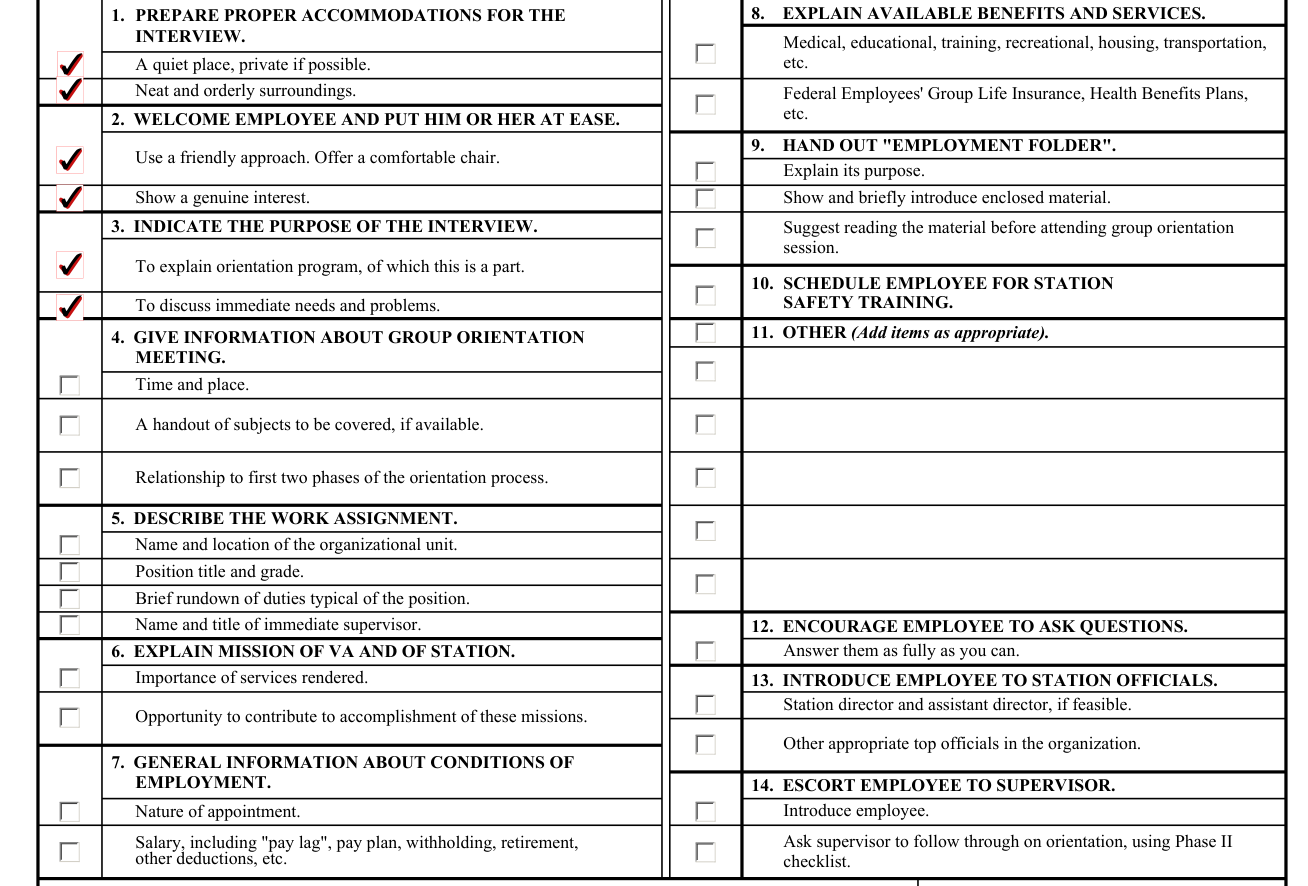
4. Give information about group orientation meeting: time and place; a handout of subjects to be covered, if available; relationship to first two phases of the orientation process.
5. Describe the work assignment: name and location of the organizational unit; position title and grade; brief rundown of duties typical of the position; name and title of immediate supervisor.
6. Explain mission of VA and of station: importance of services rendered; opportunity to contribute to accomplishment of these missions.
7. General information about conditions of employment: nature of appointment; salary, including "pay lag", pay plan, withholding, retirement, other deductions, etc.
8. Explain available benefits and services: medical, educational, training, recreational, housing, transportation, etc.; Federal Employees' Group Life Insurance, Health Benefits Plans, etc.
9. Hand out "Employment Folder": explain its purpose; show and briefly introduce enclosed material; suggest reading the material before attending group orientation session.
10. Schedule employee for station safety training.
11. Other (Add items as appropriate).
12. Encourage employee to ask questions: answer them as fully as you can.
13. Introduce employee to station officials: station director and assistant director, if feasible; other appropriate top officials in the organization.
14. Escort employee to supervisor: introduce employee; ask supervisor to follow through on orientation, using Phase II checklist.
Signature and title of person(s) conducting orientation

SIGN: the DATE and SIGNATURE AND TITLE OF PERSON(S) CONDUCTING ORIENTATION.
Phase II: the supervisor, the employee and the organization

This checklist is for use by the supervisor(s) in orienting a new employee reporting for duty at the work unit.
Phase II items 1 to 3: get ready, welcome and the work of the unit
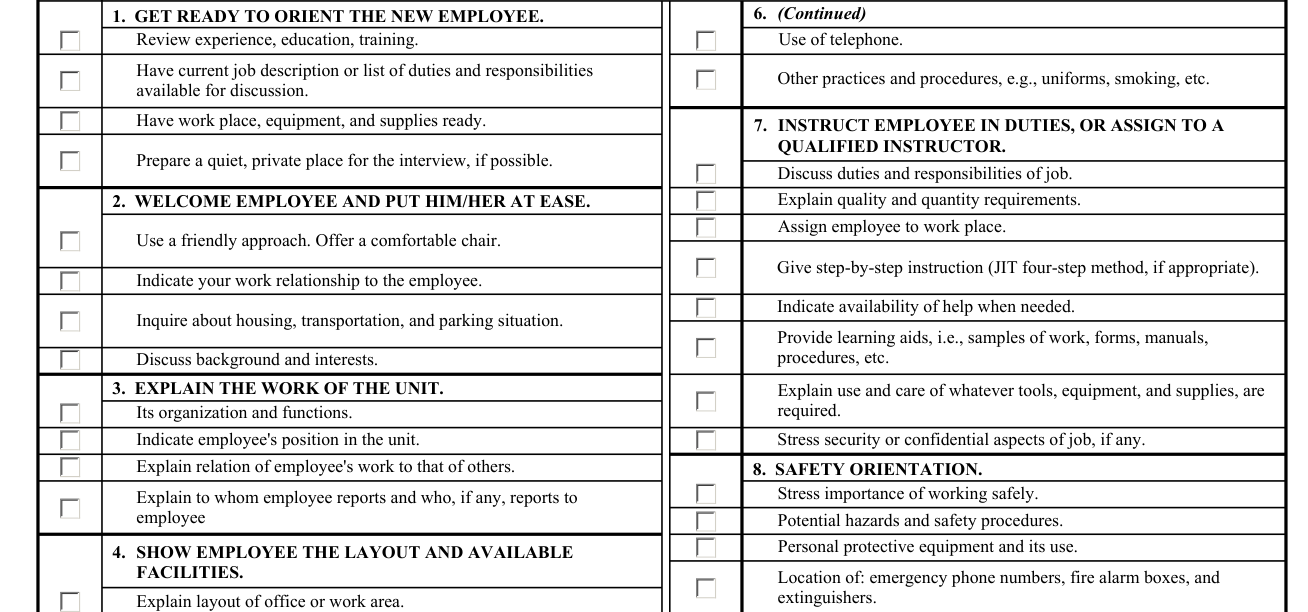
In Phase II, at the work site, check off the items covered in the interview(s).
1. Get ready to orient the new employee: review experience, education, training; have current job description or list of duties and responsibilities available for discussion; have work place, equipment, and supplies ready; prepare a quiet, private place for the interview, if possible.
2. Welcome employee and put him/her at ease: use a friendly approach; offer a comfortable chair; indicate your work relationship to the employee; inquire about housing, transportation, and parking situation; discuss background and interests.
3. Explain the work of the unit: its organization and functions; indicate employee's position in the unit; explain relation of employee's work to that of others; explain to whom employee reports and who, if any, reports to employee.
Phase II items 4 to 6: layout, introductions and unit rules
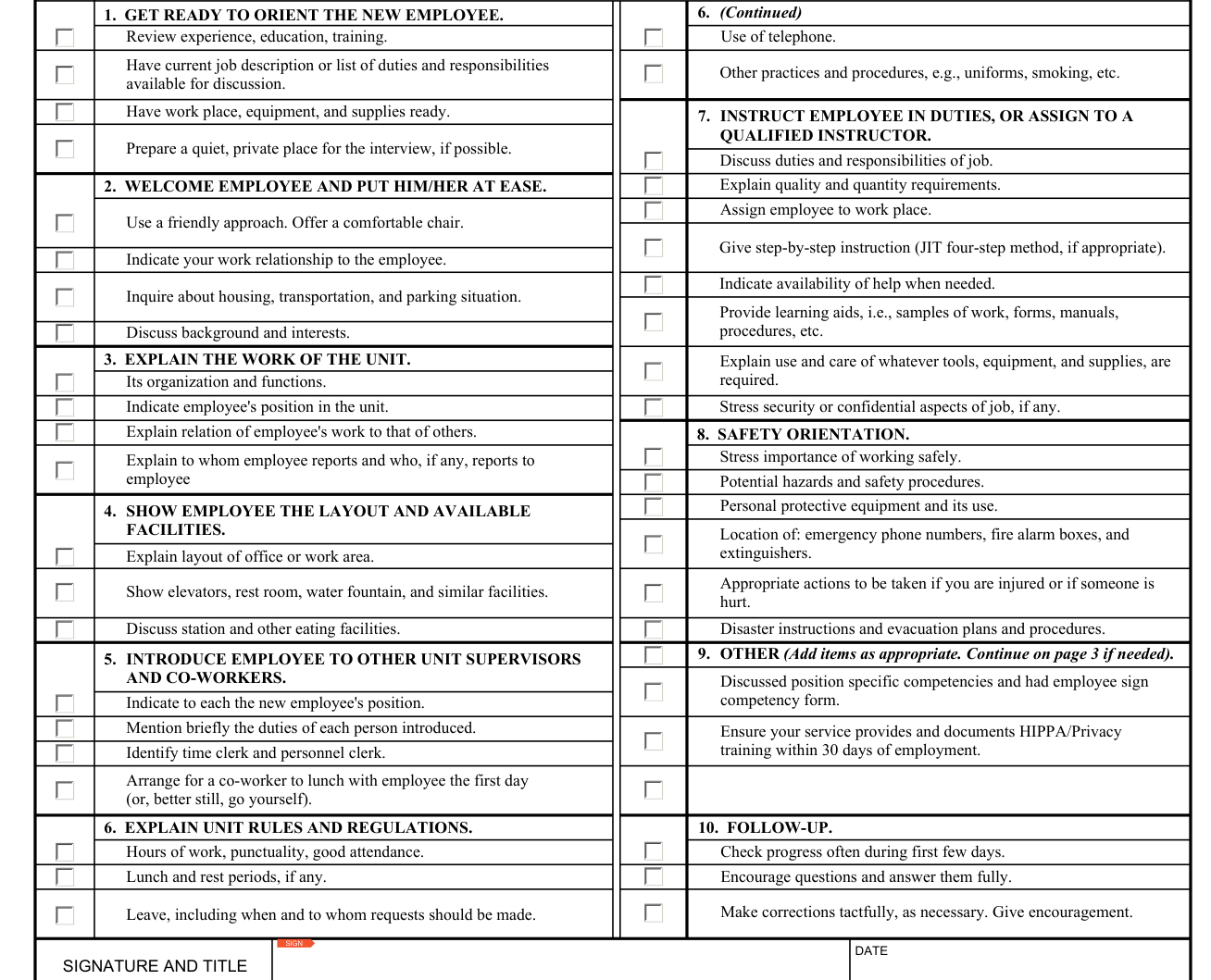
4. Show employee the layout and available facilities: explain layout of office or work area; show elevators, rest room, water fountain, and similar facilities; discuss station and other eating facilities.
5. Introduce employee to other unit supervisors and co-workers: indicate to each the new employee's position; mention briefly the duties of each person introduced; identify time clerk and personnel clerk; arrange for a co-worker to lunch with employee the first day (or, better still, go yourself).
6. Explain unit rules and regulations: hours of work, punctuality, good attendance; lunch and rest periods, if any; leave, including when and to whom requests should be made; use of telephone; other practices and procedures, e.g., uniforms, smoking, etc.
Phase II items 7 and 8: instruction in duties and safety orientation
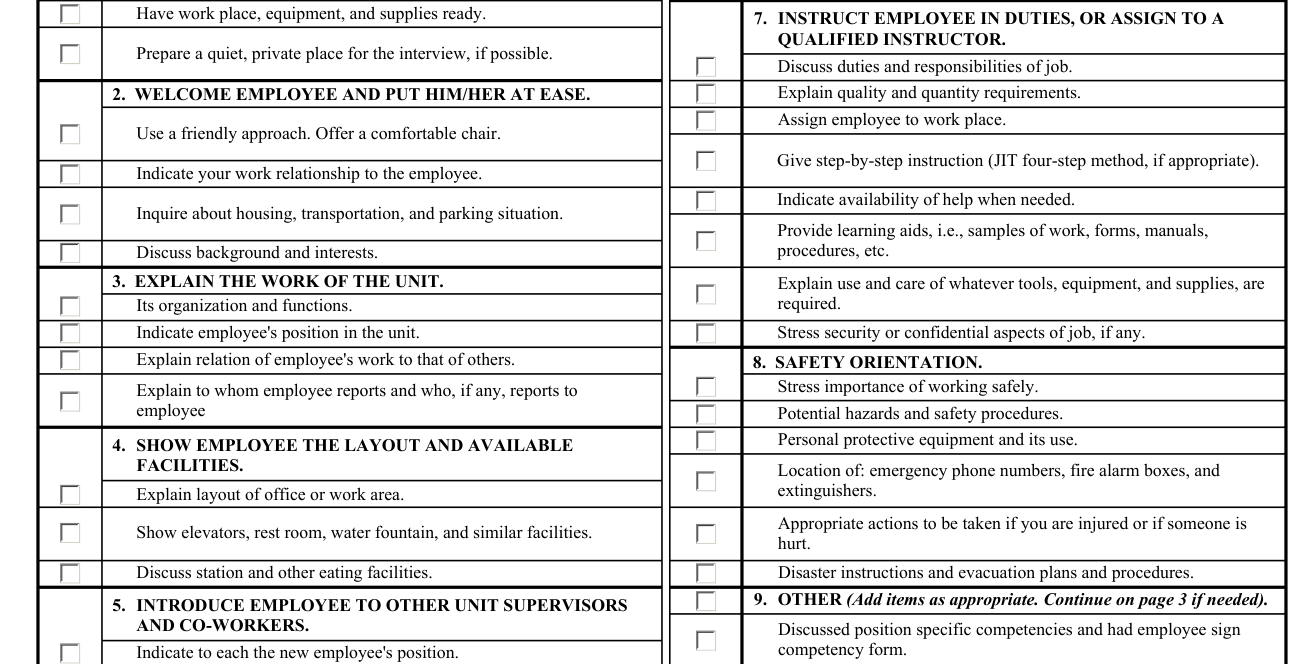
7. Instruct employee in duties, or assign to a qualified instructor: discuss duties and responsibilities of job; explain quality and quantity requirements; assign employee to work place; give step-by-step instruction (JIT four-step method, if appropriate); indicate availability of help when needed.
7. Instruct employee in duties, or assign to a qualified instructor: provide learning aids, i.e., samples of work, forms, manuals, procedures, etc.; explain use and care of whatever tools, equipment, and supplies, are required; stress security or confidential aspects of job, if any.
8. Safety orientation: stress importance of working safely; potential hazards and safety procedures; personal protective equipment and its use; location of: emergency phone numbers, fire alarm boxes, and extinguishers; appropriate actions to be taken if you are injured or if someone is hurt; disaster instructions and evacuation plans and procedures.
Phase II items 9 and 10: other and follow-up
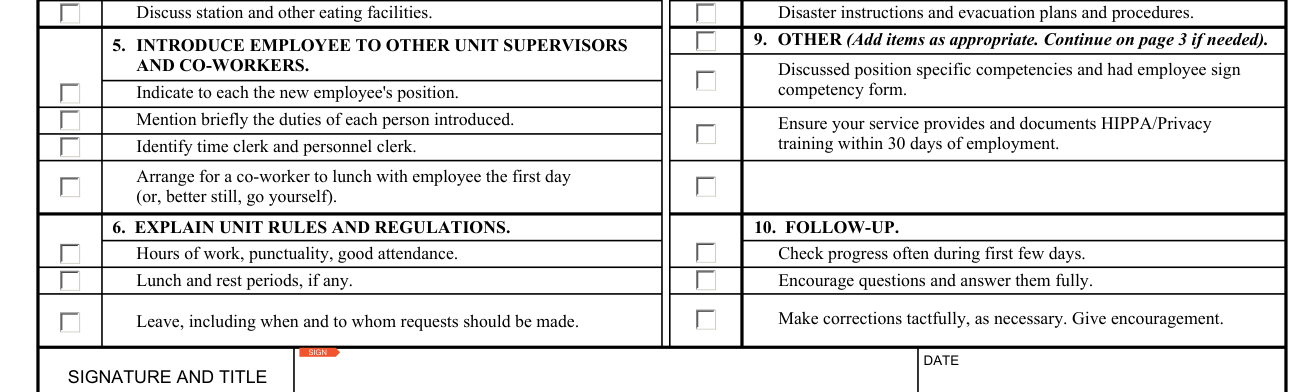
9. Other (Add items as appropriate. Continue on page 3 if needed): discussed position specific competencies and had employee sign competency form; ensure your service provides and documents HIPPA/Privacy training within 30 days of employment.
10. Follow-up: check progress often during first few days; encourage questions and answer them fully; make corrections tactfully, as necessary; give encouragement.
Phase II signature of supervisor(s) conducting orientation

SIGNATURE AND TITLE OF SUPERVISOR(S) CONDUCTING ORIENTATION: SIGN, then DATE.
The form should be signed and returned to the personnel office within 15 days after the employee's entrance on duty.
More rules for VA Form 4092
The list is intended not to be all-inclusive, but to serve as a convenient reminder of the important matters that should be covered.
Space is provided for inserting other necessary or desirable items.
Some topics may best be discussed with the employee by the division or service chief; others may be more suitable for discussion by the immediate supervisor.
(Note: Both sheets may then be destroyed. If preferred, they may be held for a locally determined time for such purposes as review by the Training Development Committee and then destroyed.)
Sources
[1] VA Form 4092 (MAR 2003), Guide for Orientation of New Employees, Department of Veterans Affairs (the Official source link on this page).