
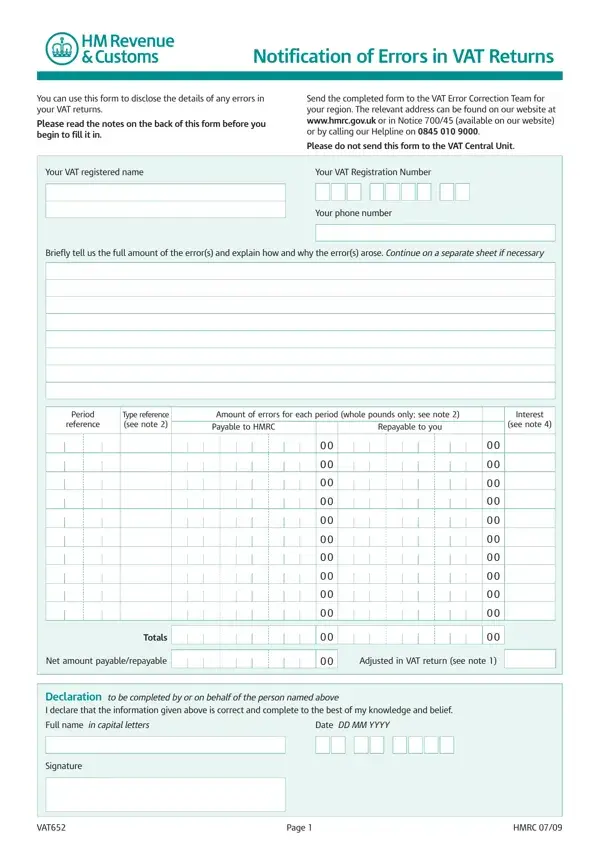

Form VAT652 at a glance
What it is: Notification of Errors in VAT Returns: you can use this form to disclose the details of any errors in your VAT returns.
Where and when to file: Send the completed form to the VAT Error Correction Team for your region. Please do not send this form to the VAT Central Unit.
When you find you have made an error(s) in a previous VAT return you must tell HM Revenue & Customs (HMRC) and can use this form to do so.
A filled-in Form VAT652 example: one output tax error disclosed by Jane Sample
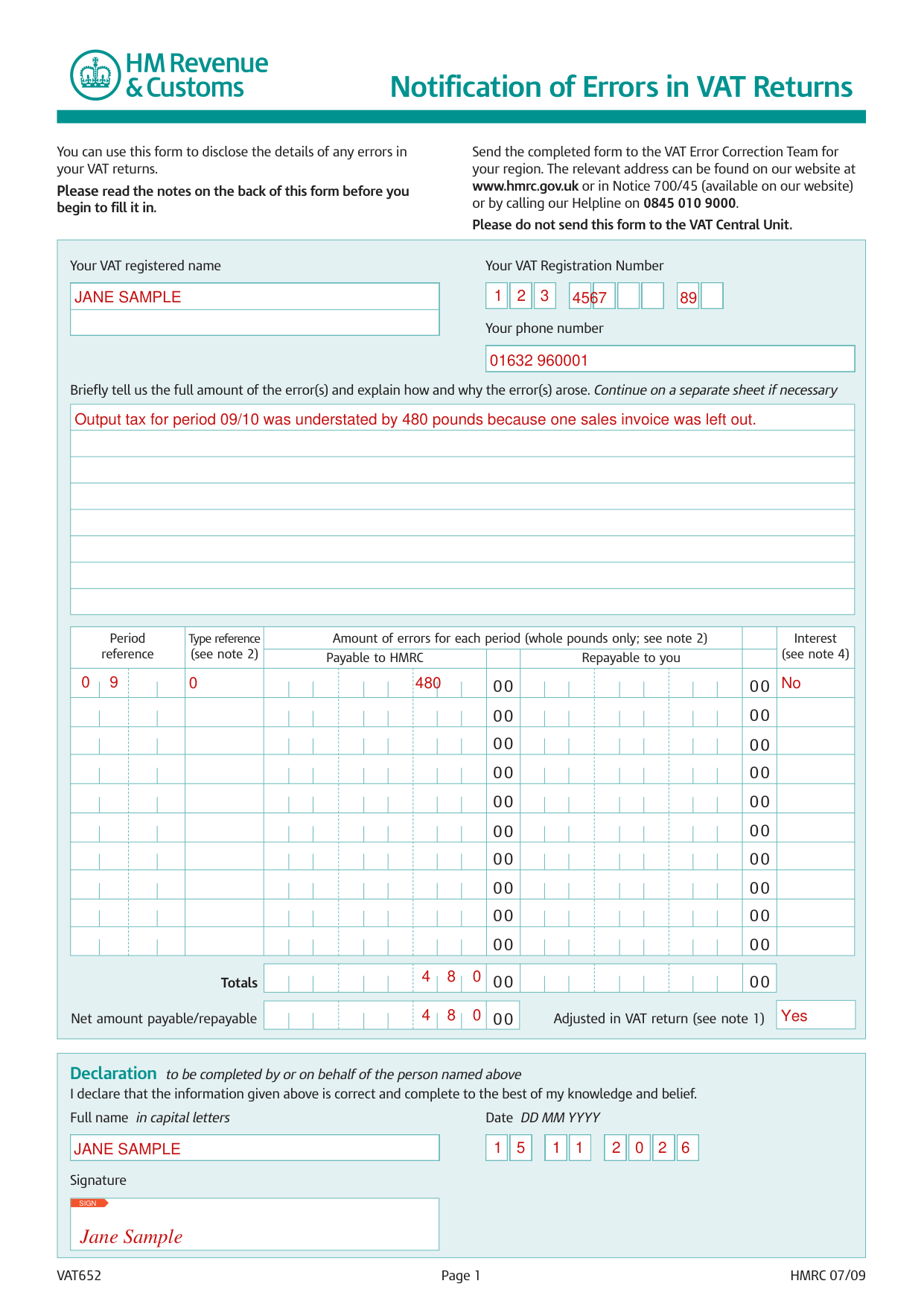
How to fill out Form VAT652, box by box
Your VAT registered name, VAT Registration Number and phone number

Enter Your VAT registered name and Your VAT Registration Number.
Enter Your phone number.
Briefly tell us the full amount of the error(s) and explain how and why the error(s) arose
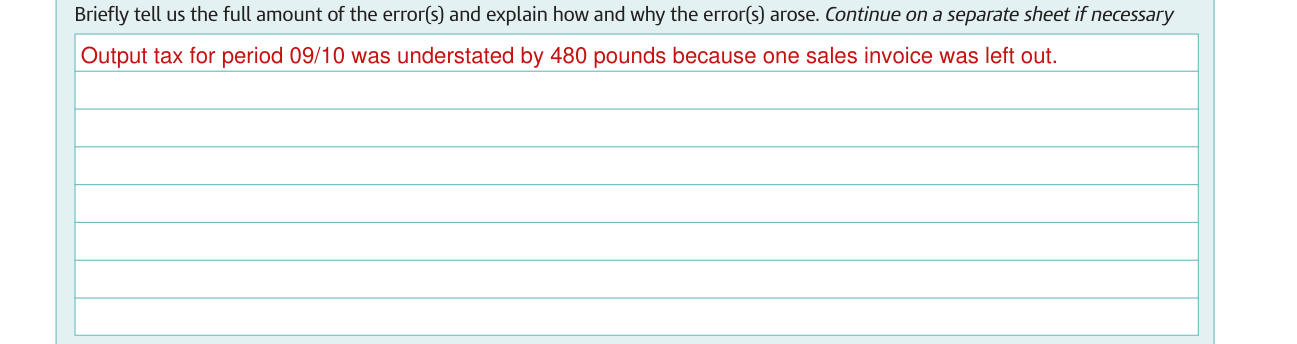
Explain how and why the error(s) arose, and briefly tell the full amount of the error(s). Continue on a separate sheet if necessary.
This form can be used to disclose careless and deliberate inaccuracies. It is entirely up to you to decide whether to provide HMRC with information about the circumstances that gave rise to an understatement of tax. However, in calculating the amount of any penalty that may be due HMRC will take into account the completeness of your explanation and the extent to which you help HMRC quantify the error.
Period reference, Type reference, Amount of errors for each period and Interest
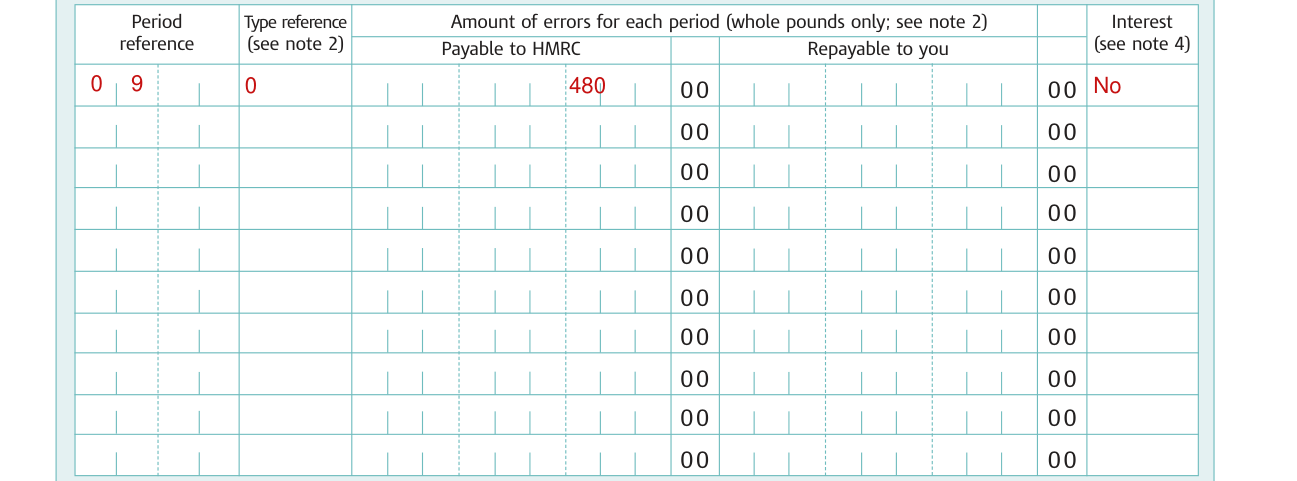
2 How to use this form: You should give details by VAT period (‘Period reference') of any underdeclarations and overdeclarations.
Amounts payable to HMRC should be rounded down to the nearest pound. Amounts payable to you should be rounded up.
Put errors arising from input tax on separate lines from those arising from output tax. Indicate in the ‘Type reference' box which are output tax and which are input tax errors by inserting ‘0' for output and ‘1' for input tax errors.
4 Default Interest: HMRC will normally charge interest if the charge represents commercial restitution. By this HMRC means the compensation required when HMRC has been deprived of an amount of VAT for a period of time as a result of an underdeclaration of the amount of tax due on a VAT return, where none of that tax is recoverable by a third party as if it were input tax. If you consider that charging interest for an error would not represent commercial restitution, then you should insert ‘No' in the box marked ‘Interest' to indicate this.
If you do not complete this box you may be charged interest. Remember, that if you insert ‘No' and HMRC later finds that interest is due, the amount HMRC then charges will be greater.
Guidance to help you decide if interest is due is available in Notice 700/43 Default Interest.
Totals

Under Totals, enter the Net amount payable/repayable and the Adjusted in VAT return (see note 1).
You can include the net value of the adjustment in the VAT return for the period of discovery if the net value of the errors does not exceed the greater of £10,000, or 1% of the box 6 figure required on the VAT return for the period of discovery, subject to an upper limit of £50,000. (checked November 10, 2026)
If you have included, or intend to include, the adjustment in the VAT return for the period of discovery then you should insert ‘Yes' in the box marked ‘Adjusted in VAT return' to indicate this.
Declaration and signature
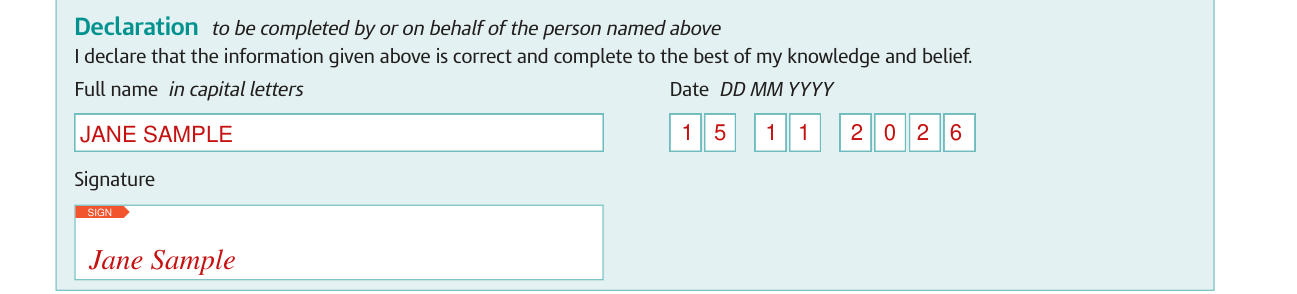
You declare that the information given is correct and complete to the best of your knowledge and belief. Write the Full name in capital letters.
Enter the Date as DD MM YYYY and sign on the Signature line.
More rules for Form VAT652
These are normal accounting adjustments and you should make them in accordance with the rules governing the relevant adjustment and show them separately in your VAT account. However, you can use this form if you made the original adjustment incorrectly or at the wrong time.
5 How to pay: You will be sent a ‘Value Added Tax Notice of Error Correction' confirming the amount of your disclosure and any interest calculated on it. You will also get a ‘Statement of Account' showing the current balance including interest payable to HMRC and details of how to make your payment.
6 Further advice: You can find out more about these procedures in Notice 700/45 How to correct VAT errors and make adjustments or claims which is available on the website or the Helpline on 0845 010 9000.
Caution: Although it may benefit you in certain circumstances to wait until the end of the current accounting period before deciding if you must tell HMRC about the errors, remember, the longer you delay the more interest you may have to pay.
You must disclose correctly, full details of the errors before enquiries start.
Common questions about Form VAT652
Where do I file it?
The relevant address can be found at www.hmrc.gov.uk or in Notice 700/45.
Is there a penalty?
If there are errors which you have not disclosed and they are discovered, you could incur a penalty.
When is this form not the right one?
Do not use this form for the following: the annual adjustment required by some retail schemes; any adjustments required on ceasing to use a retail scheme; the use of an approved estimation procedure; claims for bad debt relief; adjustments arising from credit and debit notes; adjustments made under the capital goods scheme; partial exemption standard method or annual adjustments; adjustments related to exports and intra-EC supplies, as detailed in Notice 703, Section 9.
Sources
[1] Form VAT652 (07/09), Notification of Errors in VAT Returns, HM Revenue & Customs (the Official source link on this page).