
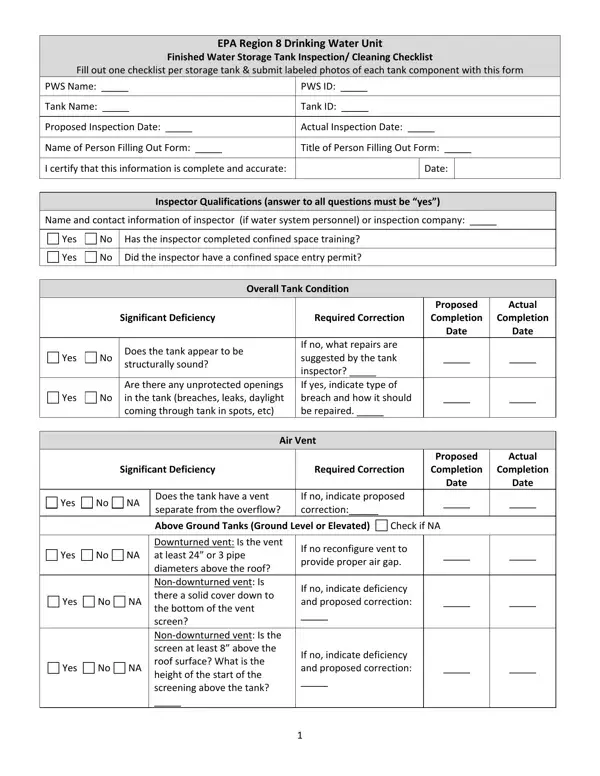

EPA Region 8 Finished Water Storage Tank Checklist at a glance
What it is: The EPA Region 8 Drinking Water Unit Finished Water Storage Tank Checklist is for either a Tank Inspection/Cleaning Report or an Unknown Integrity Significant Deficiency.
Who signs: Complete the line “I certify that this information is complete & accurate” and enter the Date.
What to bring and attach to EPA Region 8 Finished Water Storage Tank Checklist
Fill out one checklist per storage tank & submit labeled photos of each tank component with this form.
Attach tank as-built drawings or a sketch of the tank's configuration & dimensions including the location, layout & dimensions of all major components (i.e., access hatch, vent, overflow, drain).
A filled-in EPA Region 8 Finished Water Storage Tank Checklist example: an operator fills out the checklist for one cleaned tank
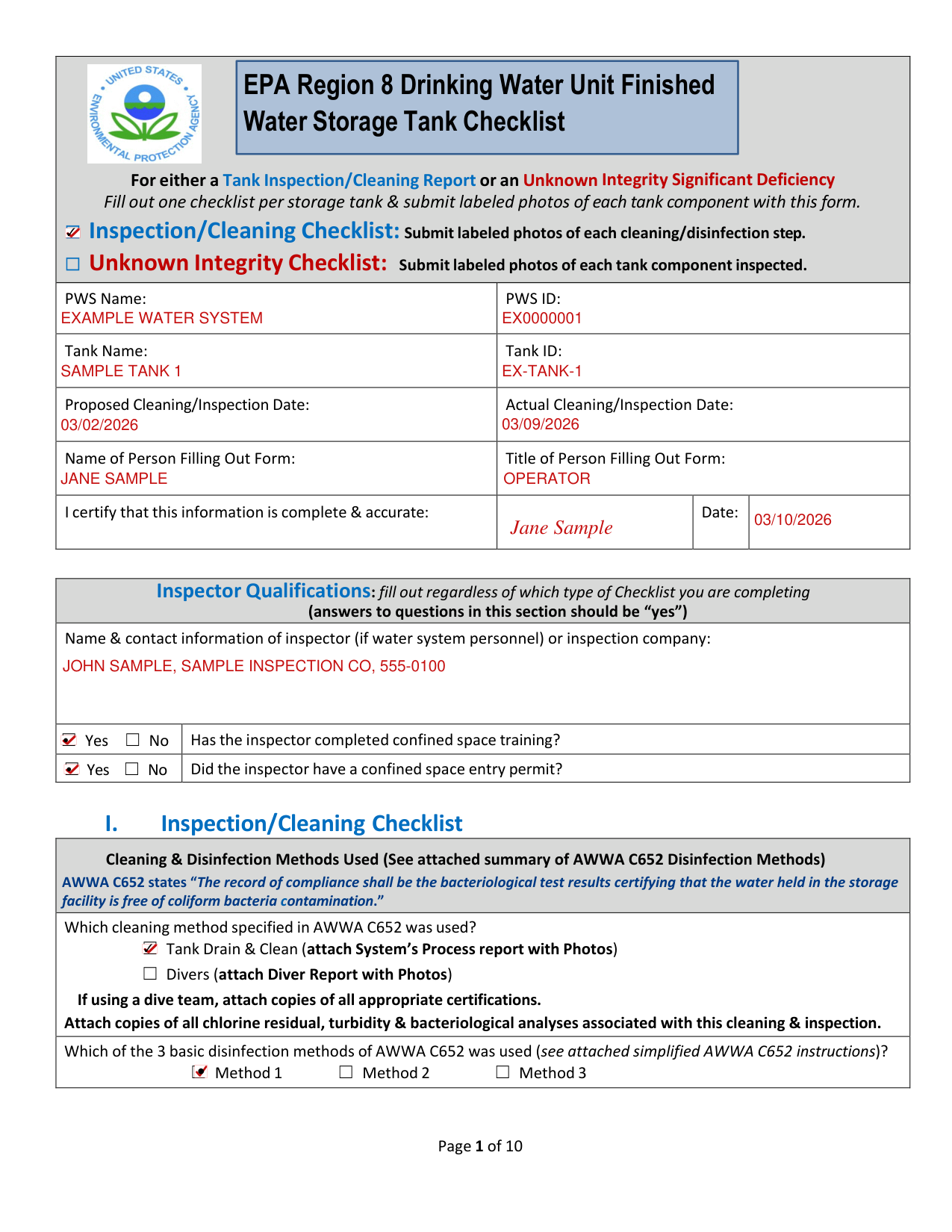
How to fill out EPA Region 8 Finished Water Storage Tank Checklist, box by box
Inspection/Cleaning Checklist or Unknown Integrity Checklist

Inspection/Cleaning Checklist: Submit labeled photos of each cleaning/disinfection step.
Unknown Integrity Checklist: Submit labeled photos of each tank component inspected.
PWS, tank, dates and person filling out the form
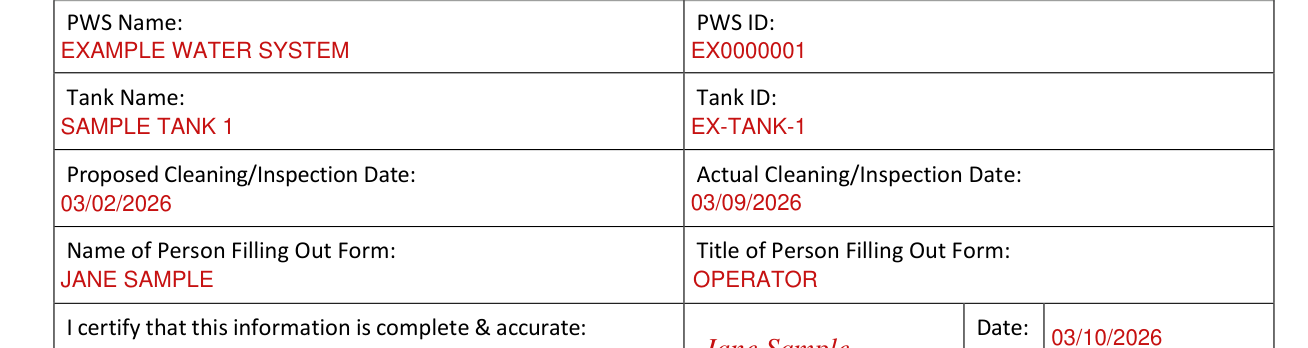
Enter the PWS Name and the PWS ID.
Enter the Tank Name and the Tank ID.
Enter the Proposed Cleaning/Inspection Date and the Actual Cleaning/Inspection Date.
Enter the Name of Person Filling Out Form and the Title of Person Filling Out Form.
I certify that this information is complete & accurate

Complete the line “I certify that this information is complete & accurate” and enter the Date.
Inspector Qualifications

Fill out Inspector Qualifications regardless of which type of Checklist you are completing; answers to questions in this section should be “yes”.
Enter the name & contact information of inspector (if water system personnel) or inspection company.
Mark Yes or No: Has the inspector completed confined space training?
Mark Yes or No: Did the inspector have a confined space entry permit?
Cleaning & Disinfection Methods Used

Mark which cleaning method specified in AWWA C652 was used: Tank Drain & Clean (attach System's Process report with Photos) or Divers (attach Diver Report with Photos). If using a dive team, attach copies of all appropriate certifications.
Attach copies of all chlorine residual, turbidity & bacteriological analyses associated with this cleaning & inspection.
Mark which of the 3 basic disinfection methods of AWWA C652 was used: Method 1, Method 2 or Method 3.
AWWA C652 states “The record of compliance shall be the bacteriological test results certifying that the water held in the storage facility is free of coliform bacteria contamination.”
Tank Cleaning Details
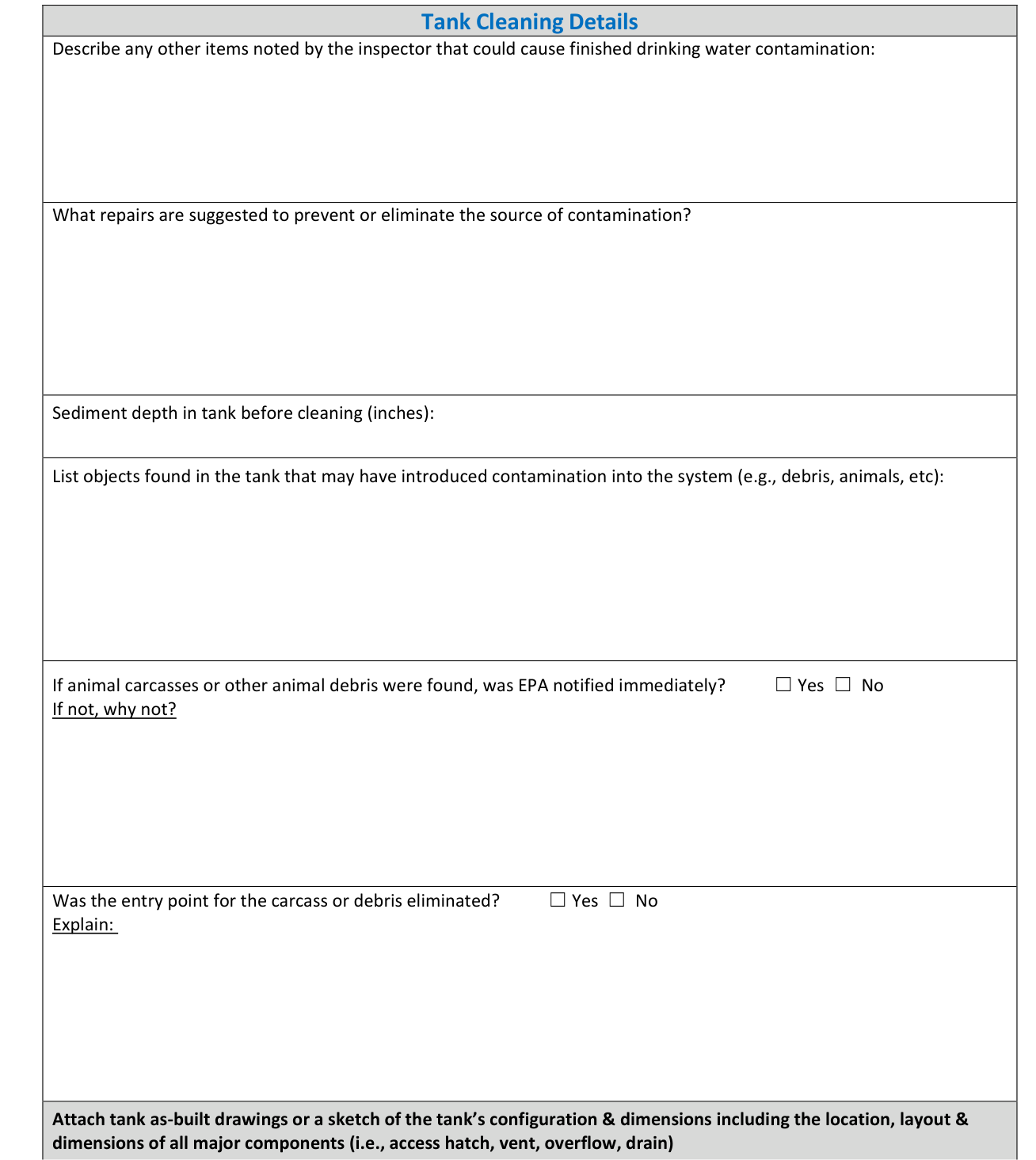
Describe any other items noted by the inspector that could cause finished drinking water contamination.
Say what repairs are suggested to prevent or eliminate the source of contamination.
Enter the sediment depth in tank before cleaning (inches).
List objects found in the tank that may have introduced contamination into the system (e.g., debris, animals, etc).
If animal carcasses or other animal debris were found, mark Yes or No: was EPA notified immediately? If not, why not?
Mark Yes or No: Was the entry point for the carcass or debris eliminated? Explain.
Overall Tank Condition
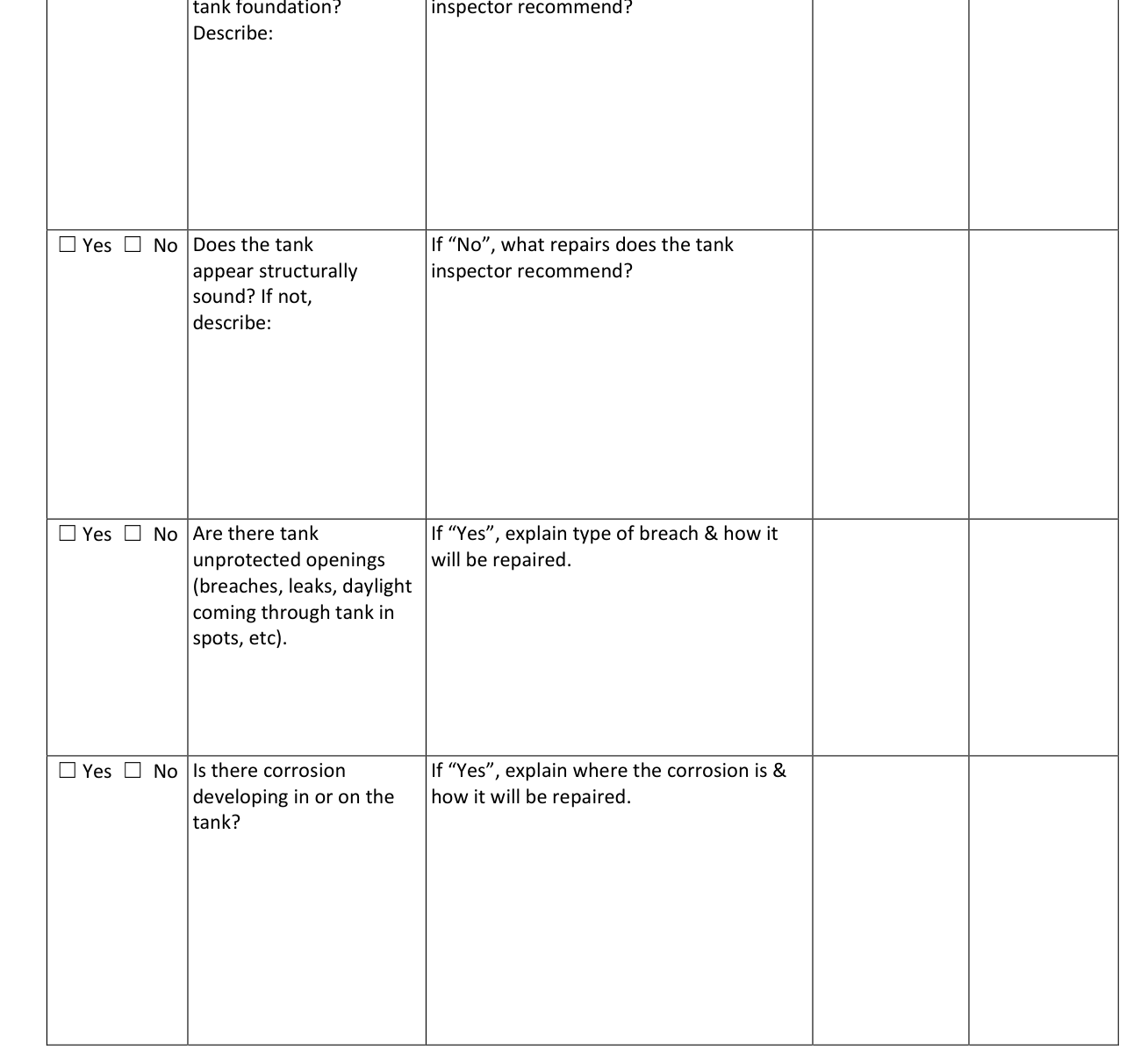
Mark Yes or No: Are there issues with the tank foundation? Describe.
If “Yes”, say what repairs the tank inspector recommends.
Mark Yes or No: Does the tank appear structurally sound? If not, describe.
If “No”, say what repairs the tank inspector recommends.
Mark Yes or No: Are there tank unprotected openings (breaches, leaks, daylight coming through tank in spots, etc). If “Yes”, explain type of breach & how it will be repaired.
Mark Yes or No: Is there corrosion developing in or on the tank? If “Yes”, explain where the corrosion is & how it will be repaired.
Unknown Integrity/Tank Inspection Checklist: Overflow
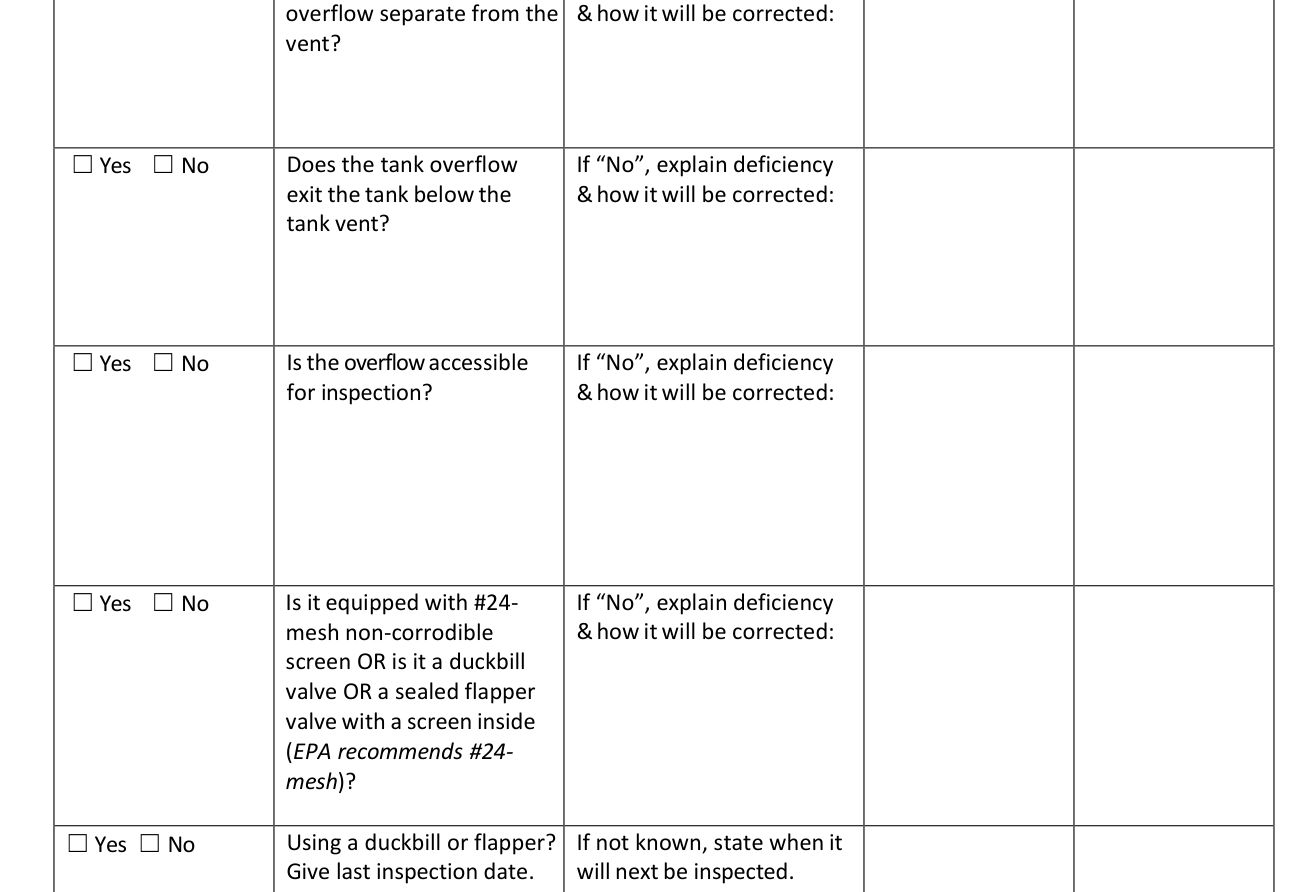
Mark Yes or No: Does the tank have an overflow separate from the vent?
If “No”, explain deficiency & how it will be corrected.
Mark Yes or No: Is the overflow accessible for inspection?
Mark Yes or No: Is it equipped with #24- mesh non-corrodible screen OR is it a duckbill valve OR a sealed flapper valve with a screen inside (EPA recommends #24- mesh)?
Unknown Integrity/Tank Inspection Checklist: Drain
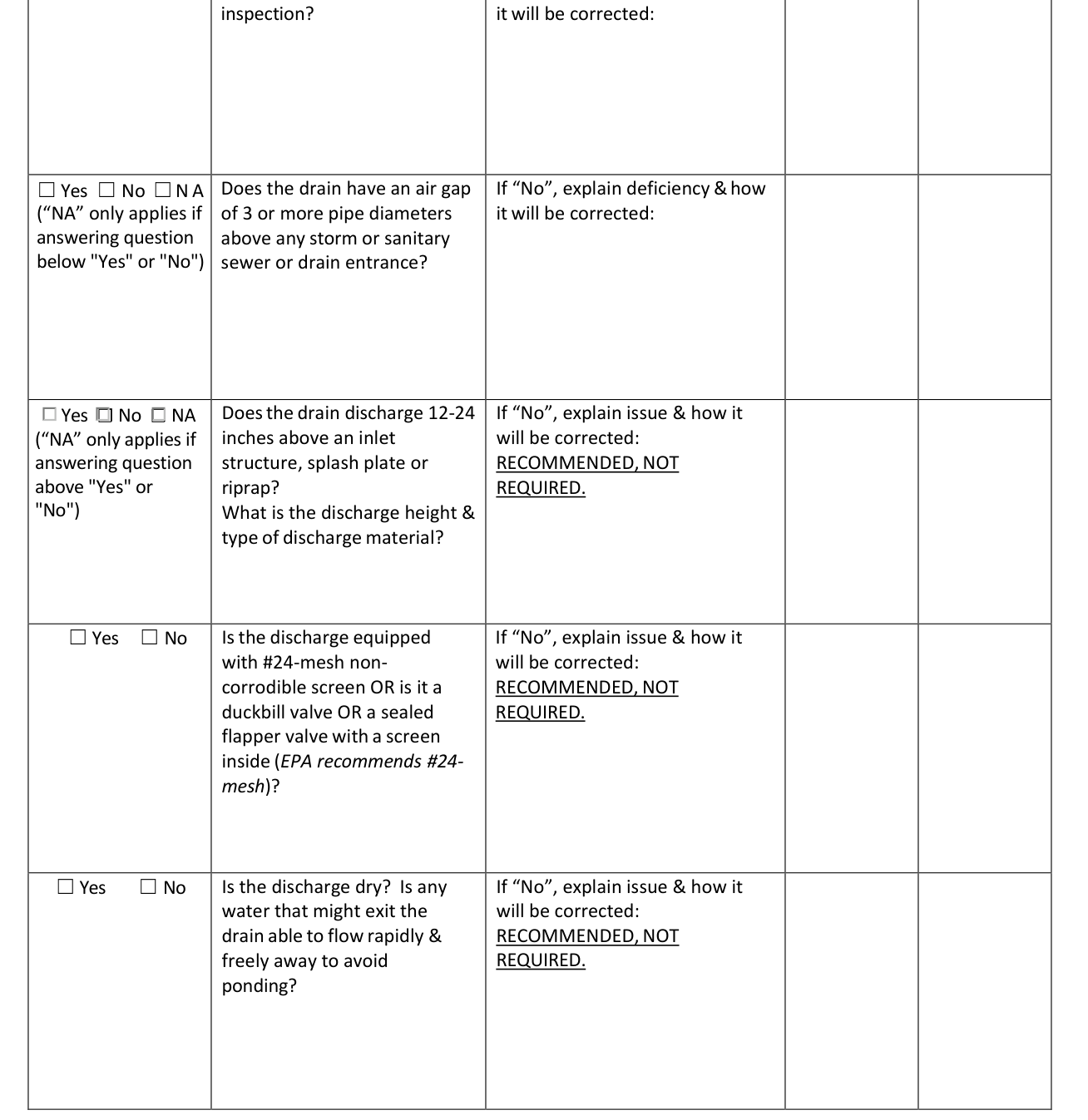
Mark Yes or No: Is the drain accessible for inspection?
Is the discharge equipped with #24-mesh non-corrodible screen OR is it a duckbill valve OR a sealed flapper valve with a screen inside (EPA recommends #24-mesh)? Is the discharge dry? Is any water that might exit the drain able to flow rapidly & freely away to avoid ponding? If “No”, explain issue & how it will be corrected: RECOMMENDED, NOT REQUIRED.
Unknown Integrity/Tank Inspection Checklist: Air Vent
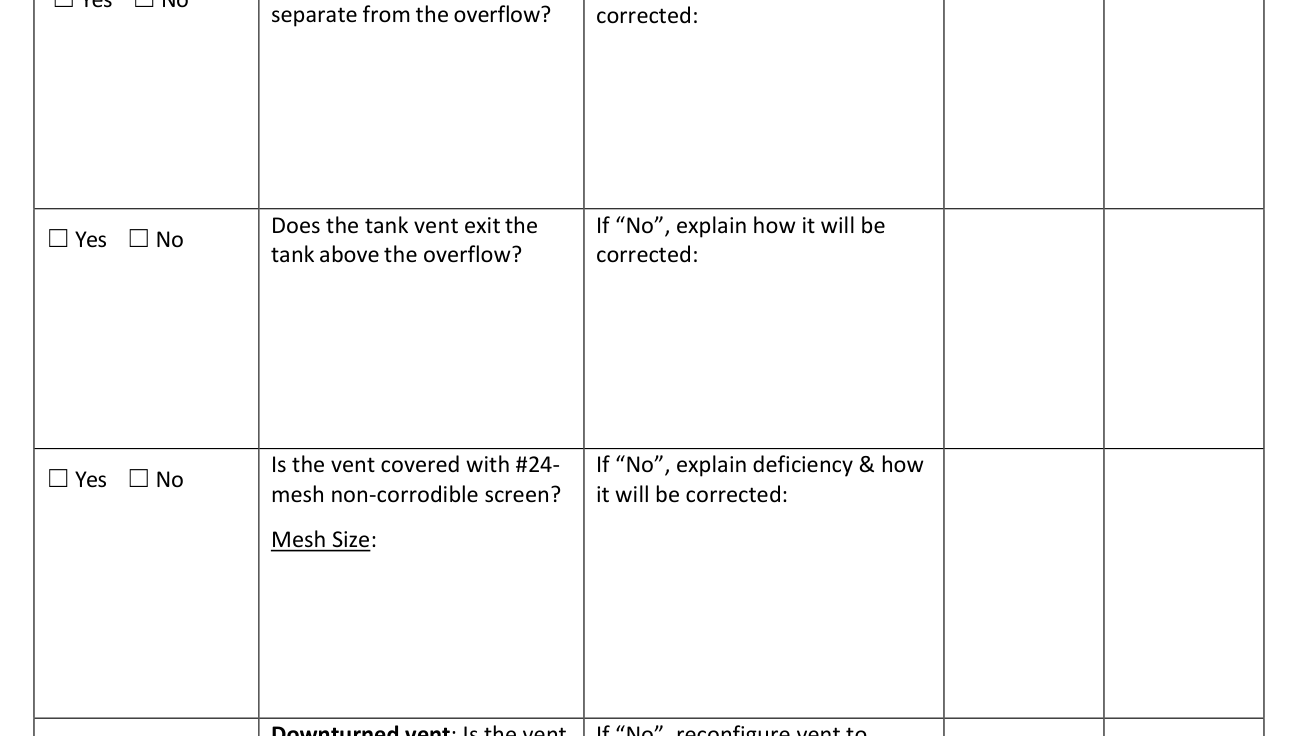
Mark Yes or No: Does the tank have a vent separate from the overflow? If “No”, explain how it will be corrected.
Mark Yes or No: Is the vent covered with #24- mesh non-corrodible screen? Enter the Mesh Size.
Unknown Integrity/Tank Inspection Checklist: Access Hatch
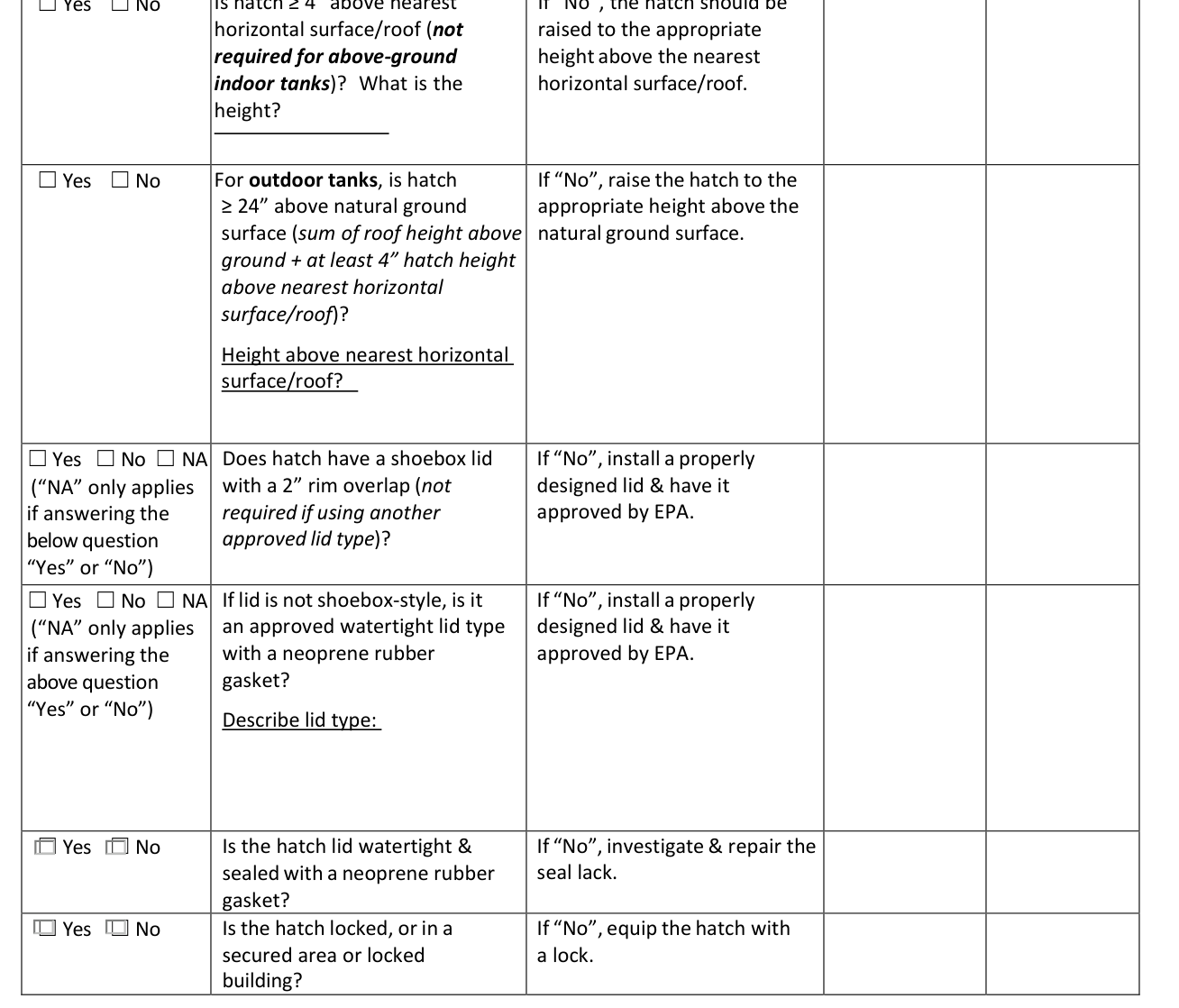
On Page 8 of 10, mark Yes or No: Is hatch ≥ 4” above nearest horizontal surface/roof (not required for above-ground indoor tanks)? What is the height?
Is the hatch lid watertight & sealed with a neoprene rubber gasket? If “No”, investigate & repair the seal lack.
Is the hatch locked, or in a secured area or locked building? If “No”, equip the hatch with a lock.
Sources
[1] EPA Region 8 Drinking Water Unit Finished Water Storage Tank Checklist, U.S. Environmental Protection Agency (the Official source link on this page).