

Wood Badge Ticket Workbook at a glance
What it is: Wood Badge Ticket Workbook: the purpose of a Wood Badge Ticket is to help you realize your personal vision of your role in Scouting. Its five goals can be attained within 18 months.
Who signs: Ticket Counselor Goal Approval: Date.
A filled-in Wood Badge Ticket Workbook example: a participant fills in the Vision and Values page
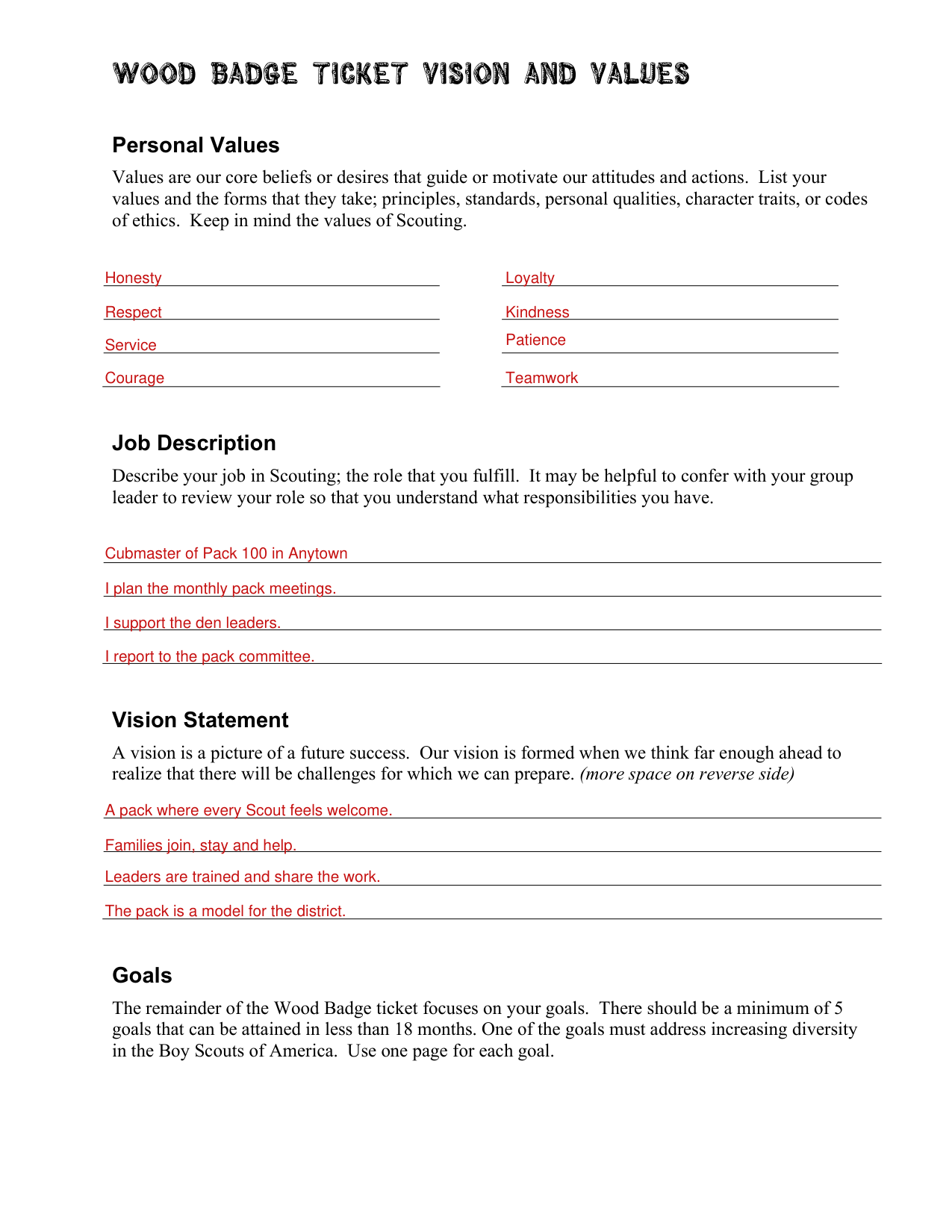
How to fill out Wood Badge Ticket Workbook, box by box
Personal Values

List your values and the forms that they take; principles, standards, personal qualities, character traits, or codes of ethics.
Values are core beliefs or desires that guide or motivate attitudes and actions. Keep in mind the values of Scouting.
Job Description
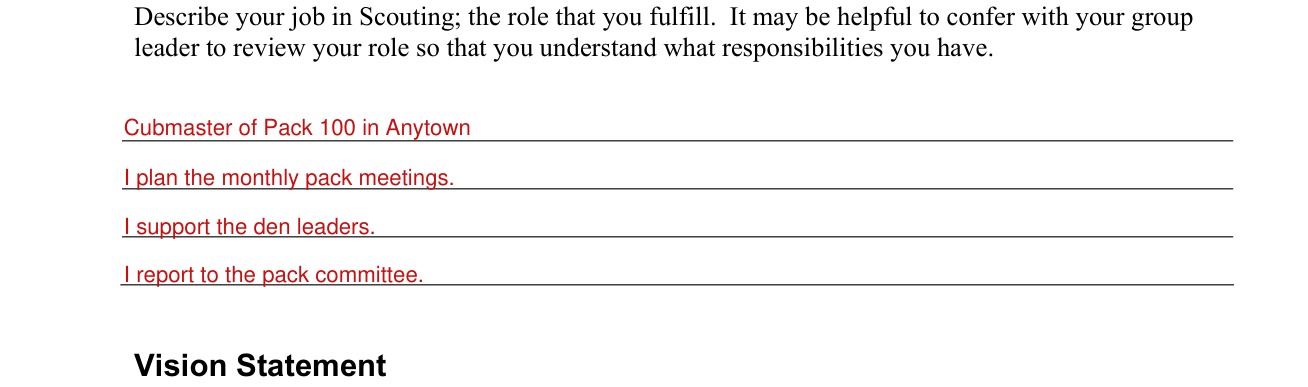
Describe your job in Scouting; the role that you fulfill.
It may be helpful to confer with your group leader to review your role so that you understand what responsibilities you have.
Vision Statement
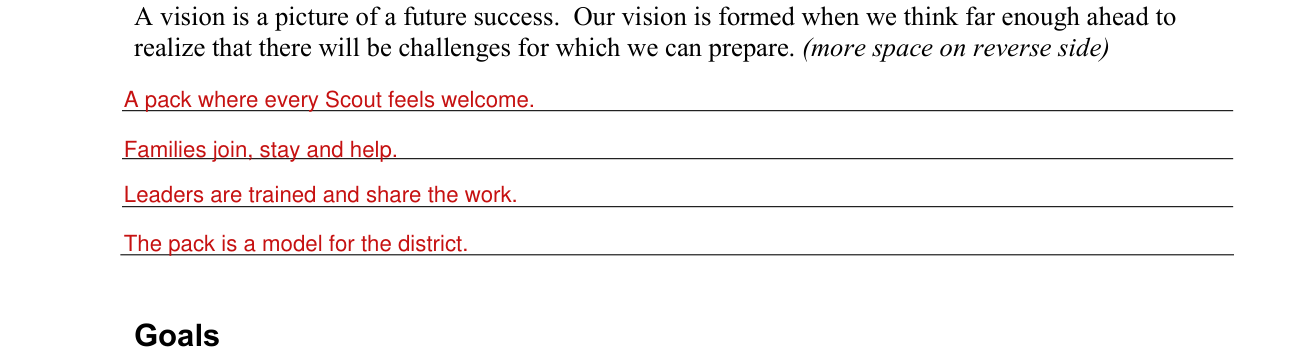
A vision is a picture of a future success.
Goal # and Step 1: This ticket goal

Fill in Goal #.
Under Step 1: This ticket goal, the boxes are Strengthens me and Strengthens my group.
Step 2: Describe your goal

Step 2: Describe your goal.
Step 6: Ticket Goal Progress Notes

Step 6: Ticket Goal Progress Notes: List what you've accomplished thus far while working on this goal.
Step 7: Ticket Goal Completion Notes
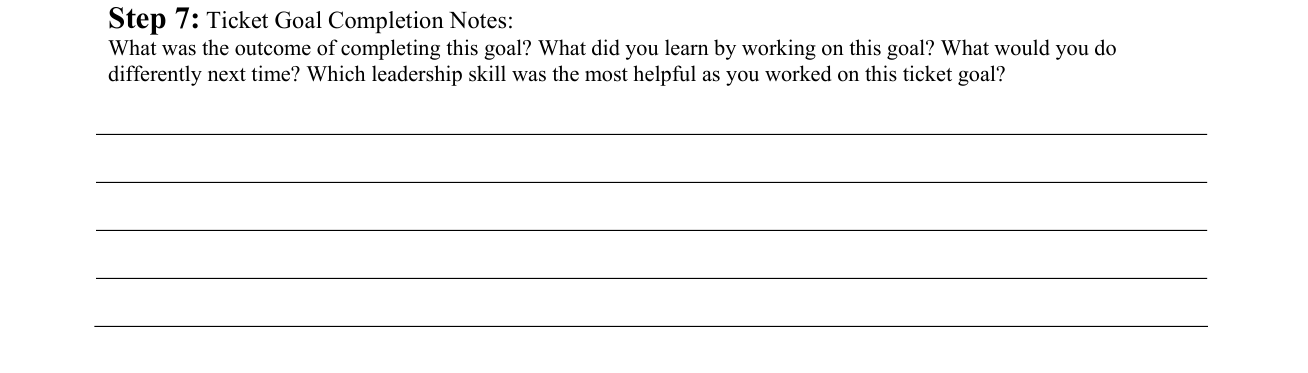
Step 7: Ticket Goal Completion Notes: What was the outcome of completing this goal? What did you learn by working on this goal? What would you do differently next time? Which leadership skill was the most helpful as you worked on this ticket goal?
Ticket Progress Notes
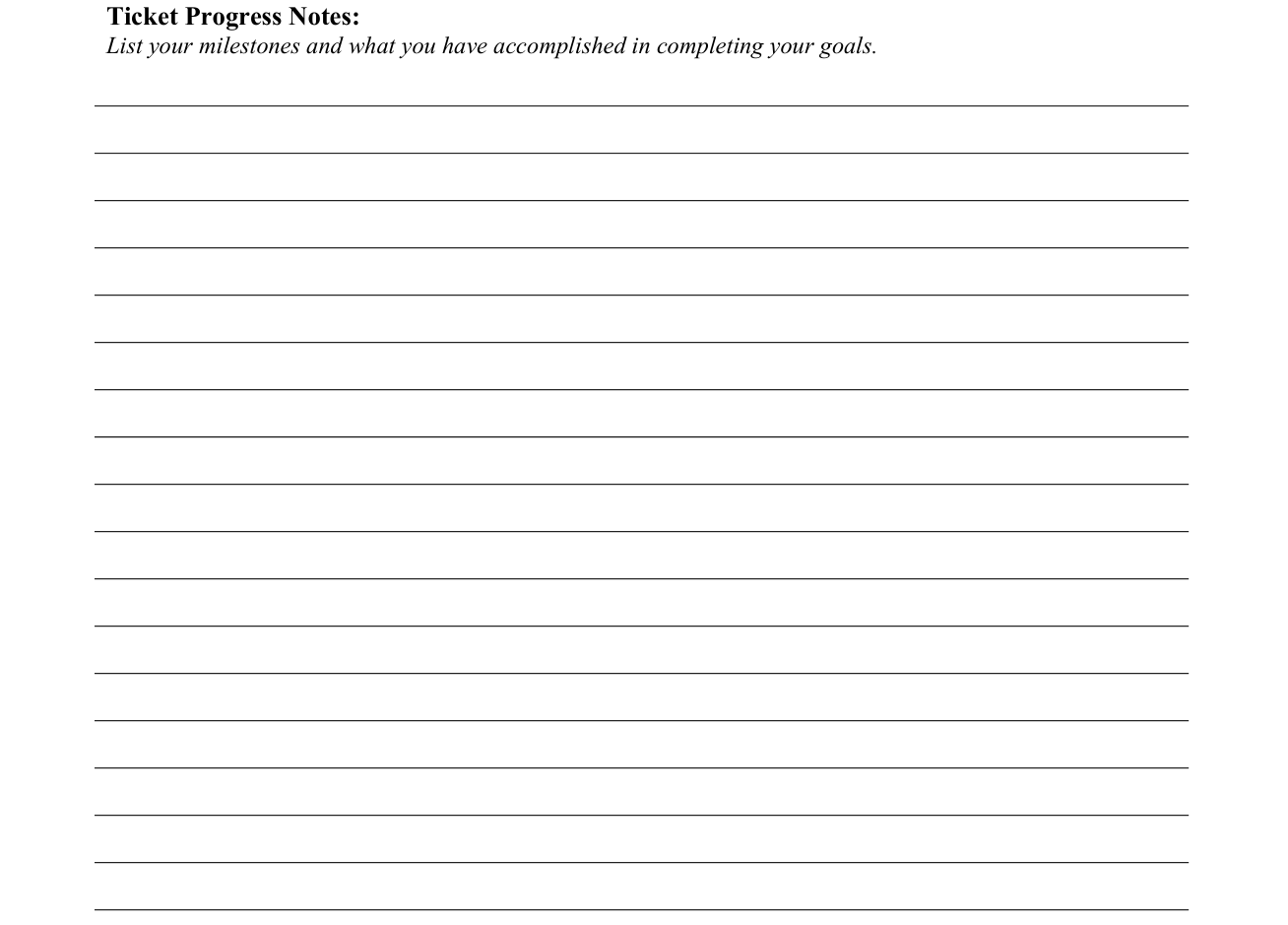
Wood Badge Ticket Completion Notes: Ticket Progress Notes: List your milestones and what you have accomplished in completing your goals.
Ticket Completion Notes
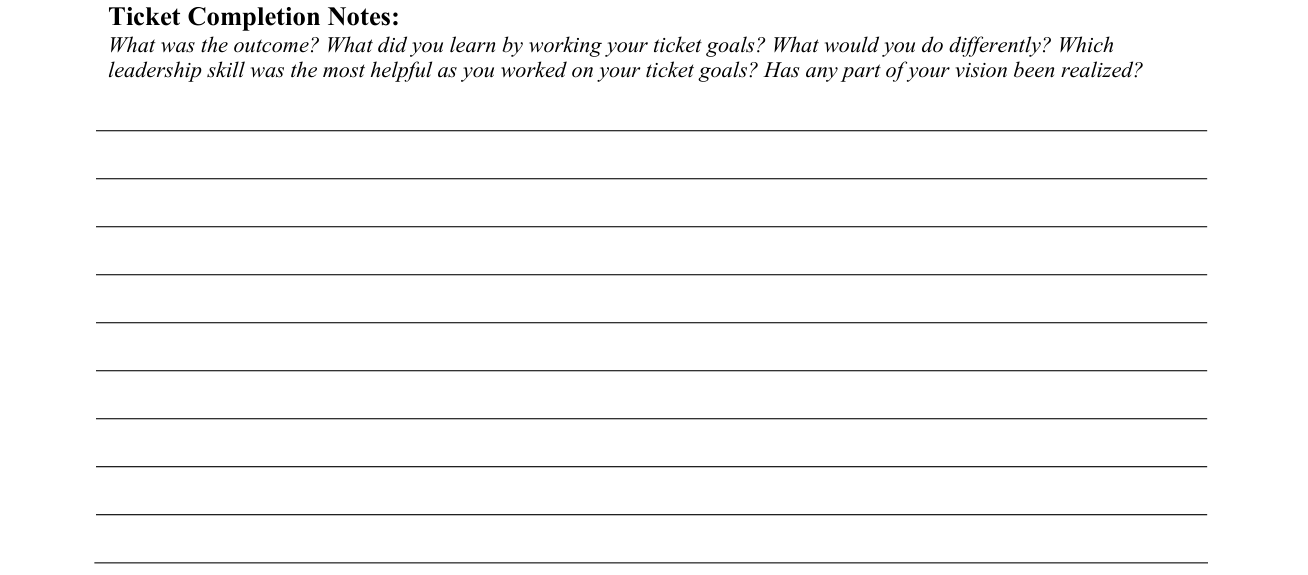
Ticket Completion Notes: What was the outcome? What did you learn by working your ticket goals? What would you do differently? Which leadership skill was the most helpful as you worked on your ticket goals? Has any part of your vision been realized?
More rules for Wood Badge Ticket Workbook
Fill in the Participant Name and the Course Number.
Ideally, you will write your ticket around your primary job in Scouting. A ticket consists of four parts: a list of your personal values, a description of your Scouting role, a statement of your vision of success, and a mission composed of five significant goals that can be attained within 18 months.
At least one goal must address increasing diversity within the Boy Scouts of America.
There should be a minimum of 5 goals that can be attained in less than 18 months.
Use one page for each goal.
You should not expect that you will realize your vision immediately upon completion of the five goals; reaching your goals is an initial part of a long-term work in progress.
In writing your ticket it will help if you list the skills you can use to accomplish your goals. It is not required that you incorporate all of the skills presented during the course into your goals.
Step 3: Complete the development of your goal: Who, What, Where, When, Why.
Who - Who is involved?
What - What, specifically, will you do to help realize your vision through this goal?
Where - Where will you work on the goal?
When - When will you work on the goal?
Why - Why is this goal important to realizing your vision?
An effective way of defining your ticket goals is to use the Who, What, Where, When, and Why steps. By describing each step for each goal, you can be assured that you will have a well-defined ticket goal.
Self-Assessment: How Measured, How Verified.
How measured - How do you measure the completion of your goal? How verified - How do you verify whether your goal helped to achieve your vision?
Then, after you have completed your ticket goal, perform a self-assessment to evaluate your goals.
This is a good time to review your goal with your troop guide or ticket counselor.
You should make sure that your ticket goals are “SMART” (Specific, Measurable, Attainable, Relevant, and Timely).
Step 4: All Ticket Goals should be “SMART,” test your goal by answering these questions. Is it challenging?
Measurable - Describe how this Ticket Goal is Measurable. How will you know when the goal has been accomplished?
Attainable - Describe how this Ticket Goal is Attainable. Can it be accomplished?
Relevant - Describe how this Ticket Goal is Relevant. Is it a part of your Scouting job? How does it relate to your Scouting job?
Timely - Describe how this Ticket Goal is Timely. What is the time frame? Can it be accomplished in a reasonable amount of time? “A Goal Without a Deadline is Only a Dream!”
Step 5: The key to making the skills you've learned a part of your leadership style is to practice using them.
List the skills that will help you accomplish this goal and how you plan to use them. It may be helpful to add additional details on this step elsewhere.
Sources
[1] Wood Badge Ticket Workbook (served form) (the Official source link on this page).