Free Delaware Power of Attorney Form PDF (General Financial)
A Delaware general power of attorney is a written document in which a person, the principal, names an agent to handle financial and business matters on the principal's behalf. It covers a wide range of actions, such as managing bank accounts and signing documents, and it does not authorize health care decisions. Download the free Delaware power of attorney form PDF below, or fill it out online first.
Last Updated: October 2026. This guide is reviewed and updated regularly to reflect current Delaware law. If you notice an error or outdated information, please contact us.
Create a high-quality Delaware General Financial Power of Attorney Form now!
Build Your Document
Answer a few simple questions to make your document in minutes
Save and Print
Save progress and finish on any device, download and print anytime
Sign and Use
Your valid, lawyer-approved document is ready
... or download your Delaware General Financial Power of Attorney Form as a PDF file
Delaware's power of attorney law is in Title 12 of the Delaware Code, chapter 49A. Under 12 Del. C. 49A-102(10), a power of attorney is a grant of authority to an agent to act in the place of the principal, authorizing the agent to convey rights in property of the principal to the agent or any other person.[1.4] For a personal power of attorney, it must be in writing, signed, dated, signed in front of a notary and signed in front of one adult witness.[1.1]
In writing and signed. The principal signs it. Another person may sign the principal's name, but only in the principal's presence and at the principal's express direction.[1.1]
Notarized. The signing must happen in the presence of a notarial officer, such as a notary public.[1.1]
Witnessed. The signing must also happen in the presence of 1 adult witness. The witness cannot be related to the principal by blood, marriage, or adoption. The witness also cannot be entitled to any portion of the principal's estate under the principal's then existing will, codicil, amendment or trust instrument.[1.1]
The steps for signing in the right order are in the signing section below.
How to Fill Out the Delaware General Power of Attorney Form
The Delaware power of attorney form PDF has five form pages. Work through them in order: the principal and agent, the powers you grant, the effective and termination dates, the successor agent and the signature. The notary completes the last page.
The screenshots under each step show the FormsPal Delaware general power of attorney template filled with sample entries in blue, so you can see where each answer goes. The names, addresses, dates and amounts are examples only.
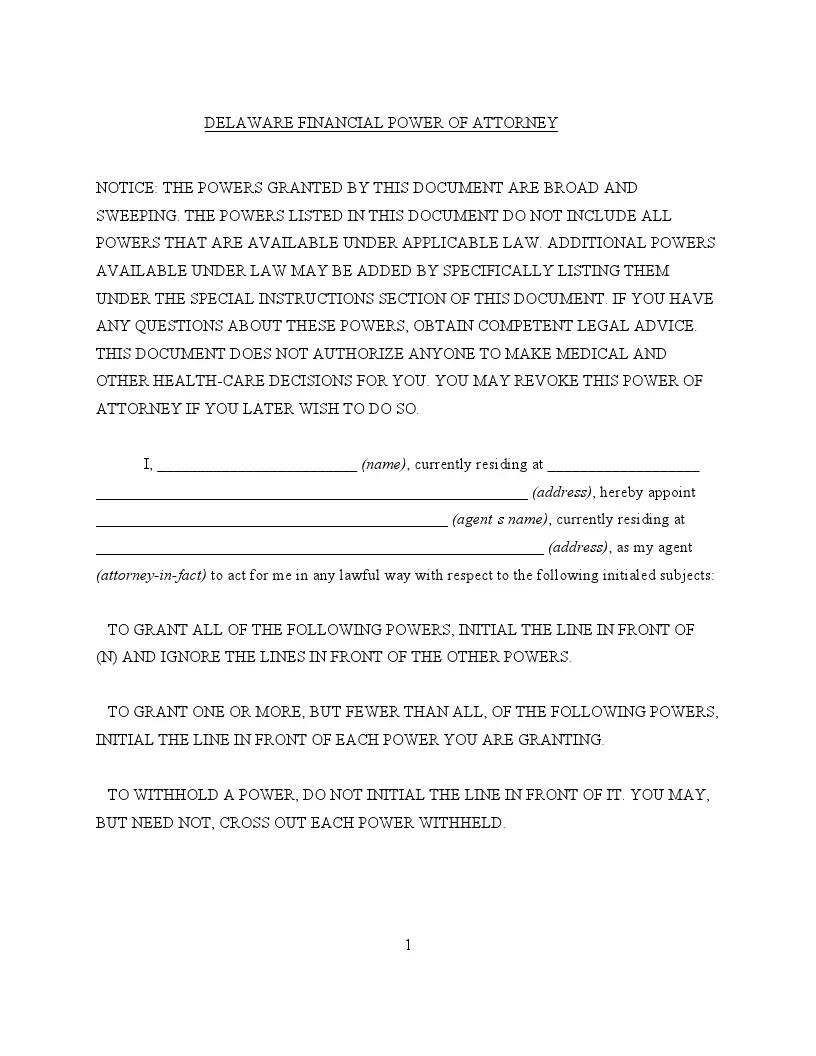
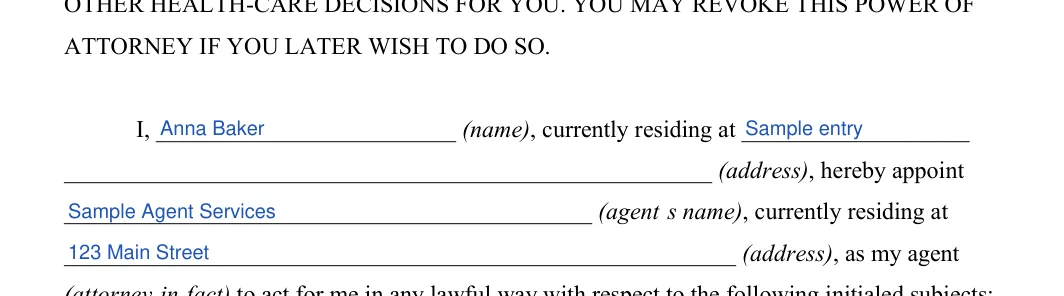
Principal and agent. On page 1, type your own name and address, then your agent's name and address, in the appointment paragraph. The notice above it says the powers are broad and that the document does not authorize health care decisions.Step 1: sample entries, not a real document.
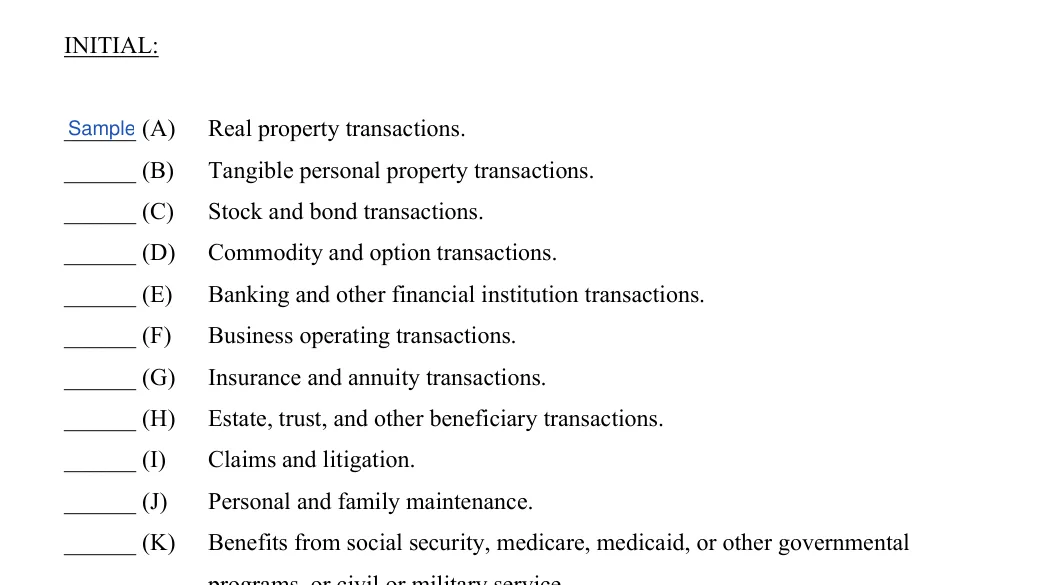
Initial the powers (A) to (K). On page 2, initial the line in front of each power you want to grant. To withhold a power, leave its line blank. You may cross it out, but you do not have to. To grant all powers, initial line (N) instead.Step 2: sample entries, not a real document.
Initial powers (L), (M) and (N). Initial (L) for retirement plan transactions and (M) for tax matters if you grant them. Line (N) stands for all the powers above, so you need not initial any other line if you initial (N). Special Instructions 1 to 3, printed below, have nothing to fill in.Step 3: sample entries, not a real document.
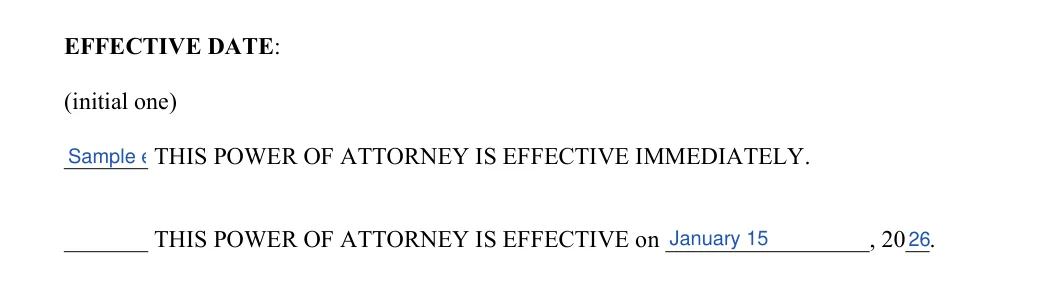
Effective date. On page 3, initial one line: effective immediately, or effective on a date. For the second, write the date and year in the blanks.Step 4: sample entries, not a real document.
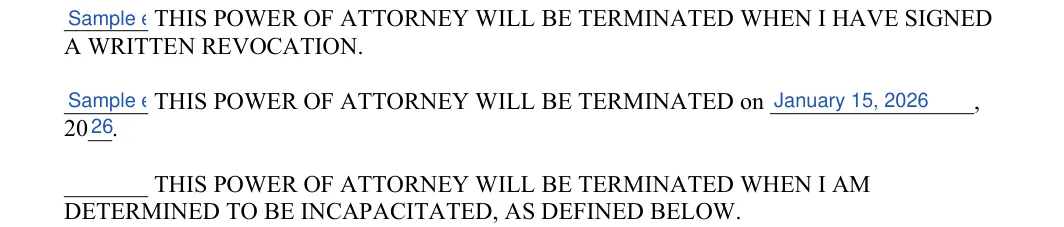
Termination date: written revocation. Under Termination Date the form says to initial one line. Initial the first line if the power of attorney should end when you have signed a written revocation.Step 5: sample entries, not a real document.
Termination date: a set date or incapacity. Or initial the line that ends the power of attorney on a date, and fill in the date and year. The third choice ends it when you are determined to be incapacitated. The form defines incapacitated in the paragraph that follows.Step 6: sample entries, not a real document.
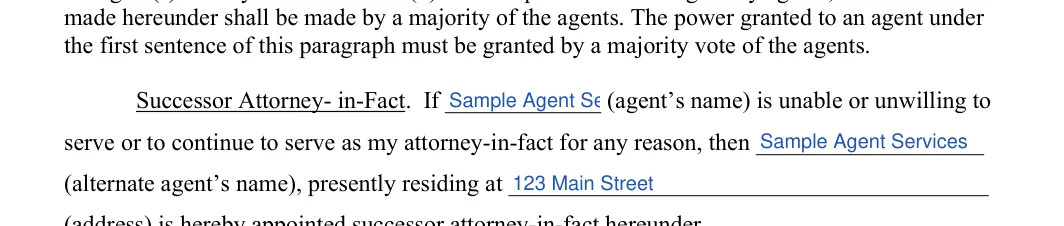
Successor attorney-in-fact. On page 4, repeat the agent's name, then write the alternate agent's name and address in the successor paragraph. The co-agent paragraph above it is printed text with nothing to fill in.Step 7: sample entries, not a real document.
Date and sign. Fill in the day, month and year after "Signed this". Sign above the signature line and print your name below. Sign in front of the notary, who completes the acknowledgment on page 5.Step 8: sample entries, not a real document.
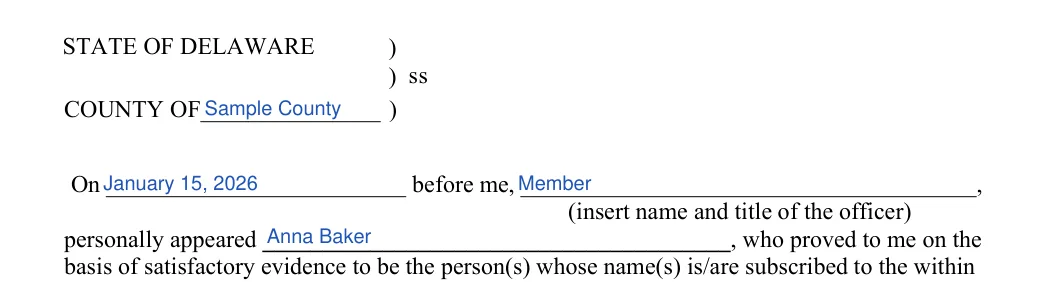
Acknowledgment: county, date and officer. On page 5, the notary completes the Delaware acknowledgment: the county, the date, the officer's name and title, and the principal's name as it appears on the document.Step 9: sample entries, not a real document.
Notary signature and seal. The notary signs on the Signature line and adds the official seal where the form shows (seal).Step 10: sample entries, not a real document.
How to Sign and Use the Delaware General Power of Attorney
After you fill out the form, the signing steps matter as much as the answers. A signed Delaware general power of attorney needs a date, a notary and one adult witness. Follow these steps in order, then give your agent a copy so the agent can use it.
Sign and date it. You sign the document and write the date, or another person signs your name in your presence and at your express direction.[1.1]
Sign in front of the notary. Delaware requires you to sign in the presence of a notarial officer.[1.1] The notary then completes the acknowledgment on page 5 of the form.
Sign in front of one adult witness. The witness must meet the rules listed in the requirements section above.[1.1]
Ask your agent to sign the certification. Delaware law gives an agent no authority to act under a personal power of attorney until the agent has first signed a certification and attached it to the document. The certification must be in substantially the form the statute sets out.[1.1]
Keep the original safe. Your agent will need the document to act, so give your agent a copy and store the original where you can find it.
A Delaware personal power of attorney does not last forever. Delaware law lists the events that end the document itself, and a separate list of events that end only the agent's authority. Knowing both lists helps you decide when to replace a document or tell your agent that the authority has ended. A personal power of attorney terminates when:
The form also has its own termination choices on page 3, which you initial when you fill it out. Read them before you sign, since they are part of the document your agent will rely on.
Create a high-quality Delaware General Financial Power of Attorney Form now!
Frequently Asked Questions
These short answers cover four common questions about signing, replacing and ending a Delaware general power of attorney. Each answer follows the text of Delaware's power of attorney law, and the source is listed at the end of the page. The topics are:
Notarization
Replacing an older power of attorney
Expiry over time
Acts done without knowing the document ended
Does a power of attorney need to be notarized in Delaware?
Yes. A Delaware personal power of attorney must be signed in the presence of a notarial officer.[1.1]
Does a new power of attorney cancel an older one in Delaware?
Not automatically. Signing a personal power of attorney does not revoke an earlier one, unless the new document says it revokes the previous one or all other personal powers of attorney.[1.2]
Does a Delaware power of attorney expire after a set time?
Not on its own. Unless the document says otherwise, the agent's authority stays exercisable until it terminates, however much time has passed since it was signed.[1.2]
Is an act valid if the agent did not know the power of attorney ended?
Yes, in many cases. Ending the agent's authority or the document is not effective against an agent or another person who acts in good faith without actual knowledge of it. Unless the act is otherwise invalid or unenforceable, it binds the principal and the principal's successors in interest.[1.2]
Mara has been practicing estate planning and trust law in California since 2003, taking pride in helping clients of all backgrounds and asset profiles form a complete and customized estate plan. Her specialties are: estate planning, wills and trusts, trust and probate administration.