
The Massachusetts general financial power of attorney is a legal document that allows you (the “principal”) to designate another person (the “agent” or “attorney-in-fact”) to manage your financial affairs. This might involve processing financial transactions, overseeing property holdings, submitting tax documents, and determining investment choices. The powers given may vary in scope, depending on how the document is structured. Create it online or download the PDF.
Last Updated: October 2026. This guide is reviewed and updated regularly to reflect current law. If you notice an error or outdated information, please contact us.
Build Your Document
Answer a few simple questions to make your document in minutes
Save and Print
Save progress and finish on any device, download and print anytime
Sign and Use
Your valid, lawyer-approved document is ready
The FormsPal template for a Massachusetts financial power of attorney lists thirteen financial areas, from real property transactions to tax matters. You initial each area you want your agent to handle, or initial one line to grant all of them. The template's own notice says it does not cover medical or health-care decisions.
The template also includes three preprinted special instructions. They cover medical reimbursement claims, retirement and savings accounts, and digital assets.
In Massachusetts, the general powers of attorney guidelines are outlined under Chapter 190B, Article V of the General Laws. These legal instruments grant agents broad powers to manage the principal’s financial affairs effectively and securely.
While Massachusetts law does not specify exact signing requirements for executing these documents, it is highly recommended that a power of attorney document be acknowledged by two witnesses and/or notarized to ensure its validity and prevent any challenges. Key legal requirements include:
Compliance with these provisions will help ensure that the power of attorney remains enforceable and accurately reflects the principal’s intentions.
| Document Name | Massachusetts General Power of Attorney Form |
| Other Name | Massachusetts Financial Power of Attorney |
| Relevant Laws | General Laws of Massachusetts, Chapter 190B, Article V |
| Avg. Time to Fill Out | 10 minutes |
| # of Fillable Fields | 41 |
| Available Formats | Adobe PDF |
Completing the Massachusetts general power of attorney form involves a series of steps to ensure it is legally binding and accurately reflects your wishes. Keep the PDF open next to these steps and work through the parts in order.
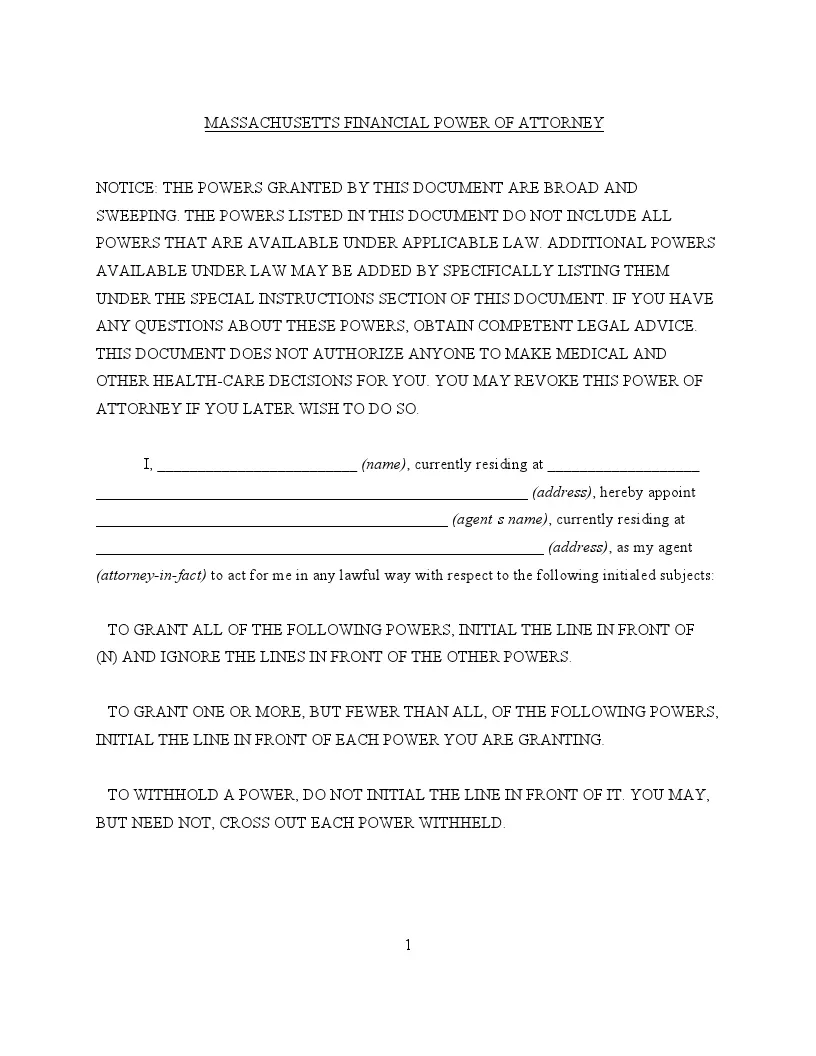
The screenshots under each step show the FormsPal Massachusetts Massachusetts General Financial Power of Attorney template filled with sample entries in blue, so you can see where each answer goes. The names, addresses, dates and amounts are examples only.
Principal and Agent
Write your full name and address in the first blanks of the appointment paragraph. Then write the full name and address of the person you appoint as your agent. Check that both names match your government-issued IDs.
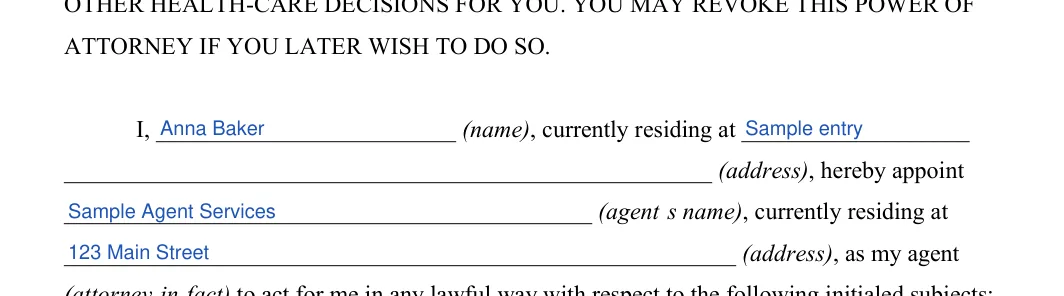
Initial Powers (A) to (K)
Initial the line in front of each power you want your agent to have. This covers (A) Real property transactions through (K) Benefits from Social Security, Medicare, Medicaid and other government programs. Leave a line blank to withhold that power.
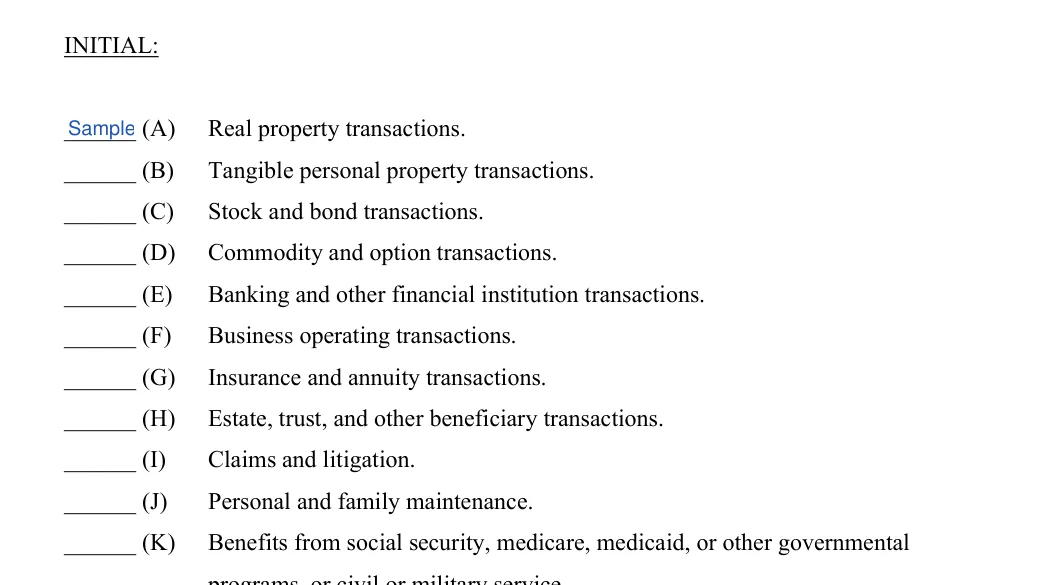
Initial Powers (L) to (N)
Initial (L) Retirement plan transactions and (M) Tax matters if you want your agent to handle them. To grant every power, initial line (N) only and ignore the other lines. The special instructions that follow are preprinted, so there is nothing to fill in there.

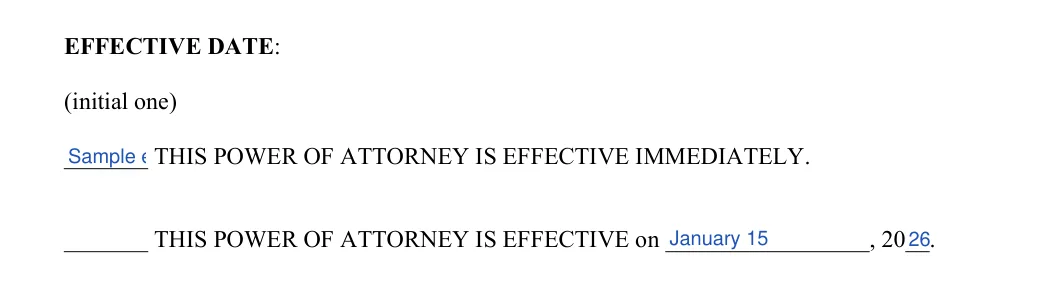
Effective Date
Initial one line. The first line makes the power of attorney effective immediately, and the second line makes it effective on a date you pick. If you pick a date, write the day and the year.
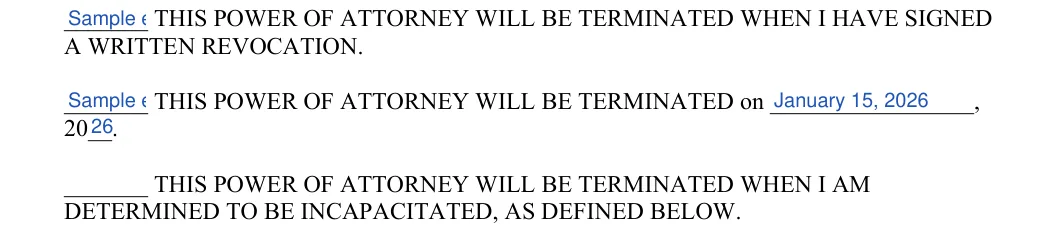
Termination Date: Written Revocation
The Termination Date section has three choices, and you initial one of them. The first choice ends the power of attorney when you sign a written revocation.

Termination Date: Set Date or Incapacity
The second choice ends the power of attorney on a date you pick, so write the day and the year. The third choice ends it when you are determined to be incapacitated, as the template defines that term.
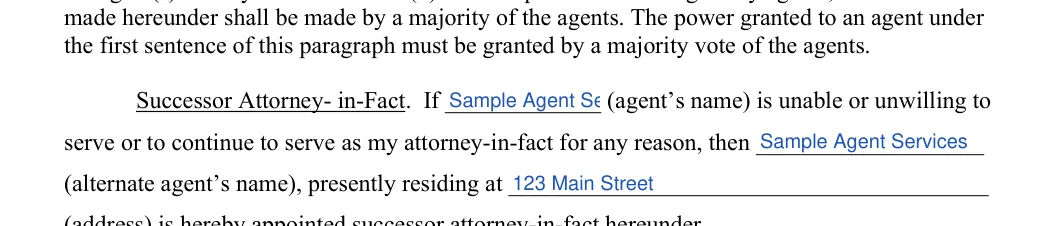
Successor Attorney-in-Fact
Write your agent's name first. Then write the name and address of the alternate agent named as successor.
Date, Signature and Printed Name
Fill in the day, month and year after "Signed this". Sign on the signature line and print your name below it.

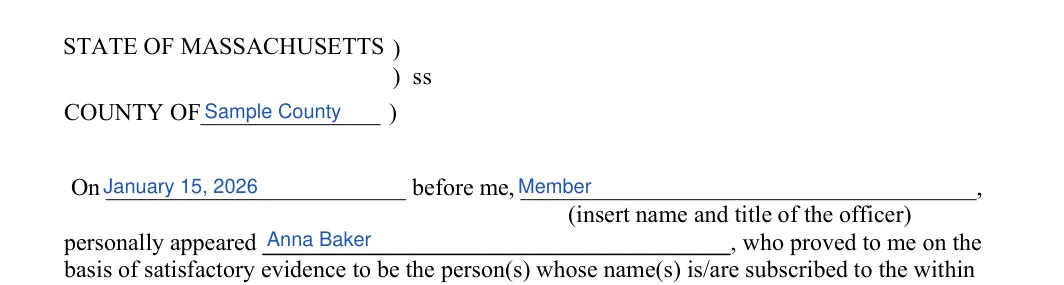
Acknowledgment: County, Date and Names
Page 5 holds the acknowledgment for a notary public or other officer. At the notary's office, fill in the county, the date, the officer's name and title, and your name.
Acknowledgment: Officer's Signature and Seal
The notary or other officer signs the signature line and adds the seal. This line is not for your signature.

Once the template is filled in, the remaining steps are signing it, having it notarized, sharing copies and storing the original. Work through them in this order, and keep a signed copy for your own records.
Signatures and Witnesses
You must sign the document once you have filled out the form and initialed the powers you grant. Massachusetts law does not explicitly require witnesses for a power of attorney to be valid. Still, having the document notarized and signed by two witnesses is highly recommended to reinforce its legitimacy.
Notarization
Take the completed form to a notary public. The notary will verify your identity and ensure you sign the form voluntarily.
Inform Relevant Parties
After the form is completed and notarized, inform any relevant institutions or individuals (like banks or medical facilities) that your attorney-in-fact has the authority to act on your behalf. Providing them with a copy of the notarized document can help facilitate transactions and decisions.
Safe Storage
Store the original document in a safe place, such as a safe deposit box or with a trusted attorney. Also, provide your attorney-in-fact with a copy of the document to ensure they can prove their authority when needed.
A general power of attorney in Massachusetts is usually non-durable. It will automatically terminate if the principal becomes incapacitated or mentally incompetent. If the principal desires the arrangement to continue despite such conditions, they must use another Massachusetts power of attorney form.
The template has a Successor Attorney-in-Fact paragraph on page 4. Write the alternate agent's name and address there.
Page 3 has an Effective Date section and a Termination Date section. In each one, initial the line you want and write the day and the year if you pick a date.
Yes. Use the Create My Document button to answer a few questions and build the form, or download the PDF and fill it in yourself with the FormsPal PDF editor.
General information, not legal or tax advice.
