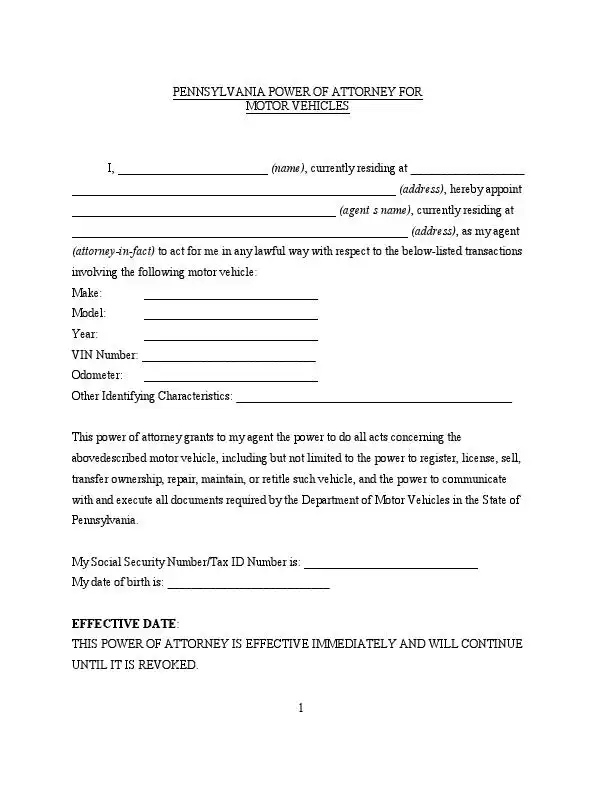
A Pennsylvania motor vehicle power of attorney is a document that lets a vehicle owner name an agent. The owner is called the principal. The agent handles title and registration matters on the owner's behalf. It is useful when the owner cannot be present to handle these transactions in person. You can create the document online with FormsPal or download the PDF from this page and print it.
Last Updated: October 2026. This guide is reviewed and updated regularly to reflect current law. If you notice an error or outdated information, please contact us.
Create a personalized Pennsylvania Motor Vehicle Power of Attorney Form online now!
Build Your Document
Answer a few simple questions to make your document in minutes
Save and Print
Save progress and finish on any device, download and print anytime
Sign and Use
Your valid, lawyer-approved document is ready
... or download your Pennsylvania Motor Vehicle Power of Attorney as a PDF file
What Is a Pennsylvania Motor Vehicle Power of Attorney?
A motor vehicle power of attorney names an agent, also called an attorney-in-fact, to act for the vehicle owner. The owner is the principal. The agent can then deal with title and registration paperwork for the principal. Keep your vehicle title and registration nearby, so the details you enter match your records.
Under Pennsylvania law, specific requirements must be met for the motor vehicle POA to be considered valid:
The form must be fully completed and signed by the principal, who is the vehicle owner.
The principal’s signature on the form must be notarized to verify the signer’s identity and acknowledge that the signature was made willingly and without duress.
It should accurately state the VIN, make, model, and vehicle year, ensuring all details match those on official documents.
The principal and the agent must understand the scope of the authority the POA grants. A power of attorney template can also be customized to grant an agent specific or broad powers over your financial or health-related decisions to address various legal needs. If you need Pennsylvania POA forms, there are various options available online.
Pennsylvania Consolidated Statutes Title 75 (Vehicles), Section 1961 addresses the fee for processing a secure power of attorney for odometer disclosure when not accompanied by an application for title. This statute ensures that the agent’s actions are legally binding.
Short names for the same document include vehicle POA, car POA and DMV power of attorney. All of them point to a document that names someone to act for the owner on vehicle paperwork.
Pennsylvania Motor Vehicle Power of Attorney Form Details
The table below lists the basics of the FormsPal template, including its name, the time it takes to complete, the number of fillable fields and the file format. The template runs three pages. Page 1 covers the people and the vehicle, page 2 covers the successor and the signing line, and page 3 is the notary page.
How to Fill Out the Pennsylvania Motor Vehicle Power of Attorney
These steps follow the FormsPal template that this page hands out. Work from page 1 to page 3 in the order below, and keep your vehicle title and your agent's details beside you. Use the same spelling that appears on your IDs.
The screenshots under each step show the FormsPal Pennsylvania Pennsylvania Motor Vehicle Power of Attorney template filled with sample entries in blue, so you can see where each answer goes. The names, addresses, dates and amounts are examples only.
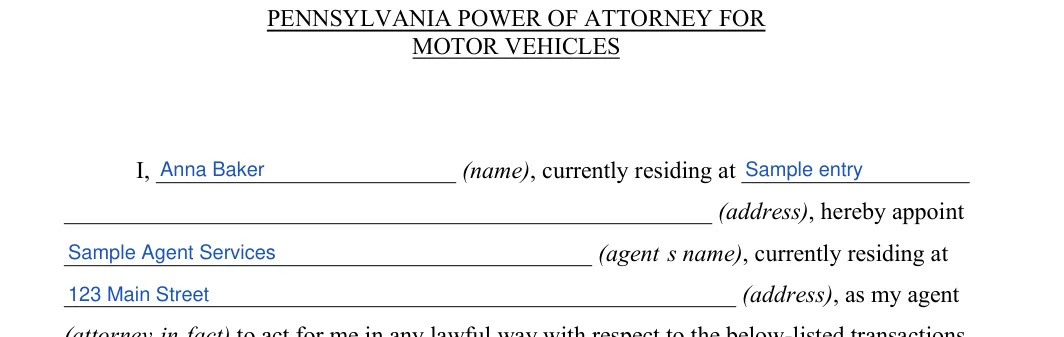
Appoint your agent. Begin by reading the entire form to understand the scope of authority you are granting to your agent. Then write your full legal name and address in the opening paragraph on page 1. Next, write the name and address of the person you designate as your agent (attorney-in-fact).Step 1: sample entries, not a real document.
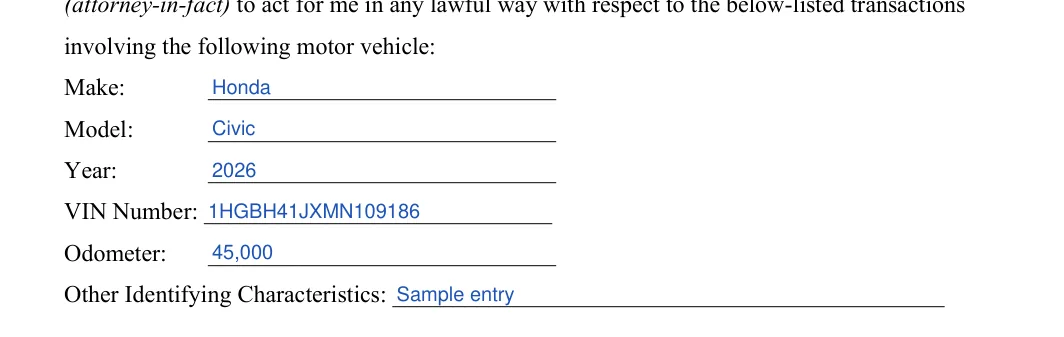
Describe the motor vehicle. In the vehicle section, fill in the Make, Model, Year, VIN Number and Odometer lines. Use the Other Identifying Characteristics line for anything else that points to the vehicle. Review the powers you grant to your agent, including the authority to register, license, sell, transfer ownership, repair, maintain, or retitle the vehicle. Confirm that these powers adequately cover your needs.Step 2: sample entries, not a real document.
Add your Social Security or Tax ID number and date of birth. These two lines sit on page 1, below the printed powers paragraph. Include your Social Security Number or Tax ID Number and date of birth in the designated spaces to comply with identification requirements. The effective date is already printed on the form, so there is nothing to enter there. Note that this power of attorney will continue until you revoke it.Step 3: sample entries, not a real document.
Name a successor attorney-in-fact. If you wish to appoint a successor attorney-in-fact in case your primary agent cannot serve, provide their name and address. At the top of page 2, repeat your agent's name first, then enter the alternate agent's name and address.Step 4: sample entries, not a real document.
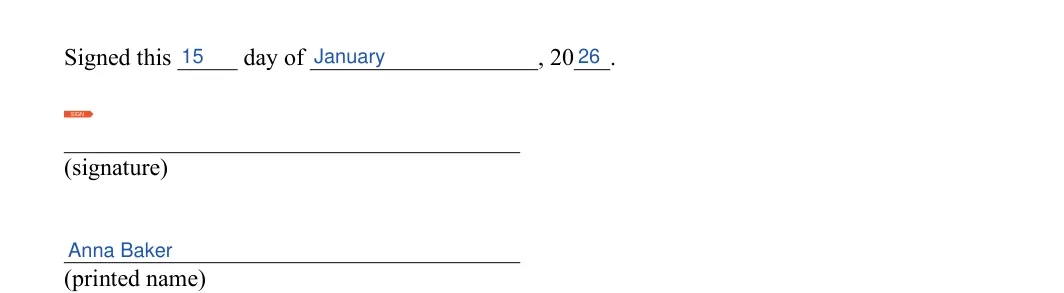
Date, sign and print your name. On page 2, fill in the day, month and year on the line that begins Signed this. Then sign on the signature line and print your name below it. The paragraph above the date is printed text about third parties who receive a copy of the document, so it needs no entry. The signing section below explains how the notary fits in.Step 5: sample entries, not a real document.
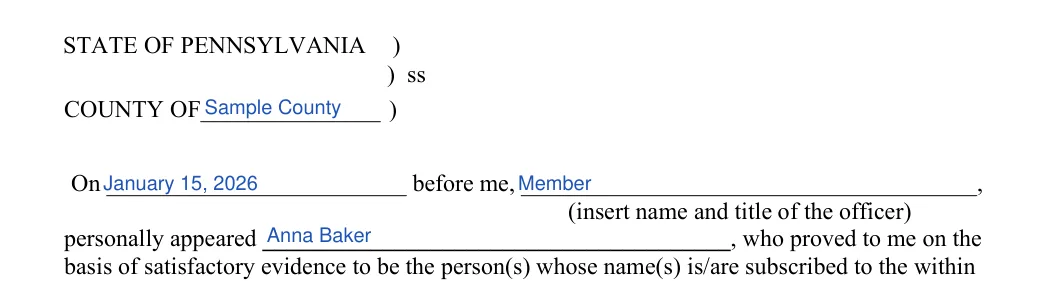
Complete the acknowledgment block. Page 3 is the acknowledgment block, with the state already printed. It has places for the county, the date, the officer's name and title, and the name of the person who appeared before the officer. Your notary completes these lines with you.Step 6: sample entries, not a real document.
Notary signature and seal. The notary or other officer signs on the Signature line at the bottom of page 3 and adds the seal. There is nothing for you to enter on this line.Step 7: sample entries, not a real document.
How to Sign and Use the Pennsylvania Motor Vehicle Power of Attorney
Once the entries are complete, print every page and check that the names match your IDs. Plan a time with your notary and decide where the original will be kept. Afterward, store a copy where you can find it.
Sign and date in front of a notary. Sign and date the form in the presence of a notary public. Ensure the notary completes the acknowledgment section, which verifies your identity.
Have the form notarized. The form must be notarized to validate your signature. The notary will fill out the state, county, and date and affix their seal on the form.
Put the document to use. Once all sections are completed and the form is notarized, your Motor Vehicle Power of Attorney will be legally binding and can be used by your agent to carry out your specified duties.
Share and store the document. Keep copies of this important document for your records and provide an original copy to your agent.
Tip: Take a photo or scan of every signed page before you hand the original to your agent. Store the copy with your other vehicle papers.
Example of a Completed Pennsylvania Motor Vehicle POA
A short example shows how the entries fit together. The names and numbers below are made up for illustration. Say Anna Baker owns a 2018 Honda Civic and wants her brother, Daniel Baker, to handle the vehicle paperwork for her.
Principal: Anna Baker, with her full home address, such as 123 Main Street.
Agent: Daniel Baker, with his full home address.
Vehicle: Make Honda, Model Civic, Year 2018, plus the VIN and odometer reading from the title.
Successor: a relative she trusts, or the lines stay empty if she wants no backup.
Last steps: Anna signs and prints her name on page 2, then meets the notary for page 3.
Common Mistakes to Avoid With the Pennsylvania Motor Vehicle POA
Most problems on this paperwork come from small slips rather than big ones. Read each page once more before you meet the notary, so you can spot a slip while it is still easy to fix.
Names that differ from the IDs. Use the same spelling on the form and on both IDs.
A typo in the VIN. Compare each character with the number printed on the title.
An empty line that needed an answer. Look over every page and confirm each line meant for you has an entry.
Writing on the notary's lines. Leave the signature and seal area on page 3 for the notary.
Frequently Asked Questions
A vehicle power of attorney involves two people, the principal who owns the vehicle and the agent who acts for the owner. These answers cover the questions that come up most often while people complete the template.
What is the difference between the principal and the agent?
The principal is the vehicle owner who names a helper. The agent, also called the attorney-in-fact, is that helper. On the template, the principal's details come first and the agent's details follow in the opening paragraph.
What information do I need to complete the template?
Have these details ready before you start:
The full names and addresses of the principal and the agent.
The make, model, year, VIN and odometer reading from the title or registration.
The principal's Social Security Number or Tax ID Number and date of birth.
The name and address of a backup agent, if you want to name one.
The sample entries in the screenshots show where each detail goes.
Can I fill in the PDF on my computer?
Yes. Download the PDF, then fill in or edit it with the FormsPal PDF editor, or print it and write the details by hand.
Where does the backup agent go on the form?
The successor attorney-in-fact block is at the top of page 2. It holds the alternate agent's name and address.
Where do I find the VIN?
The Vehicle Identification Number is printed on the vehicle title and registration. Copy it character by character onto the VIN Number line.
General information, not legal or tax advice.
Create a personalized Pennsylvania Motor Vehicle Power of Attorney Form online now!
Mara Erlach
Writer & Attorney
Mara has been practicing estate planning and trust law in California since 2003, taking pride in helping clients of all backgrounds and asset profiles form a complete and customized estate plan. Her specialties are: estate planning, wills and trusts, trust and probate administration.