
Updated:
Vermont's minor child power of attorney is a parent's delegation of child care. The form names an agent for medical, school, housing and daily care decisions during a set period. Parents and guardians need it, especially during illness, military service or a long trip.
This page explains each part of the form, how to sign it, and when the agent's authority starts and ends.
Key facts

Build Your Document
Answer a few simple questions to make your document in minutes
Save and Print
Save progress and finish on any device, download and print anytime
Sign and Use
Your valid, lawyer-approved document is ready
A Vermont minor child power of attorney is a signed document that names an agent to care for a child while the parent or guardian is away or unable to. The person who signs it is the principal. The adult who receives the authority is the agent, also called the attorney-in-fact.
The form lets three kinds of principal sign it: a parent, a court-appointed guardian or a court-appointed conservator. Parents often name a relative or close friend who knows the child's routine, school and doctors.
Vermont's Uniform Power of Attorney Act, 14 V.S.A. chapter 127, sets the general rules for a power of attorney that this page cites. Those sections speak of a principal and an agent, and none of the cited sections names a minor child's care.
| Document Name | Vermont Minor Child Power of Attorney Form |
| Other Name | Vermont Parental Power of Attorney |
| General Power of Attorney Act | Vermont Uniform Power of Attorney Act, 14 V.S.A. chapter 127 |
| Duration | From the start date to the end date written on the form |
| Avg. Time to Fill Out | 10 minutes |
| # of Fillable Fields | 44 |
| Available Formats | Adobe PDF |
A Vermont minor child power of attorney is made in seven steps: choose the agent and a backup, choose the powers, set the dates, fill out the form, sign it before a notary public and share copies.
The Vermont minor child power of attorney gives the agent either the full list of powers in item 1 or a limited list in item 2, so the parent decides how far the agent's authority reaches.
Item 1 of the form lists these powers over the child, in the form's own words:
This list is the form's wording, not a statement of Vermont law. The chapter 127 sections this page cites do not name a parent's delegation of a child's medical care or schooling, so the page cites no statute for these powers.
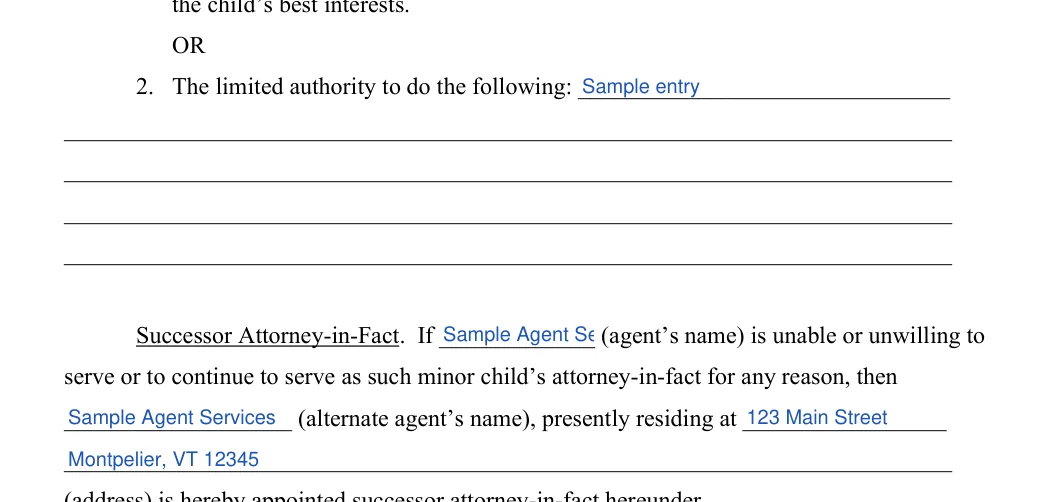
Item 2 of the form replaces the full list with powers the parent writes on the lines provided. A limited list suits a short stay, such as a school trip or a summer with grandparents, where the agent needs only medical consent. The parent picks item 1 or item 2, never both.
The Vermont minor child POA form has seven parts, from the parent's details to the notary's seal. Have the names and addresses of the parent, the child and the agent ready before you start.
The screenshots under each step show the Vermont Minor Child Power of Attorney template filled with sample entries in blue, so you can see where each answer goes. The names, addresses, dates and amounts are examples only.
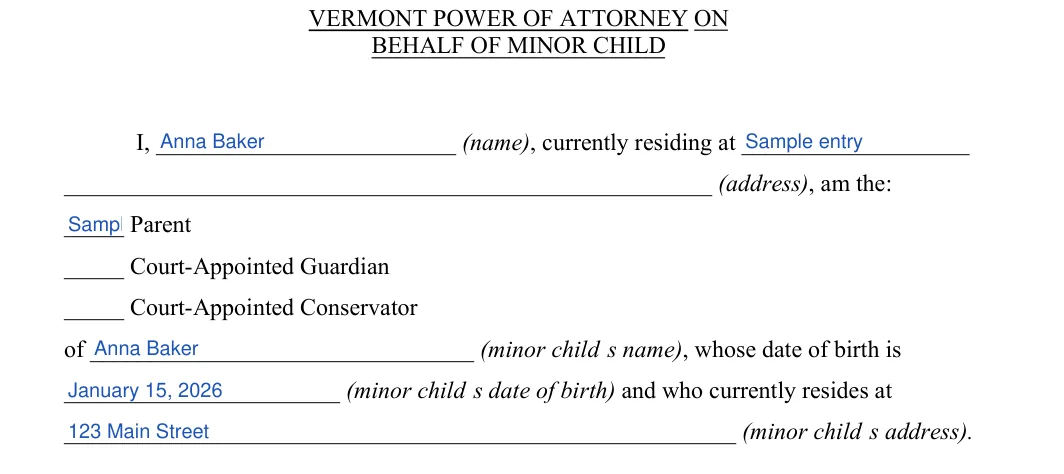
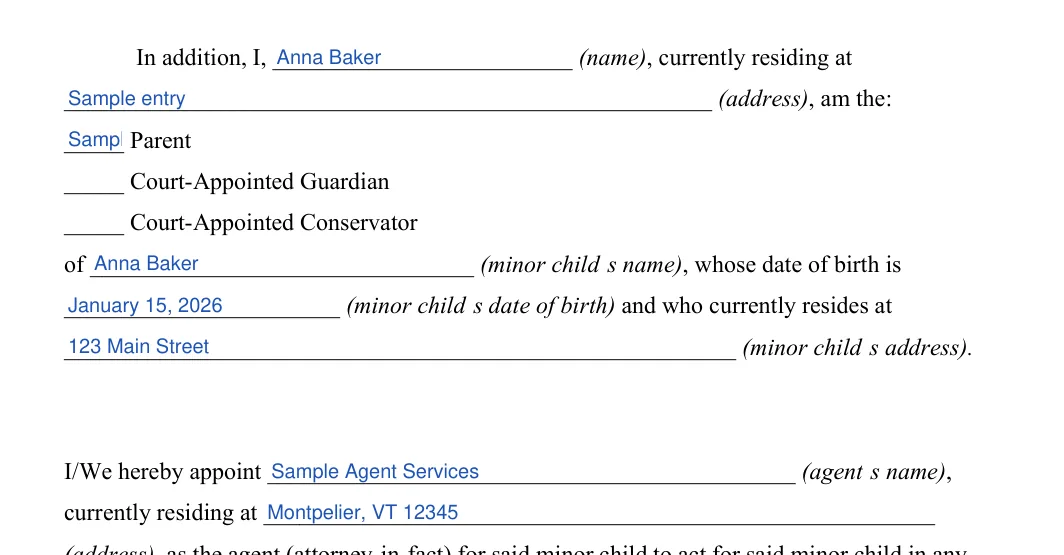

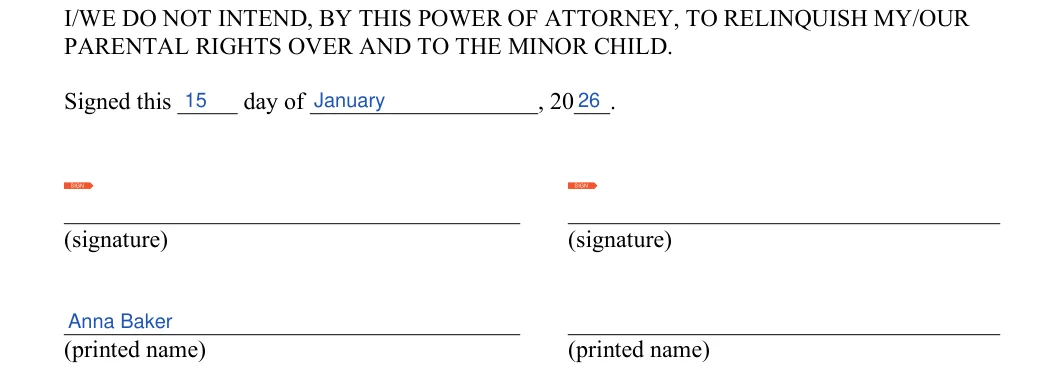
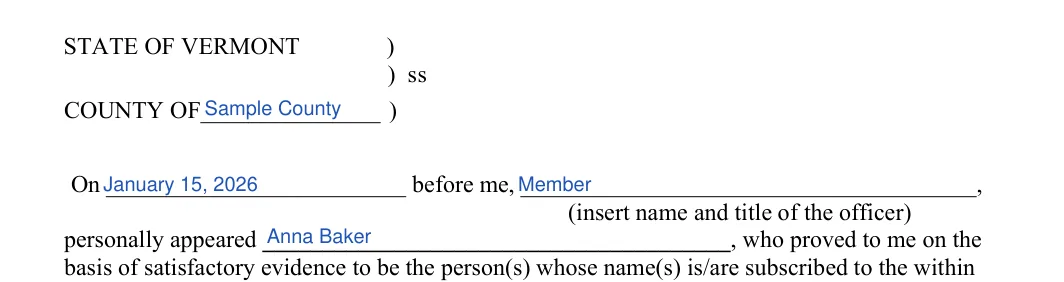

A power of attorney under 14 V.S.A. chapter 127 is signed by the principal or, if the principal directs it, by another individual in the principal's conscious presence, under 14 V.S.A. § 4005. The sections this page cites do not say whether a parent's delegation of a child's care is created under that chapter. The minor child form's page 3 holds a notary acknowledgment, so the signers plan the signing with a notary public.
A notarized signature carries a presumption: a signature on a power of attorney is presumed genuine if the principal acknowledges it before a notary public or another individual authorized to take acknowledgments (14 V.S.A. § 4005). That presumption helps when a school or a doctor's office asks whether the signature is real.
A Vermont power of attorney is effective when executed unless the principal provides in it that it becomes effective at a future date or on a future event (14 V.S.A. § 4009). The form's start date line is where the parent sets a later start.
Under 14 V.S.A. § 4010, a power of attorney ends when any of these happens:
A power of attorney created under 14 V.S.A. chapter 127 is durable unless it expressly provides that the principal's incapacity or unavailability ends it (14 V.S.A. § 4004). The sections this page cites do not say whether a parent's delegation of a child's care is created under that chapter. The start and end dates written on the form are the clearest guide to how long the agent acts.
A successor agent is the backup the form names to act if the first agent cannot. Without one, a power of attorney ends when the agent dies, becomes incapacitated or unavailable, or resigns, and the document provides for no other agent (14 V.S.A. § 4010).
Name a successor who lives near the child and agrees to serve. Write the successor's full name and address in the space below the powers, and give the successor a copy too.
A power of attorney under 14 V.S.A. chapter 127 ends when the principal revokes it, and an agent's authority ends when the principal revokes that authority (14 V.S.A. § 4010). The sections this page cites do not say whether a parent's delegation of a child's care is created under that chapter. Under chapter 127, termination is not effective as to an agent or another person who acts in good faith without actual knowledge of it (14 V.S.A. § 4010).
Under chapter 127, a new power of attorney does not cancel the old one by itself: a later power of attorney revokes an earlier one only if it says so (14 V.S.A. § 4010).
Under chapter 127, the principal of a power of attorney may not revoke it if the principal has been determined to be incapacitated (14 V.S.A. § 4010).
Most problems with a Vermont minor child power of attorney come from blank or mismatched entries that a school or a doctor's office questions later, so read the form once more before anyone signs.
A minor child power of attorney is a parent's own delegation for a set period, while guardianship, an advance directive and a financial power of attorney serve other needs.
Guardianship is a different arrangement: a court appoints the guardian, and the form itself lists a court-appointed guardian as one kind of principal.
A Vermont advance directive covers the signer's own health care, and 18 V.S.A. § 9703 requires it to be dated and signed by two or more witnesses at least 18 years of age (18 V.S.A. § 9703). A minor child power of attorney covers the child's care, not the parent's own.
Vermont's statutory form power of attorney in 14 V.S.A. § 4051 covers the principal's property and money, and its notice states that it does not authorize the agent to make health-care decisions. A parent who also needs someone to handle bank accounts or bills uses a separate financial power of attorney.
Parents use it to name a trusted adult, called the agent, to care for a child while they are away, ill, or serving in the military. The form lists the powers you give them, such as medical care and school decisions.
Choose an adult you trust who knows the child well, such as a relative or close friend. You can also name a backup on the successor agent line.
An agent accepts the appointment by exercising authority or performing duties as an agent, or by other conduct indicating acceptance, except as otherwise provided in the power of attorney (14 V.S.A. § 4013). A parent who wants a written acceptance can ask the agent to sign a short note.
Yes, a power of attorney terminates when the principal dies (14 V.S.A. § 4010). The agent's authority over the child ends at that point.
A durable power of attorney keeps working if the principal becomes incapacitated, and a power of attorney created under 14 V.S.A. chapter 127 is durable unless it expressly provides that the principal's incapacity or unavailability ends it (14 V.S.A. § 4004).
The form has 44 fillable fields and takes about 10 minutes to complete. Gather the names, addresses, and dates first so you can finish in one sitting.
Yes. The form is an Adobe PDF file, so you can fill it in with Adobe Acrobat or the PDF editor, or print it and write the answers by hand.
General information, not legal or tax advice.
