
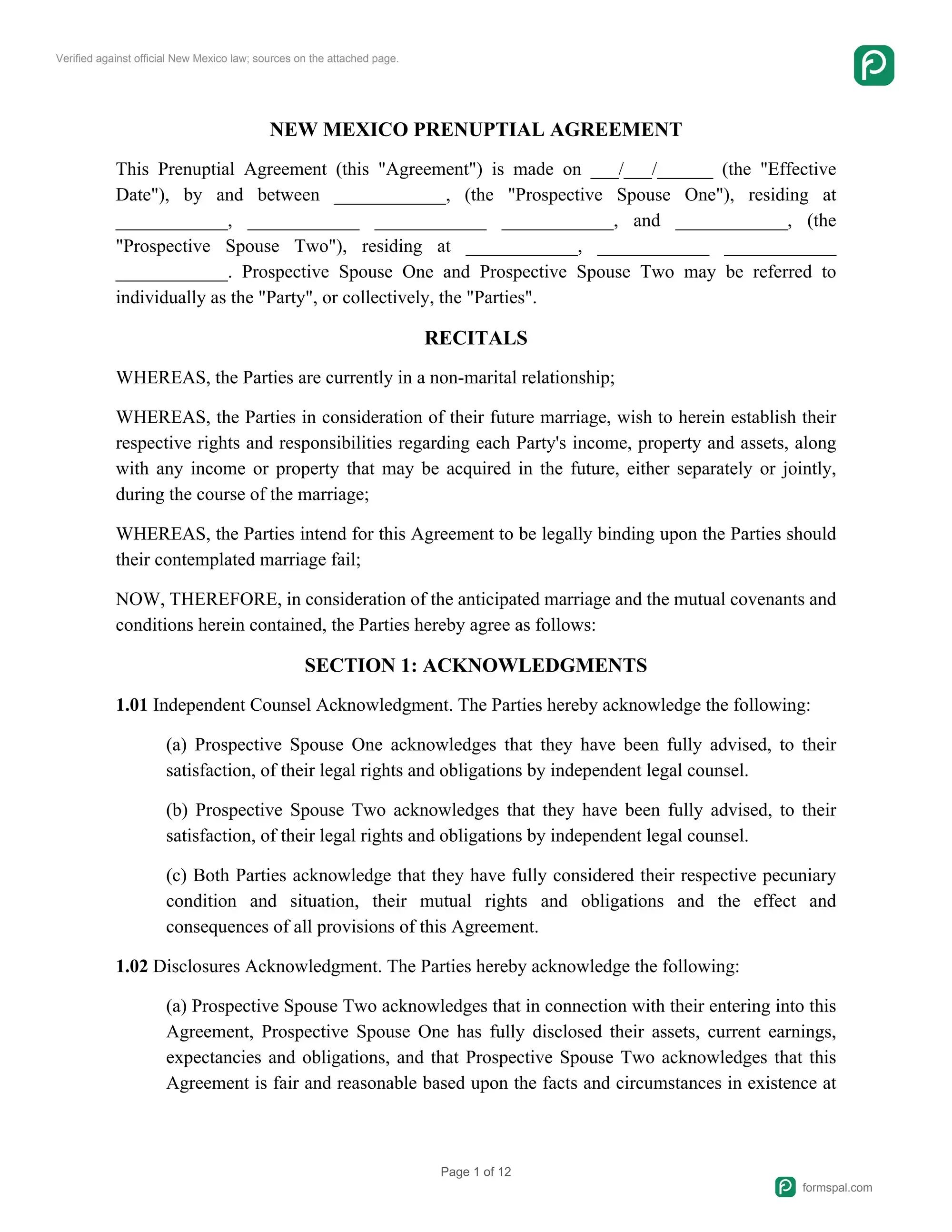
A New Mexico prenuptial agreement is a contract two people make before they marry that takes effect once the marriage begins.[1.1] It can set each spouse's rights to assets and decide how those assets are divided after a separation, divorce, or death.[1.3]
A prenup cannot reduce a child's or spouse's right to support, and it cannot limit either parent's right to custody or visitation.[1.3] Fill out the free prenup agreement template below, then sign it with your partner and have it acknowledged.[1.2]
Build Your Document
Answer a few simple questions to make your document in minutes
Save and Print
Save progress and finish on any device, download and print anytime
Sign and Use
Your valid, lawyer-approved document is ready
Last Updated: September 2026. This guide is reviewed and updated regularly to reflect current state law. If you notice an error or outdated information, please contact us.
State law defines a premarital agreement, commonly called a prenuptial agreement, as a contract between prospective spouses, made in contemplation of marriage and effective upon marriage.[1.1] It is enforceable without consideration.[1.2] That means neither of you has to pay money or hand over property in exchange for the other's signature.
The state's rules for prenuptial agreements are in Chapter 40, Article 3A of the state statutes. They set the formal requirements, when a prenup takes effect, how you can change it after the wedding, and when it cannot be enforced.
State statutes call this contract a premarital agreement. A prenup, a prenuptial agreement, and a premarital agreement are the same document. A postnuptial agreement is different because couples make it after the wedding.
Section 40-3A-3 sets three formal requirements. The agreement must be in writing, signed by both of you, and acknowledged.[1.2]
A premarital agreement must be in writing, signed by both parties and acknowledged. It is enforceable without consideration.
A prenuptial agreement becomes effective upon marriage.[1.4] After the wedding, the law allows only two ways to amend or revoke it.[1.5]
An amendment or a revocation is enforceable without consideration.[1.5]
A prenup is not enforceable if the spouse challenging it proves either of two grounds.[1.6]
Under the second ground, the statute looks at whether, before signing, the challenging spouse:
A judge decides unconscionability and voluntariness as a matter of law.[1.6]
A void marriage does not wipe out the agreement completely. If the marriage is found to be void, the agreement is enforceable only to the extent needed to avoid an inequitable result.[1.7]
Any statute of limitations for a claim under a premarital agreement is tolled, or paused, while you stay married.[1.8] Either of you can still raise equitable defenses that limit the time to enforce it, including laches and estoppel.[1.8]
Prenuptial agreements can cover the property of either or both spouses, whenever and wherever it was acquired.[1.3] Property includes any present or future interest in real or personal property, including income and earnings.[1.1]
Under Section 40-3A-4, a prenup can set the following terms.[1.3]
Couples often use these terms for debt and loans, credit card balances, joint or separate retirement accounts, family business assets, and health insurance.
A prenup cannot adversely affect a child's or spouse's right to support.[1.3] It also cannot limit either party's right to child custody or visitation, choice of where to live, or freedom to pursue a career.[1.3]
Assets acquired during the marriage are presumed to be community property.[2] In a divorce, district courts must divide community property equally, though the two shares do not have to match to the dollar.[2] A prenup lets you and your partner agree on a different division before the wedding.[1.3]
Yes. State law recognizes premarital agreements between prospective spouses, and it takes effect when you marry.[1.4] It must be in writing, signed by both of you, and acknowledged.[1.2] You do not need to exchange money or assets to make it enforceable.[1.2]
A prenup is still unenforceable if one of you signed it involuntarily, or if the terms were unconscionable without fair financial disclosure.[1.6] Couples should leave time before the wedding for both of them to review the draft.
Creating a prenup takes five steps, from listing your finances to signing the final document. Follow them in order so your prenup meets the signing rules in Section 40-3A-3 and the disclosure rules in Section 40-3A-7.
Each mistake below comes straight from the statute. Any one of them can leave a prenuptial agreement without legal effect, or give your partner grounds to challenge it later in a divorce.
