
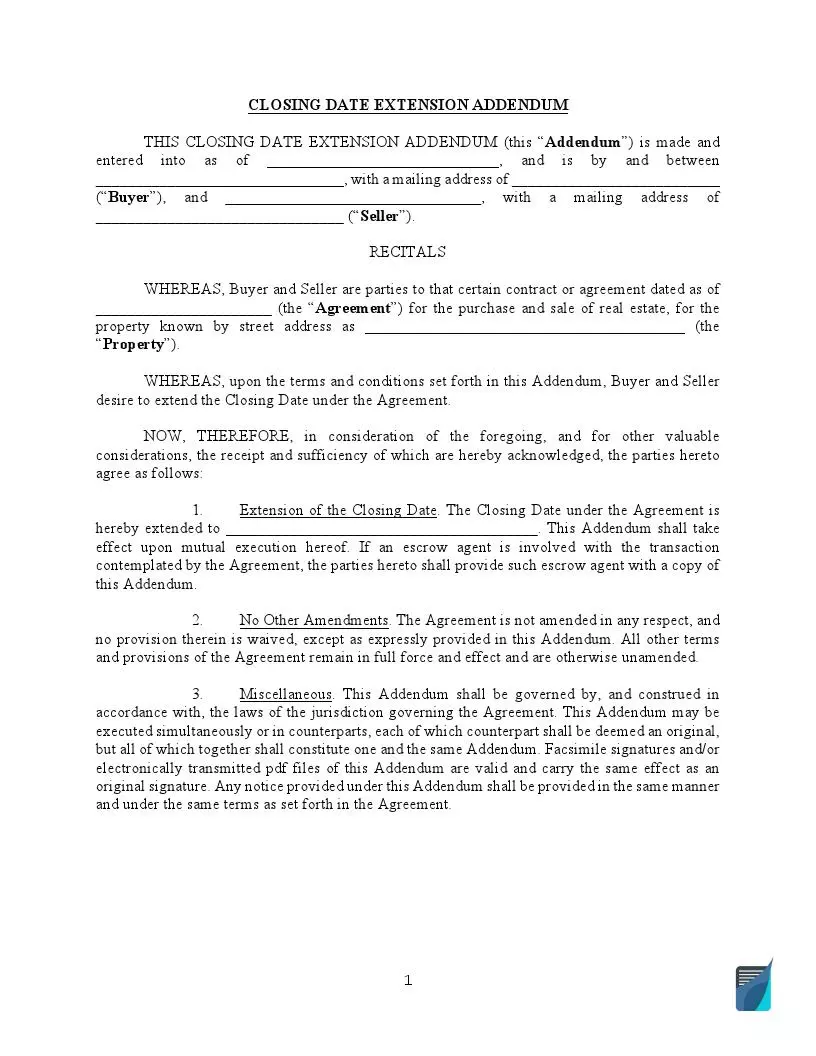
A closing date extension addendum is a short written amendment that moves the closing date in a real estate purchase agreement. Sometimes when there is an unforeseen circumstance or emergency, a closing date extension may be needed. Both the buyer and seller have to agree on a closing date extension for it to be accepted. Use the template below as an addendum to real estate purchase contract so both parties have the new date in writing.
Last Updated: October 2026. This guide is reviewed and updated regularly to reflect current law. If you notice an error or outdated information, please contact us.
Build Your Document
Answer a few simple questions to make your document in minutes
Save and Print
Save progress and finish on any device, download and print anytime
Sign and Use
Your valid, lawyer-approved document is ready
A closing date extension addendum is when the parties both agree to extend the date at which the buyer may close on the property. A closing date may be needed for several reasons, but it is usually when there is an unforeseen circumstance that affects the buyer, seller, or both.
Typical issues are usually with the title, buyer’s financing, buyer’s need to sell their property, or another reason that is deemed acceptable by the seller. Sometimes, according to the printable purchase and sale agreement, the seller does not need to grant an extension for the above circumstances.
In this case, the buyer may want to request the earnest money be returned to them. Sometimes the buyer may be more or less motivated depending on the market conditions. If they have changed to benefit the seller, he or she will probably grant an extension to still obtain the agreed-upon sales price.
A closing date may be necessary if you are experiencing issues with the financing or title. It can give you more time to gather all the information and money you need to buy the home. It might also be needed if you require extra time to process your mortgage application. Most purchase agreements will give a closing date extension of up to 14 days.
If you miss the closing date as the buyer, the real estate sales contract is in jeopardy and you need to request an extension. You might even consider requesting the extension as soon as you experience an issue so that fewer problems can occur.
While a closing date extension may seem annoying or like the end of the world, sometimes it may be necessary to close the deal and get the money. In some cases, though, it may be best not to extend the closing date.
There are some reasons though the buyer must extend the date. Check to make sure they are being honest and still plan to make the sale.
Each closing date extension addendum should consist of a few key components to ensure that the paperwork has all the necessary items. Use this checklist to confirm that both parties, the dates and every signature are in place before you send the addendum.
The template is pretty straightforward and should only take a few moments to fill out. Make sure to read every part and fill out the information correctly to avoid errors. Each step below matches one part of the form, in the same order as the form.
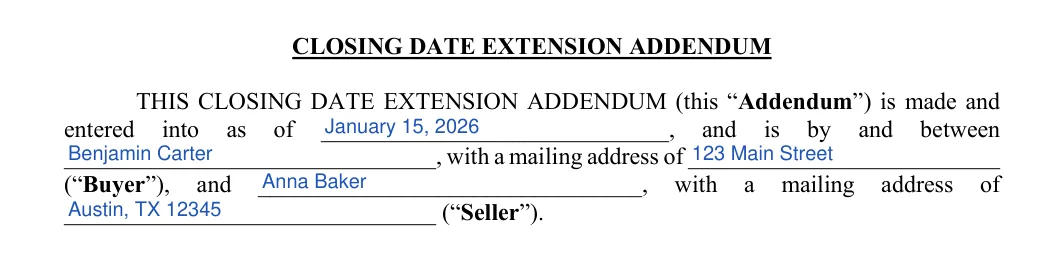
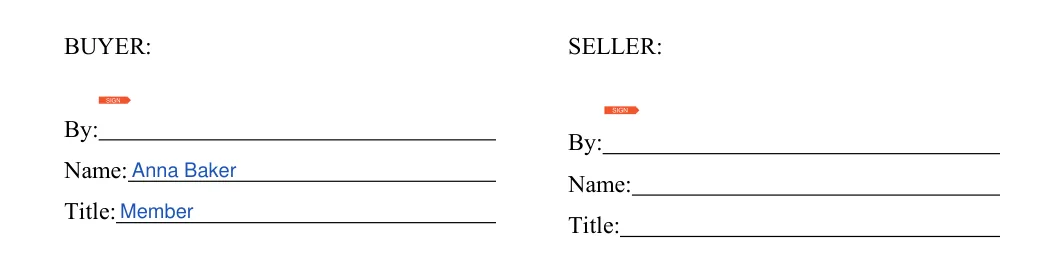
The screenshots under each step show the FormsPal Closing Date Extension Addendum template filled with sample entries in blue, so you can see where each answer goes. The names, addresses, dates and amounts are examples only.


Most problems with an amendment like this come from small slips, not big ones. A quick check of the points below before you print the pages can save the buyer and seller a second round of paperwork.
Here is how a filled-in addendum could look for a sample sale. Benjamin Carter agreed to buy the home at 123 Main Street from Anna Baker, and the original closing date was set for the end of January. His lender needs a few more weeks to finish the paperwork, so the buyer and seller agree on a later date and put it in writing on the addendum.
| Field on the form | Sample entry | Where it goes |
|---|---|---|
| Date of the addendum | January 15, 2026 | Opening paragraph |
| Buyer | Benjamin Carter, 45 Oak Avenue, Anytown, ST 12345 | Opening paragraph |
| Seller | Anna Baker, 8 Pine Road, Anytown, ST 12345 | Opening paragraph |
| Date of the purchase agreement | December 1, 2025 | Recitals |
| Property | 123 Main Street, Anytown, ST 12345 | Recitals |
| New closing date | February 12, 2026 | Agree as follows, item 1 |
These entries are made up for the example, so replace each one with the details from your own contract.
Read the finished addendum once more from top to bottom, and compare every name, address and date with the original purchase agreement before the buyer and seller sign.
Adding a closing date extension addendum takes a few minutes once the buyer and seller settle on a new date. Keep the original contract and the new closing date in front of you, and use the answers below to fill in each part of the form.
Yes. Select Create My Document to answer a few questions and build the addendum online. You can also download the PDF or Word file, then fill in the PDF with the FormsPal PDF editor or print it and write the details by hand.
Enter it in item 1, under Agree as follows, on page 1 of the template. Write the day, month, and year that the buyer and seller agreed on.
Have these details ready before you open the template:
The template has a signature line for the buyer and one for the seller on page 2. Each party fills in a name and title next to the signature.
General information, not legal or tax advice.
