
Updated:
Get Form Now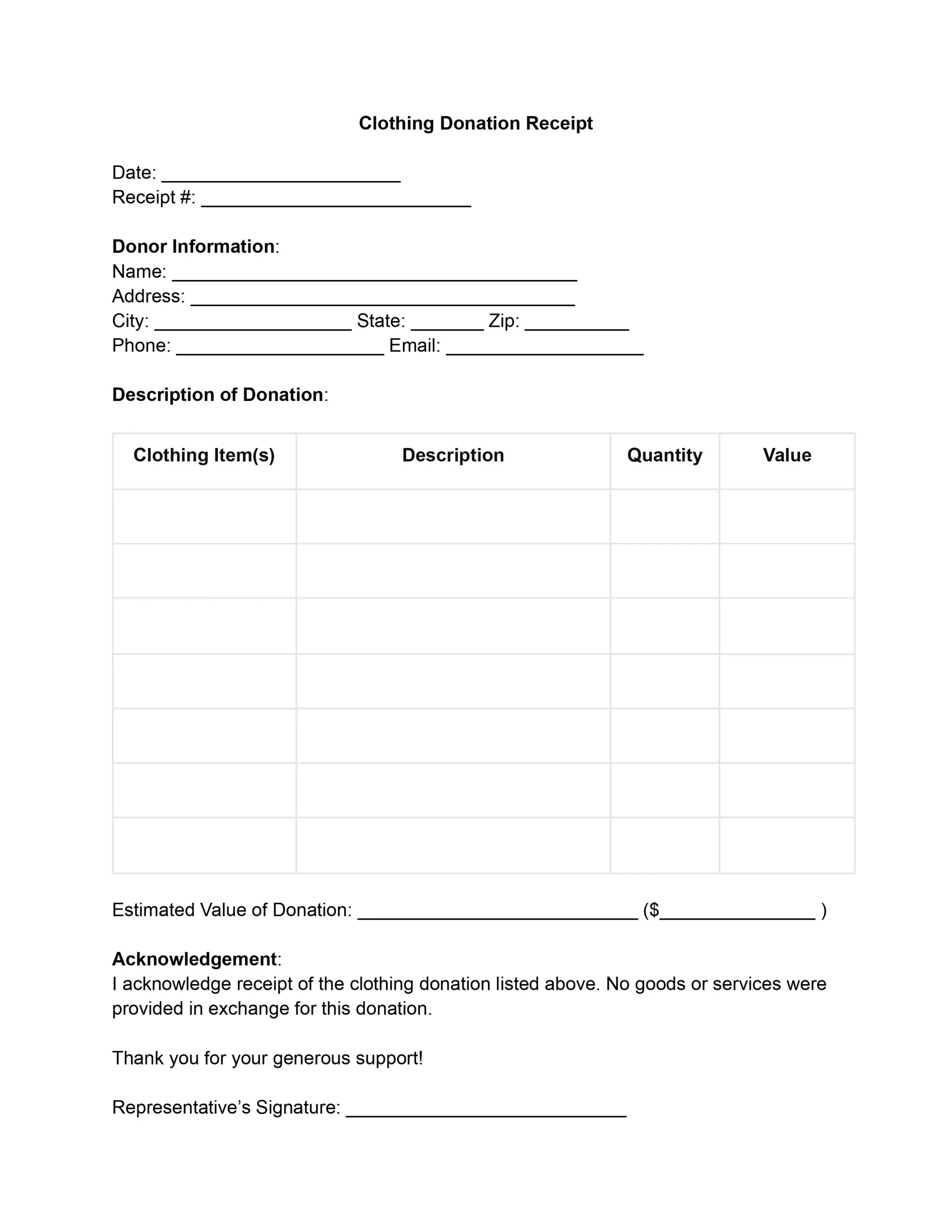
A clothing donation receipt is a charity's written proof of donated clothes. IRS Publication 526 lists the details a receipt shows for donated clothing. The receipt serves donors who itemize, especially after each clothing drop-off.
Key facts
A clothing donation receipt is a short written acknowledgment that a charity gave a donor for clothes it received on a given day. The receipt names the charity, the donor, the date and the items, and a charity representative signs it.
The receipt serves two people. For the donor, it is proof of the gift at tax time. For the charity, it is a copy of what came in and who brought it.
A clothing donation receipt is one kind of donation receipt. A charity may hand out its own printed slip, and a donor may also fill in a separate receipt with an item list and values. Both pieces of paper belong together in the donor's tax folder.
Searchers also call it a clothing receipt, a clothes donation form or a clothing donation tax receipt. Each name points to the same paper.
A clothing donation receipt for a gift under $250 shows the charity's name and address, the date and location of the donation, and a description of the clothes, as IRS Publication 526 lists for a noncash contribution.
The description in IRS Publication 526 is one a person who does not know the items can match to the clothes given. A line such as "bag of clothes" fails that test; "four women's wool sweaters" passes it.
A complete receipt usually carries these parts:
The condition column matters more on a clothing receipt than on most donation receipts. Donated clothing generally counts for a deduction only if it is in good used condition or better, under IRS Publication 526. The one exception in IRS Publication 526 is an item deducted at more than $500 with a qualified appraisal by a qualified appraiser and a completed Form 8283, Section B. A note such as "good, no stains" next to each line shows that the items met that standard on the day they left your hands.
The paper a donor keeps for donated clothes depends on the amount of the deduction, and IRS Publication 526 sets out each tier. The table shows what each amount calls for.
| Deduction for the donated property | What the donor keeps | Source |
|---|---|---|
| Less than $250 | A receipt from the charity with its name and address, the date and location, and a description of the items | IRS Publication 526 |
| Less than $250, left at an unattended drop site | Reliable written records for each item, when a receipt is impractical to get | IRS Publication 526 |
| $250 to $500 | A contemporaneous written acknowledgment from the charity | IRS Publication 526 |
| Over $500 but not over $5,000 | The charity's contemporaneous written acknowledgment and Form 8283, Section A (a receipt alone is not enough) | IRS Publication 526 |
| Over $5,000 | The charity's contemporaneous written acknowledgment, a qualified written appraisal from a qualified appraiser, and Form 8283, Section B | IRS Publication 526 |
To find the tier for the $500 line, IRS Publication 526 combines the claimed deductions for all similar items given to any qualified organization during the year, so every bag of clothing given that year counts toward one total. If the total deduction for all noncash gifts for the year is over $500, Form 8283 is attached to Form 1040 (IRS Publication 526).
A drop box with no attendant gives no receipt. IRS Publication 526 accepts reliable written records for each item when a receipt is impractical to get, such as at a charity's unattended drop site. Those records describe the condition of each piece of clothing and its fair market value, with how you figured it (IRS Publication 526). A receipt you fill in yourself on the day of the drop-off covers each of those points.
A contemporaneous written acknowledgment is a statement from the charity itself. For a deduction of $250 to $500, IRS Publication 526 calls for one, and it describes the property given and says whether the charity gave you any goods or services in return. Under IRS Publication 526, the acknowledgment also gives a description and good faith estimate of the value of any goods or services the charity gave in return. A charity's signature on your item list counts only if the paper states those points too; otherwise, ask the charity for its own acknowledgment letter.
The value on a clothing donation receipt is fair market value, which IRS Publication 526 puts at the price buyers actually pay for used items in used clothing stores, such as consignment or thrift shops.
No fixed formula sets the value of clothing, according to IRS Publication 526. The value of used clothes is usually far below the price you paid, so the original price tag is only a starting point.
Some charities publish a price guide for common items. Ask at drop-off if your charity has one.
The clothing donation receipt is filled in from top to bottom: the charity first, then the donation details, the items and their values, and the signature last.
A blank form printed ahead of time works as well as one typed on screen. If a saved PDF needs a change later, you can edit the PDF online with our PDF editor.
Example of a filled-in clothing donation receipt
Charity: Westside Community Thrift, 100 Main Street, Springfield. Date: March 14. Location: Main Street donation center. Donor: Jordan Lee, 25 Oak Avenue, Springfield.
Total: $57. Signed: A. Rivera, donation attendant.
A clothing donation receipt is signed by a representative of the charity, who also prints their name next to the signature. The signature confirms that the charity received the clothes listed above it.
The donor does not sign in the charity's place. If you fill in the receipt before the drop-off, leave the signature area blank until the attendant can sign it in person.
Most problems with a clothing donation receipt come from small gaps that are easy to fix while the clothes are still in front of you.
A clothing donation receipt is easiest to find at tax time when every receipt sits in one folder, paper or digital, with the charity's own slip attached.
At tax time, a deduction for donated clothes goes on Schedule A (Form 1040): IRS Publication 526 says that, generally, a donor has to itemize deductions to deduct a charitable contribution.
IRS Publication 526 allows no deduction for a noncash gift under $250 without a receipt from the charity, unless a receipt was impractical to get, as at an unattended drop site. In that case, reliable written records of each item take its place, under IRS Publication 526.
A charity's donation receipt is usually a one-page slip or letter with the charity's name and address, the date, a description of what it received and a signature. Many charities leave the item values blank for the donor to fill in.
Yes. One receipt covers everything you drop off at one time, with each type of clothing on its own line. Start a new receipt for the next donation.
Keep both. Staple the charity's receipt to your item list, so each donation has its proof and its values in one place.
The item description names the type of clothing, a detail such as size or fabric, and the quantity. Good lines read "men's jacket, size large" or "five cotton T-shirts, adult sizes".
The easiest fix is to correct the field and print a clean copy. If the copy is already signed, ask the charity to cross out the error and initial the change.
General information, not legal or tax advice.
