
A Texas bill of sale is a written record of a private sale. The TxDMV says to keep a written record that includes the seller’s name and address, the date of sale and the vehicle information, including the VIN. It also asks for a signed Form 130-U title application with the sales price clearly shown.[1] Download a free template below or use our document builder to create one for your case.
Last Updated: October 2026. This guide is reviewed and updated regularly to reflect current Texas law. If you notice an error or outdated information, please contact us.
Build Your Document
Answer a few simple questions to make your document in minutes
Save and Print
Save progress and finish on any device, download and print anytime
Sign and Use
Your valid, lawyer-approved document is ready
| Document Name | Texas Vehicle Bill of Sale Form |
| Other Names | Texas Car Bill of Sale, Texas Automobile Bill of Sale |
| DMV | Texas Department of Motor Vehicles |
| Title Application | Form 130-U |
| Title Deadline | 30 days from the date of sale[1] |
| Avg. Time to Fill Out | 7 minutes |
| # of Fillable Fields | 64 |
FormsPal offers Texas bill of sale templates for five kinds of sales: motor vehicles, trailers, boats, firearms and general property. Pick the template that matches what you are buying or selling, or browse all bill of sale forms for other states and items.
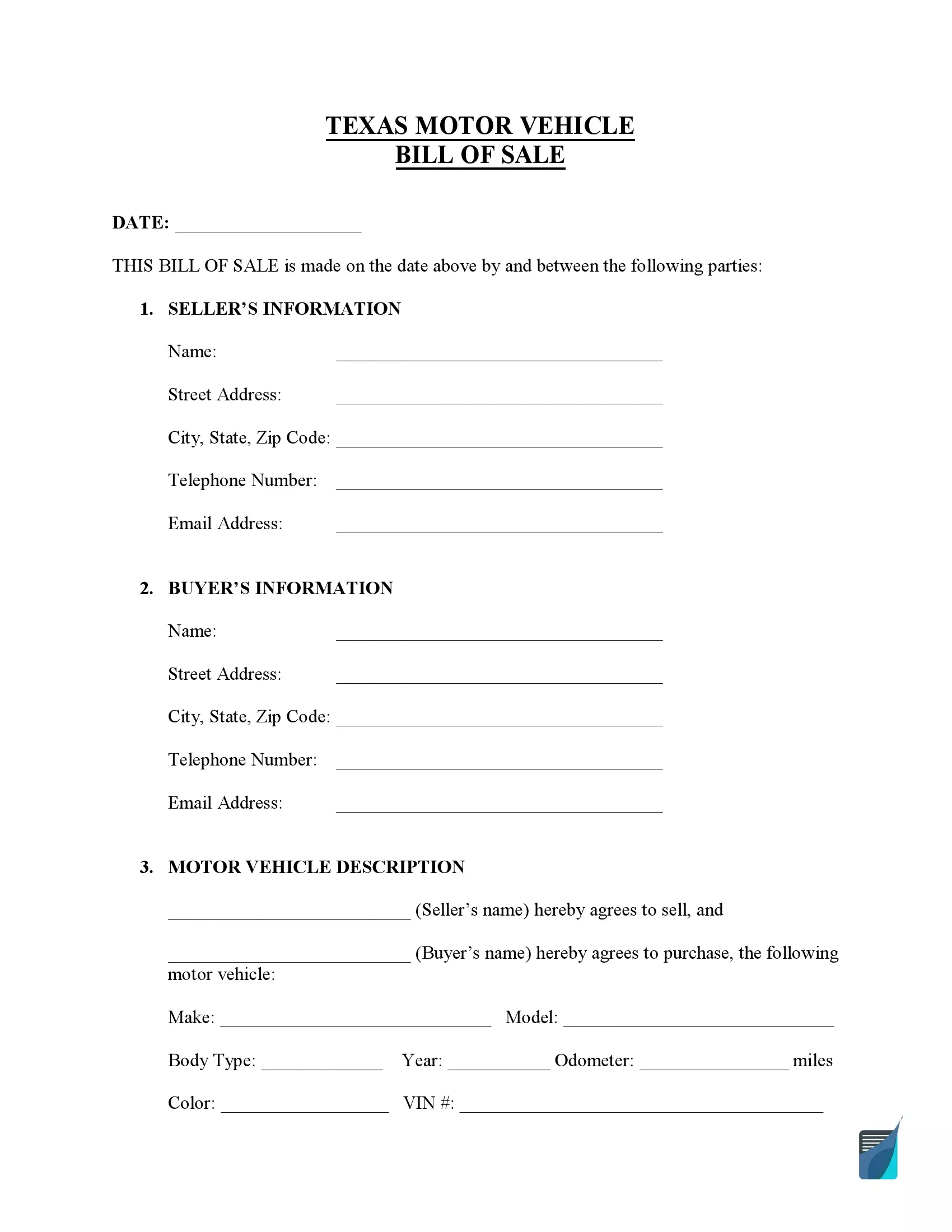
The Texas motor vehicle bill of sale records the vehicle’s make, model, VIN, odometer reading and the payment details. Copy the vehicle details from the title so the two documents match.
| Alternative Name | Car Bill of Sale |
| Seller’s Signature | Signature line on the form |
| Buyer’s Signature | Signature line on the form |
| Notarization | Notary block on the form |
| Download | PDF Template |

Texas trailer bill of sale was specifically designed for transactions involving various trailers. Use it if you want to buy or sell a trailer.
| Alternative Name | Utility Trailer Bill of Sale |
| Seller’s Signature | Customary |
| Buyer’s Signature | Customary |
| Notarization | Extra safeguard |
| Download | PDF Template |

The process for a Texas bill of sale for a boat is very similar. You will need to specify the HIN, engine hours, and any additional identifying elements.
| Alternative Name | Vessel Bill of Sale |
| Seller’s Signature | Customary |
| Buyer’s Signature | Customary |
| Notarization | Extra safeguard |
| Download | PDF Template |

Texas firearm bill of sale records a private gun sale between two parties. List the make, caliber and model of the firearm, the serial numbers of all guns, the price and the details of the buyer and the seller.
| Alternative Name | Gun Bill of Sale |
| Seller’s Signature | Customary |
| Buyer’s Signature | Customary |
| Notarization | Extra safeguard |
| Download | PDF Template |

Use a general bill of sale for other personal property when there is no more specific form available.
| Alternative Name | Generic Bill of Sale |
| Seller’s Signature | Customary |
| Buyer’s Signature | Customary |
| Notarization | Extra safeguard |
| Download | PDF Template |
Texas has no statute that requires a bill of sale for a private vehicle sale. Texas also has no statute that requires a bill of sale to be notarized. A signed bill of sale is still the clearest written record of the deal, and the rules below show what the state asks for when the vehicle changes hands.
A bill of sale does not replace the title paperwork. The TxDMV asks for the signed Form 130-U title application to put the vehicle in the buyer’s name.[1]
If the vehicle had a loan, the lienholder has a duty once the debt is paid off. Texas law says:[2]
When a debt or claim secured by a lien has been satisfied, the lienholder shall, within a reasonable time not to exceed the maximum time allowed by Section 348.408 or 353.405 (b), Finance Code, as applicable, execute and deliver to the owner, or the owner’s designee, a discharge of the lien in a manner prescribed by the department.
Keep the signed bill of sale together with the title paperwork. If the sale is ever questioned, one folder shows the date, the price and the vehicle details.
The steps below follow our Texas motor vehicle bill of sale template from top to bottom and use the same part labels you will see on the form. Each step matches one part of the PDF, so you can fill it in on screen or by hand.
Step 1: Fill in the date
Enter the date at the top of the first page.

Step 2: Complete 1. Seller’s Information
Step 3: Complete 2. Buyer’s Information
Fill in the same five lines for the buyer.

Step 4: Complete 3. Motor Vehicle Description
Write the seller’s and buyer’s names in the sentence, then fill in the vehicle details:

Step 5: Enter the purchase date and total price in 4
On page 2, write the date of sale and the total price in U.S. dollars.
Step 6: Check how the price is paid
Tick one of the four options:
Step 7: Choose the payment type and the tax line
Select one payment type: cash, check (with the check number), cashier’s check or money order. Then tick whether all applicable taxes are included in the price or not included.

Step 8: Read 5. Miscellaneous Provisions
There are no blanks on this page. It covers the seller’s confirmation of ownership and no liens, the “as is” sale and the statement that the bill of sale is the only agreement between the two sides.

Step 9: Sign 6. Signatures
The seller and the buyer each sign, add the date and print their names. The form also has a signature line for a witness.

Step 10: Use the Acknowledgment page if you want a notary
The last page is a notary acknowledgment. If you choose to notarize, sign in front of the notary and let them complete it. Print two copies and have both signed, so the seller and the buyer each keep a record of the sale.

After the sale, the buyer takes the paperwork to the County Tax Office to get the title in their name. The TxDMV says vehicles are required to be titled in the buyer’s name within 30 days from the date of sale, and the title application is Form 130-U.[1]
If the buyer plans to drive the vehicle before the title paperwork is finished, they can look into a temporary license plate, also known as a temp tag. Ask your county tax office what the buyer needs to bring.
If the sale takes place on a Saturday or Sunday and the seller removes the license plates and registration sticker, the buyer downloads a Vehicle Transit Permit from the TxDMV to drive the vehicle to the county tax office. The permit is valid for five calendar days, and only one permit may be issued per vehicle sale.[1]
Buyers commonly bring these items to the county tax office:
A signed bill of sale is also a useful supporting document when a vehicle comes without a title. It records the vehicle details and both parties in one place. For a missing title, check with the TxDMV or your county tax office.
If you are the seller, give the buyer the signed title, with the date of sale and the odometer reading, and a signed Form 130-U, then file a Vehicle Transfer Notification online within 30 days. The TxDMV says a seller who files the notification within 30 days of the sale cannot be held responsible for parking tickets and toll violations committed by the buyer.[1]
Application for Texas Title and/or Registration is used to apply for title or registration, or both. Instructions inside.

Used when a vehicle is given, without payment, by an eligible family member, guardian, qualified trust or nonprofit.

Use this Affidavit of Heirship for a Motor Vehicle if you inherited the vehicle.

Submit within 30 days of the sale if you are the seller to protect yourself from any possible liability for acts that involve the vehicle.

A vehicle power of attorney that you can use to appoint an agent that would be able to act on your behalf in matters related to vehicle registration.

Affidavit of Fact is used for previously owned vessels that have never been documented in any way.

These quick answers cover the paperwork in a private vehicle sale in Texas. For the field-by-field walkthrough of the template, see the steps above, and for registration details, see the section on registering a vehicle.
The title must be properly signed, including the date of sale and the odometer reading.[1] In your own bill of sale, also record the name and address of the seller, the date of sale and the vehicle information, including the VIN.
A common slip is forgetting the date of sale or the odometer reading, since a properly signed title includes both.[1] Before signing, compare the VIN, the names and the sale price on the bill of sale with the title and Form 130-U so every document matches.
General information, not legal or tax advice.


