
Updated:
An Arizona firearm bill of sale is a signed receipt for a gun. The form names the seller and the buyer, describes the gun by serial number and states the price. Private sellers and buyers in Arizona use it, especially for a trade or a gift. For other kinds of sales, see the bill of sale guide.
Key facts
Build Your Document
Answer a few simple questions to make your document in minutes
Save and Print
Save progress and finish on any device, download and print anytime
Sign and Use
Your valid, lawyer-approved document is ready
Find more Arizona bill of sale templates for other kinds of sales.
An Arizona firearm bill of sale is a written account of one gun changing hands between a private seller and a buyer, with the date, both parties, the firearm and the price set down on paper and signed.
The document goes by several names. Searchers call it a gun bill of sale, a firearm transfer form or a gun sale form. Each name describes the same paper: who sold which gun to whom, when, and for how much.
The firearm version differs from a general bill of sale in its description section, which asks for the caliber and the serial number. For a sale outside Arizona, see the firearm bill of sale page.
A gun bill of sale fits any private transfer of a firearm between two people, whether the gun is sold for cash, paid for in parts, traded for another gun or given as a gift.
The form handles each case with a checkbox in its payment section, so one document covers all four. The signed paper gives the seller a dated account of when the gun left their hands, and gives the buyer a written account of what was paid and received.
A sale through a licensed dealer runs on the dealer's own paperwork, which this page does not cover.
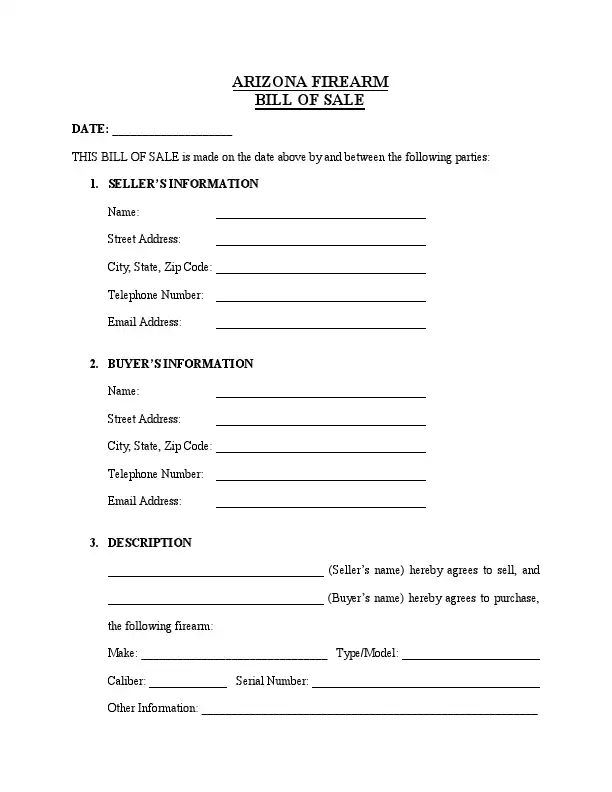
An Arizona gun bill of sale includes seven numbered sections: the seller, the buyer, the firearm, the price and payment, the disclosures, the terms and the signatures, followed by a notary acknowledgment page.
The firearm section identifies the gun by make, type or model, caliber and serial number, with a further line for details such as the finish, the sights or the accessories that come with it.
The serial number is the detail that ties the paper to one gun. Copy the serial number exactly as it is stamped on the firearm, and check it against the gun at the hand-over.
The payment section lists the purchase date, the total price and one of four payment plans, each marked with its own checkbox on the form.
The section then marks the method: cash, check (with the check number), cashier's check or money order.
The disclosure section holds statements the seller and the buyer each confirm, and each side signs its own statements on a separate line near the end of the form.
Read every statement before signing it. A party who cannot truthfully confirm a statement should not go on with the sale.
The "as is" clause states that the buyer takes the firearm in its current condition, with no warranties, and accepts all liability for it as of the sale date.
The buyer inspects the gun before signing, since the form offers no warranty to fall back on. The terms also state that the form is the only agreement between the parties, so write any extra promise onto the form itself.
Arizona law prohibits selling or transferring a deadly weapon to a prohibited possessor, as Ariz. Rev. Stat. § 13-3102 states.[1] The statute says:
Selling or transferring a deadly weapon to a prohibited possessor
Under Ariz. Rev. Stat. § 13-3102, the words cover transferring as well as selling, so a trade or a gift falls under them too.
The bill of sale does not test whether a buyer is a prohibited possessor. It holds the buyer's name, address, phone and email, so both sides have a written account of the person the gun went to. Arizona's statutes define who counts as a prohibited possessor; this page does not restate that definition.
Before handing over the gun, a seller can take these steps:
The Arizona firearm bill of sale PDF is a printable form with seven numbered sections and a notary page, laid out in the order a sale happens: parties, gun, price, disclosures, terms and signatures.
Fill in the PDF on screen or by hand in ink, then print two copies for signing.
An Arizona firearm bill of sale is filled out section by section, from the date at the top to the notary page, with every field complete before anyone signs.


Leave no field blank. Write "none" in a field that does not apply, so nothing can be added after signing.
The signature section of an Arizona gun bill of sale has dated lines for the seller, the buyer and a witness, and the last page holds a notary acknowledgment the parties can complete.
The sources behind this page hold no Arizona rule on a notary or a witness for a private gun bill of sale, so this page states none. The form keeps both options for parties who want an independent signer.
To use the notary page:
Each party keeps a signed copy. The seller's copy shows the date the gun left their hands; the buyer's copy shows what was paid and what was received.
The sources behind this page hold no Arizona rule that calls for a bill of sale in a private gun sale. Sellers and buyers use one as a signed account of the deal: who, which gun, when and for how much.
An Arizona firearm bill of sale carries a notary page, but the sources behind this page hold no Arizona rule on notarizing it. Parties who want an independent check of their signatures can sign in front of a notary.
No, Ariz. Rev. Stat. § 13-3102 prohibits selling or transferring a deadly weapon to a prohibited possessor.[1] Ariz. Rev. Stat. § 13-3102 is one limit on a private sale, not the full list: other Arizona and federal rules, such as those on buyers who are minors or who live in another state, can also restrict a sale, and this page does not restate them. A seller who checks the buyer's ID and writes the buyer's details on the form has a written account of who took the gun.
For a private sale, a firearm transfer form and a gun bill of sale hold the same facts: the two parties, the gun, the date and the price. A licensed dealer's transfer paperwork is a separate document this page does not cover.
Yes, the payment section of the form has a box for a gift, with no payment, and a box for a trade-in, with lines for the buyer's firearm and any extra payment.
Each party keeps a signed original of the firearm bill of sale. Printing two copies and signing both gives each side the same paper.
General information, not legal or tax advice.
