Georgia Motorcycle Bill of Sale Form

A Georgia motorcycle bill of sale is a written record of a motorcycle sale. It names the seller and the buyer, describes the bike and states the price and the date. Georgia asks for a bill of sale when the vehicle is 1985 or older and does not require a title.[1] This free template has 66 fillable fields, an odometer line and a notary acknowledgment block.

Last Updated: October 2026. This guide is reviewed and updated regularly to reflect current Georgia law. If you notice an error or outdated information, please contact us.
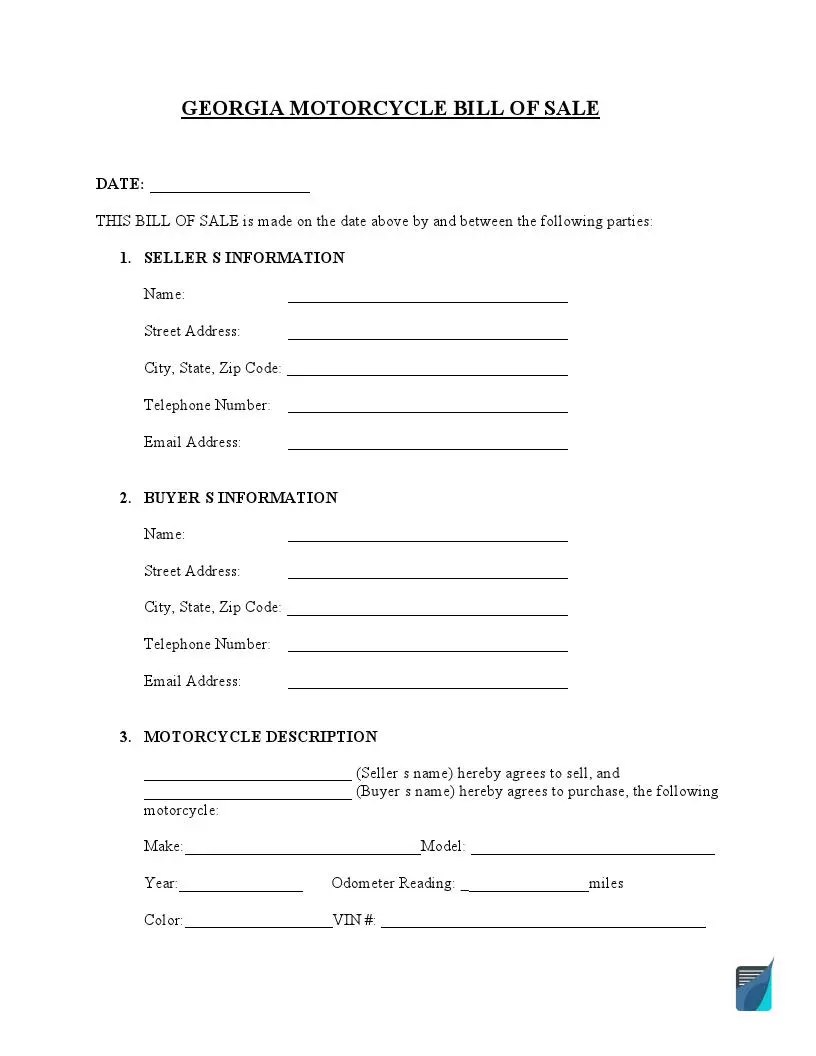
Georgia motorcycle bill of sale form preview

Create a free high quality Georgia Motorcycle Bill of Sale online now!

Build Your Document

Answer a few simple questions to make your document in minutes

Save and Print

Save progress and finish on any device, download and print anytime

Sign and Use

Your valid, lawyer-approved document is ready

... or download your Georgia Motorcycle Bill of Sale Form as a  PDF file

What Are the Georgia Motorcycle Bill of Sale Requirements?

Provide a bill of sale if the motorcycle is 1985 or older and does not require a title.[1] In every sale, the title is what moves ownership from the seller to the buyer.[2] The bill of sale records the deal for both sides, so it should be a clear record of the transaction with the date, the parties, the motorcycle and the price.

The date of sale or ownership transfer must be stated. The seller prints and signs a name under the seller line, and if the vehicle is jointly owned, each buyer must print and sign.[2] The FormsPal template has a purchase date line and signature lines for the seller and the buyer, so both can sign the same document.

Where the law requires an odometer disclosure for the transfer, the person transferring ownership must make a written statement of the mileage. That is either the reading shown on the odometer or, where the statute allows it, a statement that the actual mileage is unknown. A reading known to differ from the true mileage may not be given as the actual mileage.[2]

All recorded liens and/or security interests against the previous owner must be released in the spaces provided on the title.[1]

Signing a bill of sale is not the same as handing over the title. The statute says:

if an owner transfers his interest in a vehicle other than by the creation of a security interest, he shall, at the time of delivery of the vehicle, execute an assignment and warranty of title to the transferee in the space provided therefor on the certificate of title or as the commissioner prescribes and cause the certificate and assignment to be delivered to the transferee.

O.C.G.A. § 40-3-32(a)

In plain terms, when the motorcycle has a certificate of title, the seller signs the title over to the buyer, showing the buyer as the new owner. The seller then delivers the title to the buyer.[3]

The FormsPal template records these details:

  • Name, street address, city, state, zip code, phone and email for the seller and the buyer
  • Make, model, year, odometer reading, color and VIN of the motorcycle
  • Purchase date, total price and how the price is paid
  • Whether taxes are included in the price
  • Signatures of the seller and the buyer, two witness lines and a notary acknowledgment

The Georgia Department of Revenue publishes its own bill of sale, Form T-7, to provide evidence of a transaction between the buyer and the seller. Both the seller and the buyer sign Section E of that form.[4]

What Should You Bring to Register a Motorcycle in Georgia?

Registering a motorcycle after a private sale starts with the paperwork from the sale. In practice, the buyer takes the signed bill of sale and the title, signed over by the seller, to a local motor vehicle office. Rules and office procedures can change, so confirm what to bring before you go.

Buyers commonly bring these papers:

  • The signed bill of sale
  • The seller's title, signed over to the buyer
  • The lien release, if the title shows a lien
  • The odometer statement

For help with the title, read our guide to a motorcycle title with a bill of sale. For a general guide to motorcycle sales, read our motorcycle bill of sale guide. You can also browse all Georgia bill of sale forms or the bill of sale overview.

Make two signed copies, or one signed copy and a photocopy, so the seller and the buyer each hold a record of the sale. Keep the signed copy with the title paperwork.

The application for a Georgia title and tag is DOR Form MV-1, and it must be signed by all owners in Section B.[5]

Georgia Motorcycle Bill of Sale Form Details

Document Name Georgia Motorcycle Bill of Sale Form
Other Name Georgia Bill of Sale for Motorcycle
Relevant Link Georgia Department of Revenue
Avg. Time to Fill Out 11 minutes
# of Fillable Fields 66
Signature Lines Seller, buyer and two witnesses
Notary Acknowledgment Included on page 4
Available Formats Adobe PDF
Template Preview
Download your fillable Georgia Motorcycle Bill of Sale template in PDF format.

How to Fill Out the Georgia Motorcycle Bill of Sale Form

Fill out the form in the order it runs, from the date on page 1 to the acknowledgment on page 4. Each step below matches one part of the FormsPal template, and the picture under it shows where the answer goes. Copy the names and the VIN exactly as they appear on the title, which is an effective way to avoid mismatches. Fill in only the lines that are necessary for your sale.

The screenshots under each step show the FormsPal Georgia motorcycle bill of sale template filled with sample entries in blue, so you can see where each answer goes. The names, addresses, dates and amounts are examples only.

  1. Date. Enter the date at the top of page 1. The form says the bill of sale is made on this date between the seller and the buyer.
    Georgia motorcycle bill of sale: GEORGIA MOTORCYCLE BILL OF SALE, filled with sample entries
    Step 1: sample entries, not a real document.
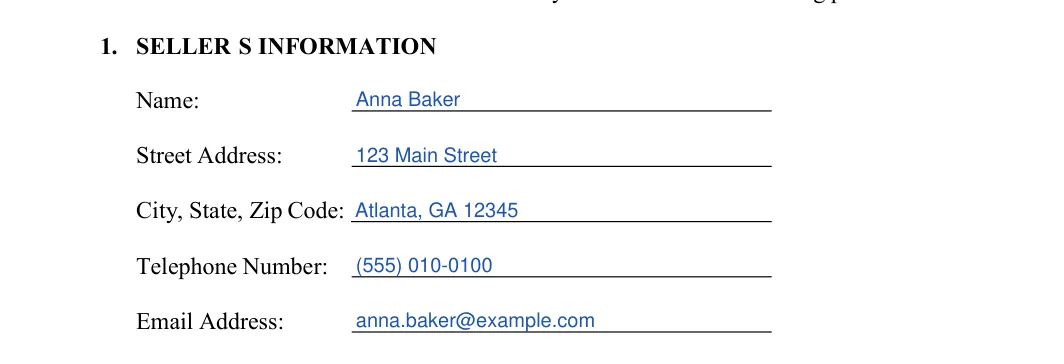
  2. Seller's information. Fill in the seller's full legal name, street address, city, state and zip code, phone number and email address.
    Georgia motorcycle bill of sale: 1. SELLER S INFORMATION, filled with sample entries
    Step 2: sample entries, not a real document.
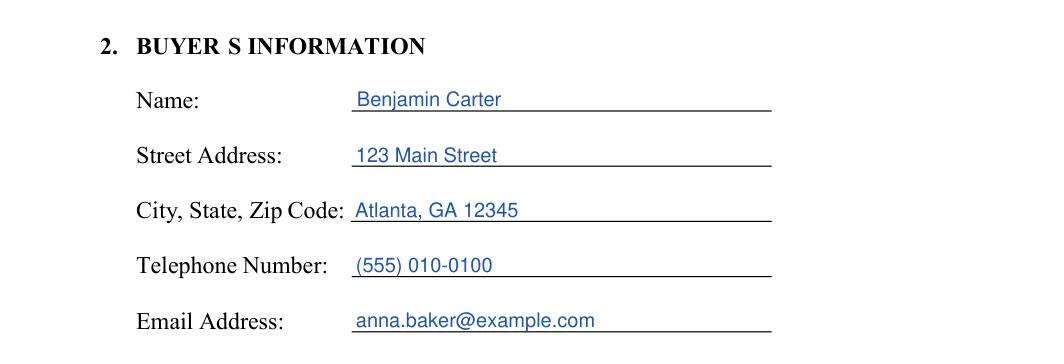
  3. Buyer's information. Fill in the buyer's full legal name, street address, city, state and zip code, phone number and email address.
    Georgia motorcycle bill of sale: 2. BUYER S INFORMATION, filled with sample entries
    Step 3: sample entries, not a real document.
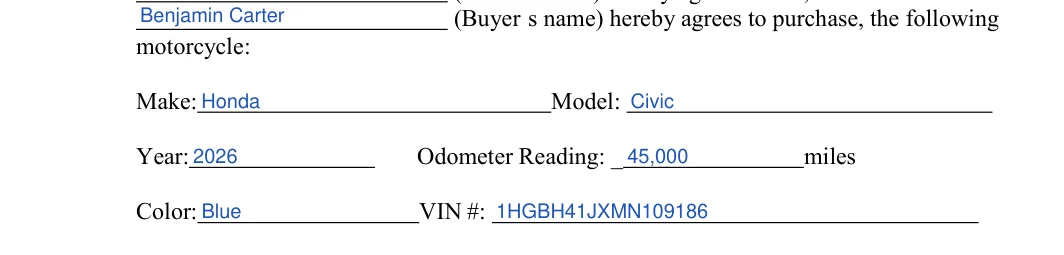
  4. Name both parties in the agreement line. Repeat the seller's name and the buyer's name in the sentence that starts the motorcycle description.
    Georgia motorcycle bill of sale: 3. MOTORCYCLE DESCRIPTION, filled with sample entries
    Step 4: sample entries, not a real document.
  5. Describe the motorcycle. Enter the make, model, year, odometer reading in miles, color and VIN of the motorcycle being sold.
    Georgia motorcycle bill of sale: motorcycle, filled with sample entries
    Step 5: sample entries, not a real document.
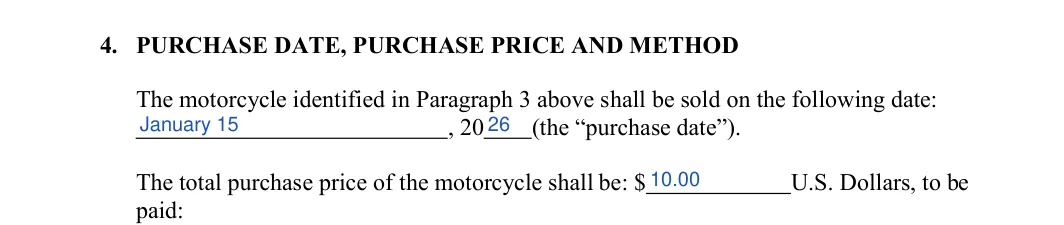
  6. Purchase date and total price. Enter the purchase date and the total purchase price in U.S. dollars.
    Georgia motorcycle bill of sale: 4. PURCHASE DATE, PURCHASE PRICE AND METHOD, filled with sample entries
    Step 6: sample entries, not a real document.
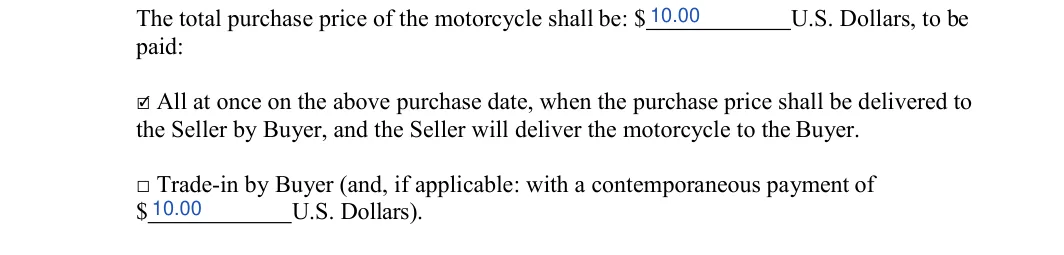
  7. Payment: all at once or trade-in. Initial one option, either payment of the full price on the purchase date or a trade-in by the buyer. For a trade-in, enter the contemporaneous payment amount if there is one.
    Georgia motorcycle bill of sale: paid, filled with sample entries
    Step 7: sample entries, not a real document.
  8. Trade-in: make and model of the buyer's vehicle. Fill this in only for a trade-in. Enter the make and model of the buyer's vehicle, and leave it blank for the other options.
    Georgia motorcycle bill of sale: Make, filled with sample entries
    Step 8: sample entries, not a real document.
  9. Trade-in: year and odometer of the buyer's vehicle. Fill this in only for a trade-in. Enter the year and the odometer reading in miles of the buyer's vehicle.
    Georgia motorcycle bill of sale: Year, filled with sample entries
    Step 9: sample entries, not a real document.
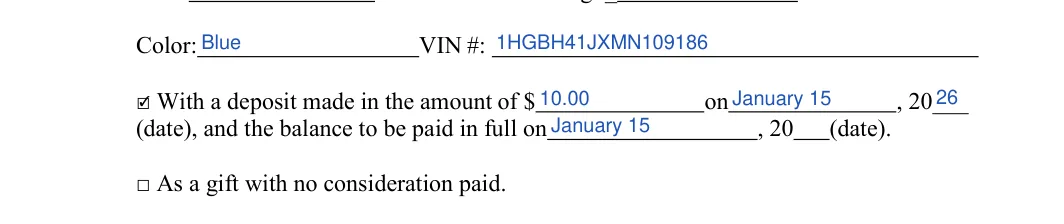
  10. Trade-in color and VIN, deposit or gift. For a trade-in, enter the color and VIN of the buyer's vehicle. For a deposit, initial that option and enter the deposit amount, the deposit date and the date the balance is paid in full. For a gift, initial the gift option.
    Georgia motorcycle bill of sale: Color, filled with sample entries
    Step 10: sample entries, not a real document.
  11. How the price is paid. Initial one method: cash, check, cashier's check or money order. For a check, add the check number.
    Georgia motorcycle bill of sale: □ Check (check #, filled with sample entries
    Step 11: sample entries, not a real document.
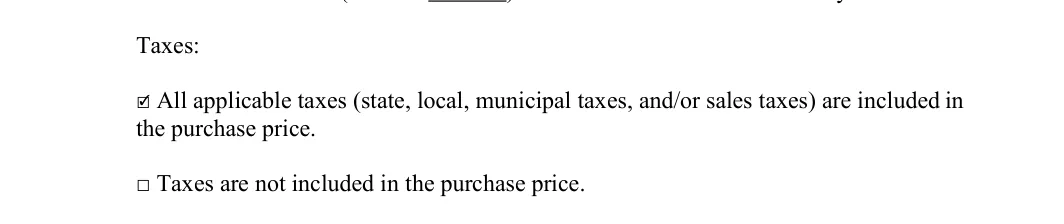
  12. Taxes. Initial one option, either taxes are included in the purchase price or taxes are not included.
    Georgia motorcycle bill of sale: Taxes, filled with sample entries
    Step 12: sample entries, not a real document.
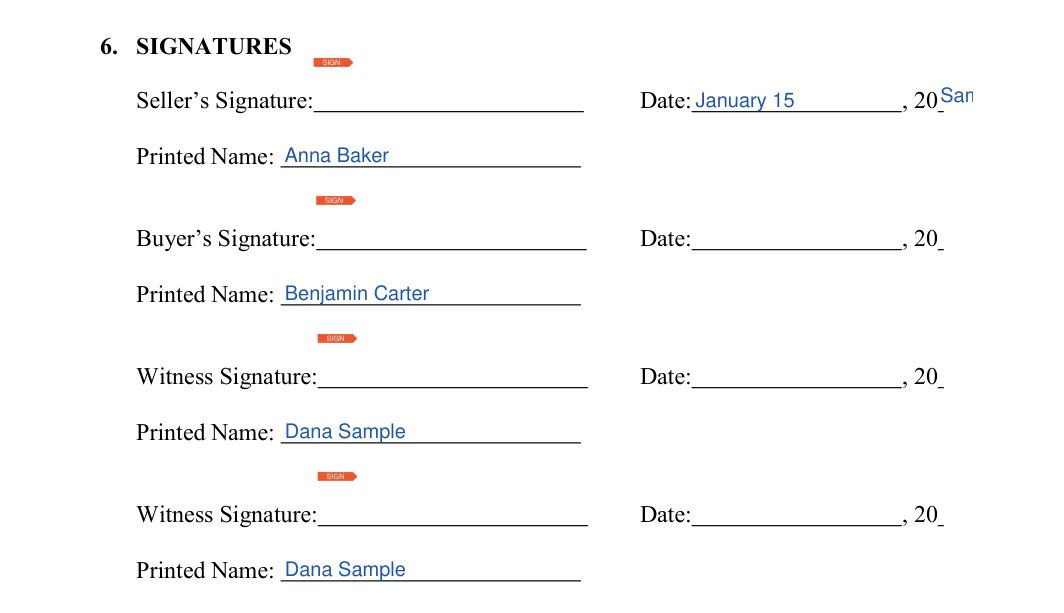
  13. Provisions and signatures. Read Section 5, which covers the seller's ownership and no-lien statement and the "as is" sale. Then the seller signs, prints a name and adds the date, and the buyer does the same. The form also has two witness lines, each with a signature, a printed name and a date.
    Georgia motorcycle bill of sale: 6. SIGNATURES, filled with sample entries
    Step 13: sample entries, not a real document.
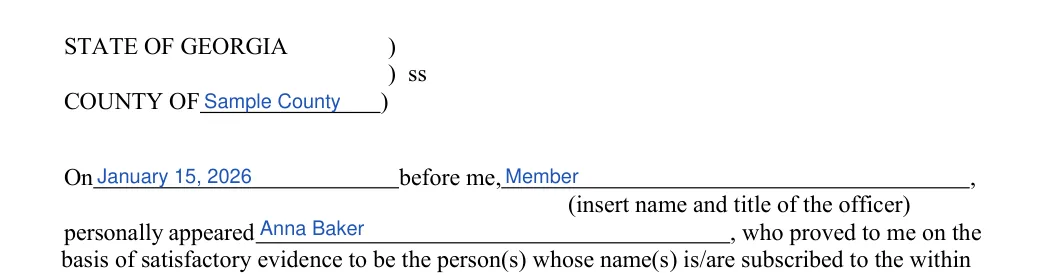
  14. Acknowledgment: county, date and officer. Page 4 holds the acknowledgment block for a notary. The notary completes the county, the date, the officer's name and title, and the name of the person who appeared. Leave the block blank if you do not use a notary.
    Georgia motorcycle bill of sale: STATE OF GEORGIA, filled with sample entries
    Step 14: sample entries, not a real document.
  15. Acknowledgment: officer's signature and seal. If you have the bill of sale notarized, sign before the notary. The officer then signs and adds the seal on the last line, under "WITNESS my hand and official seal."
    Georgia motorcycle bill of sale: Signature, filled with sample entries
    Step 15: sample entries, not a real document.

Frequently Asked Questions

Georgia asks for a bill of sale when the vehicle is 1985 or older and does not require a title,[1] and ownership is transferred with the certificate of title.[2] These answers cover the date, liens, the odometer, the title and notarizing.

What date of sale information must be included on a bill of sale in Georgia?

The date of sale or ownership transfer must be stated.[2] The FormsPal template has two date entries:

  • The date line at the top of page 1
  • The purchase date in Section 4

Is a lienholder release required on a bill of sale in Georgia?

Any lienholder must release its lien. All recorded liens and/or security interests against the previous owner must be released in the spaces provided on the title.[1] In practice, ask the lienholder to complete the release before the sale closes.

Is an odometer disclosure required on a bill of sale in Georgia?

Where the law requires one for the transfer, the odometer reading at the time of the transfer must be disclosed.[2] The template has an odometer line in the motorcycle description, so enter the reading there.

Is a title transfer required when completing a bill of sale in Georgia?

Yes. The seller transfers ownership of the vehicle with the certificate of title.[2] Under O.C.G.A. § 40-3-32(a), the owner must execute an assignment and warranty of title to the transferee and cause the certificate and assignment to be delivered to the transferee.[3]

Does a Georgia motorcycle bill of sale need to be notarized?

Georgia has no statute that requires a bill of sale to be notarized. The form on this page includes an acknowledgment block on page 4 for a notary to complete.

General information, not legal or tax advice.

Sources

  1. Ga. DOR MVD; Title and Register a Vehicle Purchased in a Casual Sale.
  2. Georgia DOR Form T-7.
  3. O.C.G.A. § 40-3-32(a).
  4. Georgia DOR Form T-7, Bill of Sale.
  5. Georgia DOR Form MV-1.
Published: Apr 12, 2022
Mara Erlach
Mara Erlach
Writer & Attorney
Mara has been practicing estate planning and trust law in California since 2003, taking pride in helping clients of all backgrounds and asset profiles form a complete and customized estate plan. Her specialties are: estate planning, wills and trusts, trust and probate administration.