
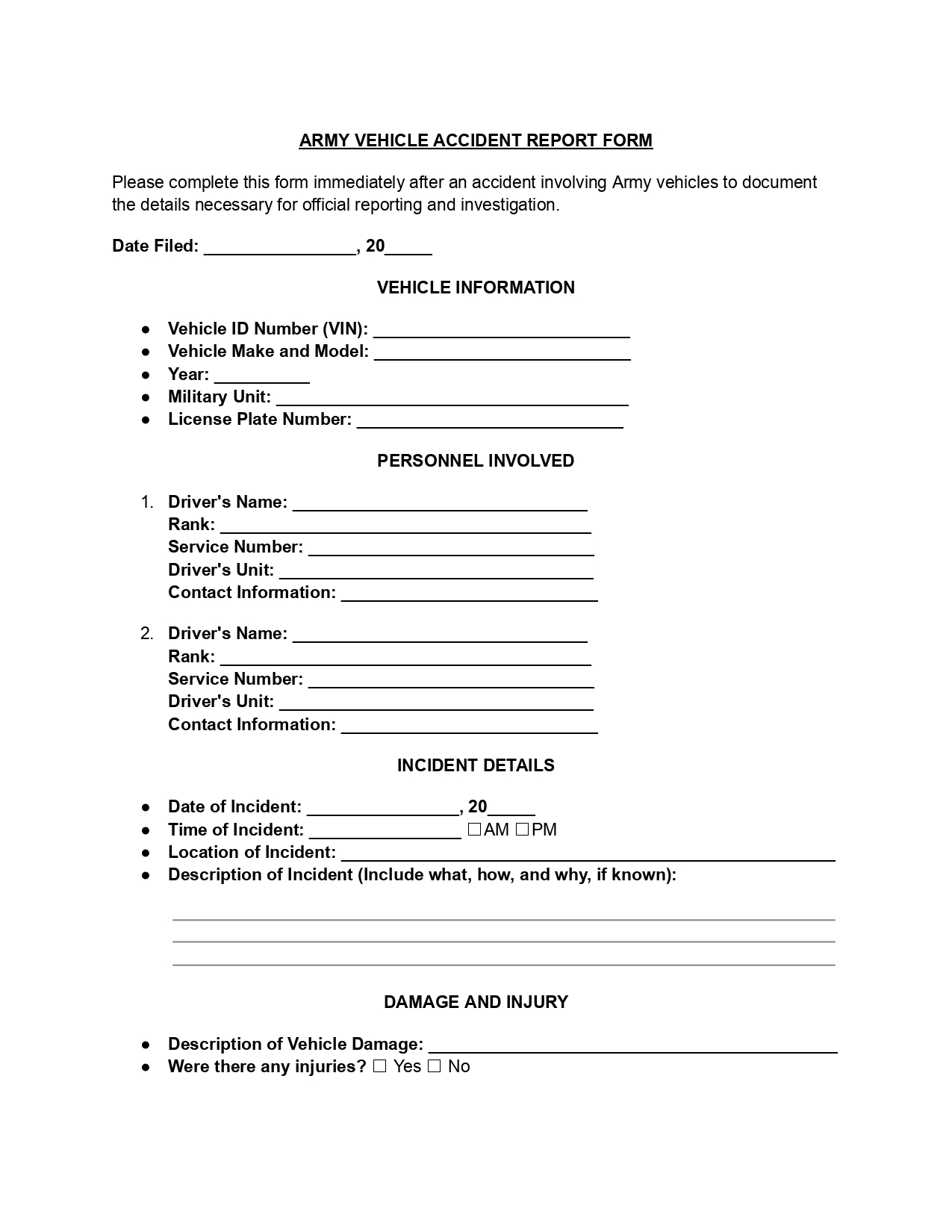
An Army vehicle accident report is a form used to document details of incidents involving military vehicles. These forms are required for official record-keeping and analysis and for initiating investigations into the causes of accidents. They are also essential to risk management and safety protocols and help prevent future incidents by addressing identified issues or trends.
Last Updated: October 2026. This guide is reviewed and updated regularly to reflect current law. If you notice an error or outdated information, please contact us.
The U.S. Army uses several official forms to document and report vehicle accidents, each tailored to the specific incidents and equipment involved. These forms are essential for maintaining readiness and safety by providing a systematic approach to accident investigation and prevention.
These forms help the Army conduct thorough investigations and develop strategies to prevent future accidents. Each form has a specific purpose and ensures detailed documentation and accountability within Army operations.
| Form | Full title | What it records |
|---|---|---|
| DA Form 5988-E | Equipment Maintenance and Inspection Worksheet | Maintenance checks, plus damage or mechanical problems found after an accident |
| SF 91 | Motor Vehicle Accident Report | Driver information, vehicle details and a narrative description of the accident scene |
You can fill in the form on a computer or print it and complete it by hand. Work through the sections in order and use plain, factual wording. The nine steps below follow the sections of the form, so you can check each one off as you go.
To type your answers, open the file in our PDF editor. Have these details close at hand before you begin:
Enter the date when the form is being filled out. Then, complete the Vehicle Information section with the Vehicle ID Number (VIN), Make and Model, Year, Military Unit, and License Plate Number of the involved vehicle. The VIN is printed on the registration papers and on the vehicle itself.
List all personnel involved in the incident. For each person, include full name, rank, service number, driver’s unit, and contacts. Add a phone number or office address for each person so someone can reach them later.
Specify the date and time of the incident, and indicate whether it was AM or PM. Provide the exact location of the incident and a detailed description of what happened, how it occurred, and why, if known. Mention the installation, road or gate by name, and note whether it was daylight or dark.
In this section, describe the vehicle damage and check whether there were any injuries. If there were injuries, provide detailed descriptions and indicate if medical assistance was required, including the name of the medical facility used. For damage, name the part of the vehicle, such as the rear bumper or the left mirror.
If there were witnesses, list their names and contact information. Include a phone number or email address for each one.
Indicate whether the incident was reported to the police or military police, providing the report number and the officer’s name if applicable. Write the number exactly as it appears on the police paperwork.
If any photos or additional documents are attached, check the appropriate box. Describe any environmental conditions during the incident, such as weather or road conditions. Rain, ice, fog, glare and a wet road are all worth a mention.
The preparer of the report should provide their name and rank/position, sign the form, and date it to certify the accuracy of the information provided. Use the same name and rank spelling you entered in the personnel section.
For internal use, someone must acknowledge receipt of the report by providing their name and the date received. They should also note any follow-up actions taken.
A clear report is easy to read and easy to check. Write down the facts in the order they happened and leave out guesses. Use the same spelling, dates and numbers everywhere, so the details line up when someone reads the report later.
An Army vehicle accident report brings together the vehicle details, the people involved, a description of what happened, the damage and any injuries. People tend to ask the same handful of questions when they sit down to write one, from which form to pick to how to word the narrative.
It is a written record of an accident involving a military vehicle. It captures the vehicle details, the people involved, what happened, the damage and injuries, and who saw it.
DA Form 5988-E records damage and mechanical problems after an accident. SF 91 records the accident scene, the drivers, the vehicles and a short narrative of what happened.
Say what happened, how it happened and why, if you know. Keep to the facts in the order they took place. If you do not know a detail, say so plainly instead of guessing.
Gather these before you sit down to write:
SF 91 is titled Motor Vehicle Accident (Crash) Report. The U.S. Army and other federal government agencies use it to record an accident that involves a vehicle.
Yes. For a private car, the Vehicle Accident or Damage Report and the Car Accident Police Report are closer matches.
Give enough detail that a reader who was not there can picture what happened. Cover the order of events, the road and weather conditions, and the direction each vehicle was heading, if you know them.
Look at the registration papers or at the plate on the vehicle itself. Your unit's motor pool can also help you find the number.
Yes. Open the PDF in the FormsPal PDF editor, type your answers and save the file. You can also print the form and fill it in by hand.
Turn the scan into editable text with the FormsPal OCR tool. Then fill in your answers and save the file.
Read it once more, check that names and numbers match, then sign and date it. Keep a copy for your records.
General information, not legal or tax advice.
