
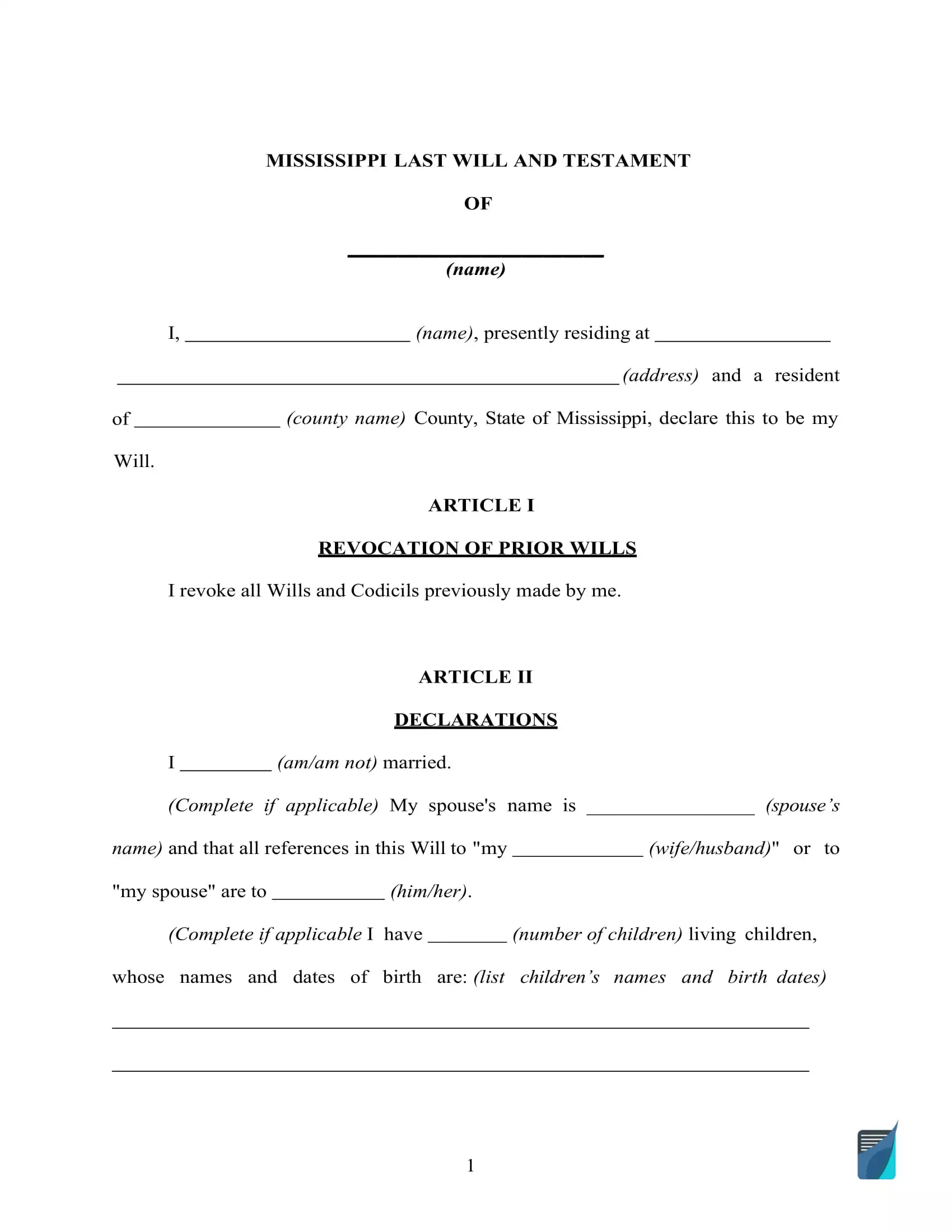
A Mississippi last will and testament is a written document in which a person (the testator) states who should receive their property after their death, under Mississippi Code Ann. 91-5-1.[1] It must be signed by the testator and, in most cases, by two witnesses to be valid.[1]
This document is also known simply as a will. Below you will find a Mississippi last will and testament example, the state’s core signing requirements, and a step-by-step guide to filling one out.
Last Updated: September 2026. This guide is reviewed and updated regularly to reflect current Mississippi law. If you notice an error or outdated information, please contact us.
Under Mississippi Code Ann. 91-5-1, a will is valid when the testator is at least 18 years old and of sound mind. The will must be in writing, and the testator must sign it or direct someone else to sign it in their presence. Unless the entire will is in the testator’s own handwriting, it must also be signed by two or more credible witnesses who watch the testator sign and attest the will.[1]
Mississippi’s core will requirements come from Miss. Code Ann. 91-5-1, covering who may sign a will, how many witnesses are required, and when a handwritten will is exempt from the witness requirement.[1] The table below lists each rule next to its citation.
| Requirements | State laws | |
| Statutes | Title 91 – Trusts and Estates; Chapter 5 – Wills and Testaments | |
| Signing requirement | Two witnesses (unless wholly handwritten and signed by the testator) | § 91-5-1. Who may execute; signature; attestation |
| Age of testator | 18 or older | |
| Handwritten wills | Witnesses not required if wholly written and signed by the testator | § 91-5-1. Who may execute; signature; attestation |
A will only controls property held in your name alone. Jointly owned property and accounts with a named beneficiary typically pass outside the will, so double check those designations separately.
1. Consider your possible format choices. Decide whether you prefer hiring a lawyer or writing your own last will. If you write it yourself, you can start from a last will and testament template, or use our form builder, which walks you through the same process with fewer blank fields to fill in by hand.
2. Specify your information (if it’s you who is creating the will). Establish the testator and their details: full legal name and address (city, county, and state). This Mississippi last will and testament example shows how it works: a testator named Anna Baker would list her full name and her city, county, and state of residence. Review the details you entered to avoid any mistakes.

3. Choose the executor (personal representative) of your estate. Decide who will be responsible for administering your estate and carrying out what your last will and testament says, by filling in their full legal name, along with their city, county, and state of residence. In practice, people usually choose an adult they trust who is capable of handling paperwork, deadlines, and communicating with beneficiaries.
It’s generally fine to name an executor who lives out of state, though many people still choose someone nearby since it can make handling estate matters easier. It also makes sense to choose one more person to perform the duty of your executor in case the first one is unwilling or not capable of carrying out your will.

4. Choose a guardian for minors (optional). You can appoint a trusted person as a guardian if you have underage or dependent children who need to be taken care of. If you don’t name a guardian, a court will generally decide who takes on that role, based on the child’s best interests.

5. Specify your beneficiaries (heirs). Now specify individuals (or charitable organizations) to whom you hand on your estate, that is, your beneficiaries. When naming each individual beneficiary, fill out the following details: full name, address, and the way they are related to you. For example, Anna Baker might name her son, Ben Carter of 123 Main Street, Austin, TX 78701, as a beneficiary.
6. Determine your assets’ distribution. You can decide what happens to your property at your death. It includes cash, shares, real estate, business ownership, money for arrearage, as well as any physical things of monetary value you possess can be mentioned in the last will. Please be aware that there are things that can’t be distributed in the last will and testament, for example, jointly obtained property and life insurance money.

7. Have your witnesses sign the will. Under Mississippi Code Ann. 91-5-1, a will not entirely handwritten and signed by the testator needs two or more credible witnesses who sign in the testator’s presence.[1] In practice, it’s common to pick witnesses who won’t inherit anything under the will, to avoid any appearance of a conflict.
After a complete revision of every section in your MS will, all parties involved (you and the two witnesses) must write their names and full addresses and sign the form.


Other Mississippi Forms
Under general estate law principles that also apply in Mississippi, you are free to leave adult children or other relatives out of your will. Spouses are usually treated differently. In practice, many states give a surviving spouse some protection against being completely disinherited, though the exact rules vary. If you are considering leaving out a spouse, talk with a Mississippi probate attorney about how that protection could apply to you.
In practice, if the original signed will cannot be found, courts generally want proof that it was properly signed and witnessed before they will accept a copy or reconstruction of it. Talk with a probate attorney about your options and what evidence you will need.
Under Mississippi Code Ann. 91-5-1, someone else may sign the will for you, as long as they do so in your presence and at your express direction.[1]
A Mississippi will generally needs two or more credible witnesses who watch the testator sign and who also sign the will themselves, in the testator’s presence. This applies unless the will is wholly written and signed in the testator’s own hand.[1]
To make a valid will in Mississippi, a testator must meet two conditions:
Both conditions come from Mississippi Code Ann. 91-5-1.[1]
| Related documents | Cases when you could need to make one |
| Codicil | You would like to slightly change your will without writing a new one from scratch. |
| Self-proving affidavit | You would like the probate to be faster when the time comes. |
| Living will | You want to state precisely what health care you expect if you can’t communicate that yourself. |
| Living trust | You would like to deal with your end-of-life affairs without probate. |
General information, not legal or tax advice.
