
Updated:
Get Form Now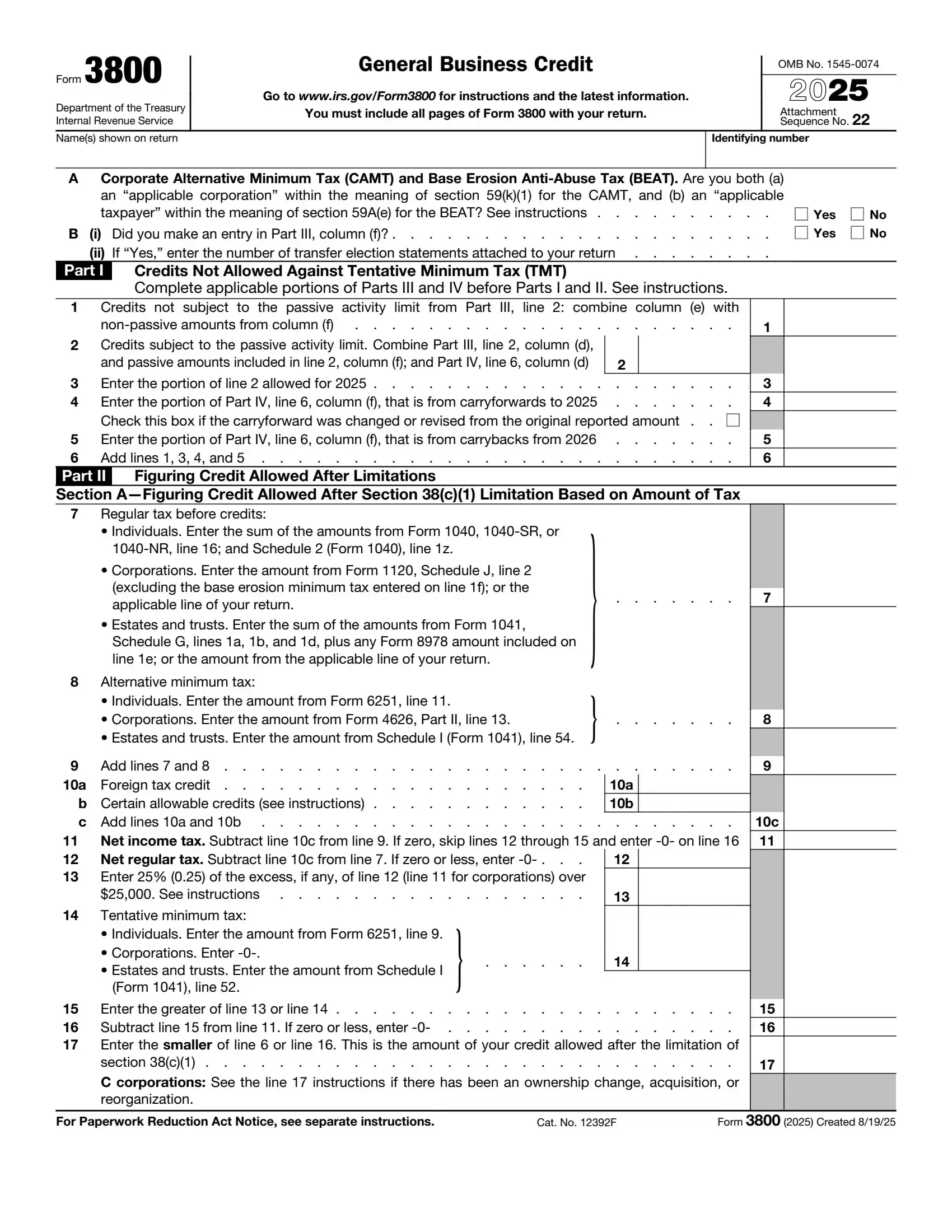
Form 3800, known as the “General Business Credit,” is a form taxpayers use to calculate and claim the total amount of business credits for which they are eligible. This form is a consolidation document for various business-related credits, ensuring taxpayers efficiently claim all applicable credits on one form. These credits can include incentives for investment, employment, research and development, and environmentally friendly practices.
Form 3800 is crucial for taxpayers who qualify for more than one business tax credit. The form is designed to aggregate the amounts from separate credit forms, such as the Work Opportunity Credit (Form 5884), Investment Credit (Form 3468), and Research Credit (Form 6765), to determine the total amount of business credits that can be applied against their tax liability. This organized approach prevents the double claiming of credits across different forms and simplifies the process of applying multiple credits to reduce tax liabilities.
Other IRS Forms for Business
Apart from claiming any of the general business credits in the Form 3800, you might need to report other information to the Internal Revenue Service. Check some other commonly used forms for businesses here.
What it is: Form 3800 is the General Business Credit form of the Department of the Treasury, Internal Revenue Service.
Where and when to file: You must include all pages of Form 3800 with your return.
You must file Form 3800 and the credit source form(s) to claim any of the general business credits.[2]
Complete and attach the appropriate credit forms used to figure your current-year credit. See exceptions under General Instructions.[2]
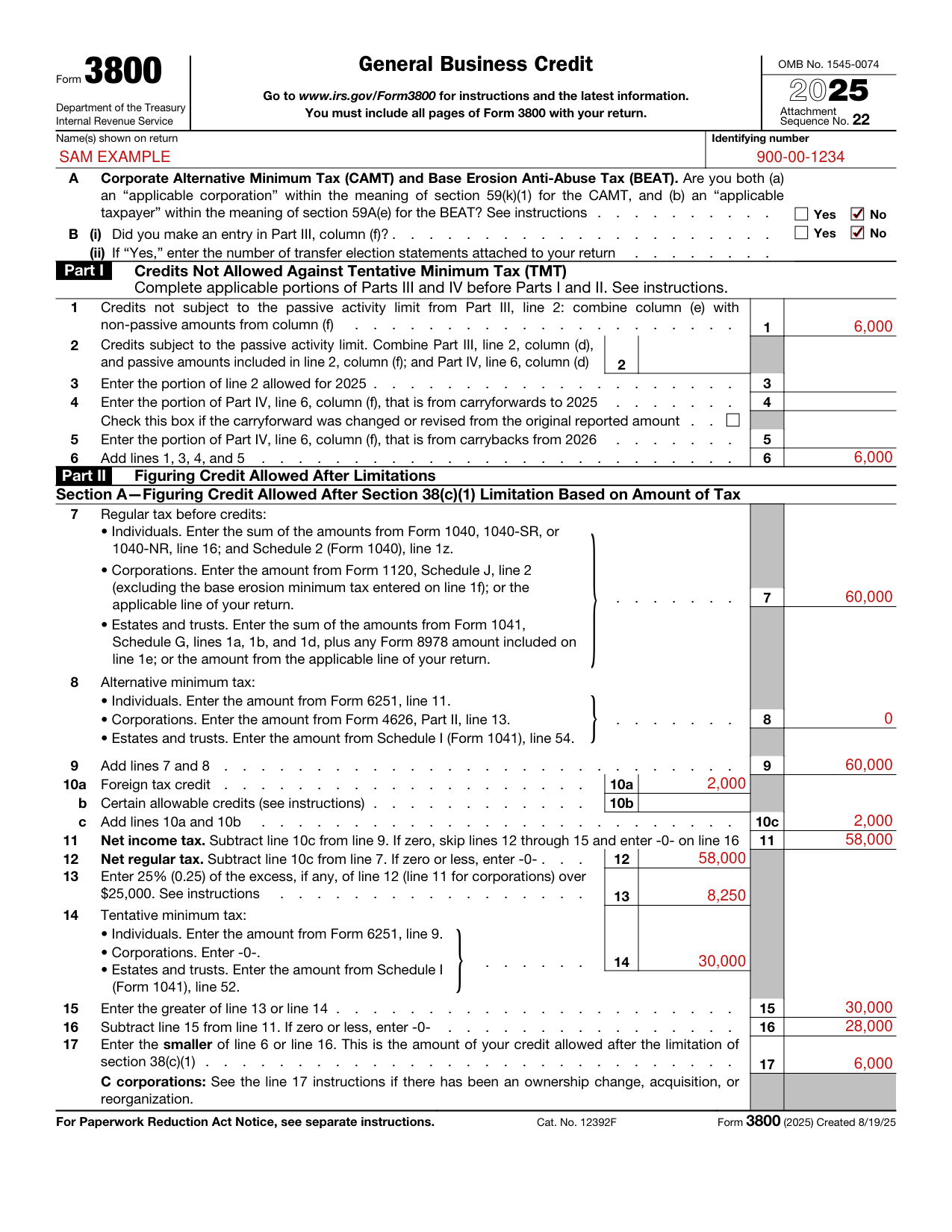

Corporate alternative minimum tax (CAMT) and base erosion anti-abuse tax (BEAT). If you are both an “applicable corporation” within the meaning of section 59(k)(1) and “applicable taxpayer” within the meaning of section 59A(e), check “Yes.” Otherwise, check “No.”[2]

If you made an entry in Part III, column (f), check the “Yes” box for item B(i), and in item B(ii) enter the number of Schedules A (Form 3800) and other transfer election statements you will attach to your return.[2]

Line 1: Non-passive credits from Part III, line 2: Combine column (e) with non-passive amounts from column (f). Caution: Do not take into account any amount in column (f) from passive activities.
Line 2: Report on line 2 the total of all passive activity credit amounts included on Part III, line 2, column (d); and passive amounts included on Part III, line 2, column (f); and Part IV, line 6, column (d).
Line 3: Enter the applicable passive activity credit amount allowed from Form 8582-CR, Passive Activity Credit Limitations; or Form 8810, Corporate Passive Activity Loss and Credit Limitations. Do not include specified credits on line 3. If no credits are allowed, enter -0- on line 3.
Line 4: Enter the amount of non-passive carryforwards to 2025 of unused credits that are reported from line 6 of Part IV, column (f). For each credit entered on line 4, if the credit amount was changed or revised from the amount originally reported, check the box on this line and see the instructions for Part IV and Part VI (if applicable) for the required statement.
Line 5: Use Part I, line 5, only when you amend your 2025 return to carry back unused credits from 2026. Enter the non-passive amount that is reported from line 6 of Part IV, column (f).[2]
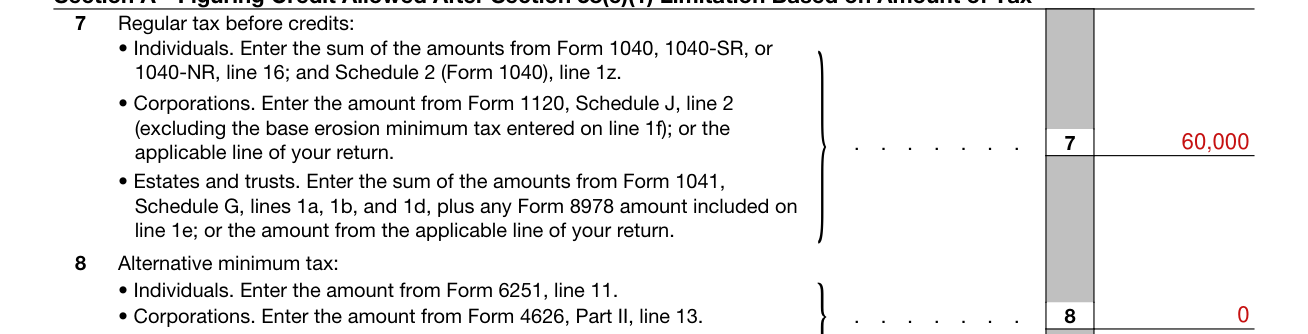
Line 7, Regular tax before credits: Individuals. Enter the sum of the amounts from Form 1040, 1040-SR, or 1040-NR, line 16; and Schedule 2 (Form 1040), line 1z. Corporations. Enter the amount from Form 1120, Schedule J, line 2 (excluding the base erosion minimum tax entered on line 1f); or the applicable line of your return. Estates and trusts. Enter the sum of the amounts from Form 1041, Schedule G, lines 1a, 1b, and 1d, plus any Form 8978 amount included on line 1e; or the amount from the applicable line of your return.
Line 8, Alternative minimum tax: Individuals. Enter the amount from Form 6251, line 11. Corporations. Enter the amount from Form 4626, Part II, line 13. Estates and trusts. Enter the amount from Schedule I (Form 1041), line 54.
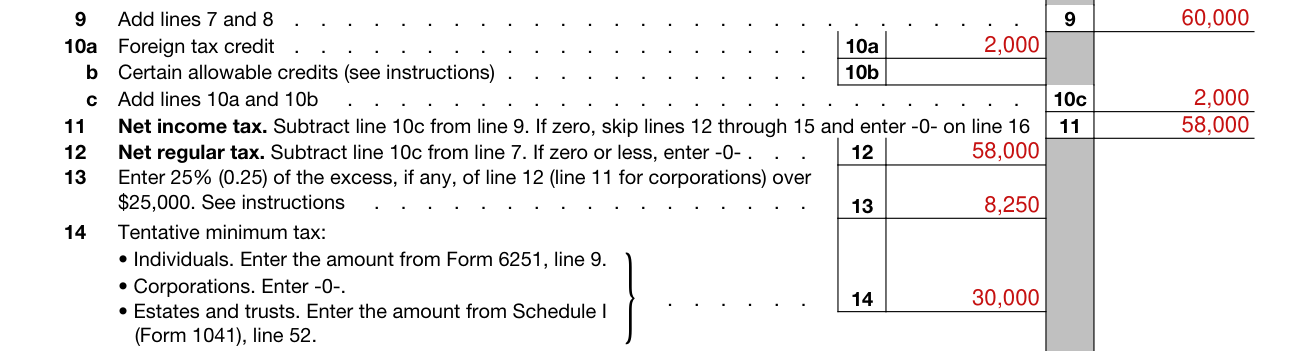
Line 9: Add lines 7 and 8. Line 10a: Foreign tax credit. Line 10b: Certain allowable credits (see instructions). Line 10c: Add lines 10a and 10b. Line 11, Net income tax: Subtract line 10c from line 9. If zero, skip lines 12 through 15 and enter -0- on line 16. Line 12, Net regular tax: Subtract line 10c from line 7. If zero or less, enter -0-. Line 13: Enter 25% (0.25) of the excess, if any, of line 12 (line 11 for corporations) over $25,000 (checked October 26, 2026). See instructions. Line 14, Tentative minimum tax: Individuals. Enter the amount from Form 6251, line 9. Corporations. Enter -0-. Estates and trusts. Enter the amount from Schedule I (Form 1041), line 52.

Line 15: Enter the greater of line 13 or line 14. Line 16: Subtract line 15 from line 11. If zero or less, enter -0-. Line 17: Enter the smaller of line 6 or line 16. This is the amount of your credit allowed after the limitation of section 38(c)(1). C corporations: See the line 17 instructions if there has been an ownership change, acquisition, or reorganization.
Note: Credits on lines 2a through 2x are expired. Only carryforwards are allowed.
If you can't use part or all of your general business credit because of the tax liability limit (Part II, line 38, is less than the sum of Part I, line 6; and Part II, lines 25 and 36), carry the unused credit back to prior years. The carryback period is generally 1 year.[2]
If you intend to make an elective payment election (EPE) and/or a transfer election on Form 3800, you must complete pre-filing registration before you file your tax return.
Prior to completing an election on Form 3800, you must get a registration number for each facility or property.[2]
Form 3800 is the General Business Credit form of the Department of the Treasury, Internal Revenue Service. If you are claiming a current-year business credit on your tax return, you must complete the applicable lines and columns of Part III.[2]
You must include all pages of Form 3800 with your return. Report the amount from line 38 (if smaller than the sum of Part I, line 6, and Part II, lines 25 and 36; see instructions) on the applicable line of your return. Individuals. Schedule 3 (Form 1040), line 6a. Corporations. Form 1120, Schedule J, line 5c. Estates and trusts. Form 1041, Schedule G, line 2b.
[1] Form 3800 (2025), General Business Credit, Department of the Treasury, Internal Revenue Service (the Official source link on this page).