
Updated:
Get Form Now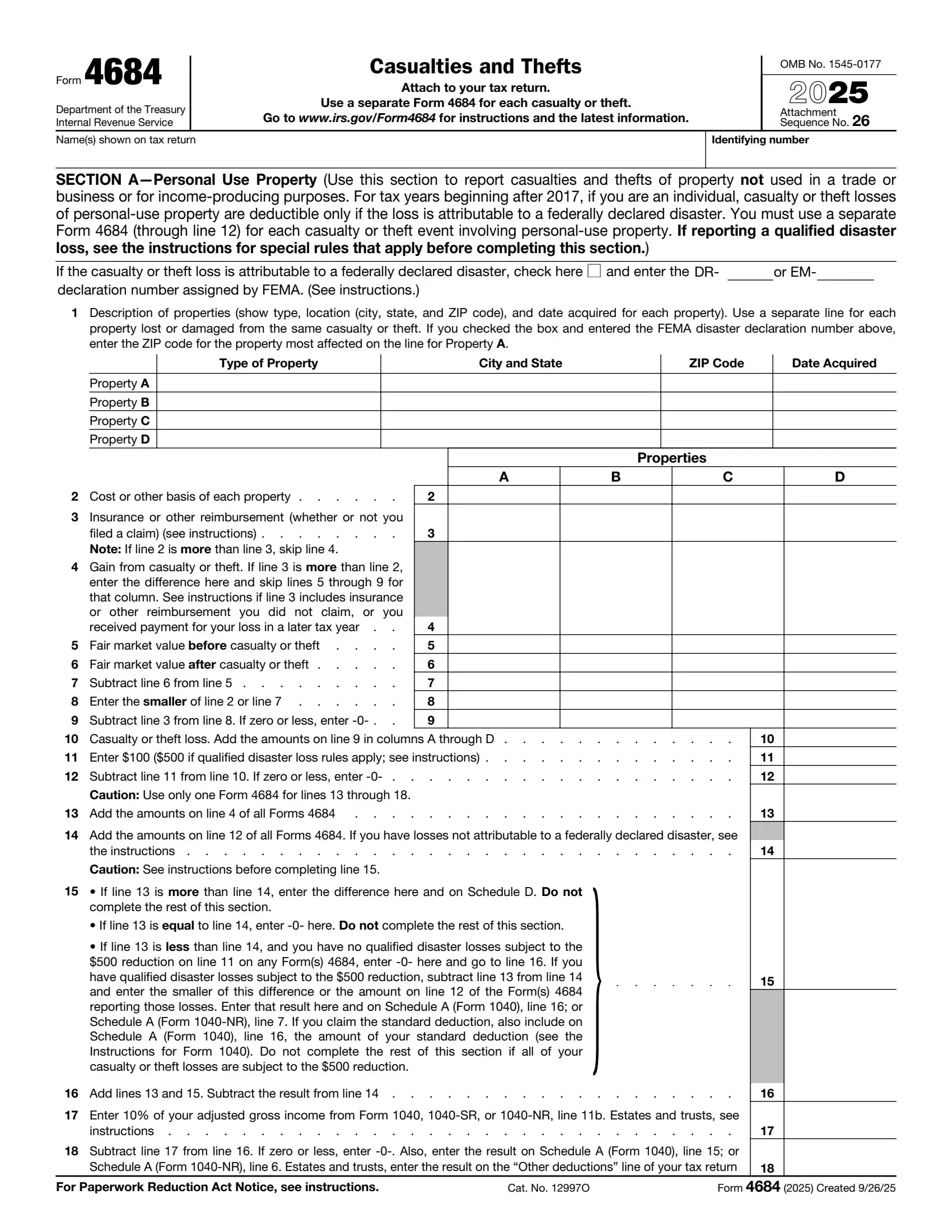
IRS Form 4684 is a tax document that reports casualties and thefts during the tax year and calculates the deductible loss resulting from these events. Taxpayers whose business or income-producing property was damaged, destroyed, or stolen may need this form to claim a deduction; for personal-use property such as a home or car, a casualty loss is generally deductible only when it was caused by a federally declared disaster. The form helps taxpayers accurately report and calculate their deductible losses, which can help offset their taxable income and reduce their overall tax liability. The essential information provided on Form 4684 includes: The taxpayer’s name and identifying number (SSN or EIN), Details about the casualty or theft event, including a description of the property lost or damaged, The fair market value of the property before and after the casualty or theft, And any insurance or other reimbursement received for the loss.
By completing Form 4684, taxpayers provide the Internal Revenue Service (IRS) with the necessary information to assess their eligibility for a casualty or theft loss deduction and to calculate the allowable amount of the deduction. This form helps taxpayers receive the appropriate tax relief for their losses and helps the IRS verify the accuracy of their claims.
Other IRS Forms for Individuals
The Form 4684 will be of use if you have faced a casualty or theft. Here are some other IRS forms that might be needed in more favourable life situations.
What it is: Form 4684 is Casualties and Thefts.
Where and when to file: Attach to your tax return. Use a separate Form 4684 for each casualty or theft. Go to www.irs.gov/Form4684 for instructions and the latest information.
Use Section A to report casualties and thefts of property not used in a trade or business or for income-producing purposes. For tax years beginning after 2017, if you are an individual, casualty or theft losses of personal-use property are deductible only if the loss is attributable to a federally declared disaster. You must use a separate Form 4684 (through line 12) for each casualty or theft event involving personal-use property. If reporting a qualified disaster loss, see the instructions for special rules that apply before completing this section.
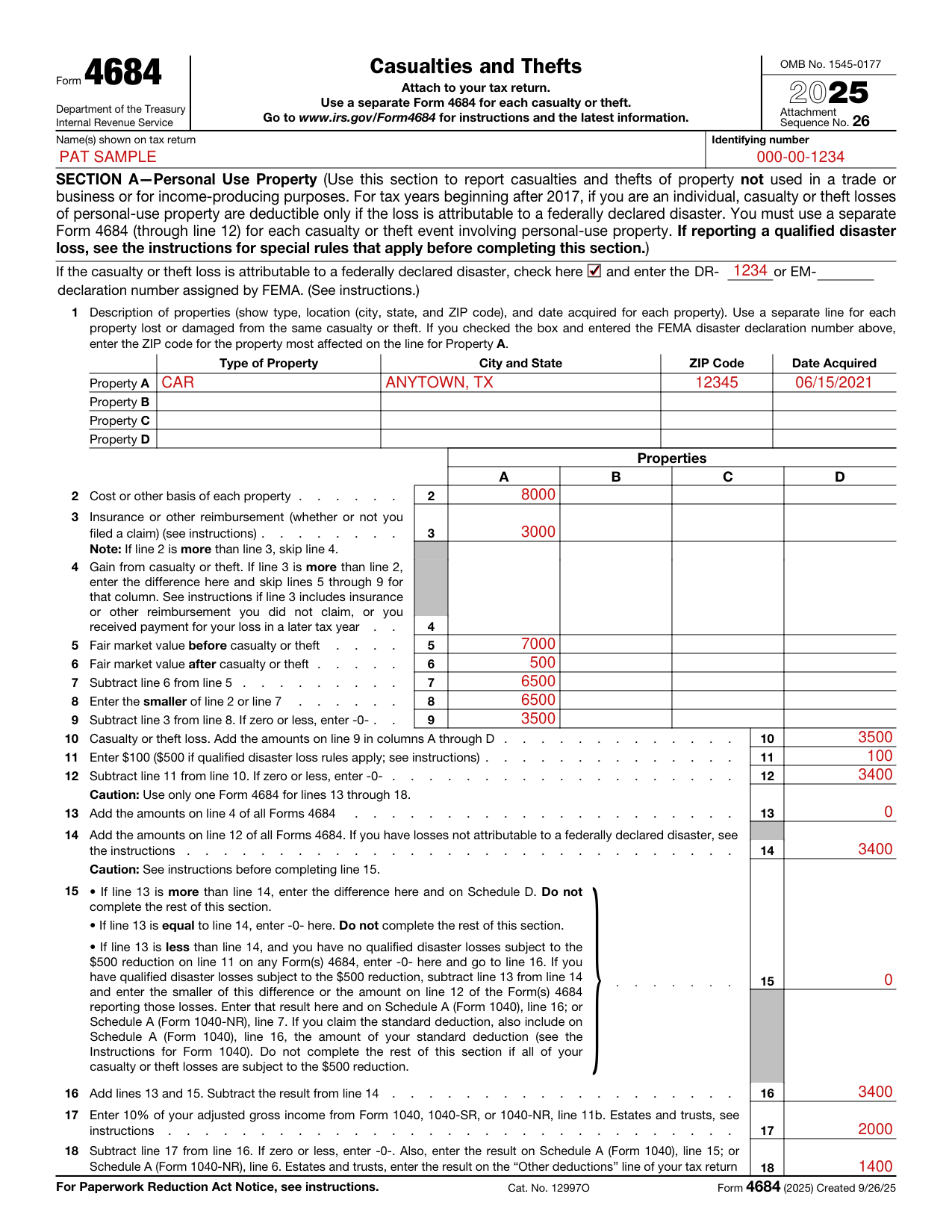

Enter the Name(s) shown on tax return and the Identifying number.

If the casualty or theft loss is attributable to a federally declared disaster, check here and enter the DR or EM declaration number assigned by FEMA (see instructions).
The FEMA disaster declaration number consists of the letters “DR” and four numbers or the letters “EM” and four numbers.[2]
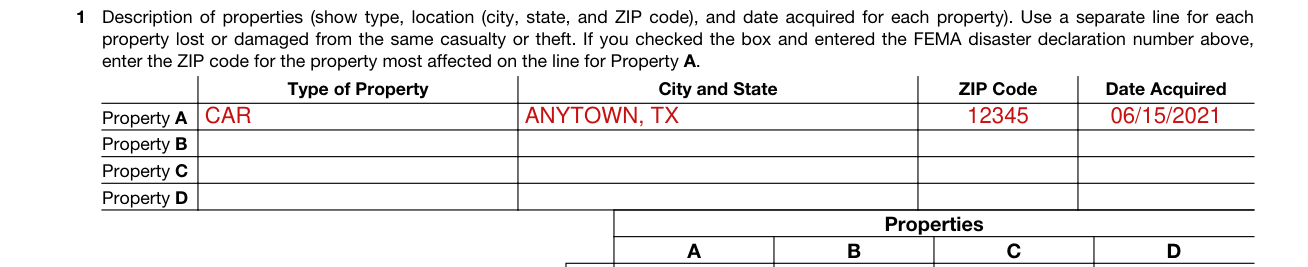
Line 1: Description of properties (show type, location (city, state, and ZIP code), and date acquired for each property). Use a separate line for each property lost or damaged from the same casualty or theft. If you checked the box and entered the FEMA disaster declaration number, enter the ZIP code for the property most affected on the line for Property A.
Line 1: Describe the type of property (for example, furniture, jewelry, car, etc.).[2]

Line 2: Cost or other basis of each property.
Line 3: Insurance or other reimbursement (whether or not you filed a claim) (see instructions). Note: If line 2 is more than line 3, skip line 4.
On line 3, enter the amount of insurance or other reimbursement you received or expect to receive for each property. Include your insurance coverage whether or not you are filing a claim for reimbursement.[2]
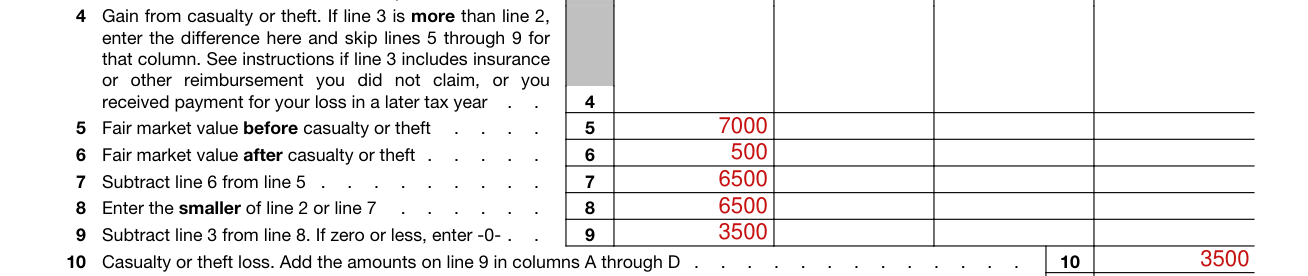
Line 4: Gain from casualty or theft. If line 3 is more than line 2, enter the difference here and skip lines 5 through 9 for that column. See instructions if line 3 includes insurance or other reimbursement you did not claim, or you received payment for your loss in a later tax year. Line 5: Fair market value before casualty or theft. Line 6: Fair market value after casualty or theft. Line 7: Subtract line 6 from line 5. Line 8: Enter the smaller of line 2 or line 7. Line 9: Subtract line 3 from line 8. If zero or less, enter -0-.
If you are entitled to an insurance payment or other reimbursement for any part of a casualty or theft loss but you choose not to file a claim for the loss, you can't realize a gain from that payment or reimbursement. Therefore, figure the gain on line 4 by subtracting your cost or other basis in the property (line 2) only from the amount of reimbursement you actually received. Enter the result on line 4, but don't enter less than zero.[2]

Line 10: Casualty or theft loss. Add the amounts on line 9 in columns A through D. Line 11: Enter $100 ($500 if qualified disaster loss rules apply; see instructions) (checked October 26, 2026).
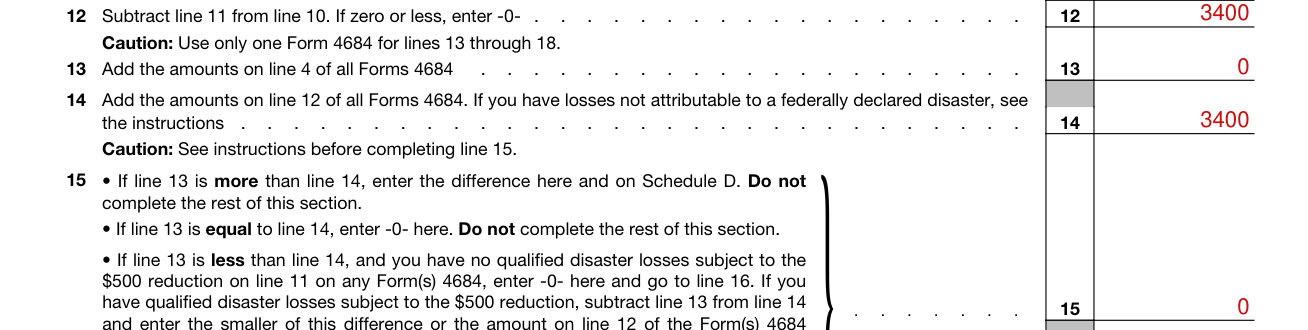
Line 12: Subtract line 11 from line 10. If zero or less, enter -0-. Line 13: Add the amounts on line 4 of all Forms 4684. Use only one Form 4684 for lines 13 through 18.
Line 14: Add the amounts on line 12 of all Forms 4684. If you have losses not attributable to a federally declared disaster, see the instructions. Caution: See instructions before completing line 15.
Line 15: If line 13 is more than line 14, enter the difference here and on Schedule D. Do not complete the rest of this section. If line 13 is equal to line 14, enter -0- here. Do not complete the rest of this section.
If line 13 is less than line 14, and you have no qualified disaster losses subject to the $500 reduction on line 11 on any Form(s) 4684, enter -0- here and go to line 16 (checked October 26, 2026). If you have qualified disaster losses subject to the $500 reduction, subtract line 13 from line 14 and enter the smaller of this difference or the amount on line 12 of the Form(s) 4684 reporting those losses (checked October 26, 2026). Enter that result here and on Schedule A (Form 1040), line 16; or Schedule A (Form 1040-NR), line 7. If you claim the standard deduction, also include on Schedule A (Form 1040), line 16, the amount of your standard deduction (see the Instructions for Form 1040). Do not complete the rest of this section if all of your casualty or theft losses are subject to the $500 reduction (checked October 26, 2026).

Line 16: Add lines 13 and 15. Subtract the result from line 14.
Line 17: Enter 10% of your adjusted gross income from Form 1040, 1040-SR, or 1040-NR, line 11b. Estates and trusts, see instructions.
Line 18: Subtract line 17 from line 16. If zero or less, enter -0-. Also, enter the result on Schedule A (Form 1040), line 15; or Schedule A (Form 1040-NR), line 6. Estates and trusts, enter the result on the “Other deductions” line of your tax return. Cat. No. 12997O Form 4684 (2025) Created 9/26/25.
Use Section B to figure casualty or theft gains and losses for property that is used in a trade or business or for income-producing purposes.[2]
Use Section C to figure a theft loss deduction from a Ponzi-type investment scheme if you qualify to use Revenue Procedure 2009-20, as modified by Revenue Procedure 2011-58, and choose to follow the procedures in the guidance.[2]
Use Section D to elect (or revoke an election) to deduct in the immediately preceding tax year a loss that was attributable to a federally declared disaster and occurred in a federally declared disaster area.[2]
Form 4684 is Casualties and Thefts. Use Form 4684 to report gains and losses from casualties and thefts.[2]
If you elect to deduct a 2025 disaster loss on your 2024 return (Section D): You must make an election to deduct a 2025 disaster loss on your 2024 return on or before the date that is 6 months after the regular due date for filing your original return (without extensions) for the disaster year. For calendar year individual taxpayers, the deadline for electing to take a 2025 disaster loss on your 2024 tax return is October 15, 2026.[2]
[1] Form 4684 (2025), Casualties and Thefts, Internal Revenue Service (the Official source link on this page).
[2] Instructions for Form 4684 (2025), Casualties and Thefts, Internal Revenue Service.