
Updated:
Get Form Now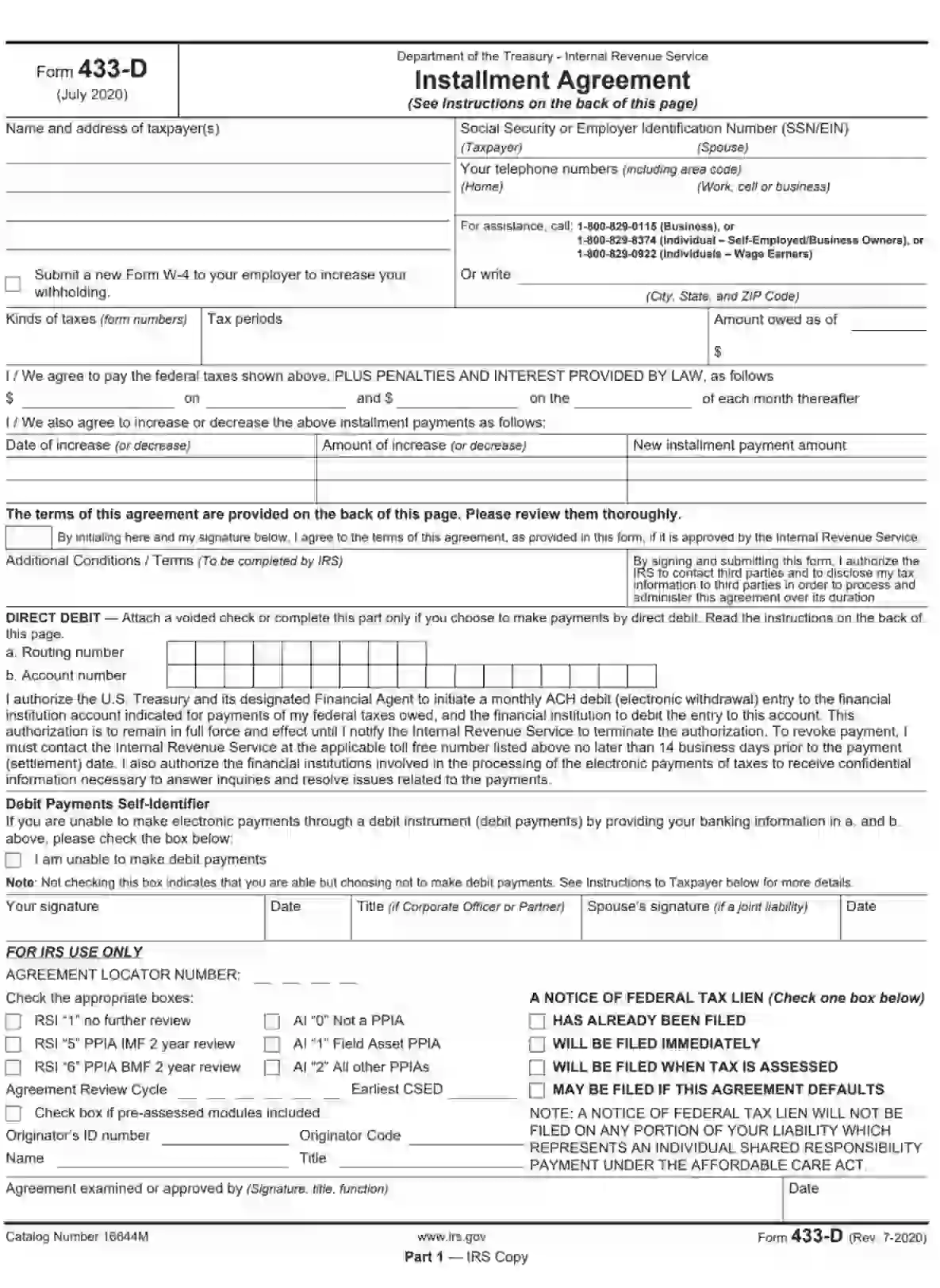
Form 433-D is a financial statement taxpayers use to request a direct debit installment agreement with the Internal Revenue Service (IRS) to pay their tax liabilities. The “Installment Agreement” form allows taxpayers to propose a structured payment plan to pay off their outstanding tax debt over time through automatic monthly withdrawals from their bank account. It requires taxpayers to provide detailed information about their income, expenses, assets, and liabilities to assess their ability to make the proposed installment payments.
The purpose of Form 433-D is to streamline the process of setting up installment agreements for taxpayers who cannot pay their tax liabilities in full. By completing this form and proposing a direct debit installment plan, taxpayers can demonstrate their commitment to fulfilling their tax obligations and avoid more aggressive collection actions by the IRS, such as liens or levies. Form 433-D serves as a tool for taxpayers to negotiate manageable payment terms with the IRS, helping to alleviate financial strain and resolve tax issues.
Other IRS Forms for Individuals
Individual taxpayers might need to file various IRS forms, based on the complexity of their finances. Check some other IRS you will want to be familiar with.
What it is: Form 433-D is the Installment Agreement of the Department of the Treasury - Internal Revenue Service.
Who signs: Your signature and the Spouse's signature (if a joint liability).
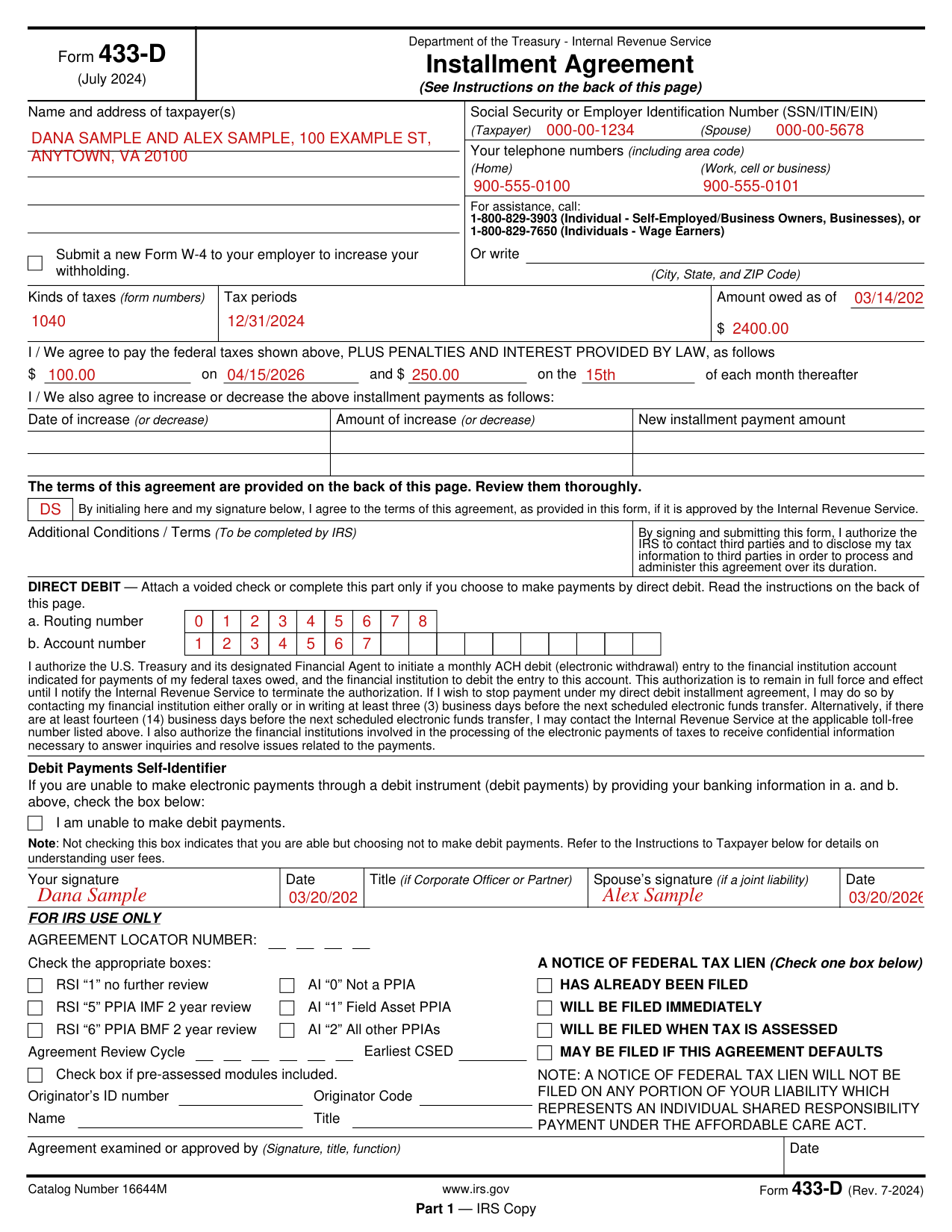

If not already completed by an IRS employee, fill in your name (include spouse's name if a joint return) and current address; your social security number and/or employer identification number (whichever applies to your tax liability); and your home and work, cell or business telephone numbers (including area code).

Fill in the Kinds of taxes (form numbers), the Tax periods and the Amount owed as of.

If not already completed by an IRS employee, fill in the amount you can pay now as a partial payment; the amount you can pay each month (or the amount determined by IRS personnel); and the date you prefer to make this payment (This must be the same day for each month, from the 1st to the 28th).
The IRS must receive your payment by the date you fill in. If you elect the direct debit option, that is the day you want your payment electronically withdrawn from your financial institution account.

You also agree to increase or decrease the installment payments. Fill in the Date of increase (or decrease), the Amount of increase (or decrease) and the New installment payment amount.

Review the terms of this agreement thoroughly. By initialing and by your signature, you agree to the terms of this agreement, as provided in this form, if it is approved by the Internal Revenue Service.

Attach a voided check or complete this part only if you choose to make payments by direct debit.
You can pay by direct debit (electronic withdrawal) from your checking account at a financial institution (such as a bank, mutual fund, brokerage firm, or credit union). Contact your financial institution to make sure that a direct debit is allowed and to get the correct routing and account numbers.
Line a: the first two digits of the routing number must be 01 through 12 or 21 through 32. For Line a, don't use a deposit slip to verify the number because it may contain internal routing numbers that are not part of the actual routing number.
Line b: the account number can be up to 17 characters. For Line b, include hyphens but omit spaces and special symbols. For Line b, enter the number from left to right and leave any unused boxes blank.
If you wish to stop payment under your direct debit installment agreement, you may do so by contacting your financial institution either orally or in writing at least three (3) business days before the next scheduled electronic funds transfer. Alternatively, if there are at least fourteen (14) business days before the next scheduled electronic funds transfer, you may contact the Internal Revenue Service at the applicable toll-free number.

If you are unable to make electronic payments through a debit instrument (debit payments) by providing your banking information in a. and b., check the box I am unable to make debit payments. Not checking this box indicates that you are able but choosing not to make debit payments.

When you've completed this agreement form, sign and date it.
Fill in Your signature and the Date.

Fill in the Title (if Corporate Officer or Partner).

Fill in the Spouse's signature (if a joint liability) and the Date.
While this agreement is in effect, you must file all federal tax returns and pay any (federal) taxes you owe on time.
Make your check or money order payable to “United States Treasury.”
Write your social security or employer identification number on each payment.
Make each payment in an amount at least equal to the amount specified in this agreement.
Don't double one payment and skip the next without contacting the IRS first.
Mail the payment to the IRS address indicated on the front of this form.
If you cannot make a scheduled payment, contact the IRS immediately.
In the event that the payment withdrawal doesn't occur as scheduled, allow one additional month before contacting the IRS to report any issues.
The IRS can terminate your installment agreement if you do not make monthly installment payments as agreed, you do not pay any other federal tax debt when due, or you do not provide financial information when requested.
You will receive a notice from the IRS prior to termination of your agreement.
If the IRS terminates your agreement, the IRS may collect the entire amount you owe, EXCEPT the Individual Shared Responsibility Payment under the Affordable Care Act, by levy on your income, bank accounts or other assets, or by seizing your property.
Form 433-D is the Installment Agreement of the Department of the Treasury - Internal Revenue Service. This agreement will remain in effect until your liabilities (including penalties and interest) are paid in full, the statutory period for collection has expired, or the agreement is terminated.
To make voluntary payments electronically, go to www.IRS.gov/Payments for payment options.
When you've completed this agreement form, return Part 1 to IRS at the address on the letter that came with the form or the address shown in the “For assistance” box on the front of the form.
You must pay a $178 user fee if you enter into a non-Direct Debit agreement (checked October 26, 2026). You must pay a $107 user fee if you enter into a Direct Debit agreement (checked October 26, 2026). Your first draft will be the cost of the user fee or your agreed upon monthly payment, whichever is more. If you default on your installment agreement, you must pay a $89 reinstatement fee if the IRS reinstates the agreement (checked October 26, 2026). The IRS has the authority to deduct the reinstatement fee from your first payment(s) after the agreement is reinstated.
You agree to pay the federal taxes, PLUS PENALTIES AND INTEREST PROVIDED BY LAW.
[1] Form 433-D (Rev. 7-2024), Installment Agreement, Department of the Treasury - Internal Revenue Service (the Official source link on this page).