
Updated:
Get Form Now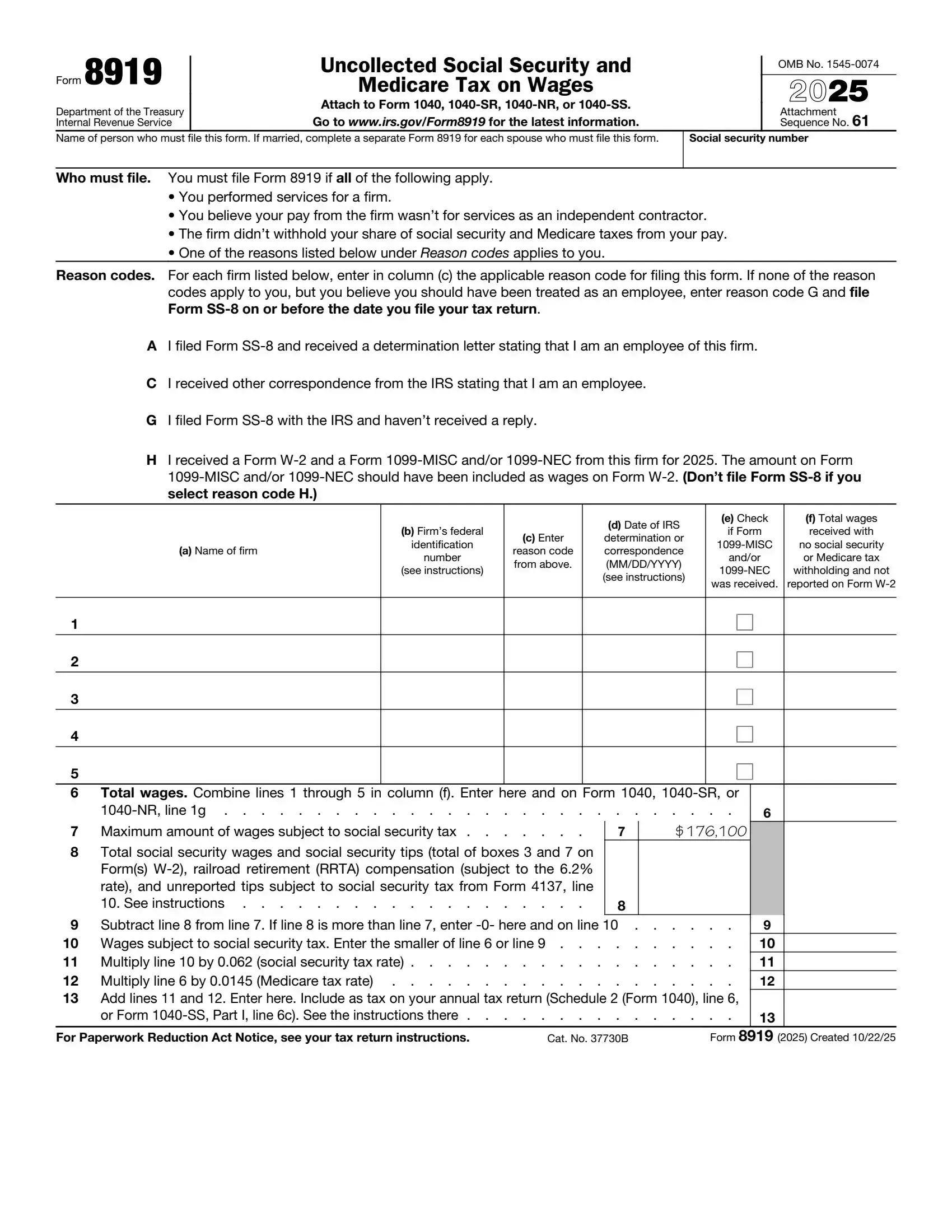
IRS Form 8919 is used by taxpayers who want to report and calculate uncollected Social Security and Medicare taxes because their wages are incorrectly treated as nonemployee compensation. This situation typically arises when an individual’s employer has classified them as independent contractors rather than employees, and consequently, the employer doesn’t withhold the appropriate taxes. The form includes several codes to specify the reason for filing:
By using Form 8919, individuals ensure that only their share of Social Security and Medicare taxes is paid, helping to correct their tax records with the IRS. This form also helps the IRS track employers who may be misclassifying employees to avoid paying their portion of payroll taxes.
What it is: Form 8919 is Uncollected Social Security and Medicare Tax on Wages. Attach to Form 1040, 1040-SR, 1040-NR, or 1040-SS.
You must file Form 8919 if all of the following apply. You performed services for a firm. You believe your pay from the firm wasn't for services as an independent contractor. The firm didn't withhold your share of social security and Medicare taxes from your pay. One of the reason codes applies to you.
Use Form 8919 to figure and report your share of the uncollected social security and Medicare taxes due on your compensation if you were an employee but were treated as an independent contractor by your employer.
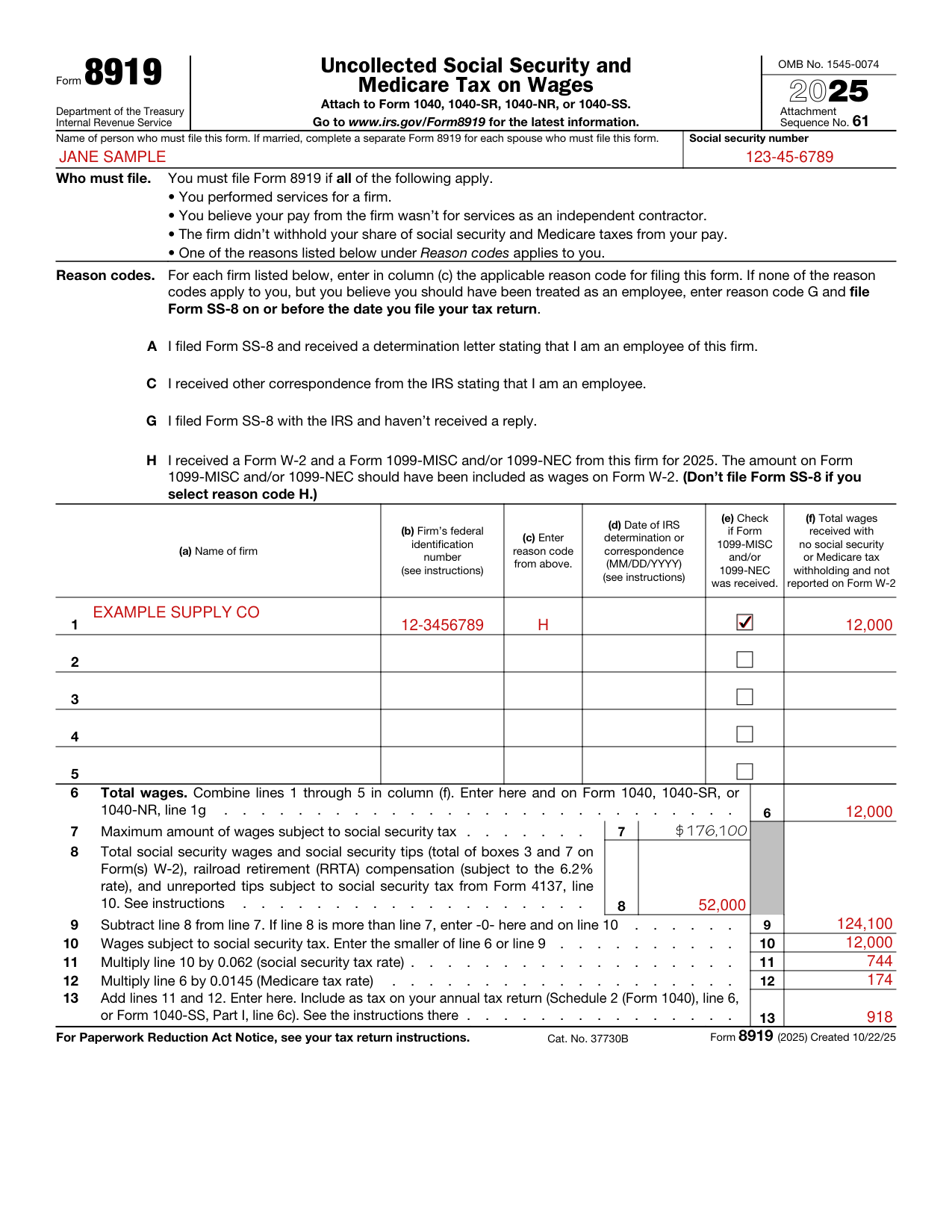

2025 Attachment Sequence No. 61. Name of person who must file this form. If married, complete a separate Form 8919 for each spouse who must file this form.
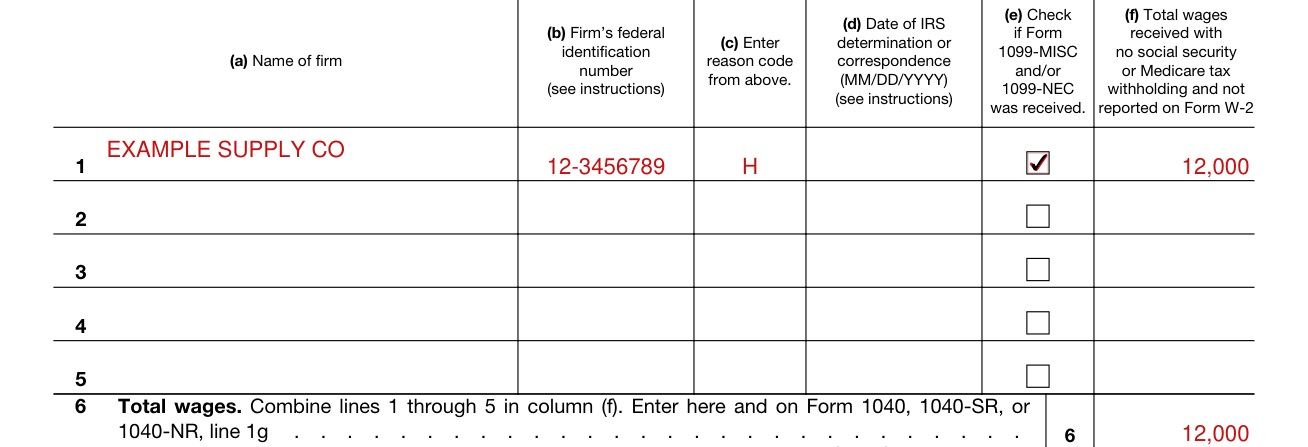
Complete a separate line for each firm. If you worked as an employee for more than five firms in 2025, attach additional Form(s) 8919 with lines 1 through 5 completed.
For purposes of this form, the term "firm" means any individual, business enterprise, company, nonprofit organization, state, or other entity for which you performed services. This firm may or may not have paid you directly for these services.
Enter the name of the firm for which you worked. If you received a Form 1099-MISC and/or 1099-NEC from the firm, enter the firm's name exactly as it is entered on Form 1099-MISC and/or 1099-NEC.
The federal identification number for a firm can be an employer identification number (EIN) or a social security number (SSN) (if the firm is an individual). An EIN is a nine-digit number assigned by the IRS to a business. Enter an EIN like this: XX-XXXXXXX. Enter an SSN like this: XXX-XX- XXXX.
If you received a Form 1099-MISC and/or 1099-NEC from the firm, enter the firm's federal identification number that is entered on Form 1099-MISC and/or 1099-NEC. If you don't know the firm's federal identification number, you can use Form W-9, Request for Taxpayer Identification Number and Certification, to request it from the firm. If you are unable to obtain the number, enter "unknown."
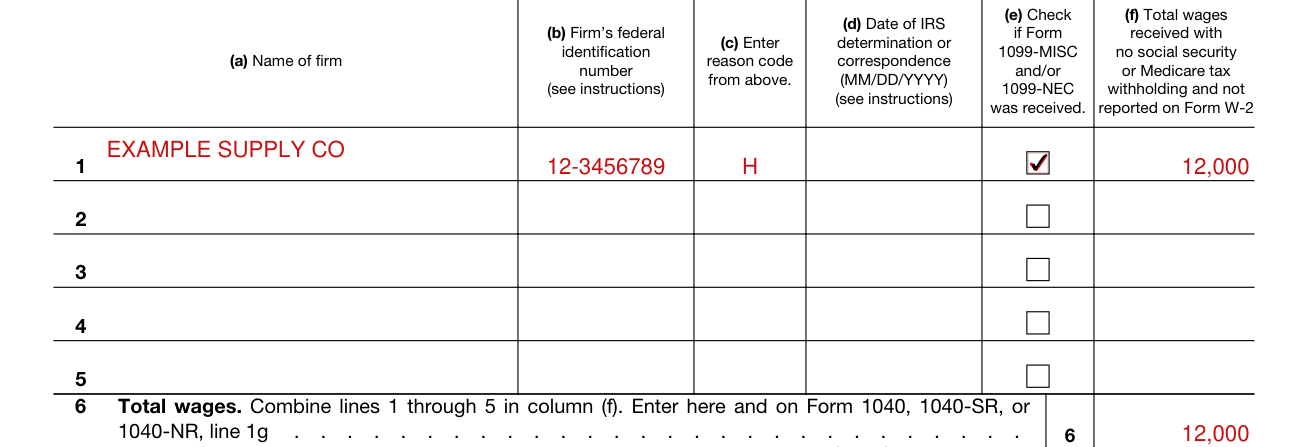
Enter the reason code for why you are filing this form. Enter only one reason code on each line. If none of the reason codes apply to you, but you believe you should have been treated as an employee, enter reason code G and file Form SS-8 on or before the date you file your tax return.
A: I filed Form SS-8 and received a determination letter stating that I am an employee of this firm.
C: I received other correspondence from the IRS stating that I am an employee.
Enter reason code C if you were designated as a "section 530 employee" by the IRS. You are a section 530 employee, for these purposes, if you were determined to be an employee by the IRS, but your employer was granted relief from payment of employment taxes under section 530 of the Revenue Act of 1978.
G: I filed Form SS-8 with the IRS and haven't received a reply.
If you select reason code G, you must file Form SS-8 on or before the date you file Form 8919. Don't attach Form SS-8 to your tax return. Form SS-8 must be filed separately.
If you enter reason code G, you or the firm that paid you may be contacted for additional information. Use of this reason code isn't a guarantee that the IRS will agree with your worker status determination.
File Form SS-8 if you want the IRS to determine whether you are an independent contractor or an employee.
Enter reason code H if you received both a Form W-2 and a Form 1099-MISC and/or 1099-NEC from the firm for 2025 and the amount on the Form 1099-MISC and/or 1099-NEC should have been included as wages on Form W-2 as an amount you received for services you provided as an employee. If reason code H applies to your situation, don't file Form SS-8.
Examples of amounts that are sometimes erroneously included on Form 1099-MISC and/or 1099-NEC that should be reported as wages on Form W-2 include employee bonuses, awards, travel expense reimbursements not paid under an accountable plan, scholarships, and signing bonuses. Generally, amounts paid by an employer to an employee aren't reported on Form 1099-MISC and/or 1099-NEC. Form 1099-MISC and/or 1099-NEC is used for reporting nonemployee compensation, rents, royalties, and certain other payments.
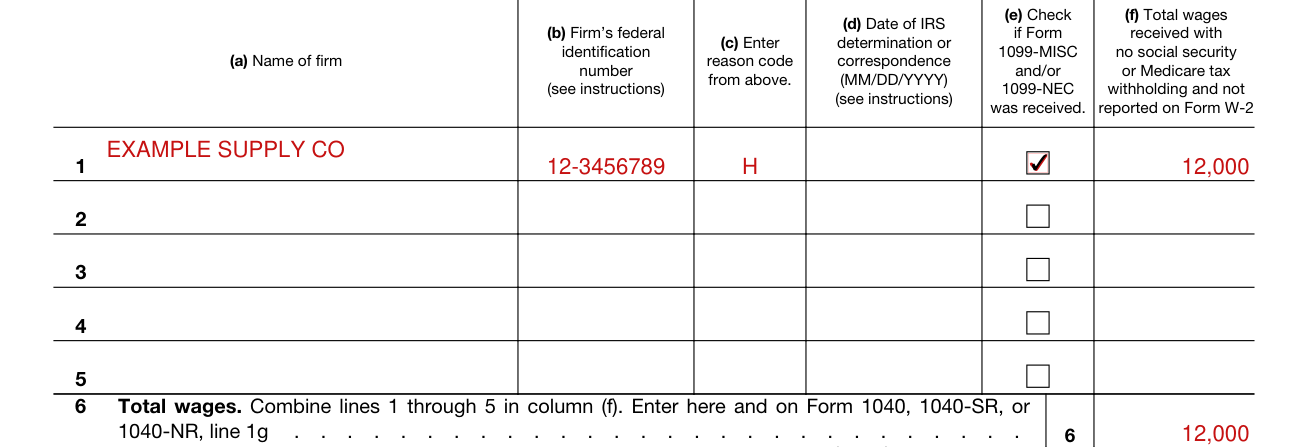
Only if reason code A or C is entered in column (c), complete column (d).
(e) Check if Form 1099-MISC and/or 1099-NEC was received. (f) Total wages received with no social security or Medicare tax withholding and not reported on Form W-2.
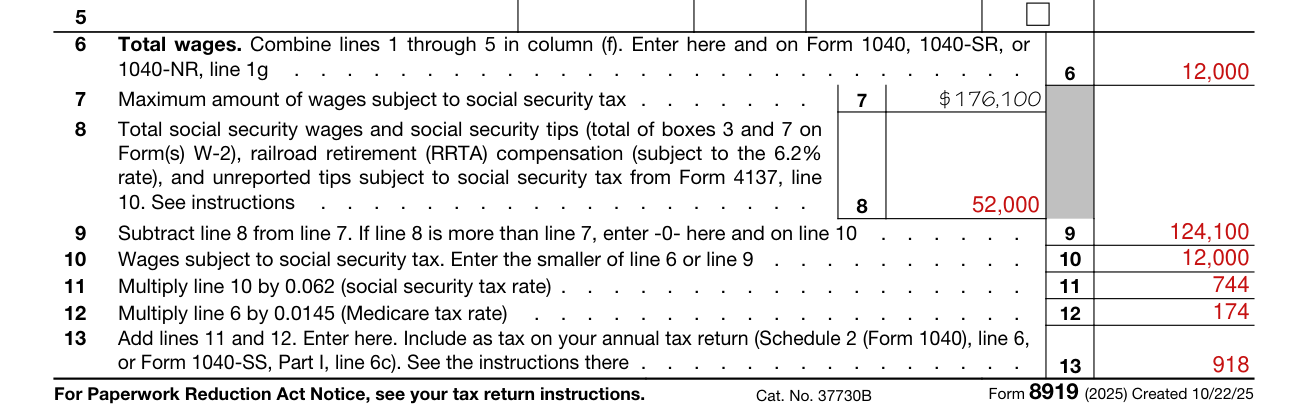
Complete lines 6 through 13 on only one Form 8919. The line 6 amount on that Form 8919 should be the combined totals of all lines 1 through 5 of all your Forms 8919.
Line 6, Total wages. Combine lines 1 through 5 in column (f). Enter here and on Form 1040, 1040-SR, or 1040-NR, line 1g. Line 7, Maximum amount of wages subject to social security tax. Line 8, Total social security wages and social security tips (total of boxes 3 and 7 on Form(s) W-2), railroad retirement (RRTA) compensation (subject to the 6.2% rate), and unreported tips subject to social security tax from Form 4137, line 10. Line 9: Subtract line 8 from line 7. If line 8 is more than line 7, enter -0- here and on line 10. Line 10, Wages subject to social security tax. Enter the smaller of line 6 or line 9. Line 11: Multiply line 10 by 0.062 (social security tax rate). Line 12: Multiply line 6 by 0.0145 (Medicare tax rate). Line 13: Add lines 11 and 12. Enter here. Include as tax on your annual tax return (Schedule 2 (Form 1040), line 6, or Form 1040-SS, Part I, line 6c). See the instructions there.
Line 6. Also enter this amount on Form 8959, line 3, if you are required to file that form.
On line 7, the maximum amount of wages subject to social security tax has increased from $168,600 to $176,100 for 2025 (checked October 26, 2026).
Line 8. For railroad retirement (RRTA) compensation, don't include an amount greater than $176,100, which is the amount subject to the 6.2% rate for 2025 (checked October 26, 2026).
By filing this form, your social security earnings will be credited to your social security record.
The IRS doesn't issue a determination letter for cases involving state or local government workers who may be performing services under an agreement entered into pursuant to Section 218 of the Social Security Act, unless the worker or firm provides a written determination issued by the Social Security Administration on whether the position is covered by a Section 218 agreement. The state or local government worker should contact the State Social Security Administrator for assistance.
A 0.9% Additional Medicare Tax applies to Medicare wages, Railroad Retirement Tax Act compensation, and self-employment income over a threshold amount based on your filing status. Use Form 8959 to figure this tax.
If the IRS doesn't agree that you are an employee, you may be billed for the additional tax, penalties, and interest resulting from the change to your worker status.
Don't use this form for services you performed as an independent contractor. Instead, use Schedule C (Form 1040), Profit or Loss From Business, to report the income. And use Schedule SE (Form 1040), Self-Employment Tax, to figure the tax on net earnings from self-employment. Don't use this form to figure the social security and Medicare tax owed on tips you didn't report to your employer, including any allocated tips shown on your Form(s) W-2 that you must report as income. Instead, use Form 4137, Social Security and Medicare Tax on Unreported Tip Income.
[1] Form 8919 (2025), Uncollected Social Security and Medicare Tax on Wages, Internal Revenue Service (the Official source link on this page).