
Updated:
Get Form Now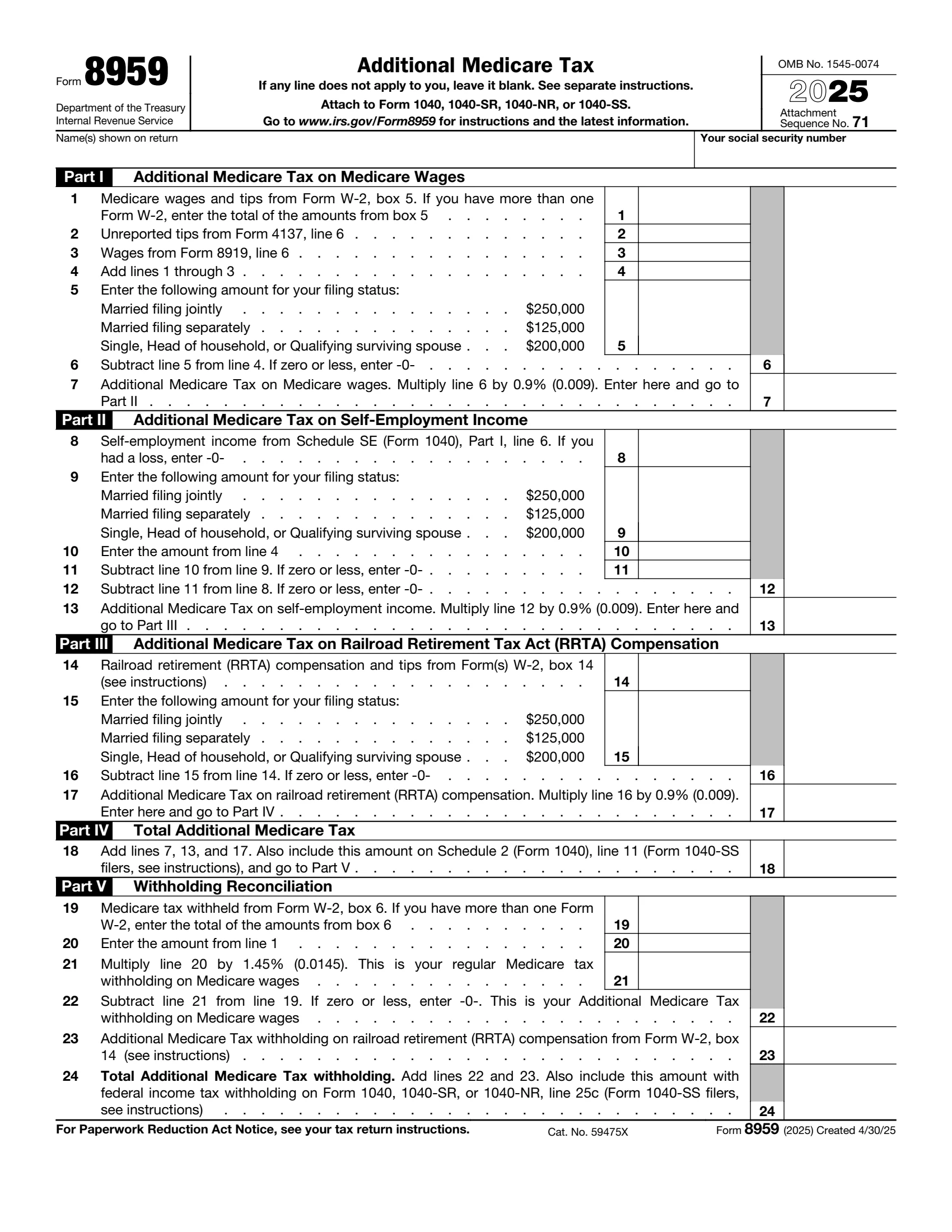
IRS Form 8959, titled “Additional Medicare Tax,” is used by taxpayers to calculate and report Additional Medicare Tax on earnings that exceed the income threshold specified by the IRS. This tax applies to wages, compensation, and self-employment income over certain amounts, and it is intended to support the funding of Medicare. Taxpayers need to provide the following information on Form 8959:
The form helps taxpayers determine the amount of Additional Medicare Tax they owe by calculating 0.9% of the income exceeding the threshold. It also facilitates the reconciliation of any additional Medicare Tax withheld by employers throughout the year, ensuring taxpayers pay the correct amount owed.
What it is: Form 8959, Additional Medicare Tax, figures the amount of Additional Medicare Tax you owe and the amount withheld by your employer, if any.[2]
Where and when to file: Attach your completed Form 8959 to Form 1040, 1040-SR, 1040-NR, or 1040-SS.[2]
You must file Form 8959 if one or more of the following applies to you: your Medicare wages and tips on any single Form W-2 (box 5) are greater than $200,000 (checked October 26, 2026).[2]
Your RRTA compensation on any single Form W-2 (box 14) is greater than $200,000 (checked October 26, 2026).[2]
Your total Medicare wages and tips plus your self-employment income, if any, and your spouse's Medicare wages and tips and self-employment income, if married filing jointly, are greater than the threshold amount for your filing status in the Threshold Amounts for Additional Medicare Tax chart.[2]
Your total RRTA compensation and tips (Form W-2, box 14) and your spouse's RRTA compensation and tips, if married filing jointly, are greater than the threshold amount for your filing status in the Threshold Amounts for Additional Medicare Tax chart.[2]
Your Medicare wages include your wages and tips from Form W-2, box 5; your tips from Form 4137, line 6; and your wages from Form 8919, line 6.[2]
Even if you don't get a Form W-2, you must still figure your Additional Medicare Tax.[2]
If you (and your spouse if filing a joint return) didn't have Medicare wages, skip Part I and go to Part II.
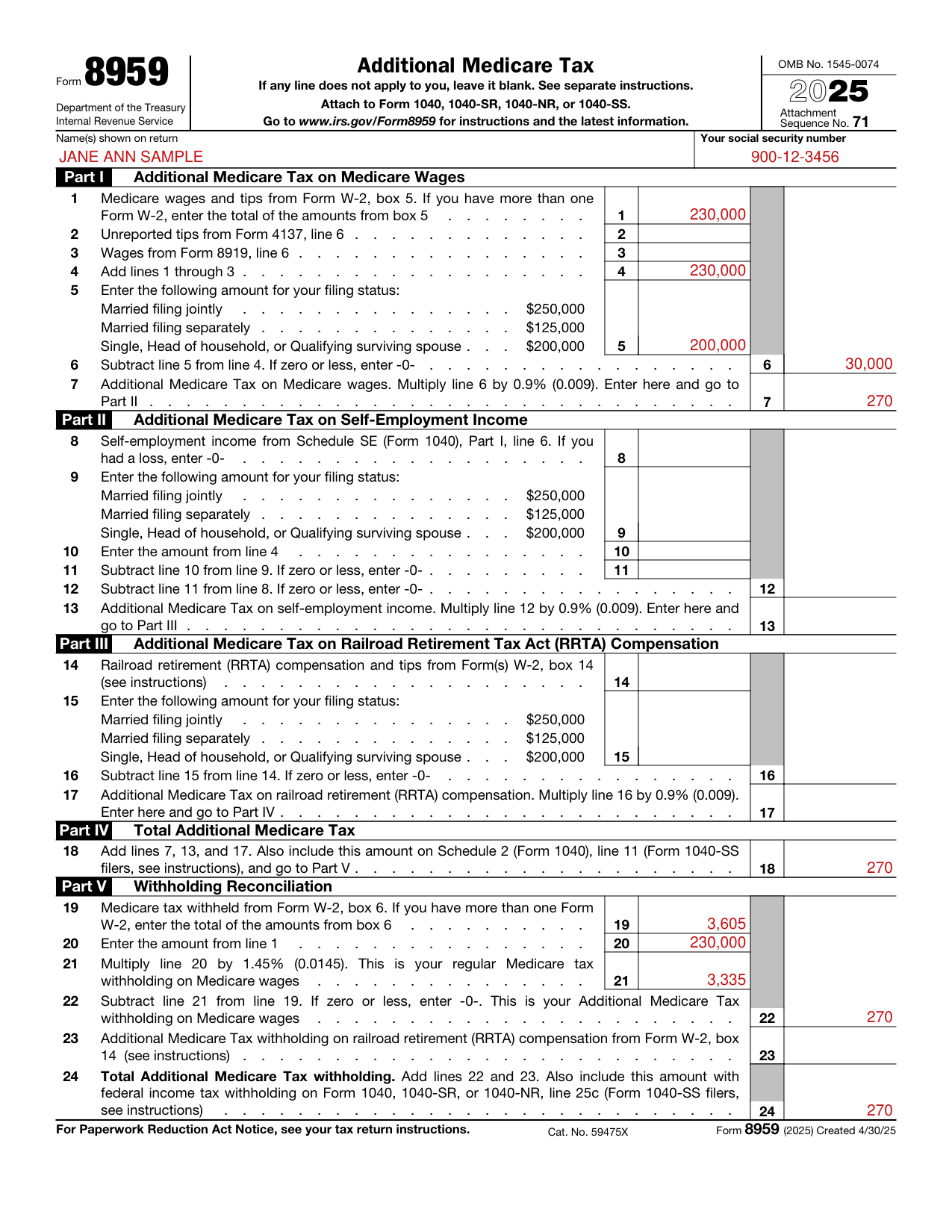
On line 1, enter your Medicare wages and tips from box 5 of your Form W-2. If you have more than one Form W-2, enter the total of the amounts from box 5 of all Forms W-2. If you are filing a joint return, also include your spouse's wages and tips.
On line 2, enter unreported tips from line 6 of Form 4137, Social Security and Medicare Tax on Unreported Tip Income. If you are filing a joint return, also include the amount from line 6 of your spouse's Form 4137.
On line 3, enter wages from line 6 of Form 8919, Uncollected Social Security and Medicare Tax on Wages. If you are filing a joint return, also include the amount from line 6 of your spouse's Form 8919.
On line 4, add lines 1 through 3.
On line 5, enter the following amount for your filing status.
On line 6, subtract line 5 from line 4. If zero or less, enter -0-.
On line 7, multiply line 6 by 0.9% (0.009). This is your Additional Medicare Tax on your wages. Enter the result on line 7 and go to Part II.[2]
Married filing jointly $250,000
Married filing separately $125,000
Single, Head of household, or Qualifying surviving spouse $200,000
If you (and your spouse if filing a joint return) didn't have self-employment income, skip Part II and go to Part III.
Common mistake: On line 8, enter your self-employment income from Schedule SE (Form 1040), Part I, line 6. If you had a loss, enter -0-. If you have multiple Schedules SE, combine the amounts.
On line 9, enter the following amount for your filing status. On line 10, enter the amount from line 4. On line 11, subtract line 10 from line 9. If zero or less, enter -0-. On line 12, subtract line 11 from line 8. If zero or less, enter -0-.
On line 13, multiply line 12 by 0.9% (0.009). This is your Additional Medicare Tax on self-employment income. Enter the result on line 13 and go to Part III.[2]
Married filing jointly $250,000
Married filing separately $125,000
Single, Head of household, or Qualifying surviving spouse $200,000
If you (and your spouse if filing a joint return) didn't have RRTA compensation, skip Part III and go to Part IV.
On line 14, enter the total of your RRTA compensation and tips. The amount of RRTA compensation for a railroad employee is reported on Form W-2, box 14. If you have more than one Form W-2, enter the total of the RRTA compensation amounts from box 14 of all Forms W-2. If you are filing a joint return, also include your spouse's RRTA compensation.
On line 15, enter the following amount for your filing status. On line 16, subtract line 15 from line 14. If zero or less, enter -0-.
On line 17, multiply line 16 by 0.9% (0.009). This is your Additional Medicare Tax on RRTA compensation. Enter the result on line 17 and go to Part IV.[2]
Married filing jointly $250,000
Married filing separately $125,000
Single, Head of household, or Qualifying surviving spouse $200,000
On line 18, add lines 7, 13, and 17. Include the amount from line 18 on line 11 of Schedule 2 (Form 1040), or on line 5 of Part I of Form 1040-SS.[2]
If you (and your spouse if filing a joint return) didn't have Medicare wages or RRTA compensation, leave Part V blank.
On line 19, enter the amount of Medicare tax withheld, if any, reported on Form W-2, box 6. If you have more than one Form W-2, add the amounts in box 6 of all your Forms W-2 and enter the total on line 19. If you are filing a joint return, include your spouse's Medicare tax withheld.
On line 20, enter the amount from line 1. On line 21, multiply line 20 by 1.45% (0.0145). This is your regular Medicare tax withholding on Medicare wages. On line 22, subtract line 21 from line 19. If zero or less, enter -0-. This is your Additional Medicare Tax withholding on Medicare wages.
On line 23, enter the amount of Additional Medicare Tax withheld, if any, reported on Form W-2, box 14. If you have more than one Form W-2, add the amounts in box 14 of all your Forms W-2 and enter the total on line 23. If you are filing a joint return, include your spouse's Additional Medicare Tax withheld.
On line 24, add lines 22 and 23. If you file Form 1040, 1040-SR, or 1040-NR, include this amount on line 25c combined with your federal income tax withholding. If you file Form 1040-SS, enter this amount on line 11a of Part I.[2]
A self-employment loss shouldn't be considered for purposes of this tax.[2]
RRTA compensation should be separately compared to the threshold.[2]
If your Medicare wages, RRTA compensation, or self-employment income is adjusted, you may need to correct your liability, if any, for Additional Medicare Tax.
When correcting Additional Medicare Tax liability, attach a corrected Form 8959 to your original return or amended return, as applicable.
If you are correcting Medicare wages or RRTA compensation, also attach Form W-2 or Form W-2c, Corrected Wage and Tax Statement.[2]
The threshold amounts aren't indexed for inflation: Married filing jointly $250,000 Married filing separately $125,000 Single $200,000 Head of household $200,000 Qualifying surviving spouse $200,000 (checked October 26, 2026). Medicare wages and self-employment income are combined to determine if your income exceeds the threshold. All wages that are subject to Medicare tax are subject to Additional Medicare Tax to the extent they exceed the threshold amount for your filing status. All RRTA compensation that is subject to Medicare tax is subject to Additional Medicare Tax to the extent it exceeds the threshold amount for your filing status.[2]
Attach Form 8959 to your return.[2]
You may be subject to a penalty for failure to make estimated tax payments if you owe Additional Medicare Tax and wait to pay the tax with your tax return. See Form 2210 (or Form 2210-F for farmers and fishers) and its separate instructions to determine if the penalty applies to you.[2]
[1] Form 8959 (2025), Additional Medicare Tax, Internal Revenue Service (the Official source link on this page).
[2] Instructions for Form 8959 (2025), Internal Revenue Service.