
Updated:
Get Form Now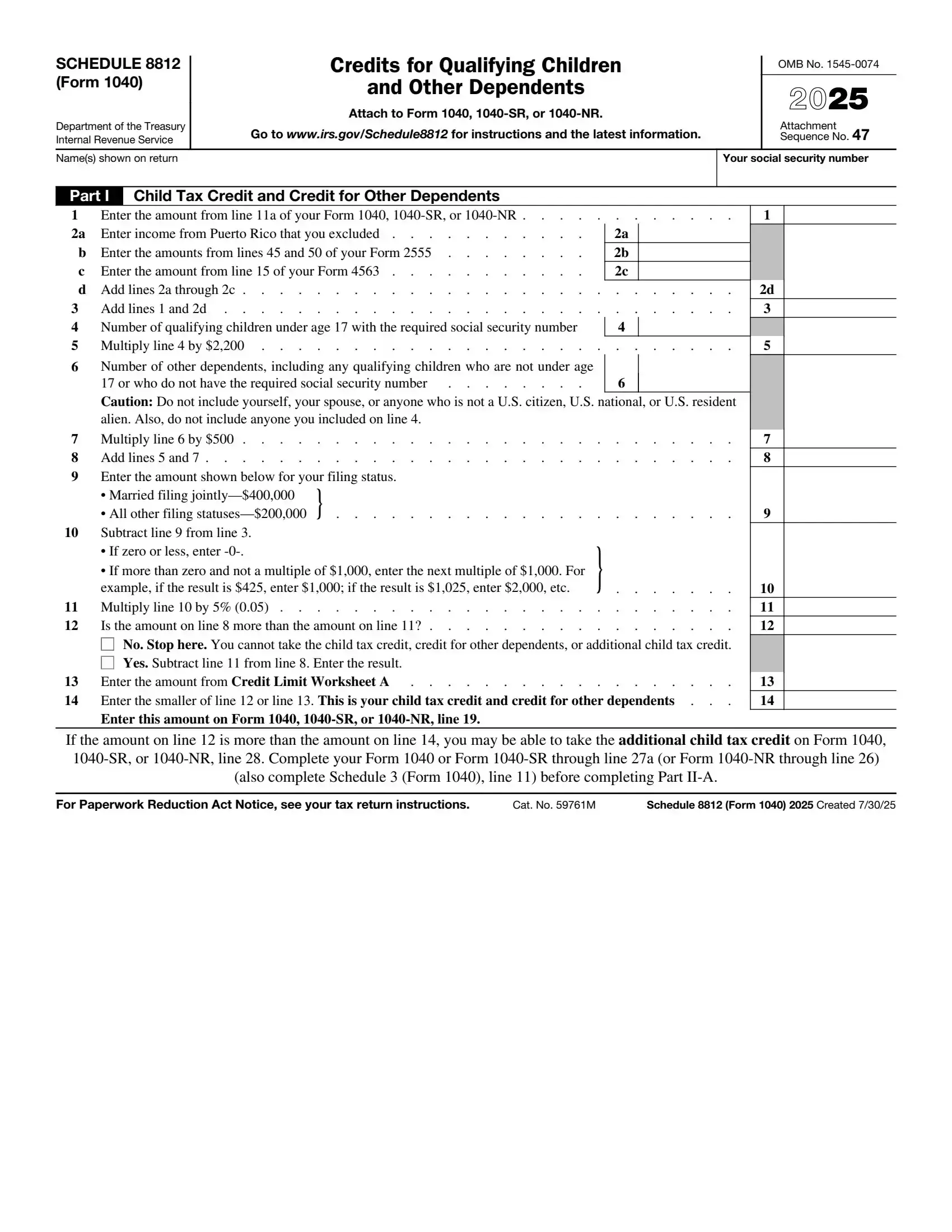
IRS Schedule 8812, which accompanies Form 1040, is specifically designed for taxpayers to calculate and claim the Child Tax Credit (CTC), including the Additional Child Tax Credit (ACTC) and the Credit for Other Dependents (ODC). This form is necessary when taxpayers need to determine their eligibility for these credits and the amount they can claim.
Schedule 8812 is divided into several parts. The first part calculates the Child Tax Credit and the Credit for Other Dependents for the qualifying children and other dependents listed on Form 1040. A child must meet the age, relationship, support, dependent, citizenship, and residency tests described in the instructions. The subsequent parts allow taxpayers to calculate the amount of credit they can claim. The ACTC is particularly beneficial for those who receive less than the full amount of the Child Tax Credit because their tax liability is lower than the credit. The ODC provides a smaller credit amount for other dependents who do not qualify for the CTC, such as dependent children aged 17 or older or elderly parents. This schedule helps ensure eligible taxpayers receive appropriate credits to reduce their tax burden.
Other IRS Forms for Individuals
Preparation of IRS schedules is only necessary under certain circumstances. Read about related schedules and IRS forms to make sure you haven’t missed out on anything important.
What it is: Schedule 8812 (Form 1040) is Credits for Qualifying Children and Other Dependents: figure your child tax credit (CTC), credit for other dependents (ODC), and additional child tax credit (ACTC).[2]
Where to get it: Go to www.irs.gov/Schedule8812 for instructions and the latest information.
Beginning in tax year 2025, you must have a valid SSN to claim the CTC or ACTC.[2]
If you are filing a joint return, only one filer must have a valid SSN. The other filer must have either an SSN or an individual taxpayer identification number (ITIN), and it must have been issued on or before the due date of your return.[2]
To claim a child for the CTC and ACTC, the child must be your dependent, under age 17 at the end of 2025, and meet all the conditions in Steps 1 through 3 under Who Qualifies as Your Dependent in the Instructions for Form 1040.[2]
If you have a qualifying child who does not have a valid SSN, you can't use the child to claim the CTC or ACTC on either your original or an amended 2025 return.[2]
Attach to Form 1040, 1040-SR, or 1040-NR.
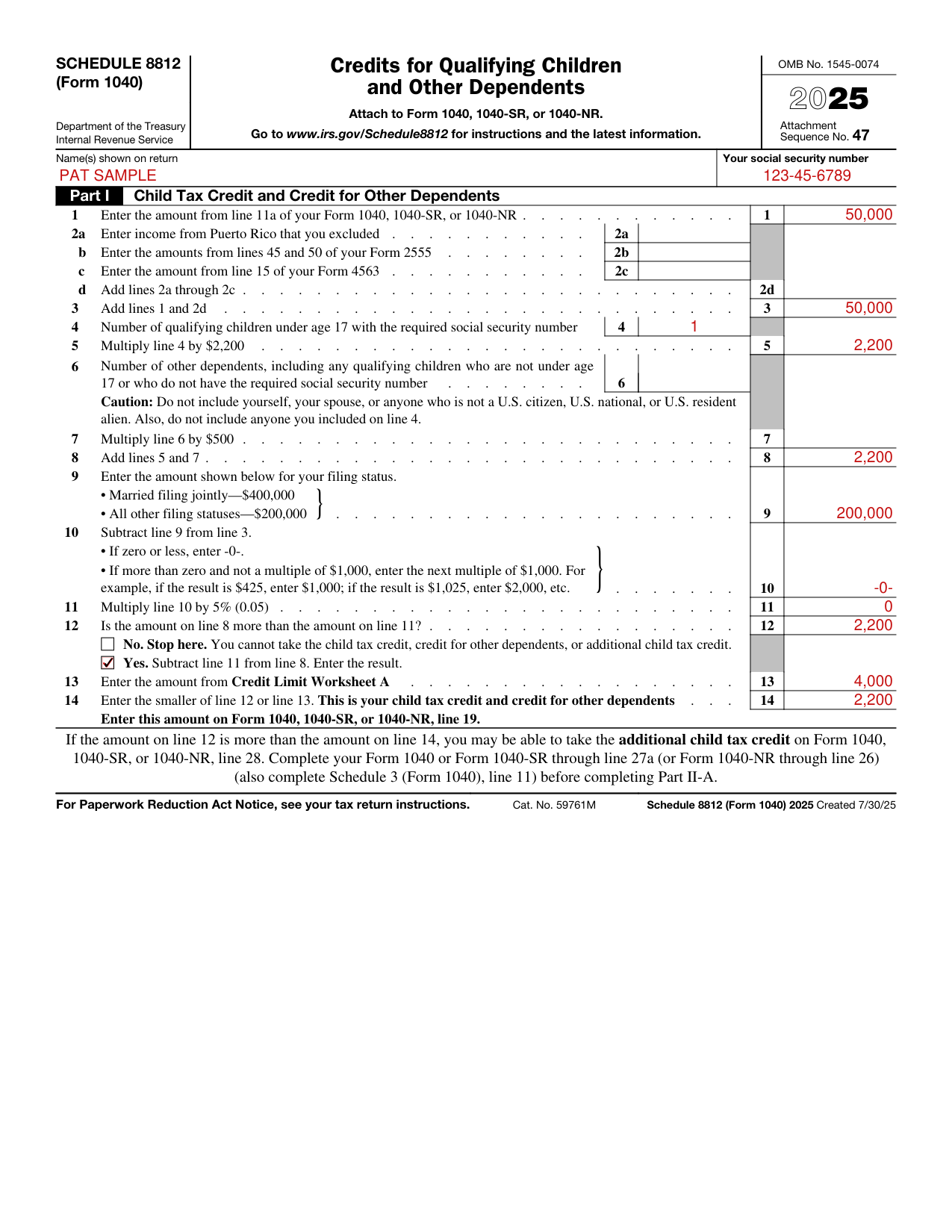
Line 1: Enter the amount from line 11a of your Form 1040, 1040-SR, or 1040-NR. Line 2a: Enter income from Puerto Rico that you excluded. Line 2b: Enter the amounts from lines 45 and 50 of your Form 2555. Line 2c: Enter the amount from line 15 of your Form 4563. Line 2d: Add lines 2a through 2c. Line 3: Add lines 1 and 2d. Line 4: Number of qualifying children under age 17 with the required social security number. Line 5: Multiply line 4 by $2,200. (checked October 31, 2026)
Line 4: Add the number of “Child tax credit” boxes checked in row (7) of the Dependents section on Form 1040 or 1040-SR (row (6) on Form 1040-NR) and enter the result on line 4.
Line 6: Number of other dependents, including any qualifying children who are not under age 17 or who do not have the required social security number. Caution: Do not include yourself, your spouse, or anyone who is not a U.S. citizen, U.S. national, or U.S. resident alien. Also, do not include anyone you included on line 4. Line 7: Multiply line 6 by $500. Line 8: Add lines 5 and 7. Line 9: Enter the amount shown below for your filing status. Married filing jointly, $400,000. All other filing statuses, $200,000. Line 10: Subtract line 9 from line 3. If zero or less, enter -0-. If more than zero and not a multiple of $1,000, enter the next multiple of $1,000. For example, if the result is $425, enter $1,000; if the result is $1,025, enter $2,000. Line 11: Multiply line 10 by 5% (0.05). Line 12: Is the amount on line 8 more than the amount on line 11? No. Stop here. You cannot take the child tax credit, credit for other dependents, or additional child tax credit. Yes. Subtract line 11 from line 8. Enter the result. Line 13: Enter the amount from Credit Limit Worksheet A. Line 14: Enter the smaller of line 12 or line 13. This is your child tax credit and credit for other dependents. Enter this amount on Form 1040, 1040-SR, or 1040-NR, line 19. If the amount on line 12 is more than the amount on line 14, you may be able to take the additional child tax credit on Form 1040, 1040-SR, or 1040-NR, line 28. Complete your Form 1040 or Form 1040-SR through line 27a (or Form 1040-NR through line 26) (also complete Schedule 3 (Form 1040), line 11) before completing Part II-A. (checked October 31, 2026)[2]
Schedule 8812 (Form 1040) 2025 Page 2 Part II-A Additional Child Tax Credit for All Filers. Caution: If you file Form 2555, you cannot claim the additional child tax credit.
Line 15: Reserved for future use. Line 16a: Subtract line 14 from line 12. If zero, stop here; you cannot take the additional child tax credit.
Line 16b: Number of qualifying children under age 17 with the required social security number: x $1,700. Enter the result. If zero, stop here; you cannot claim the additional child tax credit. TIP: The number of children you use for this line is the same as the number of children you used for line 4. (checked October 31, 2026)
Line 17: Enter the smaller of line 16a or line 16b. Line 18a: Earned income (see instructions). Line 18b: Nontaxable combat pay (see instructions).
Line 19: Is the amount on line 18a more than $2,500? No. Leave line 19 blank and enter -0- on line 20. Yes. Subtract $2,500 from the amount on line 18a. Enter the result. Line 20: Multiply the amount on line 19 by 15% (0.15) and enter the result. (checked October 31, 2026)
Next. On line 16b, is the amount $5,100 or more? No. If you are a bona fide resident of Puerto Rico, go to line 21. Otherwise, skip Part II-B and enter the smaller of line 17 or line 20 on line 27. Yes. If line 20 is equal to or more than line 17, skip Part II-B and enter the amount from line 17 on line 27. Otherwise, go to line 21. (checked October 31, 2026)
Line 27: This is your additional child tax credit. Enter this amount on Form 1040, 1040-SR, or 1040-NR, line 28.
If your child is age 17 or older at the end of 2025, see Credit for Other Dependents (ODC).
If your qualifying child does not have a valid SSN, but has another type of taxpayer identification number issued on or before the due date of your 2025 return (including extensions), you may be able to claim the ODC for that child.
You can't check both the child tax credit box and the credit for other dependents box for the same person.[2]
Common mistake: If your CTC, ACTC, or ODC for a year after 2015 was denied or reduced for any reason other than a math or clerical error, you must attach Form 8862 to your tax return to claim the CTC, ACTC, or ODC unless an exception applies.[2]
If it is determined that your error was due to fraud, you will not be allowed to claim any of these credits for 10 years. You may also have to pay penalties.[2]
[1] Schedule 8812 (Form 1040) 2025, Internal Revenue Service (the Official source link on this page).
[2] 2025 Instructions for Schedule 8812 (Form 1040), Internal Revenue Service.