
Updated:
Get Form Now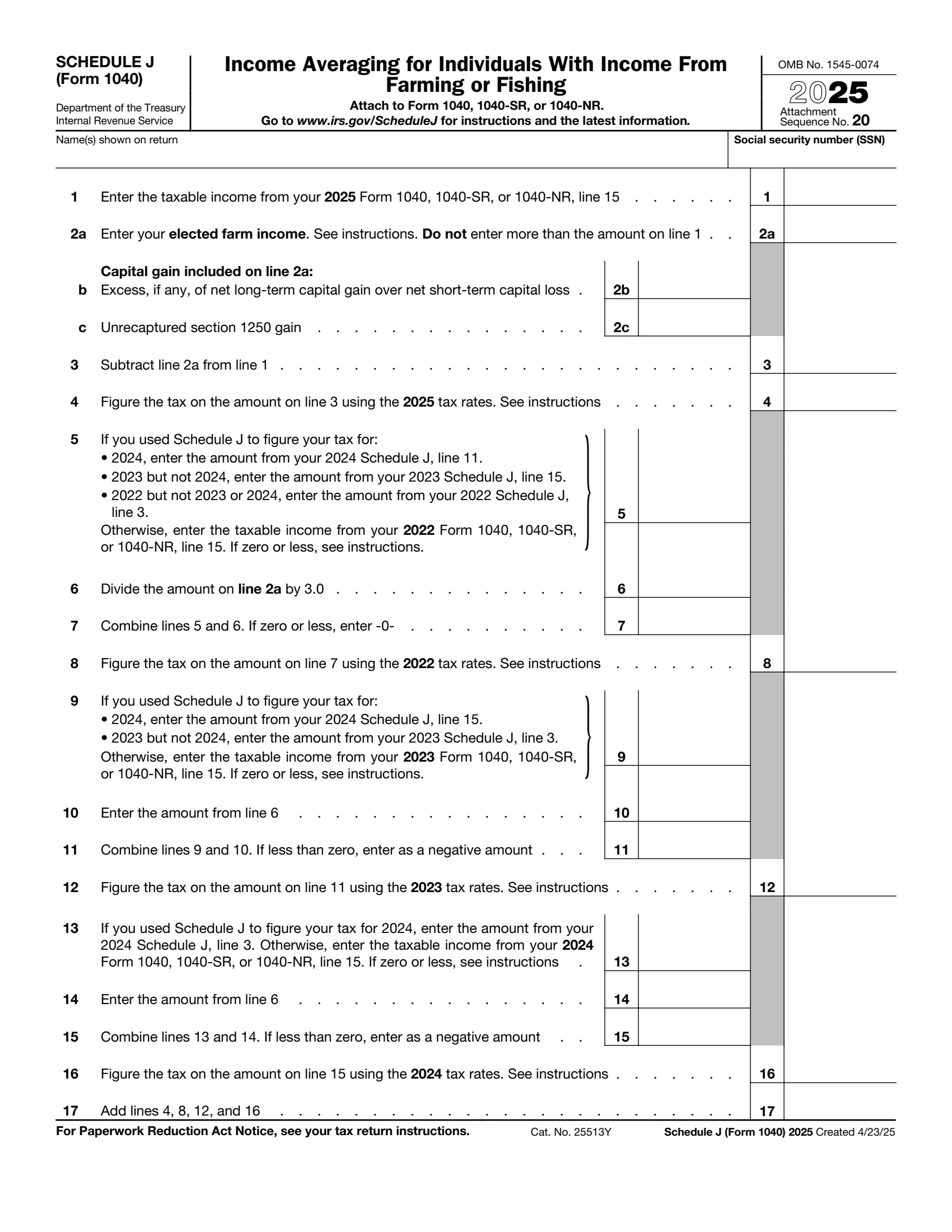
IRS Schedule J, also known as “Income Averaging for Farmers and Fishermen,” is a tax form qualifying farmers and fishermen use to calculate their income tax liability under an income averaging method. This method allows farmers and fishermen to average their income over the past three years, which can result in a lower tax liability by reducing the impact of significant fluctuations in income from year to year. Schedule J is attached to Form 1040 or Form 1040-SR. The basic information provided on Schedule J includes:
By completing Schedule J, qualifying farmers and fishermen can take advantage of the income averaging method to reduce their tax liability and smooth out the impact of income fluctuations. This form helps ensure that farmers and fishermen are taxed fairly and provides them with a tax planning tool to manage their tax obligations more effectively.
Other IRS Forms for Individuals
There might be some other schedules to IRS forms you need to get familiar with before you file your tax return.
What it is: Schedule J (Form 1040) is Income Averaging for Individuals With Income From Farming or Fishing.
Where and when to file: Attach to Form 1040, 1040-SR, or 1040-NR.
This election may give you a lower tax if your 2025 income from farming or fishing is high and your taxable income for 1 or more of the 3 prior years was low.[2]
In order to qualify for this election, you aren't required to have been in the business of farming or fishing during any of the base years.[2]
You may need copies of your original or amended income tax returns for 2022, 2023, and 2024 to figure your tax on Schedule J.[2]
If you need copies of your tax returns, use Form 4506.[2]
If you want a free transcript of your tax return or account, use Form 4506-T.[2]
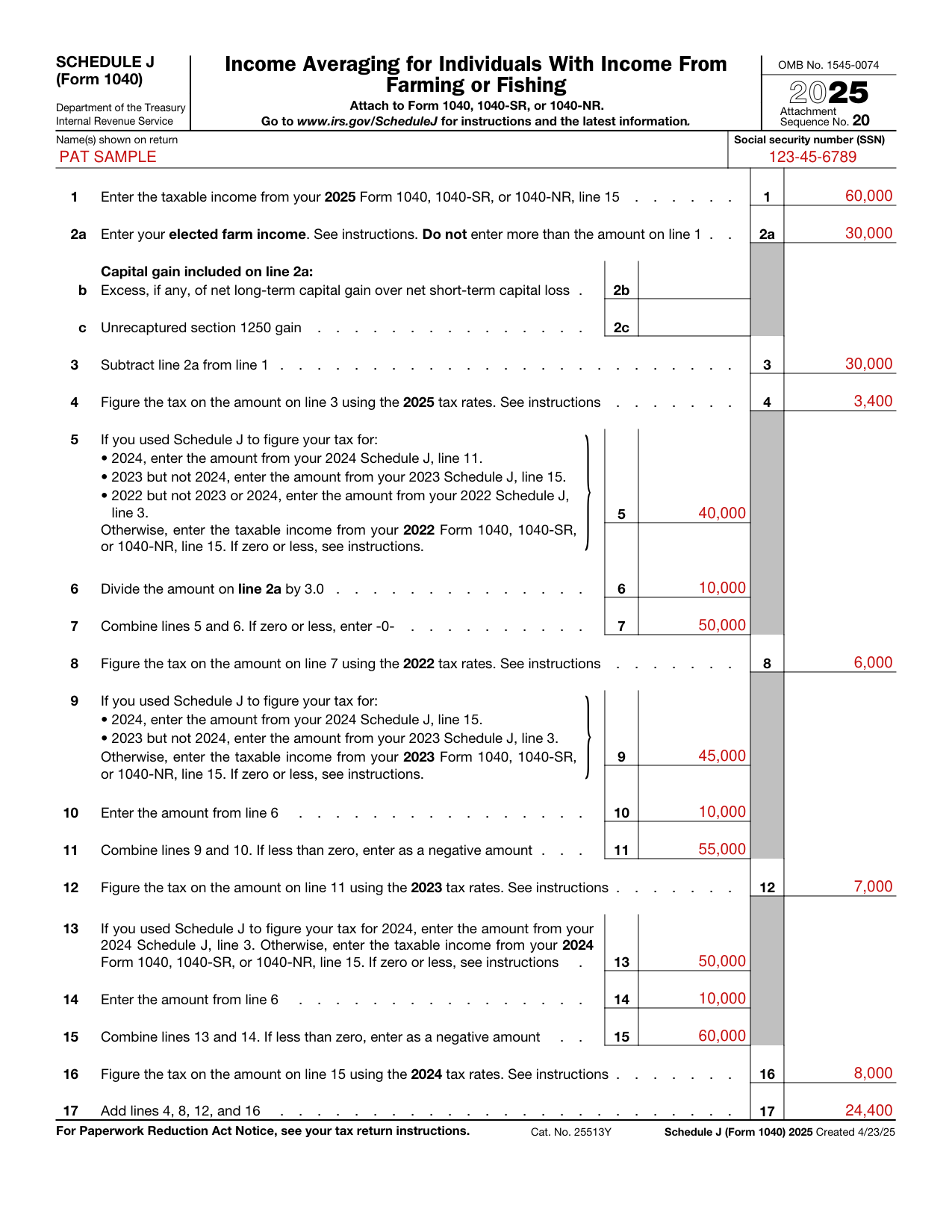
On line 1, enter the taxable income from your 2025 Form 1040, 1040-SR, or 1040-NR, line 15.
On line 2a, enter your elected farm income. Do not enter more than the amount on line 1.
Your elected farm income is the amount of your taxable income from farming or fishing that you elect to include on line 2a. You don't have to include all of your taxable income from farming or fishing on line 2a. Your elected farm income can't exceed your taxable income.
On line 3, subtract line 2a from line 1.[2]
Complete lines 2b and 2c if the amount of your elected farm income on line 2a includes net capital gain.
Enter on line 2b the portion of your elected farm income on line 2a treated as a net capital gain. The amount you enter on line 2b can't exceed the smaller of your total net capital gain or the net capital gain attributable to your farming or fishing business.
Enter on line 2c the smaller of line 2b or the unrecaptured section 1250 gain attributable to your farming or fishing business, if any.[2]
Figure the tax on the amount on line 3 using the 2025 Tax Table, Tax Computation Worksheet, or Qualified Dividends and Capital Gain Tax Worksheet from the 2025 Instructions for Form 1040 or the 2025 Instructions for Form 1040-NR; the 2025 Foreign Earned Income Tax Worksheet from the 2025 Instructions for Form 1040; or the Schedule D Tax Worksheet in the 2025 Instructions for Schedule D.[2]
On line 5, if you used Schedule J to figure your tax for 2024, enter the amount from your 2024 Schedule J, line 11; for 2023 but not 2024, enter the amount from your 2023 Schedule J, line 15; for 2022 but not 2023 or 2024, enter the amount from your 2022 Schedule J, line 3. Otherwise, enter the taxable income from your 2022 Form 1040, 1040-SR, or 1040-NR, line 15. But if that amount is zero or less, complete the 2022 Taxable Income Worksheet to figure the amount to enter on line 5.
On line 6, divide the amount on line 2a by 3.0.
On line 7, combine lines 5 and 6. If zero or less, enter -0-.
On line 8, figure the tax on the amount on line 7 using the 2022 tax rates.
If line 7 is zero, enter -0- on line 8.
If your elected farm income includes net capital gain, you must use the 2022 Schedule D Tax Worksheet to figure the tax on the amount on line 7.[2]
On line 9, if you used Schedule J to figure your tax for 2024, enter the amount from your 2024 Schedule J, line 15; for 2023 but not 2024, enter the amount from your 2023 Schedule J, line 3. Otherwise, enter the taxable income from your 2023 Form 1040, 1040-SR, or 1040-NR, line 15. But if that amount is zero or less, complete the worksheet to figure the amount to enter on line 9.
On line 10, enter the amount from line 6. On line 11, combine lines 9 and 10. If less than zero, enter as a negative amount.
On line 12, figure the tax on the amount on line 11 using the 2023 tax rates.
If line 11 is zero or less, enter -0- on line 12.[2]
On line 13, if you used Schedule J to figure your tax for 2024, enter the amount from your 2024 Schedule J, line 3. Otherwise, enter the taxable income from your 2024 Form 1040, 1040-SR, or 1040-NR, line 15. But if that amount is zero or less, complete the worksheet to figure the amount to enter on line 13.
On line 14, enter the amount from line 6.
On line 15, combine lines 13 and 14. If line 15 is less than zero, enter it as a negative amount.
On line 16, figure the tax on the amount on line 15 using the 2024 tax rates.
If line 15 is zero or less, enter -0- on line 16.[2]
On line 17, add lines 4, 8, 12, and 16.
On line 18, enter the amount from line 17.
On line 19, if you used Schedule J to figure your tax for 2024, enter the amount from your 2024 Schedule J, line 12; for 2023 but not 2024, enter the amount from your 2023 Schedule J, line 16; for 2022 but not 2023 or 2024, enter the amount from your 2022 Schedule J, line 4. Otherwise, enter the tax from your 2022 Form 1040, 1040-SR, or 1040-NR, line 16.
On line 20, if you used Schedule J to figure your tax for 2024, enter the amount from your 2024 Schedule J, line 16; for 2023 but not 2024, enter the amount from your 2023 Schedule J, line 4. Otherwise, enter the tax from your 2023 Form 1040, 1040-SR, or 1040-NR, line 16.
On line 21, if you used Schedule J to figure your tax for 2024, enter the amount from your 2024 Schedule J, line 4. Otherwise, enter the tax from your 2024 Form 1040, 1040-SR, or 1040-NR, line 16. Only include tax reported on this line that is imposed by section 1 of the Internal Revenue Code.
On line 22, add lines 19 through 21.
On line 23, subtract line 22 from line 18. Also include this amount on Form 1040, 1040-SR, or 1040-NR, line 16.
Keep a copy of your 2025 income tax return to use for income averaging in 2026, 2027, or 2028.[2]
Be sure to keep all your records for 2022 for at least 3 years after April 15, 2026 (or the date you file your 2025 tax return, if later).[2]
Schedule J (Form 1040) is Income Averaging for Individuals With Income From Farming or Fishing. Use Schedule J (Form 1040) to elect to figure your 2025 income tax by averaging, over the previous 3 years (base years), all or part of your 2025 taxable income from your trade or business of farming or fishing.[2]
There is a fee for each return requested. See Form 4506 for the fee amount.[2]
Attach Schedule J only if you are using it to figure your tax. Caution: Your tax may be less if you figure it using the 2025 Tax Table, Tax Computation Worksheet, Qualified Dividends and Capital Gain Tax Worksheet, or Schedule D Tax Worksheet.
[1] Schedule J (Form 1040) 2025, Income Averaging for Individuals With Income From Farming or Fishing, Internal Revenue Service (the Official source link on this page).
[2] 2025 Instructions for Schedule J (Form 1040), Internal Revenue Service.