
Updated:
Get Form Now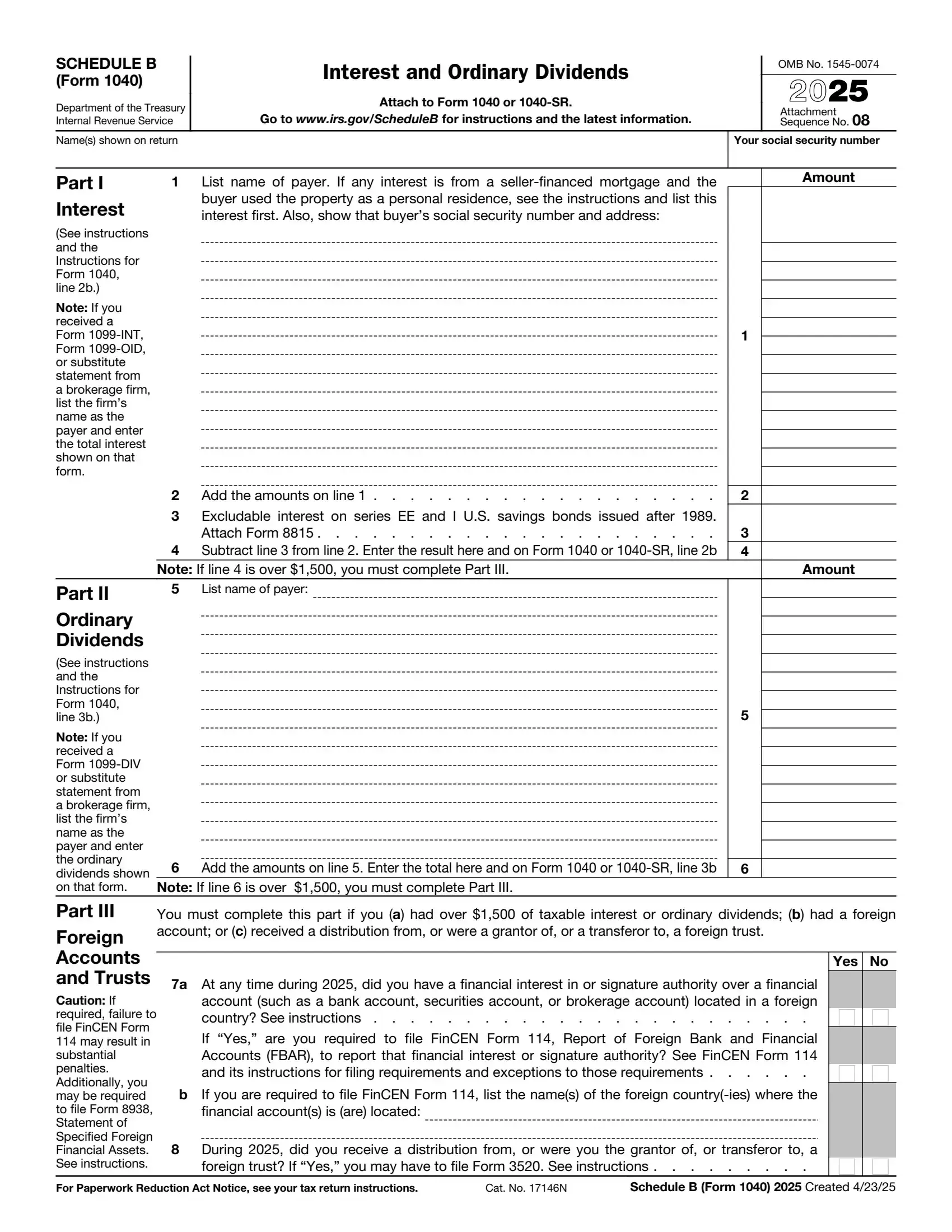
IRS Schedule B, an attachment to Form 1040, is titled “Interest and Ordinary Dividends.” Taxpayers use this form to report the amount of interest and ordinary dividends received during the tax year that exceed certain thresholds. Specifically, Schedule B is required if a taxpayer has more than $1,500 of taxable interest or more than $1,500 of ordinary dividends, or had a financial account in a foreign country or a connection with a foreign trust. Schedule B is organized into three sections where taxpayers must list:
This form ensures that taxpayers accurately report their income from these sources. Completing Schedule B accurately is essential for compliance with tax laws and correctly calculating taxable income, potentially affecting the taxpayer’s overall tax liability.
Other IRS Forms for Individuals
Whether or not you need to add a certain schedule to an IRS form will depend on specific factors. Learn what schedules there are to make sure you have used the proper one.
What it is: Schedule B (Form 1040), 2025, Interest and Ordinary Dividends.
Where and when to file: Attach to Form 1040 or 1040-SR.
Use Schedule B (Form 1040) if any of the following applies.[2]
You had over $1,500 of taxable interest or ordinary dividends. (checked November 16, 2026)[2]
You received interest from a seller-financed mortgage and the buyer used the property as a personal residence.[2]
You have accrued interest from a bond.[2]
You are reporting original issue discount (OID) of less than the amount shown on Form 1099-OID.[2]
You are reporting interest income of less than the amount shown on a Form 1099 due to amortizable bond premium.[2]
You are claiming the exclusion of interest from series EE or I U.S. savings bonds issued after 1989.[2]
You received interest or ordinary dividends as a nominee.[2]
You had a financial interest in, or signature authority over, a financial account in a foreign country or you received a distribution from, or were a grantor of, or transferor to, a foreign trust.[2]
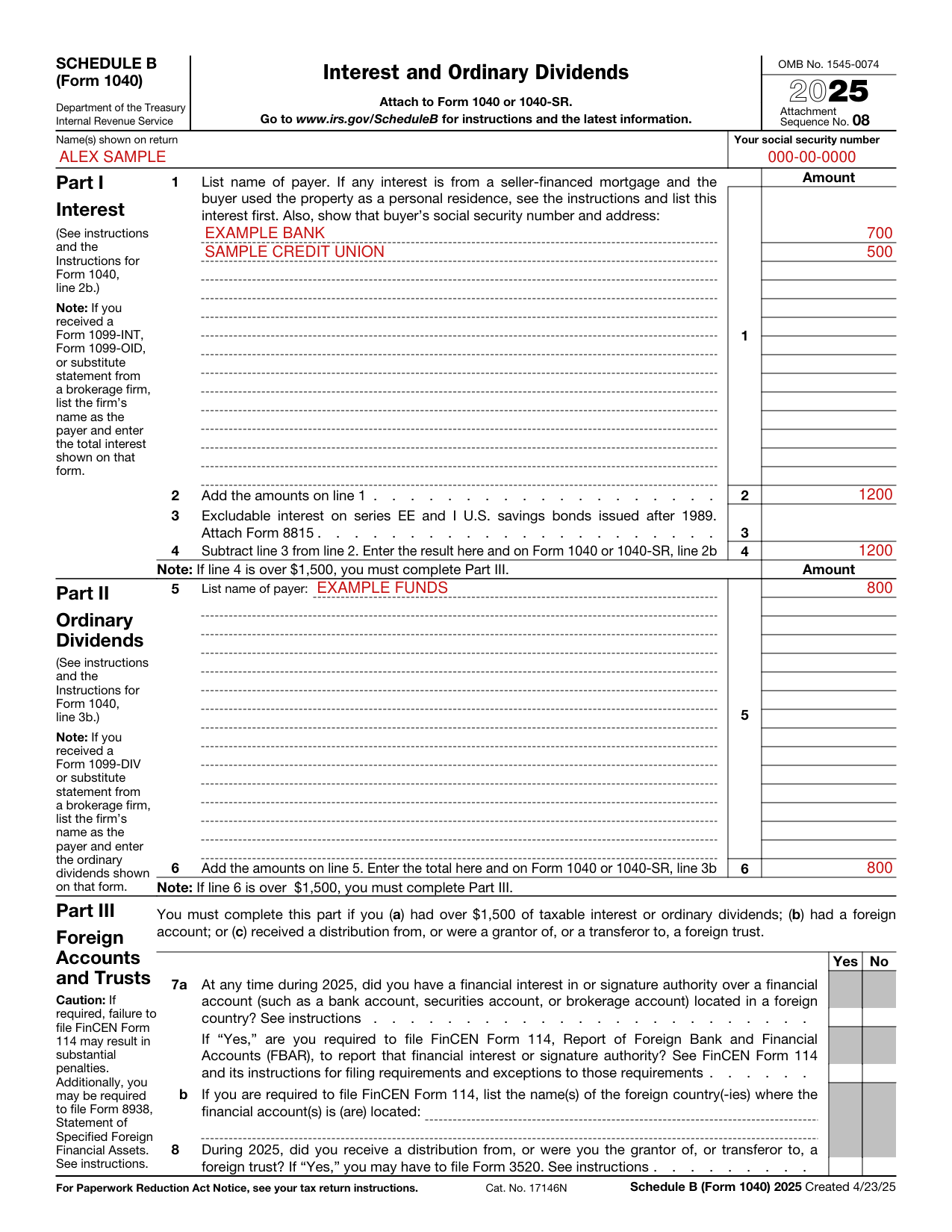

Enter the name(s) shown on your return and your social security number.
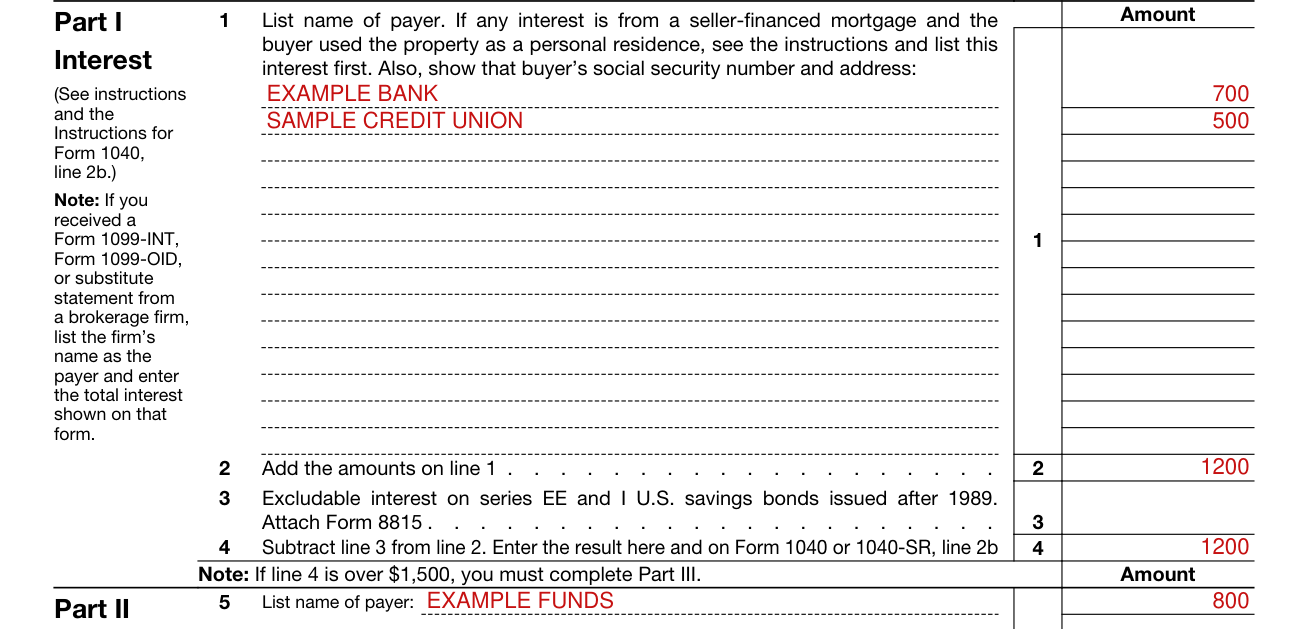
On line 1, report all of your taxable interest. List each payer's name and the amount.
Taxable interest generally should be shown on your Forms 1099-INT, Forms 1099-OID, or substitute statements.
Include interest from series EE, H, HH, and I U.S. savings bonds.
If you received a Form 1099-INT, Form 1099-OID, or substitute statement from a brokerage firm, list the firm's name as the payer and enter the total interest shown on that form.
Don't report on line 1 any tax-exempt interest.
You can list more than one payer on each entry space for lines 1 and 5, but be sure to clearly show the amount paid next to each payer's name. Add the separate amounts paid by the payers listed on an entry space and enter the total in the "Amount" column.
If you still need more space, attach separate statements using the same format as lines 1 and 5, but show your totals on Schedule B. Put your name and social security number (SSN) on the statements and attach them at the end of your return.
Line 2: add the amounts on line 1.
Line 3: enter the excludable interest on series EE and I U.S. savings bonds issued after 1989. Attach Form 8815.
Line 4: subtract line 3 from line 2. Enter the result on Form 1040 or 1040-SR, line 2b. If line 4 is over $1,500, you must complete Part III. (checked November 16, 2026)[2]
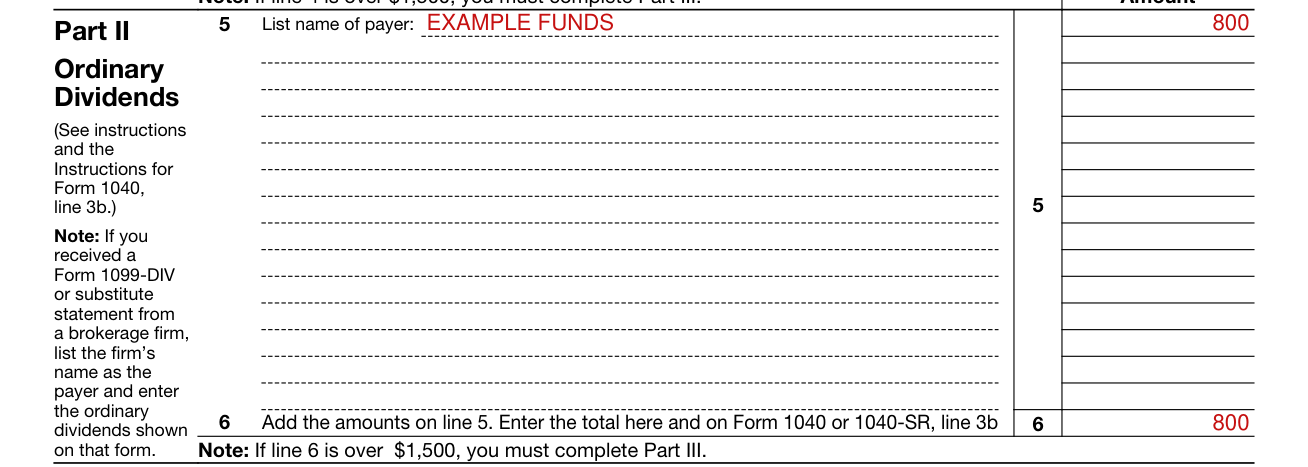
On line 5, report all of your ordinary dividends. This amount should be shown in box 1a of your Forms 1099-DIV or substitute statements.
If you received a Form 1099-DIV or substitute statement from a brokerage firm, list the firm's name as the payer and enter the ordinary dividends shown on that form.
Line 6: add the amounts on line 5. Enter the total on Form 1040 or 1040-SR, line 3b. If line 6 is over $1,500, you must complete Part III. (checked November 16, 2026)[2]
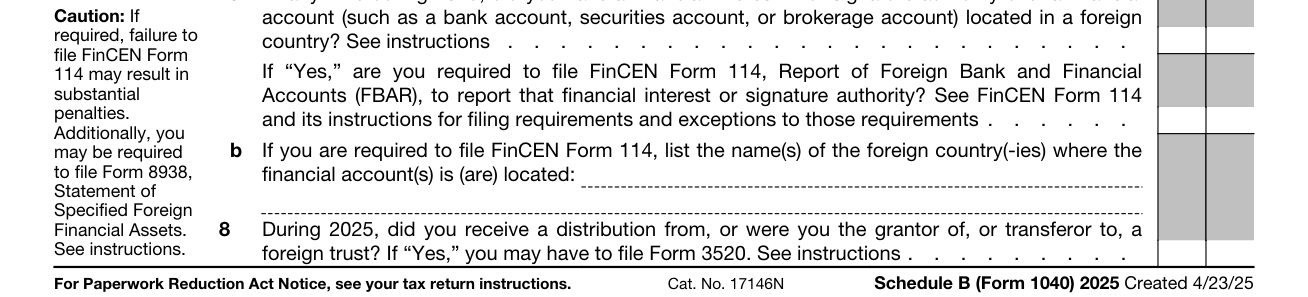
You must complete Part III if you (a) had over $1,500 of taxable interest or ordinary dividends; (b) had a foreign account; or (c) received a distribution from, or were a grantor of, or a transferor to, a foreign trust. (checked November 16, 2026)
Line 7a, Question 1: check the "Yes" box if at any time during 2025 you had a financial interest in or signature authority over a financial account located in a foreign country.
Common mistake: Check the "Yes" box even if you aren't required to file FinCEN Form 114.
A financial account is located in a foreign country if the account is physically located outside of the United States.
Line 7a, Question 2: see FinCEN Form 114 and its instructions at FINCEN.gov to determine whether you must file the form. Check the "Yes" box if you are required to file the form. Check the "No" box if you aren't required to file the form.
A U.S. person that has a financial interest in or signature authority over foreign financial accounts must file the form if the aggregate value of foreign financial accounts exceeds $10,000 at any time during 2025. (checked November 16, 2026)
Do not attach FinCEN Form 114 to your tax return.
If required, failure to file FinCEN Form 114 may result in substantial penalties. Additionally, you may be required to file Form 8938, Statement of Specified Foreign Financial Assets.
Line 7b: if you are required to file FinCEN Form 114, list the name(s) of the foreign country or countries in the space provided. Attach a separate statement if you need more space.
Line 8: if you received a distribution from a foreign trust, you must provide additional information. If "Yes," you may have to file Form 3520.
Don't attach Form 3520 to Form 1040 or Form 1040-SR. Instead, file it at the address shown in its instructions.[2]
If you sold your home or other property and the buyer used the property as a personal residence, list first any interest the buyer paid you on a mortgage or other form of seller financing. Be sure to show the buyer's name, address, and SSN.[2]
If you received a Form 1099-INT that includes interest you received as a nominee (that is, in your name, but the interest actually belongs to someone else), report the total on line 1. Do this even if you later distributed some or all of this income to others. Under your last entry on line 1, put a subtotal of all interest listed on line 1. Then enter "Nominee Distribution" and show the total interest you received as a nominee. Subtract this amount from the subtotal and enter the result on line 2.[2]
If, during 2025, you cashed series EE or I U.S. savings bonds issued after 1989 and you paid qualified higher education expenses for yourself, your spouse, or your dependents, you may be able to exclude part or all of the interest on those bonds.[2]
If you are required to file FinCEN Form 114 but don't properly do so, you may have to pay a civil penalty up to $10,000. (checked November 16, 2026) A person who willfully fails to report an account or provide account identifying information may be subject to a civil penalty equal to the greater of $100,000 or 50% of the balance in the account at the time of the violation. Willful violations may also be subject to criminal penalties. (checked November 16, 2026) If you don't show the buyer's name, address, and SSN, or let the buyer know your SSN, you may have to pay a $50 penalty. (checked November 16, 2026)[2]
[1] Schedule B (Form 1040) (2025), Interest and Ordinary Dividends, Internal Revenue Service (the Official source link on this page).