
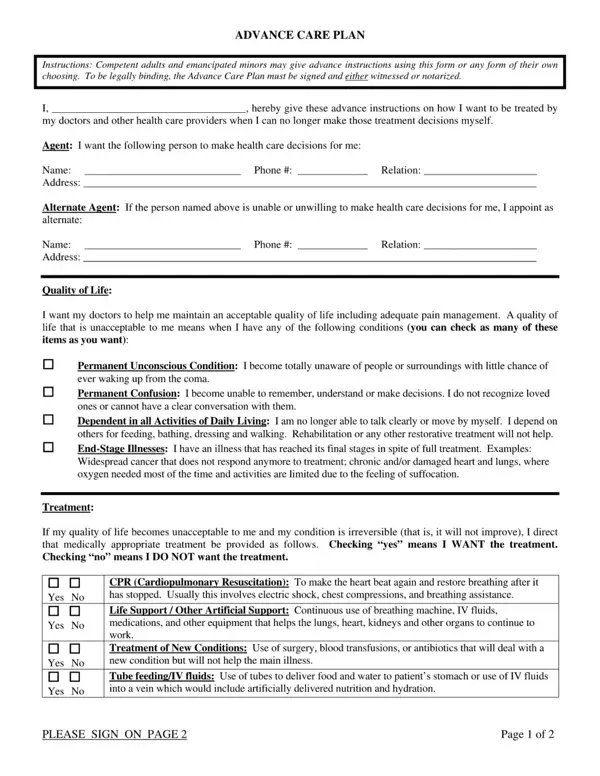
An Advance Care Plan form works alongside related legal documents to give healthcare providers complete guidance on your medical wishes. It is typically used together with a health care proxy form, which designates your chosen decision-maker, and a POLST form, which translates your preferences into active medical orders. For residents of states with specific healthcare directive laws, a state-specific advance healthcare directive may also be required for the document to be legally valid.
The Advance Care Plan addresses your preferences on resuscitation, mechanical ventilation, artificial nutrition, comfort care, and palliative care priorities. It also provides space for organ donation preferences. Once signed and witnessed according to your state's requirements, distribute copies to your primary care physician, your designated healthcare agent, and family members involved in your care. Keeping a copy in a clearly visible location at home ensures medical teams can access it quickly during an emergency.
| Question | Answer |
|---|---|
| Form Name | Advance Care Plan Form |
| Form Length | 2 pages |
| Fillable? | No |
| Fillable fields | 0 |
| Avg. time to fill out | 30 sec |
| Other names | advance directive, advance healthcare directive, durable power of attorney for healthcare, healthcare directive |
Advance Care Plan Form isn’t the one you’re looking for?