
An affidavit of heirship form is a legal document that helps identify the heirs of the intestate decedent, that is, the one who died without leaving a will. If the deceased person does not leave the last will, the assets will be divided among the family members through a probate court. However, the heirs can avoid these court expenses by completing the affidavit of heirship.
Last Updated: October 2026. This guide is reviewed and updated regularly to reflect current law. If you notice an error or outdated information, please contact us.
Build Your Document
Answer a few simple questions to make your document in minutes
Save and Print
Save progress and finish on any device, download and print anytime
Sign and Use
Your valid, lawyer-approved document is ready
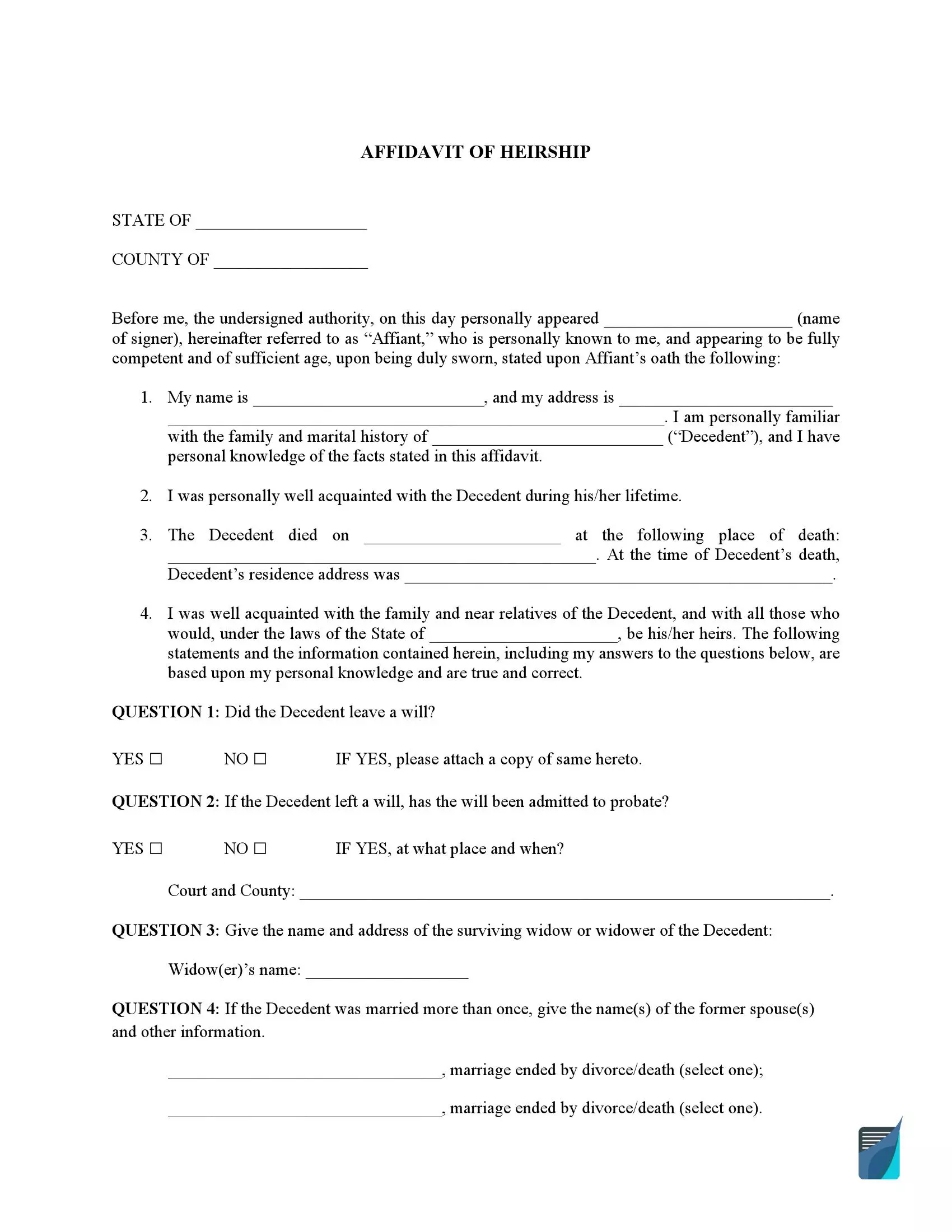
Affidavits of heirship will save time and money and help arrange the inherited real estate. If you want to avoid expensive probate proceedings, use our template to complete the affidavit yourself. The affidavit form must be signed in the presence of a notary public and then recorded with the county recorder’s office. You can also ask your family attorney for help during the preparation process.
Here are some definitions that may be useful to know:
Affidavit – a document used to make a written statement, which is sworn under oath to be true.
Affiant refers to the person who signs an affidavit and swears that its statements are true.
Decedent – a deceased person.
Heir – a person legally entitled to inherit some assets from a decedent.
Descendant refers to a child, grandchild or other person who descends from the decedent.
Intestate – refers to someone who dies without the last will.
Probate – a legal process in which the real estate is administered and divided among the legal heirs. This term also refers to a process of the last will validation.
Nowadays, it’s common to make the last will to distribute the real estate after a person’s death. Still, a lot of people die without leaving this legal document. It happens due to different reasons, for example, sudden death or lack of resources to make a will.
If the decedent has neither the last will nor legal heirs, all of the assets will go to the state. However, when the decedent has, for example, a spouse and children, the estate should be divided among them.
An affidavit of heirship is a good way to transfer the decedent’s interest in the real property to the beneficiaries. The affidavit could be used not only if the last will is lacking but also if the decedent’s will was not probated within four years of the death.
No matter the case, an affidavit of heirship is a time and cost-effective way out of the estate division issue. It’s essential to use the affidavit correctly following the next requirements:
An intestate estate is the property of a person who died without a will. In all 49 jurisdictions FormsPal's verified state data covers (48 states and DC), state law sets the share of that estate that goes to a surviving spouse. The exact share depends on where the decedent lived.
The same state data shows which other questions the rules answer:
Check the rules of the state involved before you list the heirs on your affidavit. If you are unsure, ask your family attorney or the county office where you plan to record the document.
The table shows how many of the 49 jurisdictions FormsPal's verified state data covers have a rule on each question. A higher number means the rule appears more often in the data, not that every state words it the same way.
| Question the rules answer | Jurisdictions with a rule (out of 49) |
|---|---|
| Share for a surviving spouse | 49 |
| Share for the decedent's descendants | 48 |
| Distribution by representation | 45 |
| Heirs when there is no spouse or descendant | 42 |
| Half-blood relatives | 6 |
Rules differ by state. A number in the table means FormsPal's verified state data holds a rule on that question. It does not mean the other jurisdictions have none. Check the rules for your state and county before you file.
Losing a relative is a hard experience. You may want not to rush and wait a certain period after the death before preparing the affidavit of heirship. It’s okay, particularly since the state law contributes to this.
Some states have a waiting period after a relative passing before the affidavit may be filed. When the time comes, it will help to follow the next steps when preparing your document.
To create a comprehensive document, you are expected to complete various sections and answer specific questions. It’s possible to address the attorney and obtain legal advice while working on the document. Nonetheless, our free template includes all the necessary questions, and you will have to only fill in the relevant information.
Have this information ready before you start:
Please follow the next steps.
Step 1. Identify the affiant
As the affiant filing the affidavit of heirship, you need to provide information about yourself. This includes your name and address, details on how you know the decedent, and for how long. These questions are aimed at confirming your competence to complete the document. Note that the affiant cannot be the family member or somehow related to the decedent.

Step 2. Define the decedent
You are expected to answer questions about the decedent’s family history. You also give the date of death and say whether the deceased died with or without a will. You have to also provide information about the marital status, name the surviving spouse, and, if applicable, indicate the spouse’s date of death.

Step 3. Indicate the heirs
You must fill in the information about all the heirs, including their names and addresses. If one of them is minor or incapacitated, their parents or legal guardians should sign the document. In some states, a spouse of the decedent is not considered an heir since they are entitled to properties following marital and community property laws.

Step 4. Describe the property
This section describes information about the real and personal property left after the decedent. You have to provide a legal description specifying the county where the property is located and the boundaries of specific land.
In the case of personal property, it’s necessary to list all the belongings. Also, you need to state whether the decedent has any debts. If the decedent isn’t transferring any assets, and the document is only necessary to establish the heirs, this section is omitted.

Step 5. Sign the affidavit
After completing the form, you must indicate the date, sign, and notarize it. Before filing the document in the county recorder’s office, please make sure that it’s free of any mistakes.
It’s also necessary to check the state laws since some jurisdictions may require additional witnesses to sign the form. It’s possible to attach other documents to the affidavit. For example, a copy of the last will (if any) or the papers proving the guardian’s competence to sign the form (if there is a minor).

Small slips can slow down an affidavit of heirship, especially when a title company or a county office reviews it. These are common mistakes to avoid when you prepare yours:
A will is written by a person during life and says who should receive their property. An affidavit of heirship is made after the death by someone who knows the family. It states who the heirs are and how each one is related to the decedent.
Half-siblings share one parent with the decedent. In 6 of the 49 jurisdictions FormsPal's verified state data covers, state law sets a rule for half-blood relatives. Because the answer depends on the state involved, check its rules before you list a half-sibling on the affidavit.
Yes. Our template asks a few questions about you, the decedent and the heirs, then builds the document for you. You can save your progress and finish on any device. To work on a downloaded copy, fill in the PDF with the PDF editor.
Yes. The number of jurisdictions with a rule varies from one question to the next, as the table above shows. For example, in 45 of the 49 jurisdictions FormsPal's verified state data covers, state law has a rule on distribution by representation. Check the rules for your state and county before you file.
Answering the questions in our template takes a few minutes when you have the family details ready. Three things usually set the pace:
Start with the list of information in the section on filling out the form.
Our template asks for all the details, so you can complete the affidavit yourself. An attorney can review it if the estate is large or the heirs disagree.
General information, not legal or tax advice.
