
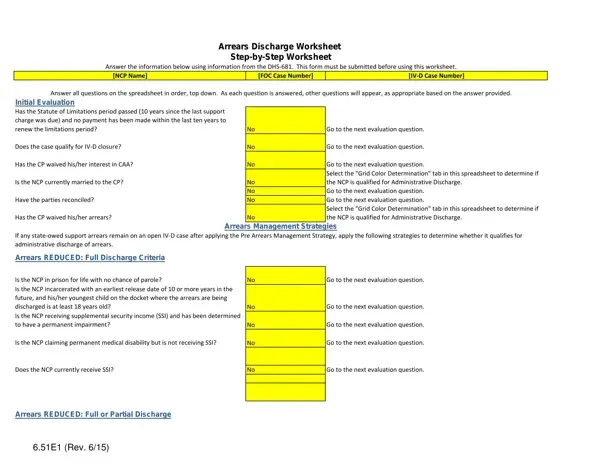
The Michigan Arrears Discharge Worksheet is a four-step administrative tool developed under DHS-681 guidelines and Michigan's IV-D Child Support Manual. It determines whether a non-custodial parent (NCP) qualifies for a full or partial forgiveness of state-owed child support arrears.
Who qualifies for arrears discharge? Eligibility depends on several factors the FOC reviews through the worksheet:
The final section of the form is the Partial Forgiveness Calculator. It estimates the maximum arrears amount that may be forgiven, taking into account the NCP's financial situation and household circumstances.
If you need to address child support obligations more broadly, the Agreed Motion to Terminate Child Support and the Repayment Plan Request form are closely related documents. A Financial Affidavit is often required alongside this worksheet to formally document income and household expenses.
| Question | Answer |
|---|---|
| Form Name | Arrears Discharge Form |
| Form Length | 4 pages |
| Fillable? | No |
| Fillable fields | 0 |
| Avg. time to fill out | 1 min |
| Other names | Michigan arrears discharge worksheet, arrears discharge child, DHS-681 discharge, discharge worksheet template |
Arrears Discharge Form isn’t the one you’re looking for?