
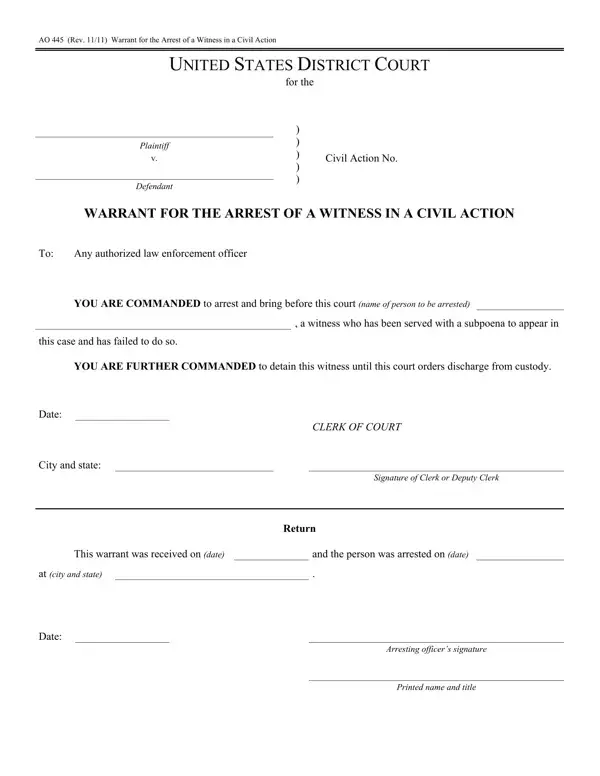
An arrest warrant form, specifically AO 445 (Rev. 11/11) for the arrest of a witness in a civil action, plays a pivotal role within the United States judicial system. This document ensures the presence of witnesses crucial to civil litigation. Issued by the UNITED STATES DISTRICT COURT for a specified district, it commands any authorized law enforcement officer to arrest and detain a witness who has defied a subpoena to appear before the court.
The form delineates the responsibilities of the arresting officer, including the mandate to bring the individual directly to court and to keep them in custody until the court releases them. The arrest warrant remains active until the witness appears before the court or until the issuing court withdraws the order. This authority derives directly from federal civil procedure rules, which grant courts the power to enforce compliance with subpoenas through legal compulsion.
Unlike a criminal arrest warrant, which is issued when a person is charged with a crime, the AO 445 form applies strictly to civil proceedings. The detained witness has not been charged with any offense. They are being compelled to fulfill a legal obligation to provide testimony or documents in connection with an ongoing civil case. This distinction is important for both the individual detained and for the law enforcement officers executing the warrant.
The AO 445 arrest warrant form is organized into two main sections. The front section contains the court order itself, including the district and court name, the name and address of the witness, the case caption, the basis for issuance, and the signature of the issuing judge or clerk. The second page is reserved for law enforcement use only and is marked "Not for Public Disclosure."
The law enforcement section of the arrest warrant form captures detailed information about the subject of the warrant:
After the arrest is executed, the arresting officer must complete the return section at the bottom of the warrant form. This section documents the date and location where the warrant was received, the date and location of the actual arrest, and the signature and printed name and title of the arresting officer. This completed return is filed with the court clerk and becomes part of the official case record, confirming that the order was lawfully carried out.
The AO 445 arrest warrant form applies to civil proceedings in all 94 federal judicial districts across the United States. Each district issues warrants under its own court seal and case number. The form itself is standardized at the federal level, so its structure and required information remain consistent across districts. State courts may use similar warrant procedures, but they operate under separate state rules and use different forms specific to each state's civil procedure code.
Parties involved in federal civil litigation should treat the issuance of this warrant as a significant escalation in legal proceedings. If you are a witness who has received or is at risk of receiving an arrest warrant, you should consult a licensed attorney immediately. Voluntary compliance with a subpoena is always preferable to compelled attendance through an arrest.
For related legal documents, you may also need a criminal subpoena template to initially compel witness attendance before an arrest warrant becomes necessary. A civil case information sheet documents the full details of the litigation, including parties, case type, and jurisdictional basis. When a court orders conditional release of a detained witness, a bail bond form may also be required to set the terms of that release.
| Question | Answer |
|---|---|
| Form Name | Arrest Warrant Form |
| Form Length | 2 pages |
| Fillable? | No |
| Fillable fields | 0 |
| Avg. time to fill out | 30 sec |
| Other names | fillable arrest warrant template, arrest warrant template word, warrant template, blank warrant |
Arrest Warrant Form isn’t the one you’re looking for?